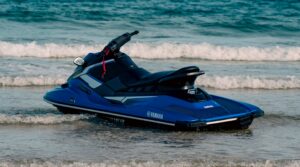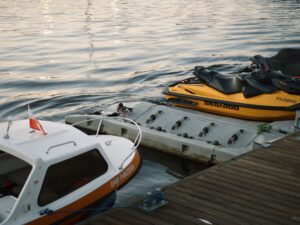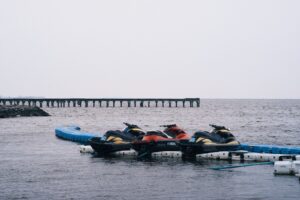
Leaving your jet ski tied to a dock overnight is not automatically a disaster, but it is never consequence-free. In calm freshwater conditions with proper preparation, one night on a dock carries relatively low risk. In saltwater, rough weather, or without confirming bilge drainage first, the calculus changes quickly.
This guide gives you a clear framework for making that call tonight, not a blanket verdict in either direction.
The Short Answer: It Depends on These Conditions
One night on a dock will not ruin your jet ski under the right circumstances. But “it depends” is only useful if you know what it depends on.
Four variables determine whether overnight docking is low-risk or genuinely problematic:
- Water type: Freshwater versus saltwater, since the two create very different corrosion and fouling timelines even over a single night.
- Overnight weather forecast: Wind chop and wake from passing boats can work water into the hull that calm conditions wouldn’t.
- Bilge status: Whether the hull has been confirmed dry and the drain plug seated before you tie up.
- Dock type: Whether you’re on a private dock or a public facility subject to posted rules that may prohibit unattended overnight tie-ups outright.
Get all four in your favor and the risk is manageable. Miss one and you may come back to a problem in the morning.
When Overnight Docking Is Generally Low-Risk
These conditions together make a single overnight stay unlikely to cause damage:
- Water type: Calm freshwater lake with no significant wave action.
- Weather: No storm, strong wind, or heavy rain in the overnight forecast.
- Bilge status: Hull confirmed dry and drain plug seated before tying up.
- Dock type: Private dock on personal property, not a public marina facility.
- Security: Ski secured with proper dock lines, bumpers in place, kill-switch lanyard removed.
When Overnight Docking Becomes a Real Problem
Any of these conditions should make you reconsider leaving the ski in the water:
- Saltwater environment: Corrosion risk begins within 48 to 72 hours of continuous submersion.
- Incoming weather: Wake from passing boats or wind chop can work water into the hull overnight.
- Bilge drainage unconfirmed: A ski with standing water in the hull before docking is a swamping risk.
- Public dock with posted restrictions: Many facilities prohibit unattended personal watercraft (PWC) overnight.
- No security measures: An open dock with no cable lock is a theft exposure.
Freshwater vs. Saltwater: Why the Difference Matters
The water your ski sits in overnight is the single biggest variable in this decision. Freshwater and saltwater create meaningfully different risk profiles, even over a single night.
| Category | Freshwater | Saltwater |
| Corrosion onset | Slow; low overnight risk | Can begin within 48 to 72 hours |
| Biological buildup | Minimal in one night; algae possible in warm shallow water | Higher risk; salt residue accelerates fouling |
| Metal fitting risk | Low for single overnight | Elevated; salt crystals accumulate in cooling passages |
| Recommended max dwell | Short stays manageable; flush after use | Minimize to shortest possible window |
Freshwater Overnight Risks
In freshwater, a single overnight stay carries low corrosion risk overall, but a few specific things are still worth knowing:
- Bilge accumulation happens regardless of water type. Water still enters the hull through exhaust ports and fittings while the ski sits stationary, so this isn’t a saltwater-only concern.
- Algae and mineral deposits can start forming fast in the right conditions. Warm, shallow lake water is enough to begin surface buildup on the hull after even a single night.
- The damage compounds over repeated stays. No single overnight exposure is catastrophic on its own, but doing this regularly rather than occasionally is where the real wear accumulates.
Saltwater Overnight Risks
Saltwater is where a single overnight stay moves from low-risk to genuinely problematic, and the mechanism is straightforward:
- Salt crystals accumulate even with the engine off. They build up in cooling passages, fittings, and the exhaust system simply from sitting in saltwater, with no operation required.
- The recommended fix is impossible if the ski stays overnight. Sea-Doo’s own maintenance guidance states that saltwater operation requires flushing the exhaust system with fresh water to neutralize corrosion, a step that can’t happen while the ski is still tied to the dock overnight.
- Residue compounds with each subsequent stay. One exposure doesn’t cause serious damage on its own, but repeated overnight stays accelerate corrosion on metal fittings and the impeller housing well ahead of the normal schedule.
What Happens Inside the Hull When a Jet Ski Sits in the Water
Most jet ski owners assume a ski floating quietly at the dock is in a neutral, resting state. It is not. Water enters the hull through the exhaust outlet, jet pump intake, and hull fittings even when the ski is powered off and stationary. This is a well-documented risk for any unattended vessel, not just jet skis, which is why bilge checks are a standard part of pre-departure and pre-storage routines for boats generally.
If bilge water is not confirmed drained before an overnight tie-up, the water level inside the hull can rise to the point of swamping by morning. Wake from passing boats rocking the ski overnight makes this worse. Some models have automatic bilge pumps; others require manual draining. Knowing which type you have is not optional before leaving the ski overnight.
How to Check Bilge Drainage Before an Overnight Tie-Up
This check takes under five minutes and is the most important step before any overnight tie-up:
- Remove the seat or access panel and look into the hull interior.
- Check for standing water. More than a cup or two is a red flag.
- Confirm the drain plug is firmly seated and not cross-threaded.
- If your model has a manual bilge, lift the rear of the ski to help drain before seating the plug.
- Confirm whether your specific model includes an automatic bilge pump. If it does not, manual drainage is the only option.
Signs Your Hull Has a Water Intrusion Problem
More than a small amount of residual moisture in the hull interior signals a problem worth diagnosing before you dock overnight. Common causes include a damaged hull, loose fittings, or wear in the impeller housing. If you notice more bilge water than usual after a normal day on the water, overnight docking should wait until a technician checks the source.
Marina Rules and Dock Regulations for Overnight PWC Tie-Ups
Before you walk away from the dock for the night, it is worth confirming that you are actually allowed to. Many public marina docks, lake management authorities, and state harbor facilities post rules that explicitly prohibit unattended PWC tie-ups overnight. This is often part of a broader rule against overnight storage at day-use docks.
State boating authorities, including the California Division of Boating and Waterways, publish dock use rules that vary by facility and by individual waterway designation. Violating posted dock rules can result in a fine or the watercraft being removed by dock management. Private docks on personal property are generally exempt, though a homeowners association (HOA) or lake association may still have rules that apply.
Public Docks vs. Private Docks
The distinction here determines which set of rules you need to look up before assuming overnight docking is permitted.
| Public Docks | Private Docks | |
| Examples | Marina slips, lake access points, state-managed waterway facilities | Personal property dock, waterfront lot |
| Governing rules | State and local authority regulations | HOA or lake association rules, if any apply |
| Who to check with | Harbormaster, state boating authority, or posted signage | Your own HOA documents or lake association |
| Default assumption if unsure | Assume these rules apply | N/A |
If you’re unsure which category your dock falls under, assume public rules apply until you confirm otherwise.
How to Find Overnight Docking Rules for Your Location
A few practical steps, in order of how quickly they’ll get you an answer:
- Check posted signage at the dock itself first. This is the fastest way to get a direct answer, since many docks post their rules right at the entry point.
- Ask the harbormaster directly if you’re in a marina. Do this before tying up and leaving for the night, not after, since a quick question in person resolves the ambiguity immediately.
- Look up your state’s boating authority website if there’s no harbormaster on site. Search for the specific body of water or marina by name, since general state rules often don’t capture facility-specific restrictions.
- Don’t assume one state’s rules apply everywhere in that state. Rules can vary not just by state but by individual facility management, so a rule at one lake or marina may not hold at another nearby.
Theft Risk and Security for a Jet Ski Left on a Dock Overnight
An unattended jet ski on an open dock overnight is a high-exposure theft scenario. According to NICB’s most recent recreational vehicle theft analysis, watercraft are tracked alongside motorcycles, ATVs, and snowmobiles as one of the recreational vehicle categories most frequently targeted by thieves, with roughly 63% of all stolen recreational vehicles never recovered.
Practical security does not require expensive equipment. Removing the kill-switch lanyard prevents the ski from being started even if someone boards it. A cable lock through the dock cleat adds a physical deterrent. Dock lines should be properly tied and not so long that the ski can drift into another vessel or the dock edge.
Minimum Overnight Security Steps
- Kill-switch lanyard: Remove it and take it with you. No lanyard means no start, even with a key.
- Cable lock: Run a cable lock through the dock cleat and a secure point on the ski.
- Dock lines: Tie both bow and stern lines to cleats. Use dock bumpers between the hull and dock edge.
- Visibility: A ski in a well-lit, visible area is a harder target than one in a dark corner of the dock.
Does PWC Insurance Cover Overnight Dock Theft?
Some personal watercraft insurance policies include theft coverage, but unattended overnight scenarios may come with conditions. Some policies exclude theft when the ski is left overnight without a locking device in place. Check your specific policy terms before relying on coverage as a fallback. If you are unsure, call your insurer and ask directly about unattended overnight docking scenarios.
Alternatives If You Can’t or Don’t Want to Dock Overnight
If overnight docking is not practical or permitted for your situation, three alternatives cover most scenarios. The right one depends on how often you ride, how close you are to the water, and whether you need a one-time solution or something more recurring.
Explore jet ski storage options before settling on a routine that creates repeated exposure risk.
Trailering After Each Use
Trailering the ski home after every ride is the approach OEM manuals recommend. Before loading, lift the rear of the ski to drain the hull, then confirm the drain plug is seated. If you were in saltwater, flush the engine with freshwater before securing the ski to the trailer. This approach eliminates overnight dock exposure entirely and keeps the ski under your control between rides.
Marina Dry-Dock and Launch Services
Some marinas offer dry-stack or crane storage, where the ski is lifted out of the water between uses. This option works well for owners staying near the water for multiple days who do not want to trailer back and forth. Availability varies widely by marina, and not every launch facility offers this service. Call ahead to confirm before counting on it.
Secured Jet Ski Storage Near the Water
For owners who ride regularly but cannot or prefer not to dock overnight, a secured storage facility near the waterway is the practical middle ground. It eliminates repeated weather exposure, corrosion risk, and docking policy concerns in a single step. If you want to understand how much storage costs before committing, that breakdown is a straightforward starting point.
Final Thoughts on Overnight Dock Parking
If overnight docking has become a recurring workaround rather than a one-time situation, the simplest fix is having a secure place to put the ski when it is not on the water. RecNation jet ski storage offers dedicated facilities for watercraft across multiple states, so your ski stays protected from weather, theft, and water damage between rides, without the stress of wondering whether the tie-up will hold until morning.
Frequently Asked Questions
Are jet skis illegal to operate at night?
In most U.S. states, operating a jet ski after sunset is either prohibited or heavily restricted. Many states require navigation lights for any vessel operating after dark, and PWCs are typically not equipped with them. Rules vary by state and waterway. Check your state’s boating authority for the specific rules before planning any after-dark use.
Can I leave my jet ski overnight without a cover if it’s on a dock?
You can, but it is not advisable even for a single night. UV exposure, bird droppings, and airborne debris can cause surface damage to the hull and seat material. Rain, dew, and wake splash from passing boats reach the interior without a cover in place. A fitted PWC cover secured with a strap is a low-cost step that meaningfully reduces overnight exposure.
How do you park a jet ski on a dock safely?
Use two dock lines, one at the bow and one at the stern, tied to cleats on the dock. Add bumpers or fenders between the hull and the dock edge to prevent impact damage from wave action or passing boat wake. The lines should have enough slack to allow for water level changes but not enough to allow the ski to drift into the dock edge or nearby vessels.
Is it okay to store a jet ski outside long-term?
Short-term outdoor storage is manageable with a quality weatherproof cover, but long-term outdoor storage exposes the hull, seat, and engine compartment to UV degradation, moisture, and temperature cycling. For seasonal storage or anything longer than a few weeks, a covered or enclosed facility is the better option. Many jet ski owners use dedicated vehicle storage to avoid the wear that comes from months of outdoor exposure.
How long can a jet ski safely stay in the water?
Most PWC manufacturers, including Sea-Doo, recommend removing the watercraft from the water and flushing it after each use. That puts the manufacturer baseline at zero overnight in-water dwell time. In practice, short freshwater stays of a day or two are unlikely to cause serious damage in calm conditions. Saltwater exposure should be minimized to the shortest possible window given how quickly corrosion can begin.
What should I do if my jet ski fills with water while docked overnight?
Do not start the engine. A waterlogged hull puts stress on the engine mounts and can allow water into the engine compartment. Use a bilge pump to remove standing water, then check the hull interior with the seats removed before restarting. If there is significant water intrusion, have a technician inspect the drain plug, hull fittings, and exhaust system before returning the ski to the water.