A jet ski can sit outside for a short stretch without issue, but damage from UV exposure, moisture, and engine deterioration begins sooner than most owners expect. The timeline depends heavily on which outdoor scenario applies: a ski parked on a trailer in your driveway faces different risks than one tied to a dock or left in a yard for months without winterization.
This guide breaks down each situation with specific thresholds so you know exactly what you’re dealing with.
The Short Answer: How Long Is Too Long Outside?
The safe window for parking your jet ski varies by situation. Here is a quick reference for each common scenario.
| Scenario | Safe Window | Primary Risk After That Window |
| Uncovered on trailer or driveway | 30 days | UV gelcoat fading, seat vinyl cracking |
| Docked in freshwater | 48 to 72 hours | Water intrusion, algae buildup |
| Docked in saltwater | A few hours without rinsing | Corrosion on pump, fittings, and exhaust |
| Seasonal outdoor storage, no winterization | One freeze event | Cracked engine block, burst cooling lines |
Why the Scenario Matters More Than the Duration
“Outside” covers a wide range of situations, and treating them as interchangeable is where most owners get into trouble. A covered PWC on a shaded trailer under an overhang faces almost none of the risks that an uncovered ski baking in direct Arizona sun does, and neither of those scenarios has anything in common with one floating in a saltwater slip, where the clock on corrosion starts running the moment it hits the water.
Applying the wrong scenario’s guidance to your situation is worse than having no guidance at all, since it can leave you thinking you’re fine when you’re not. An owner who read a freshwater docking timeline and assumes it applies to their saltwater slip, or who covers the hull but ignores the fuel system, is making decisions based on the wrong risk profile entirely.
The sections below are organized by scenario specifically so you can find the one that actually matches your situation and skip the rest.
Sitting on a Trailer or Driveway: UV, Ozone, and Weather Damage
This is the risk most competitors miss entirely. Land-stored skis face UV degradation, ozone exposure, and temperature swings that water-focused articles never address.
UV radiation begins breaking down hull gelcoat within 30 days of regular unprotected sun exposure. 303 Products’ marine protectant guidance documents how UV exposure causes measurable fading, cracking, and degradation on unprotected marine vinyl and gelcoat over time. Oxidation causes a chalky, faded surface. Over a full season, micro-cracking can develop.
Seat vinyl suffers similarly. Ozone and sun exposure cause the material to stiffen, crack, and eventually delaminate. Rubber seals and hoses also deteriorate under prolonged UV and ozone exposure, which can affect water tightness over time.
- Hull gelcoat: Fading begins within 30 days of direct sun. Oxidation and micro-cracking develop over a full season without a UV-rated cover.
- Seat vinyl: Cracking and delamination start within one summer of unprotected outdoor exposure.
- Rubber seals and hoses: Ozone and UV exposure accelerates brittleness, reducing their ability to keep water out of the engine compartment.
- Plastic trim and bumpers: Surface hazing and color loss appear within weeks in high-UV climates.
A fitted, UV-rated PWC cover is the single most effective way to extend the safe window for any land-stored ski.
What Happens to the Engine When a Jet Ski Sits Without Running
Fuel left in the tank without a stabilizer begins to degrade within 30 days. As it breaks down, it leaves varnish deposits that gum up fuel lines, injectors, and carburetors.
A few specific things to check and do:
- Add fuel stabilizer before any sit longer than a month. Both Sea-Doo’s storage guidelines and Yamaha WaveRunner owner manuals recommend this, and running the engine briefly afterward to circulate the treated fuel through the system.
- Check the spark plug after extended storage. A fouled or corroded plug is one of the first things to inspect if the engine won’t start cleanly after sitting.
- Fog the engine if it hasn’t been run in a while. Moisture entering through the exhaust or intake can cause internal corrosion without this step, since there’s no combustion cycle keeping the internal surfaces dry.
Battery Drain Timelines on a Parked Jet Ski
A jet ski battery self-discharges even when nothing is drawing power from it, and the rate depends heavily on chemistry and storage temperature:
- Standard lead-acid batteries lose roughly 4 to 6% of charge per month under normal conditions, reaching a critically low state somewhere in the 8-to-12-week range without a maintainer.
- Lithium (LiFePO4) batteries, increasingly common in newer PWC models, self-discharge much more slowly, around 1 to 2% per month, meaning they can often go several months before reaching a similarly low state.
- Heat accelerates lead-acid discharge sharply. A battery stored in a hot garage or under direct sun can lose charge far faster than the baseline rate, potentially reaching critical levels within 4 to 8 weeks in extreme conditions.
Caveat worth stating plainly: exact timelines vary by battery age, condition, and ambient temperature, so treat these as general ranges, not guarantees. Repeated deep discharge shortens battery life regardless of chemistry and can make a lead-acid battery unrecoverable.
For any storage period longer than two to three weeks, connect a float charger or battery maintainer rated for your specific battery type, since lithium and lead-acid batteries often require different charging profiles.
Docked in Water: How Long Before Damage Starts?
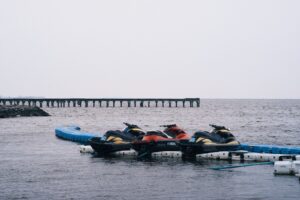
The 48-hour question comes up constantly in owner forums, and for good reason. Most PWC owners with dock access leave their boat-adjacent ski in the water between weekend trips and want to know if that is safe.
In freshwater, 48 to 72 hours is generally low-risk for a properly functioning ski. The hull needs to be in good condition, the drain plug properly seated, and the bilge functioning. Beyond that window, the risk of water intrusion and algae buildup increases, especially in warm water.
Freshwater vs. Saltwater: Why the Timeline Is Different
Saltwater changes the equation entirely, and the reason comes down to chemistry, not just intuition. Salt ions accelerate the electrochemical corrosion process on exposed metal, which is why components that hold up for weeks in freshwater can show pitting after a single unrinsed night in saltwater.
| Freshwater | Saltwater | |
| Corrosion mechanism | Minimal electrochemical activity | Salt ions accelerate corrosion on exposed metal |
| Onset of visible corrosion | Roughly a week of continuous exposure | A single unrinsed overnight exposure |
| Cumulative effect | Low; damage doesn’t compound significantly between sessions | High; each wet-dry cycle leaves salt residue that draws moisture even during storage |
| Most vulnerable components | Jet pump, fasteners | Jet pump, fasteners, exhaust fittings, electrical connections |
| Required action | Standard rinse after use | Remove from water after each use when possible; thorough rinse of intake and electrical connections before leaving unattended |
Electrical connections are particularly vulnerable in saltwater specifically, since corrosion at a connector can cause intermittent failures long before it’s visible anywhere else on the craft.
Signs That In-Water Storage Is Causing Damage
- Waterline staining or green discoloration on the hull
- Corroded or discolored exhaust fittings and fasteners
- Difficulty starting after extended dock time
- Sluggish pump output during acceleration
- Visible buildup around the drain plug or bilge access
Seasonal Outdoor Storage Without Winterization: The Highest-Risk Scenario
Leaving a non-winterized ski outside through winter is where the most expensive damage occurs. At temperatures at or below 32°F (0°C), residual water inside the engine, cooling system, and exhaust can freeze and expand, cracking internal components.
Rotax engines in Sea-Doo models and Yamaha TR-1 engines both require complete water evacuation before cold-weather storage. Even a single freeze-thaw cycle can cause damage that requires engine block repair. For dedicated boat and jet ski storage that keeps your PWC out of freezing conditions entirely, covered and enclosed facility options remove that risk without requiring indoor space at home.
Fuel risk compounds the freeze risk. Without a stabilizer, fuel left in the tank for more than 30 days begins degrading, clogging injectors, and causing hard-start conditions the following spring.
Can You Leave a Jet Ski Outside in the Winter?
You can, but only if the ski has been properly winterized first. Drain all water, fog the engine, stabilize the fuel, and disconnect or maintain the battery. An unwinterized ski left outside in freezing temperatures risks cracked engine components, burst cooling lines, and degraded seals. Repairs can run into the thousands of dollars.
How Temperature Extremes Affect the Hull and Seals
Repeated freeze-thaw cycles cause micro-cracking in fiberglass and composite hulls over time. In the Southwest, extreme heat accelerates UV degradation and can soften or warp seat foam and vinyl when a cover is not used. Both extremes shorten the life of rubber seals and gaskets that keep water out of critical components.
How to Extend the Safe Outdoor Window
If moving to covered storage is not immediately possible, these steps reduce damage risk for any outdoor storage situation.
- Use a fitted, UV-rated PWC cover for any storage lasting more than a few days. This addresses gelcoat fading, seat vinyl cracking, and rubber seal deterioration caused by sun and ozone exposure.
- Add fuel stabilizer for sits longer than 30 days. Run the engine briefly after adding it to circulate the stabilizer through the fuel system and prevent injector gumming.
- Use a battery maintainer or float charger for any storage beyond two to three weeks. This prevents deep discharge and extends overall battery life.
- Rinse thoroughly after every saltwater use before leaving the ski unattended. Pump housing, exhaust outlets, and metal fasteners all corrode faster than most owners expect.
- Store on a trailer with the drain plug removed so accumulated water can drain out instead of sitting in the hull.
- Fog the engine with corrosion inhibitor spray for any seasonal sit longer than four to six weeks. This protects cylinder walls and internal components from moisture-related corrosion.
For owners who use their ski seasonally and want a longer-term solution, covered vehicle storage keeps the ski protected from UV, weather, and temperature swings without requiring a full indoor unit. If you want to compare facility options against other storage approaches, our guide to storage costs breaks down what different storage setups typically cost.
When a Cover Alone Is Not Enough
A cover handles UV and weather exposure, but it doesn’t address the risks that actually cause the most expensive damage. Think of it as the first layer of protection, not a complete solution.
What a cover does and doesn’t cover:
- UV and gelcoat fading: Handled. A quality cover blocks the sun exposure that causes oxidation and cracking.
- Rain and weather: Handled. The cover keeps precipitation off the hull and seat.
- Fuel degradation: Not handled. Stale fuel breaks down inside the tank whether or not the ski is covered, and only a stabilizer addresses this.
- Battery drain: Not handled. A battery self-discharges under a cover exactly the same as it would sitting exposed; only a maintainer prevents this.
- Freeze risk: Not handled. Residual water inside the engine and cooling system freezes regardless of what’s draped over the hull.
Owners storing a ski for more than a month outdoors need fuel stabilizer, a battery maintainer, and proper water drainage in addition to the cover. Skipping any one of these because “it’s covered” is the single most common mistake owners make going into a long off-season.
Final Thoughts on Leaving a Jet Ski Outside
For owners who want more than a cover and a hope-for-the-best approach, RecNation offers dedicated covered and enclosed storage built around recreational vehicles. Facilities across Arizona, Florida, Texas, and other states provide options that take the guesswork out of how long is too long outside. Check out jet ski and boat storage at RecNation to find a facility near you.
Frequently Asked Questions
Can you leave a jet ski outside in the winter?
You can leave a jet ski outside in winter, but only after proper winterization. At temperatures at or below 32°F (0°C), any water remaining in the engine, cooling system, or exhaust can freeze and crack internal components. Before outdoor winter storage, drain all water, fog the engine, stabilize the fuel, disconnect or maintain the battery, and use a fitted cover rated for outdoor conditions.
Can a jet ski stay in the water overnight?
Yes, a jet ski can stay docked in freshwater overnight without significant risk, provided the hull is in good condition, the drain plug is properly seated, and the bilge is functioning. Saltwater is different: even overnight exposure without rinsing accelerates corrosion on metal components, the jet pump, and exhaust fittings. If your ski is docked in saltwater, rinse it before leaving it unattended.
How long can a jet ski sit without being used before the engine has problems?
Fuel left in a jet ski without stabilizer begins to degrade within 30 days and can gum up fuel lines, injectors, or the carburetor. If you are not running the ski for more than a month, add a marine fuel stabilizer, run the engine briefly to circulate it, and fog the cylinders with corrosion inhibitor spray. Sea-Doo and Yamaha both recommend this for any off-season storage period.
Does leaving a jet ski outside without a cover cause permanent damage?
Over time, yes. UV exposure begins breaking down hull gelcoat and seat vinyl within a few weeks of regular direct sun exposure. A full season without a cover can cause visible fading, oxidation, and cracking. Some gelcoat oxidation can be repaired with polishing, but severe vinyl cracking or delamination may require seat replacement.
How do I know if my jet ski has been damaged from sitting outside too long?
Common signs include faded or chalky hull gelcoat, cracked or peeling seat vinyl, corroded fittings or exhaust components, hard starting or rough running from stale fuel, and a battery that will not hold charge. If the ski sat through a freeze without winterization, inspect the engine block, cooling hose connections, and exhaust manifold for cracks before attempting to start it.
Does leaving a jet ski in the water too long affect insurance coverage?
It can. Some marine insurance policies include provisions that limit or exclude coverage for damage during extended unattended mooring or improper storage. BoatUS recommends notifying your insurer of any extended storage arrangement that deviates from normal use. If you plan to leave your ski docked for weeks at a time without monitoring, review your policy first.