Yes, covered storage is better than outdoor storage for jet skis in most situations, and the reasons come down to specific damage mechanisms that cost real money to fix. This article compares both options across UV exposure, moisture, security, insurance, and cost so you can make a defensible decision before the off-season starts.
What “Covered Storage” Actually Means for a Jet Ski
Not all storage with a roof is the same. The term “covered storage” gets used loosely, and conflating a tarp at home with a dedicated facility bay changes the protection math entirely.
The three common tiers are outdoor (no roof, no enclosure), covered carport (roof overhead, open sides), and enclosed indoor (full walls, possible climate control). This article focuses on the outdoor-versus-covered-carport comparison, which is where most personal watercraft owners are actually deciding. If you own multiple vehicles or need year-round storage in an extreme climate, enclosed RV and boat storage is worth a separate look.
Covered storage at a facility means a dedicated roofed bay with perimeter fencing and gate access. That is materially different from a backyard canopy or a tarp over a trailer hitch.
Covered Carport vs. Fully Enclosed Indoor
A covered carport bay has a solid roof and open sides. A fully enclosed indoor unit adds walls, a door, and sometimes climate control. For most seasonal jet ski storage, covered carport storage closes the meaningful gap over outdoor storage. Enclosed indoor is the higher tier, primarily worth it for long-term storage or owners in climates with extreme temperature swings.
| Feature | Outdoor | Covered Carport | Enclosed Indoor |
| Roof | None | Yes | Yes |
| Walls | None | Open sides | Full enclosure |
| Climate control | No | No | Sometimes |
| Security | Open lot | Gated perimeter | Gated, locked unit |
How Outdoor Storage Damages a Jet Ski Over a Full Off-Season
Outdoor storage is not a neutral default. It is a decision that carries a specific set of costs, and understanding them helps you weigh whether the savings justify the risk.
UV Damage and Gelcoat Degradation
Direct sunlight drives photochemical degradation in gelcoat and fiberglass. The result is oxidation, which makes the surface chalky and dull, and crazing, which produces fine surface cracks. This damage is cumulative and accelerates in high-UV climates like Florida and Texas, where UV index readings are consistently higher for more months of the year.
ASTM G154 is the standard testing protocol for UV exposure on nonmetallic materials, and it quantifies exactly how quickly gelcoat degrades under sustained UV cycling. Professional gelcoat restoration typically costs $300 to $800 or more depending on severity. A fitted jet ski cover in outdoor storage reduces this risk but does not eliminate it, because reflected UV and heat buildup under the cover still cause gradual hull deterioration.
Moisture, Humidity, and Engine Corrosion
Rain and ambient humidity are two separate problems, and this distinction is where outdoor storage causes damage that most owners do not anticipate. A weatherproof cover handles rain. It does not handle humidity.
Sustained relative humidity above approximately 70% over several weeks infiltrates engine compartments and drives corrosion inside exhaust manifolds, carburetors, and throttle bodies. In coastal states like South Carolina and Florida, that threshold is regularly exceeded for months at a time.
This is the moisture problem that covered storage helps reduce, and it is the reason engine fogging is non-negotiable before any storage period, regardless of storage type.
Theft, Pests, and Surface Wear
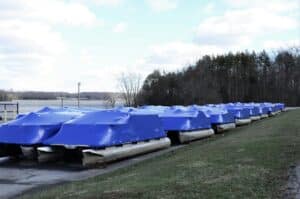
Open-lot outdoor storage has higher theft and vandalism risk than secured covered facilities. Trailer hitches are a common vulnerability for jet skis stored outdoors without a hitch lock.
Rodent damage to wiring is a documented repair issue for any vehicle stored outside for months. Mice nest in engine compartments and chew through ignition and sensor wiring. Add bird damage to seat vinyl and mold and mildew growth under covers in humid climates, and outdoor storage accumulates maintenance costs beyond the obvious UV and moisture categories.
What Covered Storage Actually Protects Against, and What It Doesn’t
Covered storage eliminates direct rain, direct sunlight, and wind-driven debris. Those protections extend gelcoat life, reduce deep cleaning before each season, and lower theft and vandalism risk compared to an open lot. If you are storing a jet ski through a four-to-six month off-season in a warm or humid climate, covered storage is a practical minimum, not a premium upgrade.
But covered storage does not control humidity. It does not prevent condensation inside the hull or engine compartment during temperature swings. And it does not eliminate UV risk entirely, because reflected UV and ambient ozone still cause gradual oxidation on fiberglass surfaces in open-sided bays.
The Humidity Problem Covered Storage Doesn’t Solve
Temperature swings between day and night cause moisture to condense inside the engine compartment and hull, even in a covered bay. This is a winterization problem, not a storage-type problem. Engine fogging, desiccant packs in the storage compartment, and battery removal or trickle-charging address it directly. Covered storage reduces overall humidity exposure, but it does not substitute for proper winterization.
Why a Jet Ski Cover Still Matters Inside a Covered Bay
A covered facility bay and a fitted jet ski cover serve different functions. The roof protects from rain and direct sun. The cover protects from dust, pests, reflected UV, and condensation on the hull surface. Using both together provides substantially better protection than either alone. A jet ski stored in a covered bay without a cover still has partial exposure to the factors that cause paint fading and surface oxidation.
The Insurance Angle Most Jet Ski Owners Overlook
Most personal watercraft insurance policies require you to declare a storage location and type. Progressive Marine and BoatUS are the two most widely held carriers for PWC owners, and both rate premiums and claim eligibility based on declared storage type.
If your policy lists covered or indoor storage and your jet ski is sitting on an open lot, a theft or damage claim can be denied on the basis of a material misrepresentation. That is a concrete financial risk that has nothing to do with the physical condition of your jet ski. The reverse matters too: if your policy rates a lower premium for outdoor storage and you move to covered, that change should be reported.
Checking Your Policy Before Off-Season Storage
Before you choose a storage arrangement, call your insurer and ask one specific question: “Does my policy require a specific storage type, and does a change affect my coverage or premium?” This takes five minutes and removes the risk of a denied claim after months of off-season storage. Update your declaration if you change your storage arrangement.
Cost of Covered vs. Outdoor Jet Ski Storage, What You’re Actually Paying For
The price difference between outdoor and covered storage is real, but so is the cost of the damage it prevents. Before deciding based on monthly rate alone, it helps to see what each tier actually costs.
| Storage Type | Typical Monthly Range |
| Outdoor (open lot) | $50 to $100 |
| Covered carport | $80 to $150 |
| Enclosed indoor | $150 to $300+ |
For a broader look at how storage costs are structured across vehicle types and facilities, see our article on how much you should pay for storage.
The monthly premium for covered storage over outdoor is typically $30 to $70. A single professional gelcoat polishing or paint restoration job runs $300 to $800 or more. One off-season of adequate protection can pay for itself if it prevents one significant repair.
A sit-down jet ski on a standard trailer typically fits in a 10×15 covered bay, which is one of the more common and accessible unit sizes at vehicle storage facilities. Facilities like RecNation offer covered carport storage designed specifically for vehicles, not converted general-purpose units, with gate access and surveillance included.
What to Look for in a Covered Storage Facility
Not all covered storage delivers the same protection. Before you commit, confirm the facility has:
- Roof construction: A solid metal roof, not an open canopy or shade sail structure.
- Perimeter fencing: Full enclosure around the storage area, not just a gate at the entrance.
- Coded gate access: Keypad or key fob entry that limits access to tenants.
- Surveillance cameras: Monitored or recorded coverage of the storage area.
- Lighting: Adequate lighting throughout the facility, not just at the entrance.
These features determine whether the premium for covered storage is delivering the security and weather protection it implies.
When Outdoor Storage Is and Isn’t Acceptable
Outdoor storage is defensible only under specific conditions: a storage period of 60 days or fewer, low ambient humidity (below roughly 60% average), a quality fitted weatherproof cover rather than a generic tarp, and a properly prepared engine.
Outside those conditions, it isn’t equivalent to covered storage. A full off-season of four to six months in Florida, the Gulf Coast, or coastal South Carolina puts gelcoat and engine components through UV exposure, ozone, heat cycling, and humidity that a cover alone can’t offset, degrading resale value and accelerating wear.
The verdict: covered storage is worth the premium for a full off-season in a warm or humid climate. Outdoor storage with a quality cover is acceptable for a 30-to-60-day window in a mild, dry climate.
The Minimum Prep Steps for Any Storage Type
These winterization steps are required regardless of whether you use outdoor or covered storage. They are not a substitute for storage type; they are the baseline for any seasonal storage:
- Add fuel stabilizer to the tank and run the engine briefly to distribute it.
- Fog the cylinders with engine fogging oil through the air intake.
- Flush the cooling system with fresh water, then drain it completely.
- Remove the battery or connect a trickle charger for battery maintenance.
- Clean the exterior thoroughly to remove salt, algae, and debris.
- Fit a quality jet ski cover, not a generic tarp.
If you are in covered storage and skip these steps, the jet ski will still accumulate internal corrosion and fuel system degradation over a multi-month period. Storage type and winterization prep work together, not as alternatives.
Final Thoughts on Covered vs. Outdoor Jet Ski Storage
If you’re storing your jet ski through a full off-season and want the protection that makes covered storage worth the cost, RecNation’s jet ski storage facilities are built for vehicles like yours, with roofed bays, perimeter security, and gated access at facilities across Florida, Texas, South Carolina, and Tennessee. It’s a practical way to make sure your jet ski comes out of storage in the same condition it went in.
Frequently Asked Questions
How Should I Store My Jet Ski During Winter?
Before storage, run fuel stabilizer through the engine, fog the cylinders, remove or trickle-charge the battery, flush the cooling system with fresh water, and clean the exterior thoroughly. Fit a quality jet ski cover regardless of whether you’re using outdoor or covered storage. For a full off-season in a warm or humid climate, covered storage at a secure facility provides meaningfully better protection than leaving the jet ski on an open lot.
Is It Okay to Store a Jet Ski Outside Year-Round?
Year-round outdoor storage is the hardest on a jet ski’s hull and engine components. Continuous UV exposure degrades gelcoat and causes paint fading faster than any other single factor, and sustained humidity in coastal or southern states drives internal corrosion in exhaust and fuel system components. A quality fitted cover and thorough winterization reduce outdoor storage risk, but covered or enclosed storage is the better long-term approach for protecting resale value.
What Is the Best Way to Protect a Jet Ski From UV Damage During Storage?
A fitted, UV-resistant jet ski cover is the most effective single step for UV protection in any storage type. If the jet ski is in covered facility storage, a roof overhead reduces direct sun exposure but does not eliminate reflected UV from surrounding surfaces, so a cover still matters. Applying a UV-protective wax or gelcoat conditioner before storage provides an additional barrier and is recommended by manufacturers including Sea-Doo and Kawasaki before long-term storage periods.
How Much Does Covered Jet Ski Storage Cost Compared to Outdoor Storage?
Outdoor storage at a facility typically runs $50 to $100 per month depending on location. Covered carport-style storage typically runs $80 to $150 per month. The monthly premium for covered storage is often $30 to $70 above outdoor, which is less than the cost of a single professional gelcoat polishing job, which can run $300 to $800 or more. A sit-down jet ski on a trailer usually fits in a 10×15 covered bay, which is one of the more common configurations at vehicle storage facilities.
Does Outdoor Storage Void a Jet Ski Warranty?
Most manufacturer warranties do not explicitly require covered or indoor storage, but they do require proper winterization and maintenance per the owner’s manual. Where outdoor storage becomes a financial risk is through insurance, not warranty. Personal watercraft insurance policies from carriers like Progressive and BoatUS rate premiums and claim eligibility based on declared storage type. Storing outdoors when your policy lists covered or indoor storage can complicate or void a damage or theft claim. Check your policy declaration before each storage season and update your insurer if you change your storage arrangement.