Yes, storing a jet ski outside is something thousands of owners do every year. Whether it works for you depends on four things: your climate, how long the ski will sit, the quality of your cover, and whether your ski has been properly prepared before you close it up. This guide walks through each factor so you can make an informed decision before the off-season arrives.
The Short Answer: Yes, But It Depends
Outdoor storage is a legitimate option for personal watercraft. It is not inherently reckless. The outcome depends almost entirely on the conditions you’re working with and the steps you take beforehand.
Four variables determine whether outdoor jet ski storage is low-risk or likely to cause damage:
- Climate: Freezing temperatures and extreme UV exposure are the two biggest environmental threats.
- Storage duration: A few weeks in a mild climate is very different from a six-month winter in the Midwest.
- Cover quality: A marine-grade, UV-resistant watercraft cover and a generic tarp are not equivalent.
- Preparation: Winterization, fuel treatment, and battery removal are what protect the engine while the ski sits.
When Outdoor Storage Is Acceptable
The low-risk scenario looks like this: you’re in a mild climate, the ski will be stored for under three months, you’re using a quality marine-grade cover, the ski has been fully winterized, and the trailer is locked. If all five of those conditions are true, outdoor storage is a reasonable choice.
When Outdoor Storage Becomes a Problem
The risk climbs significantly in a few specific situations. Freezing climates where temperatures drop below 32°F are a clear concern if the ski hasn’t been winterized. High-UV regions like Florida, Arizona, and Southern California will degrade an unprotected ski faster than most owners expect. Storage extending beyond one riding season without active maintenance is another threshold. And as covered below, some neighborhoods make outdoor driveway storage legally unavailable regardless of how well you prepare the ski.
What Outdoor Storage Does to a Jet Ski Over Time
Skipping preparation steps isn’t just an inconvenience. Each environmental factor causes a distinct type of damage, and the costs add up quickly. Here’s what actually happens to an unprotected ski sitting outside.
UV Damage and Gelcoat Degradation
Prolonged sun exposure oxidizes gelcoat, which produces the chalky, faded finish you see on neglected watercraft. In high-UV regions, this can become visible within a single season without cover protection. Seat vinyl cracks as UV breaks down plasticizers in the material, and rubber gaskets and seals deteriorate on a similar timeline.
The ASTM G154 standard governs UV weathering testing for plastics and polymeric materials. It exists because UV degradation of exposed surfaces is measurable and predictable. A storage cover rated for outdoor use with UV inhibitors is not optional in high-sun climates; it’s the primary defense against this category of hull damage.
Freeze Damage and the 32°F Threshold
Residual water in the exhaust manifold, intercooler, and cooling passages can freeze at sustained temperatures below 32°F. When water expands as it freezes, it cracks components that are expensive to replace. Both Yamaha WaveRunner and Sea-Doo owner’s manuals specifically flag this risk and require winterization before any period of cold-weather storage.
This is not a worst-case-scenario warning. It is the standard guidance from the manufacturers themselves. In transitional climates like the Mid-Atlantic or Pacific Northwest, where freezing temperatures arrive unpredictably, this is the most commonly overlooked risk for owners planning outdoor storage.
Moisture, Rust, and Corrosion
A cover that traps moisture underneath is sometimes worse than no cover at all. Condensation under a poorly fitted cover accelerates rust and corrosion on metal fittings and can promote mold growth in the engine compartment. Moisture and humidity are a slow threat compared to UV or freeze damage, but they compound over a full off-season.
A quality cover needs ventilation eyelets that allow airflow while keeping rain out. Fit matters too. A cover that pools water or creates sealed air pockets against the hull will cause problems over a long storage period.
How to Store a Jet Ski Outside Without Causing Damage
If outdoor storage fits your situation, these are the steps that actually protect the ski. Each one exists for a specific reason, so that reason is noted alongside it. For owners who also store other recreational equipment, the same facility that offers RV and boat storage can often accommodate personal watercraft as well, which is worth knowing before you commit to a long-term outdoor setup.
Cover Selection: What “Marine-Grade” Actually Means
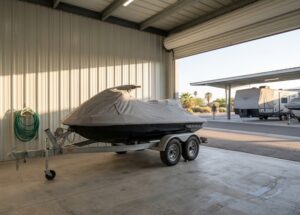
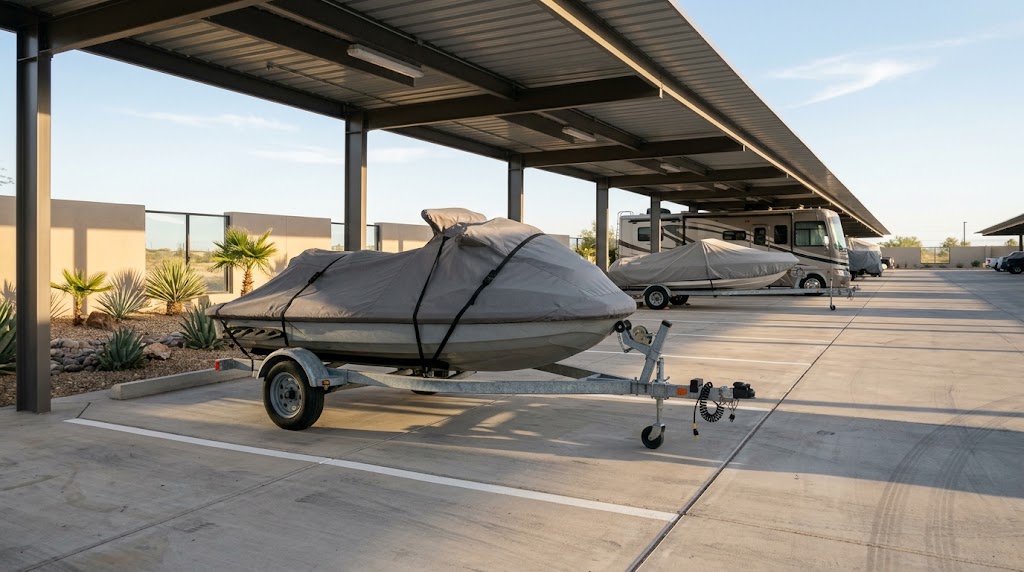
A marine-grade cover is not just marketing language. A quality outdoor watercraft cover should meet these specifications:
- Material: Solution-dyed polyester or marine-grade polyester with UV inhibitors woven into the fabric, not just a surface coating.
- Ventilation: Built-in eyelets that allow air circulation to prevent moisture and humidity from building up under the cover.
- Fit: Hull-specific sizing that sits snug against the body without loose material that can flap and abrade the gelcoat in wind.
- UV rating: The storage cover should be rated for continuous outdoor exposure, not just light weather protection.
A generic tarp fails on every one of these points. It lacks UV protection, traps moisture, and will cause abrasion damage during windy conditions.
Trailer Maintenance During Storage
The jet ski trailer gets skipped in most storage guides. It has its own failure modes that matter when you try to pull the ski out in spring.
- Inflate tires to the manufacturer’s specification before storage to prevent flat-spotting from prolonged static load.
- Lubricate wheel bearings and the hitch before the ski goes into storage, not just before launch.
- Chock the wheels and position the trailer on a level, hard surface to reduce frame contact with wet ground.
- Place plywood under tires if the trailer will sit on soil or gravel to reduce moisture absorption into the rubber.
Winterization Basics Before You Close the Cover
Winterization must happen before the first freeze, not after a cold night has already passed. The minimum steps for outdoor storage are:
- Flush the engine with fresh water and run it until it’s clear.
- Add fuel stabilizer to a full tank. A full tank reduces the air space where condensation forms. Fuel stabilizer prevents varnish buildup in the fuel system that can block injectors after 30 days of non-use.
- Apply fogging oil to the engine cylinders and intake to protect internal surfaces from corrosion during storage.
- Remove the battery and store it indoors on a trickle charger to maintain charge without overcharging.
Two Things Most Owners Don’t Check Before Storing Outside
Most outdoor storage guides stop at preparation steps. Two other factors can make outdoor driveway storage either financially risky or legally unavailable. Neither one gets covered by competitors, and both can be deal-breakers. Before committing to outdoor storage, also review our guide to storage costs to see how facility options compare on price.
Does Your Watercraft Insurance Cover Outdoor Storage?
Standard watercraft insurance policies from carriers like Progressive and BoatUS frequently include storage condition clauses. These clauses specify how and where the craft must be stored for theft, vandalism, and weather damage claims to be valid. Leaving a jet ski unsecured on an open trailer in a driveway may not satisfy those requirements.
The theft risk is the most immediate concern. Some policies require that a personal watercraft stored off-premises be in a locked facility for theft coverage to apply. It’s worth reviewing your policy’s storage location requirements before the off-season, since this is exactly the kind of detail that varies by carrier and gets missed until a claim is denied.
The action step here is simple: call your insurer before the riding season ends and ask specifically whether your storage setup satisfies the policy’s coverage conditions.
HOA Rules and Local Ordinances on Driveway Storage
Homeowners association (HOA) covenants commonly classify trailered watercraft as regulated vehicles:
- Visual screening or street-visibility bans. Many subdivisions prohibit storage visible from the street.
- Time limits. Some CC&Rs cap trailered vehicles in driveways at as little as 24 to 72 hours.
- Municipal nuisance ordinances often layer additional restrictions on top of HOA rules.
This isn’t a rare edge case. A meaningful percentage of jet ski owners live in neighborhoods where driveway storage of a trailered watercraft is simply not permitted. If your HOA prohibits driveway storage, renting a dedicated storage unit through a facility like RecNation is one practical way to stay compliant without giving up access to your watercraft.
You can verify your local rules through your HOA’s CC&R document or by searching your county’s municipal code on a public ordinance database like Municode. Do this before the off-season, not after you’ve already decided where the ski is going to sit.
Short-Term vs. Long-Term Outdoor Storage: How the Risk Changes
Duration is the variable that most changes your risk exposure. The preparation steps don’t change dramatically between a four-week gap and a six-month winter, but the consequences of skipping them compound significantly over longer periods.
| Factor | Short-Term (Under 4 Weeks, Mild Climate) | Long-Term (3+ Months or Freezing/High-UV Climate) |
| Cover required | Yes, marine-grade recommended | Yes, marine-grade required |
| Winterization required | If temps may drop below 32°F | Yes, mandatory before first freeze |
| Trailer maintenance required | Tire pressure check | Full inspection: bearings, tires, frame |
| Insurance check advised | Recommended | Strongly recommended |
| Risk level | Low with quality cover | Elevated without full preparation |
What Changes After Three Months
UV damage compounds with extended sun exposure, which is why short-term uncovered storage in mild climates carries less visible risk than a full winter. Battery voltage drops below safe charge thresholds after 60 to 90 days without a trickle charger, which can permanently reduce capacity. Fuel stabilizer begins losing effectiveness after approximately 12 months, so ski stored longer than one full season may need fresh fuel treatment before launch.
For owners whose situation falls into the higher-risk column, long winters, no garage, or HOA restrictions that rule out driveway parking, covered storage options through a dedicated facility remove most of those variables without requiring a full indoor storage commitment.
Final Thoughts on Storing a Jet Ski Outside
If outdoor jet ski storage isn’t viable because of HOA rules, climate, insurance requirements, or simply a driveway that doesn’t have room, RecNation offers covered storage for jet skis across multiple states, with the security and weather protection that outdoor home storage can’t reliably provide. It’s worth getting a quote before the off-season arrives and spots fill up.
Frequently Asked Questions
How do you protect a jet ski stored outside?
Start with a marine-grade, UV-resistant watercraft cover that fits the hull snugly and has ventilation eyelets to prevent moisture buildup. Before closing the ski up for the season, flush the engine, add fuel stabilizer to a full tank, remove the battery, and apply fogging oil to protect internal engine components. Use a hitch lock or cable lock on the trailer to reduce theft risk, and check tire pressure and wheel bearings before storage begins.
Is it bad to leave a jet ski outside in winter?
It can be, depending on your climate and how well the ski has been prepared. Any sustained temperature below 32°F creates a risk of residual water in the exhaust manifold or cooling system freezing and cracking components. If you’re storing in a region with freezing temperatures, complete a full winterization before the first freeze and use a cover rated for outdoor use.
What is the best cover for outdoor jet ski storage?
Look for a cover made from solution-dyed polyester or marine-grade polyester with UV inhibitors, a snug hull-specific fit, and built-in ventilation eyelets. A generic tarp is not an adequate substitute. It traps moisture underneath, lacks UV protection, and can abrade the gelcoat during wind events. Reputable personal watercraft cover manufacturers offer hull-specific sizing for Sea-Doo, Yamaha, and Kawasaki models.
How long can a jet ski sit outside without damage?
With proper preparation, a quality storage cover, winterization, and a locked trailer, a jet ski can be stored outdoors for a full off-season in a mild climate without significant damage. In high-UV regions like Florida or Arizona, even short-term uncovered exposure of a few weeks can begin degrading gelcoat and seat vinyl. In freezing climates, any outdoor storage without winterization is risky regardless of duration.
Should I store my jet ski on a trailer or a stand?
Most owners store on a trailer for practical reasons. It’s easier to launch, the ski doesn’t require lifting equipment, and the trailer provides a stable base. If storing on a trailer outdoors, inflate tires to the manufacturer’s specification to prevent flat-spotting, chock the wheels, and position the trailer on a level, hard surface. A stand is a reasonable option for long-term indoor storage but is less practical for outdoor use.
Can storing a jet ski outside affect my insurance coverage?
It can. Many standard watercraft policies contain storage condition clauses that specify how and where the craft must be stored for theft, vandalism, and weather damage claims to remain valid. Leaving a jet ski unsecured on an open trailer in a driveway may not meet the policy’s requirements. Contact your insurer before the off-season and ask specifically whether your storage setup satisfies the policy’s coverage conditions.