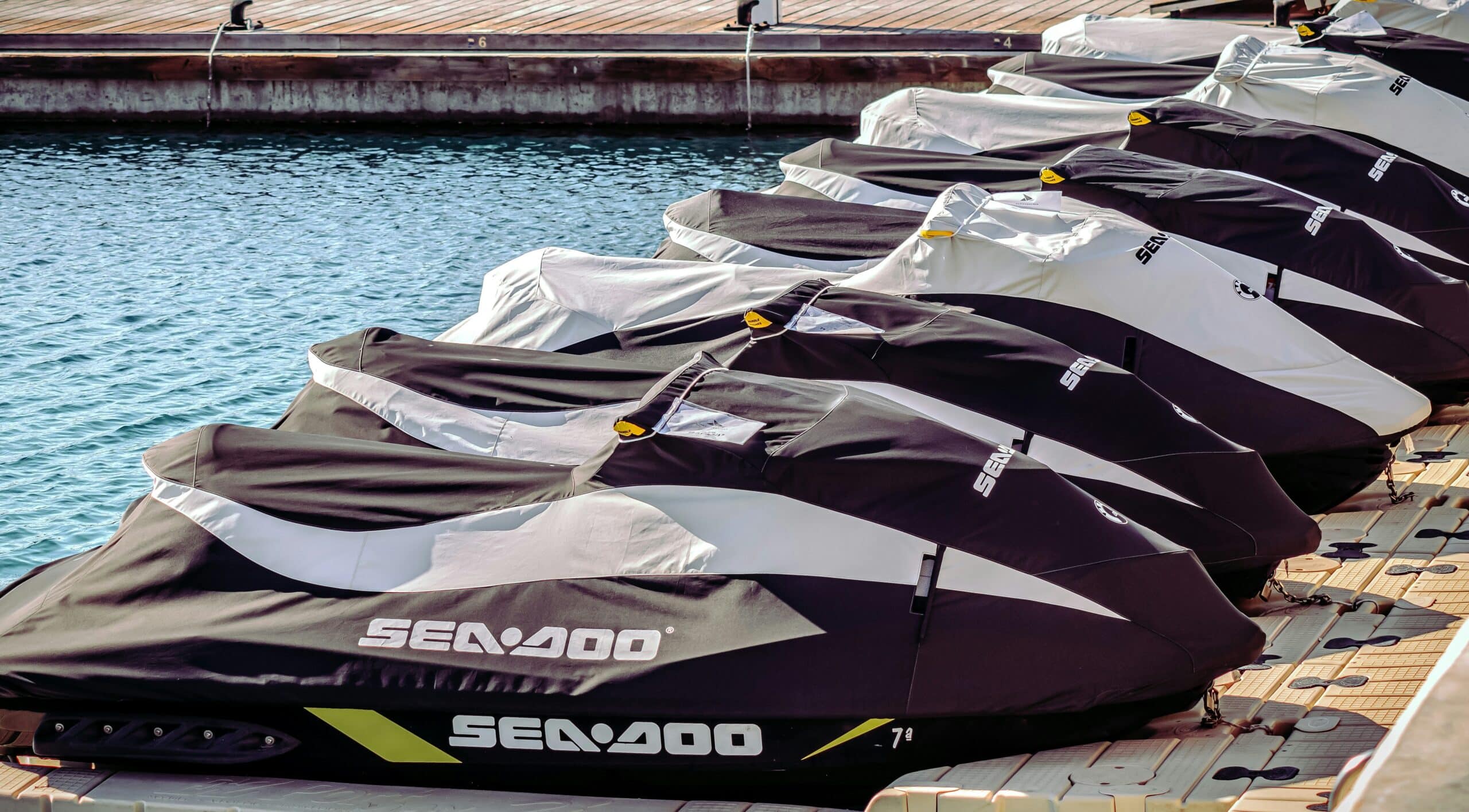
The right place to store a jet ski long-term depends on four things: security, climate, cost, and how much preparation work you want to do before dropping it off. There is no single best answer for every owner. A reader with a large garage in Phoenix faces a completely different set of trade-offs than someone renting an apartment in Tampa.
This guide covers every realistic storage option with actual cost ranges, compliance considerations, and how your choice affects winterization prep.
What Makes a Storage Location Suitable for a Jet Ski?
Before comparing specific options, it helps to have a clear decision framework. Every storage location should be evaluated against the same four criteria, because a place that scores well on cost but poorly on security is not actually a good deal.
- Security: A jet ski sitting idle for months is a theft target. A personal watercraft (PWC) left outdoors without a lock on the trailer coupler can be towed away in under two minutes. Look for locations with gated access, lighting, and at minimum a trailer tongue lock or cable lock through the handpole.
- Climate and temperature: Water trapped in cooling systems and drain lines freezes at 32 degrees Fahrenheit and can crack internal components. In hot climates like Florida, Arizona, and Texas, prolonged UV exposure degrades hull gel coat and seat vinyl over a full off-season even without freezing temperatures.
- Surface and hull support: Prolonged storage on uneven ground creates stress points on the hull. The trailer must sit level, and the hull should rest on its designed support points, typically where the trailer bunks or rollers contact the hull at manufacturer-specified locations, rather than on unsupported sections.
- Access: If you need to retrieve the PWC occasionally, a facility 45 minutes away with limited gate hours becomes a real inconvenience. Factor in how often you realistically need to get to the machine.
Security
Facility-level security features worth verifying include coded gate access, 24-hour camera coverage, and perimeter lighting. At home, a trailer coupler lock and a cable lock through a fixed point on the PWC are minimum deterrents. Neither replaces a secure enclosure, but both raise the effort required to steal the machine.
Climate and Temperature Protection
The 32-degree threshold is the critical number for cold-climate owners. Below that, any water remaining in the engine cooling system, exhaust manifold, or hull drain lines becomes a freeze risk. In warm climates, UV exposure is the primary threat. A hull left uncovered in direct sun for six months will show fading and surface oxidation by the time you retrieve it.
Storing a Jet Ski at Home: Garage, Driveway, or Property
Home storage avoids a monthly fee, but it is not automatically the right call. Space constraints, homeowners association (HOA) rules, and local ordinances eliminate this option for more owners than you might expect.
Garage Storage
A sit-down jet ski on a standard trailer runs roughly 10 to 12 feet long plus the hitch, and about 5 to 6 feet wide. You need approximately 10 feet of width free and enough floor depth to clear the hitch behind the garage door. Many two-car garages can technically fit a jet ski, but only if you move one vehicle out or park around it carefully.
Ventilation matters if the fuel tank is not drained before indoor storage. Gasoline vapors are heavier than air and collect at floor level. A garage with poor airflow and a fuel-loaded tank is a fire risk. Many HOA rules also prohibit trailer storage in residential garages or require garage doors to remain closed at all times, which can restrict loading and unloading.
Outdoor Home Storage
The driveway or backyard is the highest-risk option but workable in mild climates. The minimum requirements are a quality UV-resistant, water-repellent jet ski cover rated for outdoor use (look for 600D polyester or heavier material), a trailer tongue lock, and a level surface to prevent uneven hull stress.
Pest damage prevention is a genuine concern here. Rodents nest in PWC engine compartments and seat foam when a machine sits idle for months. Before storing outdoors long-term, seal any open gaps in the engine compartment and inspect the seat for existing wear that gives pests an entry point. In freezing climates, outdoor storage requires a far more thorough winterization process than indoor options.
Waterfront Property Storage
Owners with water access at their property have an option competitors rarely mention: dry-dock storage on their own land. PWC ramps and floating lifts keep the hull entirely out of the water between uses, which eliminates the fouling and corrosion that comes with leaving a jet ski in a slip. This is the most convenient setup for frequent users, but it still requires a quality cover and pest prevention measures when the machine sits idle for extended periods.
Self-Storage Units for Jet Ski Storage
A self-storage unit for your jet ski is a logical option when home storage is not feasible, but there are compliance and sizing questions to resolve before signing any contract. Understanding how much you should expect to pay for storage before you shop will also help you negotiate.
What Size Storage Unit Does a Jet Ski Need?
- Sit-down jet ski on a standard trailer: Requires a minimum 10×20 ft unit to allow for door swing, safe loading, and adequate clearance on both sides.
- Stand-up PWC: Smaller footprint, may fit in a 10×15 ft unit if stored vertically on a purpose-built cradle or stand rather than on its hull. Stand-up models have a different center of gravity than sit-down machines, and resting them on their hull for months creates stress fracture risk.
Unit size directly affects monthly cost. A 10×20 ft unit typically runs $100 to $200 per month depending on region and whether climate-controlled storage is included. Standard self-storage units are not climate-controlled by default, so freeze risk still applies in cold climates.
Facility Compliance and Fire Code
This is the question most owners skip, and it can result in a forced removal mid-winter. NFPA 30 (Flammable and Combustible Liquids Code) governs the storage of fuel-containing vehicles in enclosed facilities. Many self-storage operators prohibit gasoline-containing watercraft under this standard. Facilities that do allow it often require the fuel tank to be drained or treated with a stabilizer before move-in.
Not knowing the policy before you sign is how owners end up scrambling to find an alternative in January. Confirm the facility’s fuel policy in writing before committing.
Five questions to ask any self-storage facility before signing:
- Do you permit watercraft with fuel in the tank?
- What is your minimum unit size for a PWC on a trailer?
- Is the unit climate-controlled or ambient temperature?
- What security features does the facility have (gated access, cameras, individual unit alarms)?
- Is there drive-up access so a trailer can be pulled directly to the unit door?
Dedicated Vehicle Storage Facilities and Marinas
If you want the most protection with the least preparation work on your end, professional storage is worth the cost comparison. Two options exist here: dedicated vehicle storage facilities and marina dry-stack storage.
What to Look for in a Vehicle Storage Facility
Purpose-built vehicle storage facilities offer options that standard self-storage does not:
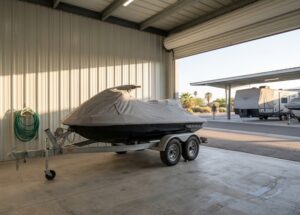
- Covered outdoor storage (carport-style canopies) protects against UV and rain without the cost of a fully enclosed unit.
- Fully enclosed indoor storage with climate control is available at the upper end of the cost range.
Both represent significantly better protection than an unshaded outdoor self-storage lot.
Security at dedicated facilities is typically stronger than standard self-storage:
- Gated access with coded entry.
- Camera systems.
- Drive-through lanes wide enough for trailers.
RecNation Storage, which operates facilities across Florida, Texas, Arizona, and other states, is one example of a vehicle-specific operator that offers covered storage for personal watercraft and their trailers. Cost for covered vehicle storage runs roughly $80 to $180 per month depending on region and unit type, with fully enclosed indoor storage running higher.
Before signing with any vehicle storage facility, verify that it explicitly accepts fuel-containing watercraft. Not all vehicle storage facilities operate under the same terms as a marina or boat storage facility, and confirming fuel policy in advance remains important regardless of the operator type.
Marina Dry-Stack Storage
Marina storage operates differently from any land-based option. A dry-stack program stores your PWC in a warehouse-style rack system and launches it by forklift on request. You call ahead, and the marina has it in the water by the time you arrive. No trailering, no loading, no backing down a ramp.
That convenience comes with a significant cost premium. Seasonal marina storage for a jet ski typically runs $500 to $1,500 or more for a full off-season, depending on the marina and region. For owners who use their PWC frequently at a single location and want same-day launch capability, the cost may be justified. For pure off-season storage where the machine sits for three to six months, it is rarely the most economical choice.
Jet ski storage at a dedicated facility will almost always cost less for owners whose primary need is protection during the off-season, not launch-day convenience.
How Your Storage Choice Affects Winterization Prep
Storage location and winterization are not separate decisions. Where you store the jet ski determines how much preparation the machine needs before you leave it. The more exposed the environment, the more thorough the process has to be.
Minimum Prep for Any Storage Location
These steps apply regardless of where you store the PWC:
- Flush the engine with fresh water to remove salt and contaminants from the cooling system.
- Add a marine-grade fuel stabilizer to a full tank to prevent varnish buildup in the fuel system during long-term storage.
- Remove the battery (or keep it on a trickle charger) to prevent permanent degradation from sitting uncharged.
- Apply a jet ski cover as the minimum hull protection for any location.
Both Sea-Doo and Yamaha manufacturer guidelines agree on these baseline steps regardless of storage location or climate. Climate-controlled indoor storage reduces certain risks, but it doesn’t eliminate the need for engine flushing, battery maintenance, or fuel stabilizer.
Extra Steps for Outdoor and Uncovered Storage
| Storage Type | Minimum Prep Required | Additional Steps |
| Indoor climate-controlled | Engine flush, fuel stabilizer, battery removal or trickle charger, cover | Inspect hull for cracks before storage |
| Covered outdoor | All above, plus corrosion prevention spray on exposed metal | Secure cover against wind; inspect monthly |
| Uncovered outdoor | All above, plus remove drain plug to prevent water accumulation | Shrink wrapping as an alternative to a cover in cold climates |
Outdoor storage in freezing climates adds the drain plug removal step. Water left in the hull collects and freezes, cracking the hull from the inside. Corrosion prevention spray on exposed metal fittings and the trailer frame also slows deterioration in wet or coastal environments.
One note on fuel: ethanol-blended fuel (E10) degrades faster during storage than ethanol-free marine fuel. In states where ethanol-free marine fuel is available, it is worth using at season’s end before adding stabilizer. The EPA’s guidance on nonroad spark-ignition engine fuel standards provides useful background on why ethanol content affects storage behavior.
Final Thoughts on Storing Jet Ski Long-Term
If you want a storage setup built around vehicles rather than adapted for them, RecNation Storage offers covered and enclosed options across multiple states that are sized and secured for personal watercraft. Facilities are gated, camera-monitored, and designed for owners who want their jet ski protected without managing storage conditions themselves.
Frequently Asked Questions
How do you prepare a jet ski for long-term storage?
The minimum preparation for any storage location includes flushing the engine with fresh water, adding a marine-grade fuel stabilizer to a full tank, removing the battery or connecting it to a trickle charger, and covering the PWC with a UV-resistant, water-repellent cover. If storing outdoors in a cold climate, also remove the drain plug to prevent water from accumulating in the hull and freezing. The more exposed your storage environment, the more thorough your prep needs to be.
Is it better to store a jet ski indoors or outdoors?
Indoor storage offers significantly better protection than outdoor storage. It eliminates UV degradation to the hull and seat vinyl, removes freeze risk in cold climates, and reduces theft and pest exposure. Outdoor storage can work in mild climates with a quality cover and a trailer lock, but it requires more thorough winterization prep and ongoing monitoring. If you are storing for more than three months, indoor or covered storage is the better long-term choice.
How much does it cost to store a jet ski at a storage facility?
A 10×20 ft self-storage unit typically runs $100 to $200 per month depending on whether it is climate-controlled and where the facility is located. Covered outdoor storage at a dedicated vehicle storage facility generally runs $80 to $180 per month. Marina dry-stack storage is the most expensive option, often $500 to $1,500 or more for a full off-season depending on the marina and region. Pricing in high-demand coastal markets like Florida and California tends to run higher than in inland areas.
Can you store a jet ski outside in the winter?
Yes, but only with the right preparation and in climates where temperatures stay consistently above freezing. In regions where temperatures drop below 32 degrees Fahrenheit, outdoor storage creates a serious freeze risk. Water in the cooling system, exhaust manifold, and drain lines can freeze and crack internal components. If outdoor winter storage is your only option in a cold climate, a full winterization including fogging the engine, draining all water, and removing the battery is required. A heavy-duty, weatherproof cover secured against wind is also necessary.
Do you need to winterize a jet ski before storing it long-term?
Yes, regardless of where you store it or what climate you live in. Even in warm climates, long-term storage without fuel stabilizer leads to varnish buildup in the fuel system, and a battery left uncharged will degrade permanently within a few months. The baseline steps (engine flush, fuel stabilizer, battery maintenance, and a protective cover) apply to every storage scenario. Cold-climate storage adds steps like fogging the engine and draining all water passages to prevent freeze damage.