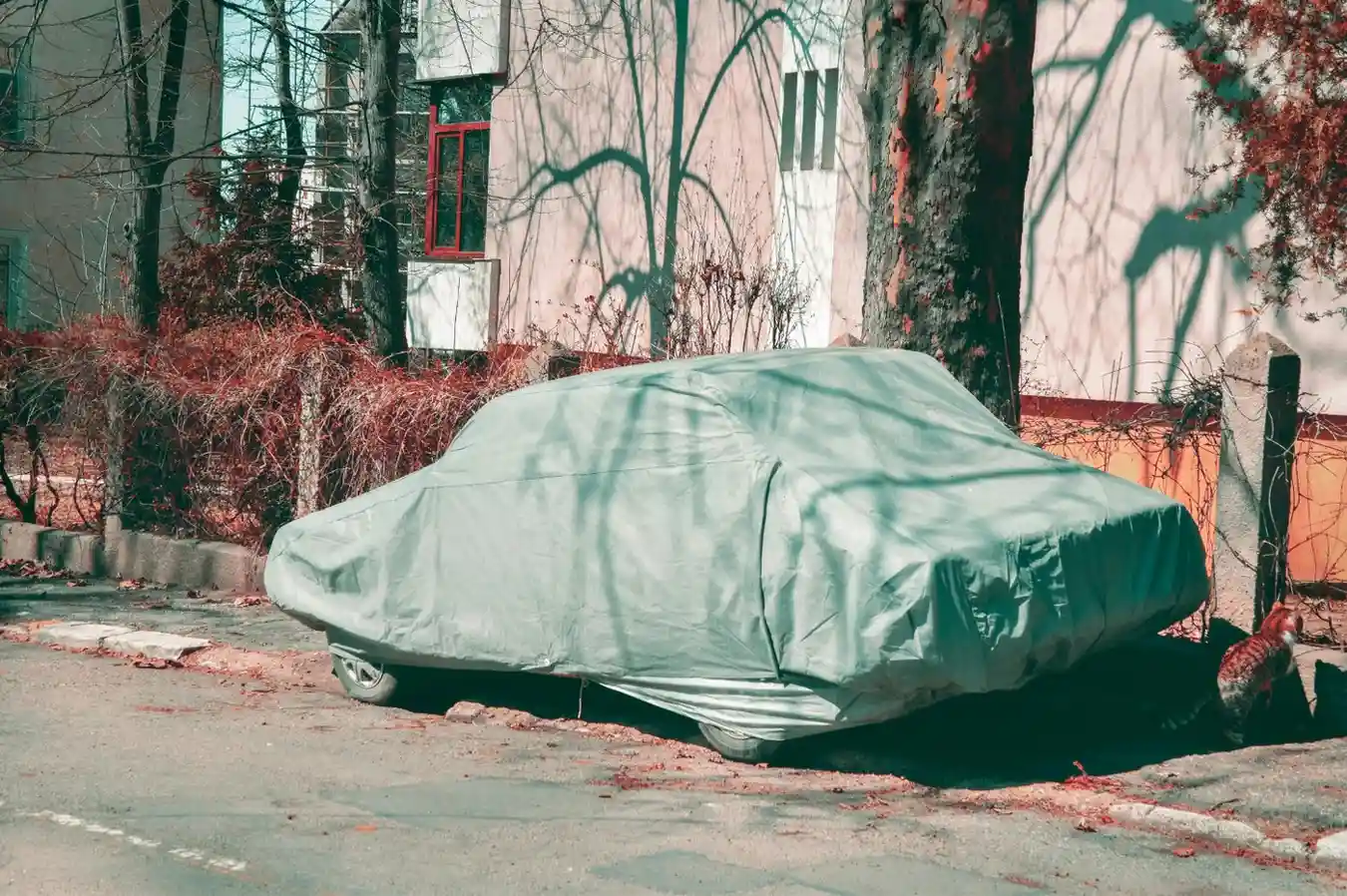
Yes, in most U.S. cities, covering your car and leaving it on the street is perfectly legal.
But a few things can turn that into a ticket: an obstructed license plate, a city’s anti-storage rules, or a residential permit no one can see under the cover. Los Angeles and San Francisco both enforce 72-hour limits, cover or no cover.
Here’s exactly what applies where, and how to park a covered car without inviting a citation.
Is It Legal to Park a Covered Car on the Street?
No federal law prohibits it, and most cities have no blanket ban on car covers. But three categories of state and local law can still turn a covered, street-parked car into a citable or towable situation: license plate visibility statutes, anti-storage ordinances, and residential permit zone identification requirements. Whether you face enforcement depends on where you live, how long the car sits, and whether the cover blocks the rear plate.
The Short Answer
No federal law prohibits parking a covered car on a public street, and most jurisdictions don’t explicitly ban car covers. But three categories of law regularly create violations:
- State plate visibility statutes. Prohibit any cover draped over the rear plate.
- City anti-storage ordinances. Classify a long-term covered car as a stored vehicle, subject to towing.
- Residential parking permit zone rules. Require the permit decal to stay visible from outside the cover.
A cover that triggers any of these can result in a citation or tow, even if the parking spot itself is perfectly legal.
Key Variables That Determine Legality
Use this table to identify the rules most likely to apply to your situation before you cover and park.
| Rule Type | What Triggers a Violation | Where It Applies |
| License plate visibility statute | Cover drapes over the rear plate, obstructing it from view | California (CVC § 5201), Texas (Tex. Transp. Code § 504.945), Florida (Fla. Stat. § 316.605), and most other states |
| Anti-storage ordinance | Vehicle remains standing or parked in the same spot for 72+ consecutive hours | Los Angeles (LAMC § 80.73.2), Phoenix, and other cities with stored-vehicle enforcement |
| 72-hour parking limit | Car has not moved within 72 hours of being chalk-marked, regardless of cover | San Francisco (SFMTA), and many other U.S. cities with time-limit enforcement |
| Residential permit zone rule | Cover obscures permit decal, preventing officer from confirming parking authorization | Any city with a residential parking permit (RPP) program |
Local Parking Laws and Regulations for Covered Vehicles
The gap between “not explicitly banned” and “legal in practice” narrows fast once you look at city-level street parking rules. Four jurisdictions illustrate the range of enforcement approaches, and understanding them tells you more about your own city’s likely rules than any general summary will.
Los Angeles: Anti-Storage Ordinances and CVC § 22651
Los Angeles Municipal Code § 80.73.2 prohibits parking or standing a vehicle on any city street, highway, or alley for 72 or more consecutive hours. Once flagged and confirmed, the vehicle becomes subject to towing under California Vehicle Code § 22651(k), the specific subsection governing 72-hour stored-vehicle removal.
A few things worth knowing about how this actually plays out:
- A covered car is just as identifiable to enforcement as an uncovered one. The cover doesn’t hide the fact that the vehicle hasn’t moved.
- The city relies on reports, not automatic detection. LA runs a dedicated 1-800-ABANDON hotline specifically for residents to flag vehicles that appear stored rather than actively used.
- No explicit no-parking zone is required. A stationary, covered vehicle can trigger this classification anywhere on a public street.
- Enforcement timing varies by location, not a fixed clock. The 72-hour threshold is the legal standard, but in practice, enforcement is complaint-driven and officer-discretion based. A car covered for two days in a quiet residential area may draw no attention, while the same car on a busy commercial street could be flagged within hours.
The practical guidance: move the vehicle regularly, and avoid leaving a car covered on an LA street for more than 24 to 48 hours without moving it, well inside the legal threshold and outside the range where enforcement attention typically starts.
San Francisco: The 72-Hour Rule and Covered Cars
San Francisco’s 72-hour parking limit is enforced by the San Francisco Municipal Transportation Agency (SFMTA) and applies to every vehicle on a public street, covered or not. A parking enforcement officer can chalk the tires of a covered car without removing the cover, and can affix a marking notice to the vehicle’s windshield or body.
If the car has not moved 72 hours after being marked, it can be cited and towed. A car cover does not reset the clock, does not delay the marking process, and does not prevent a marking notice from being issued. Officers are not required to lift or remove the cover to conduct the marking.
An additional layer applies in San Francisco’s RPP zones: having a valid residential parking permit decal does not exempt a vehicle from the 72-hour limit. A covered car with a legitimate permit can still receive a marking notice and ultimately be towed if it hasn’t moved within the 72-hour window.
Washington D.C.: Enforcement Gray Zone
A 2023 NBC4 Washington investigation found that some DC residents believed car covers made their vehicles untouchable to parking enforcement, and DC 311 had actually been telling callers that ticket writers were forbidden from lifting covers.
- That belief was wrong. DPW’s own Parking Enforcement leadership confirmed officers are authorized to lift covers, and always have been.
- The confusion came from DC’s own 311 service, not from any actual DPW policy or ordinance.
- DPW said it would correct the internal miscommunication with staff, meaning the “gray zone” some residents relied on was never a real legal exemption to begin with.
- Enforcement still happened despite the confusion. In the specific case NBC4 reported on, officers ultimately issued two citations to the covered vehicle in question.
The practical takeaway: relying on a car cover to avoid DC parking enforcement isn’t a strategy, it’s a misunderstanding that officers are actively correcting. A cover has never been a legal shield, and the agency responsible for enforcement says its officers can act on that at any time.
Residential Permit Zones: When a Cover Hides Your Permit
In any city with a residential parking permit program, a car cover that obscures the permit decal creates citation risk. Parking enforcement officers need to visually confirm that a vehicle is authorized to park in an RPP zone. If the cover makes that confirmation impossible, the officer has grounds to issue a citation.
This risk applies even when the permit is perfectly valid and properly displayed underneath the cover. The enforcement trigger is not the absence of a permit; it is the officer’s inability to see one. In cities that use windshield stickers or dashboard placards for RPP authorization, ensure the front of the vehicle or the windshield area remains visible from outside the cover.
Visibility and Identification Requirements
Most car owners focus on parking ordinances when they think about covering a street-parked vehicle. The license plate visibility issue is separate from parking rules entirely, and it catches more people off guard. A full car cover that drapes over the rear bumper can violate your state’s vehicle equipment code without you breaking a single parking rule.
State License Plate Visibility Laws
Most U.S. states require the rear license plate to be clearly visible and unobstructed at all times the vehicle is on a public street. A car cover that covers the rear of the vehicle creates a standalone, citable vehicle equipment violation in these states, independent of where the car is parked or how long it has been there.
The key statutes are:
| State | Statute | What It Requires | Consequence |
| California | CVC § 5201 | License plates must be maintained in a condition so they are clearly legible and unobstructed | Infraction; fixable with proof of correction, or a fine (commonly cited around $196-$197 with penalty assessments) |
| Texas | Tex. Transp. Code § 504.945 | License plates must be clearly visible and not obscured by any material or covering | Misdemeanor or citation depending on officer discretion |
| Florida | Fla. Stat. § 316.605 | License plates must be plainly visible and legible from 100 feet | Traffic citation; non-criminal infraction |
Most other states have equivalent provisions in their vehicle equipment codes. If your state is not listed, check your state’s transportation or vehicle equipment statutes for language about plate obstruction or legibility.
An officer who cannot read the plate cannot run the vehicle’s registration. In some jurisdictions, an unreadable plate triggers a “vehicle of unknown status” classification, which can initiate an investigation or additional enforcement steps independent of any parking violation.
How to Keep Your Plate Visible Under a Cover
The fix is straightforward. Choose a car cover with a built-in rear license plate cutout, which most quality outdoor covers now include. If your cover does not have a cutout, fold the rear edge of the cover above the plate and secure it there before leaving the vehicle.
A partial cover that stops above the bumper line also avoids the plate visibility issue entirely. Any of these approaches keeps you compliant with state plate visibility laws without giving up weather protection.
What Risks Come With Covering a Car on the Street?
A car cover addresses one problem, weather exposure, while quietly creating several others. Understanding the full picture helps you decide whether a cover is the right tool, and how to use it correctly if it is. For a deeper look at how street parking performs as a long-term option, our breakdown of whether street parking is safe for long-term vehicle storage covers the trade-offs in detail.
Moisture Trapping, Dust Buildup, and Paint Damage
A non-breathable outdoor car cover repels rain on the outside but traps moisture that forms from condensation underneath. That trapped moisture sits against the paint, seals, and any small rust-prone areas for as long as the cover is in place. According to the EPA’s guidance on mold, mold can begin growing within 24 to 48 hours on surfaces with sufficient moisture and organic material present, and the underside of a cover provides both conditions.
Dust and grit that settle on the car’s surface before the cover is installed become an abrasive layer between the cover and the paint. Wind moves the cover slightly, even when secured, and that movement drags the particles across the finish. Over weeks, this creates fine scratches across flat body panels where cover movement is most pronounced.
The fix is a breathable outdoor car cover made from multi-layer polyester with UV inhibitors. Breathable covers allow vapor to escape from underneath, which reduces condensation buildup significantly. They are the correct choice for any car left on a street for more than a day or two.
Theft, Vandalism, and Security Risks
A covered car on a public street signals to anyone passing that the owner is absent for an extended period. This is the opposite effect of deterrence. Opportunistic theft and vandalism are more likely when a vehicle appears unattended and stationary, not less.
The cover itself can be stolen. Covers are expensive and easy to remove from a parked car in under a minute without any tools. Threading a cable lock through the cover’s grommets and looping it around the wheel or axle is the standard precaution, and it deters casual theft without requiring a complicated setup.
Breaking into a covered car takes a motivated thief no additional effort. A cover does not add any meaningful security against vehicle theft, and it should not be treated as a security measure.
Weather Exposure and Long-Term Wear
Car covers offer real short-term protection from bird droppings, tree sap, and airborne debris. These are legitimate benefits, and for a car parked under trees or near a busy road, a cover prevents paint staining that is otherwise difficult to remove.
Over weeks or months, the protection calculation changes. UV degradation affects the cover material itself, causing it to become brittle and shed fibers onto the car. Water that pools in low points of the cover increases localized pressure and keeps paint wet for extended periods.
Wind causes the cover to move repeatedly against the same contact points on the body, concentrating abrasion damage. A car cover on a public street is a good overnight or short-term solution. It is not a substitute for sheltered parking over weeks or months.
What Type of Car Cover Works Best for Street Parking?
Once you have confirmed that covering your car is legal in your area and you have addressed the plate visibility requirement, the cover selection itself determines how much protection you actually get. Not all outdoor car covers are appropriate for street use, and the differences matter. Before committing to street parking long-term, it is also worth reading our guide on whether you should cover a car in storage for context on how cover performance differs between open-air and enclosed environments.
Waterproof vs. Breathable Outdoor Covers
The waterproof versus breathable distinction is the most important choice you will make when selecting an outdoor car cover.
| Feature | Waterproof Cover | Breathable Cover |
| Rain protection | Repels water effectively | Water-resistant; light rain only |
| Moisture trapping | Traps condensation underneath | Allows vapor to escape |
| Best use case | Short-term rain events; covered storage | Extended outdoor or street parking |
| Paint risk | Higher over days or weeks | Lower with proper fit |
| Recommended for street parking | No, except for single-day use | Yes |
For a car parked on a street overnight or for multiple days, a breathable cover is the correct choice in almost every situation. Waterproof covers are better suited to short-term rain events or enclosed storage where condensation is less likely to accumulate.
Choosing the Right Size, Material, and Security Features
A cover that fits poorly causes more damage than no cover in some conditions. Follow this checklist when selecting a cover for street parking:
- Measure your vehicle’s exact length, width, and height. Match to a cover designed for your car’s make and model, not a generic size range.
- Choose multi-layer polyester with UV inhibitors. Single-layer plastic or tarp-style covers are not appropriate for extended outdoor use. They degrade quickly and trap moisture at a much higher rate.
- Confirm the cover has a rear plate cutout. If it does not, verify you can position the cover above the plate before purchasing.
- Check for mirror pockets. Covers with mirror pockets fit tighter to the body and reduce wind sail effect, which cuts down on the abrasion caused by cover movement.
- Buy a cable lock sized for the cover’s grommets. Thread the cable through the grommets and loop it to a wheel or axle before leaving the vehicle.
- Look for elasticized hems. A cover with a snug hem line stays in place in wind and reduces the gap through which debris can enter from below.
How to Reduce Risk When Parking a Covered Car on the Street?
Knowing the risks is useful. Knowing exactly what to do about them is more useful. Follow these steps in order each time you plan to leave a covered car on a public street.
Proper Cover Installation
A cover should always go on a clean, dry vehicle. Dirt, dust, or moisture trapped under the cover at installation becomes an abrasive or mold-promoting layer that the cover then holds in contact with the paint. Wash and dry the vehicle before any extended cover use.
Fit the cover front-to-back with even overlap on all sides. Pull the rear edge above the license plate and confirm the plate is fully visible before securing the cover. If the cover has mirror pockets, seat the mirrors fully before pulling the sides down. A cover that is crooked or bunched creates pressure points against the body panels.
Regular Inspections
In cities with a 72-hour parking limit, inspect the vehicle and move it before the 72-hour mark. Do not assume the cover will delay enforcement or that an officer will not mark the tires.
Check for these conditions at every inspection:
- Moisture pooling under the cover along the roofline or hood
- Cover displacement caused by wind, which can create exposed areas or plate obstruction
- New parking signs installed since you last parked (temporary construction, street cleaning schedule changes, or permit zone expansions)
- Cover abrasion marks on the paint, particularly along the hood and trunk lid
Preventing Moisture Damage and Legal Issues
Lift the edges of the cover periodically to allow air circulation underneath. Even a breathable cover benefits from this, particularly in humid climates or after rain. Keep the cover itself clean, as a dirty cover transfers grime to the paint surface during installation and removal.
Move the vehicle on a regular schedule rather than waiting for an enforcement notice. In cities with anti-storage ordinances, movement is the most reliable way to avoid a stored vehicle classification. Keep the cover stored properly when not in use so it does not accumulate grit that will scratch the paint on next installation.
When Off-Street Parking or Storage Is a Better Option
There is a point where a car cover on a public street stops being a solution and starts being a liability. If your vehicle will stay in the same spot for more than a few days, or if your city enforces anti-storage ordinances, a cover on a public street is not the right answer.
For a detailed comparison of what each option delivers, our comparison of covered outdoor storage vs street parking lays out the differences clearly. If you are already wondering whether the street is still working for your situation, our article on when street parking stops being a good option covers exactly that decision point. For a broader look at the difference between parking and storage as two distinct categories, check out our article helping you decide whether you should go for car parking or car storage.
The threshold is straightforward: if the vehicle is a classic car or collector vehicle where paint and mechanical condition matter, if the city is Los Angeles or Phoenix where anti-storage enforcement is active, or if the car will regularly sit for more than 72 hours without being moved, covered outdoor storage at a dedicated facility is the more practical option.
Benefits of Secure Parking Facilities
A covered storage bay at a dedicated facility gives you everything a street cover is trying to provide, without the risks that come with a public street. The specific advantages over street parking with a car cover are:
- No 72-hour limit. A facility space is yours for the duration of your rental agreement. No chalk marking, no marking notices, no enforcement clock.
- No anti-storage ordinance exposure. A vehicle stored in a licensed facility is not subject to municipal stored-vehicle classifications.
- No plate visibility issues. License plate obstruction statutes apply to vehicles on public streets, not to vehicles in a storage facility.
- Dedicated, consistent space. No circling for a spot and no returning to find the space taken.
- Controlled weather protection. A covered carport bay keeps rain, sap, and debris off the vehicle without the moisture-trapping risks of a full car cover on an exposed street.
- Better security. Gated facilities with camera monitoring provide a more secure environment than a public street, where a covered car signals an absent owner to anyone passing.
For owners who need to keep a vehicle covered and protected for more than a few days at a time, RecNation covered parking offers a dedicated carport bay without the legal exposure of a public street, with no 72-hour clock, no plate-visibility issues, and no risk of being flagged as a stored vehicle.
Final Thoughts on Street Parking a Covered Car
If you have found that street parking with a cover creates more uncertainty than it resolves, whether that means navigating your city’s anti-storage ordinances, working around a 72-hour time limit, or protecting a vehicle you do not drive every day, a dedicated covered storage bay may be the simpler answer. RecNation carport storage provides weather protection, a secure dedicated space, and none of the enforcement risk that comes with leaving a covered car on a public street long-term.
Frequently Asked Questions
Is it illegal to park a covered car on the street?
In most U.S. cities, no specific law prohibits parking a covered car on a public street. However, two types of laws frequently make it a citable offense anyway: state license plate visibility statutes, which require the rear plate to be unobstructed at all times, and city anti-storage ordinances, which can classify a covered, stationary vehicle as a stored vehicle subject to towing. Check your state’s vehicle equipment code and your city’s parking ordinances before leaving a covered car on a public street for more than a day.
Can a car cover get my car towed?
Yes, in cities with anti-storage ordinances, including Los Angeles (LAMC § 80.73.2, which prohibits standing a vehicle on a public street for 72 or more consecutive hours), a covered car can be flagged as stored and towed under California Vehicle Code § 22651(k) or equivalent local provisions. Separately, if a cover prevents an enforcement officer from confirming the vehicle’s registration or permit status, it can trigger a separate enforcement pathway. Moving the vehicle regularly and keeping required permit decals visible are the most reliable ways to avoid this outcome.
Do I have to leave the license plate uncovered when using a car cover?
In most states, yes. California (CVC § 5201), Texas (Tex. Transp. Code § 504.945), Florida (Fla. Stat. § 316.605), and most other states require the rear license plate to be clearly visible and unobstructed at all times. A full car cover that drapes over the rear plate is a citable vehicle equipment violation in these states, entirely separate from any parking rule. Use a cover with a rear plate cutout, or position the cover above the plate before leaving the vehicle.
Does a car cover reset the 72-hour parking clock in San Francisco?
No. San Francisco’s 72-hour parking limit applies regardless of whether a vehicle is covered. Parking enforcement officers can chalk tires and affix marking notices to covered vehicles. If your car has not moved within 72 hours of being marked, it can be towed. The cover does not delay or prevent that enforcement process.
Can parking enforcement officers remove a car cover to inspect the vehicle?
This varies by jurisdiction. In Washington D.C., DCDPW parking enforcement officers have been documented as declining to lift covers without police involvement. However, police officers generally can and do remove covers to inspect vehicles. Being covered does not legally exempt a vehicle from parking violations. If the car is in a violation zone, it is still in violation whether or not the cover is lifted.
What happens if I cover a car in a residential parking permit zone?
If the cover obscures your permit decal, an enforcement officer may not be able to confirm you are authorized to park in the RPP zone and can issue a citation. In San Francisco specifically, having a valid RPP decal does not exempt a car from the 72-hour parking limit. A legitimately permitted, covered vehicle can still receive a marking notice and ultimately be towed if it has not moved within 72 hours.


