Building a detached garage costs roughly $50 to $100 per square foot, putting a standard two-car build between $20,000 and $57,600 and a dedicated recreational vehicle (RV) garage between $50,000 and $160,000, based on HomeGuide’s detached garage cost guide updated January 21, 2026.
This article gives you sourced figures by size and type, surfaces the hidden costs that push real projects above quoted ranges, and runs a side-by-side comparison with renting indoor vehicle storage. If you have a number in your head and want to pressure-test it before committing, this is where to start.
What It Costs to Build a Detached Garage: Figures by Size
At $50 to $100 per square foot, according to HomeGuide’s detached garage cost guide, garage construction cost varies widely by size and finish. A single-car garage at the low end of that range looks very different from a two-car garage with a finished interior at the high end. The table below gives sourced figures for the most common sizes.
| Size | Type | Total Cost Range |
| 12 x 24 ft (288 sq ft) | Single-car garage | $14,400 to $28,800 |
| 20 x 20 ft (400 sq ft) | Two-car garage | $20,000 to $40,000 |
| 24 x 24 ft (576 sq ft) | Two-car garage | $28,800 to $57,600 |
| Two-car detached garage, overall | Two-car garage | $20,000 to $57,600 |
Source: HomeGuide, updated January 21, 2026. Figures are for detached garages.
Cost per square foot varies with materials, region, foundation type, and finishes, not just size. Labor accounts for roughly 50% of total cost, which means regional wage rates and site conditions are as important as the structure itself. The same structure can cost noticeably more in a high-cost metro than in a low-labor-cost market.
Why Garage Prices Vary So Much
Two garages of the same size can land at opposite ends of the $50 to $100 per square foot range, because the structure is only part of what you pay for. The choices below, from the foundation to the finishes, decide where a specific project falls. These are the main variables:
- Foundation type: A concrete slab on grade is typically the more affordable option. A full perimeter footing for a cold-climate build adds significant cost.
- Regional labor rates: Labor costs differ widely by region, which moves the total even when the structure is identical.
- Material costs: Wood-frame construction is standard for residential garages, but steel framing adds durability at higher material costs.
- Garage door installation: A basic single door differs substantially in price from an insulated double door with an opener.
- Electrical wiring: Running a circuit for lighting and outlets requires a licensed electrician in most jurisdictions.
- Insulation and drywall: A finished interior adds livability, and it adds cost.
- Local building codes and permit fees: These vary widely by jurisdiction and are rarely reflected in kit or contractor quotes.
Prefab Garage Kits: A Lower-Cost Option With Trade-offs
A prefab garage kit costs $7,200 to $26,000, based on HomeGuide figures updated January 21, 2026. That range excludes installation and foundation, which are separate line items that add to the final number.
Before pricing this option, check your homeowners association (HOA) rules. Many HOAs do not allow prefab structures on residential lots, and discovering that restriction after purchasing a kit creates a costly problem. Confirm your HOA covenants first, then price the kit.
What an RV Garage Actually Costs to Build
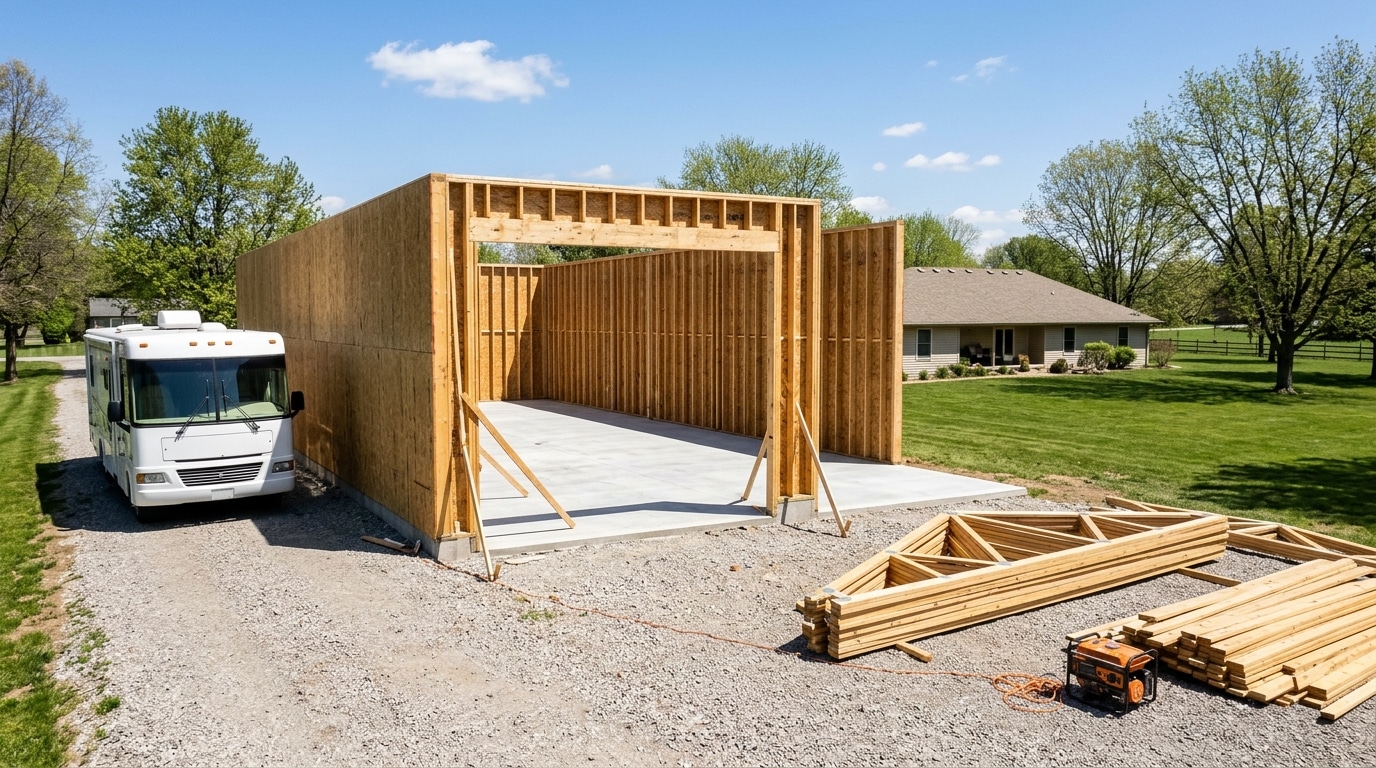
A dedicated RV garage costs $50,000 to $160,000 to build, based on HomeGuide figures updated January 21, 2026. The wide range reflects structural requirements that a standard two-car garage never faces:
- Depth: At least 40 to 50 ft to fit most motorhomes and fifth wheels.
- Ceiling height: 12 to 14 ft of clearance.
- Foundation, framing, and roofing: Scaled to those dimensions, which drives up materials and labor hours well beyond a standard two-car build.
- Utilities: Power hookups and sewer line connections can add further cost on top of the base build.
Before committing to a custom build, whether an RV fits in a standard garage is worth checking first.
Permits and Site Preparation for a Large Garage
In most US jurisdictions, structures above a certain square footage require a full building permit, and fees are typically calculated as a percentage of construction value. A large RV garage can therefore carry significant permit costs.
Site grading, drainage, and utility connections are pre-construction costs that rarely appear in contractor quotes or kit pricing. If the building site slopes or has drainage issues, grading adds to the timeline and the budget. Utility connections for power and water are priced separately from the structure itself.
Does a Home RV Garage Add Resale Value?
An RV garage adds home value for buyers who want one. It may not appeal to buyers who do not own a large vehicle, which limits the pool of interested buyers at resale.
As a general principle, the build cost is rarely fully recovered at resale. A large RV garage may yield a modest home value increase rather than a dollar-for-dollar return. If you plan to stay in the property for many years and use the structure regularly, the utility justifies the cost. If your timeline is shorter, that calculation changes.
The Hidden Costs That Push Real Projects Over Budget
A contractor quote or kit price typically reflects the structure itself. It rarely reflects everything that has to happen before and after the build. The longer-term picture also includes how enclosed and outdoor storage compare over time. Here are the cost variables most estimates leave out:
- Land: If you do not have a suitable site on your current property, land acquisition is the first line item, and in some markets it can exceed the construction cost.
- Site preparation and grading: Leveling and draining a build site costs money that does not appear in a structural quote.
- Building permits and inspection fees: These scale with construction value and vary by jurisdiction, so they belong in the budget from the start.
- Foundation: Requirements vary significantly by soil type and frost depth. A frost-depth footing in a northern climate requires deeper excavation and more concrete than a slab-on-grade in a Sun Belt state.
- Utility connections: An electrical panel upgrade, water line, or sewer connection each carries its own contractor and permit cost.
- Property tax reassessment: Adding a structure triggers a reassessment in many jurisdictions. The resulting tax increase is an ongoing annual cost, not a one-time expense.
- Homeowners insurance adjustment: A new structure raises your insured replacement value and your premium.
These costs are real and cumulative, and they can add tens of thousands of dollars to a project priced at $30,000 to $50,000 on paper. The comparison to renting only makes sense if you are comparing the true all-in build cost, not just the contractor estimate.
DIY Garage Builds: What You Can and Cannot Do Yourself
Labor is roughly half of total garage construction cost, so owner-building has real savings potential. But most jurisdictions require licensed subcontractors for electrical wiring and plumbing even on owner-permitted projects.
Pulling permits and acting as your own general contractor is possible in most states for a residential outbuilding. Confirm your local rules before assuming you can self-perform everything. The savings are real on framing, but the licensed-trade requirements put a floor under how low the total can go.
Renting Indoor Vehicle Storage: What It Costs Per Year
Before the comparison makes sense, you need a concrete number for the rental side. RecNation, which operates 70 vehicle storage facilities across the US, lists indoor garage spaces for RV storage and other vehicles at the rates below, as of October 2026. Prices vary by location, size, and availability, and since these figures are industry estimates, it helps to confirm current rates with the specific facility.
Converted to annual figures, the indoor garage rates look like this:
- Most indoor garage spaces: $114 to $216 a month, or $1,368 to $2,592 a year.
- Largest indoor spaces: Up to about $701 a month for a 15 x 50 ft space, or up to about $8,412 a year.
- Online booking: Web rates run about $20 a month below standard rates, so booking online reduces that total.
For owners whose vehicle does not require full enclosure, the other storage types cost less, as of October 2026:
- Outdoor uncovered: About $57 to $183 a month.
- Covered canopy: About $99 to $351 a month.
Depending on what you store, these pages are useful next steps:
- Protection tiers: For the full picture across protection tiers, vehicle storage costs goes into more detail.
- Boats on a trailer: If you are storing a boat on a trailer, boat storage is the place to start the same comparison.
- RVs: For RVs specifically, spaces start at 20 ft and scale up to accommodate full-size motorhomes and fifth wheels.
What to Ask Before Signing a Storage Contract
It helps to work through these questions before committing to a storage facility:
- Minimum contract length: Is the lease month-to-month, or is there a required minimum term?
- Space dimensions: Does the specific space fit your vehicle’s footprint, including height for taller RVs and length for longer boats on trailers?
- Access policy: What are the access hours, and do they fit how often you plan to retrieve the vehicle?
- Power availability: Power hookups are not universal, so if you need a connection for battery maintenance or shore power, confirm it is available at the specific space.
- Insurance requirements: Some facilities require the tenant to carry insurance on the stored vehicle, so confirm what coverage is required before signing.
Build vs Rent: A Side-by-Side Comparison
Here is what the comparison looks like in practice. A $50,000 RV garage equals approximately six years of top-end indoor storage rent at $8,412 a year. That is an estimate, and it does not include land, permits, insurance adjustments, or ongoing upkeep. On the rental side, RV storage costs breaks down the full range by space type.
If a covered-but-not-enclosed middle option appeals, carport vs garage compares the trade-offs between protection levels. The table below compares building and renting factor by factor:
| Factor | Building a Garage | Renting Indoor Storage |
| Upfront cost | $14,400 to $160,000 (structure only) | No construction cost |
| Ongoing monthly cost | Property taxes, insurance, maintenance | $114 to $701 a month (as of October 2026) |
| Flexibility | Fixed to the property | Varies with lease terms, such as month-to-month or a longer commitment |
| HOA or zoning constraints | May prohibit prefab or limit structure size | No impact on your property |
| Maintenance responsibility | Owner’s responsibility | Not your responsibility |
| Suitability | Best for multiple vehicles and long-term use | Best for a single vehicle or a flexible timeline |
Renting typically makes more sense when:
- Your ownership horizon is shorter than the break-even point
- HOA restrictions or lot size rule out a build
- Your budget is better deployed elsewhere right now
- You may change vehicles and need a different space size
Building typically makes more sense when:
- You own the property long-term and have a suitable site
- You store multiple vehicles and use them frequently
- You need daily or near-daily access that a facility cannot provide
- You are on a rural property with space and no HOA constraints
Neither option is universally better. The right answer depends on how long you will own both the vehicle and the property.
The Costs Building Estimates Leave Out
The break-even math shifts once you add the costs that never appear in a contractor quote. Permits, land, foundation upgrades, insurance increases, and annual maintenance can add substantially to a build priced at $50,000 on paper. That means the six-year break-even estimate above is a floor, not a ceiling.
Ready to Protect Your Vehicle Without the Construction Commitment?
If you are weighing a build against a rental and are not ready to commit to a six-figure construction project, RecNation offers indoor vehicle and car storage at 70 locations across the country, with spaces sized for everything from a compact car to a full-size motorhome. It is a practical way to protect your vehicle on a flexible timeline while you decide what permanent infrastructure, if any, makes sense for your property.
Frequently Asked Questions
What is the average cost to build a 2-car garage?
A two-car detached garage typically costs $20,000 to $57,600 to build, based on HomeGuide figures updated January 21, 2026. A 20 x 20 ft footprint runs $20,000 to $40,000, while a 24 x 24 ft build runs $28,800 to $57,600. Because labor is roughly half of the total, local wages and the condition of the building site largely decide where a project lands in that range.
Is it cheaper to build an attached or detached garage?
An attached garage is generally less expensive to build than a detached one because it shares a wall with the house, which reduces framing and foundation costs. Detached garages are more common for large vehicles like RVs and boats because they can be sized and positioned independently of the home’s footprint. The cost gap depends heavily on size, foundation requirements, and local labor rates.
Do I need a permit to build a garage?
Most US jurisdictions require a building permit for a detached garage above a certain size, and fees are typically a percentage of construction value. Starting work without one can create problems at resale or when filing an insurance claim, so it helps to confirm requirements with your local building authority first.
How much does it cost to build an RV garage?
A dedicated RV garage typically runs $50,000 to $160,000, based on HomeGuide figures updated January 21, 2026. The range is wide because the building has to be at least 40 to 50 ft deep with 12 to 14 ft of clearance, and extras such as power hookups and sewer connections can raise the total further.
How long does it take to build a garage?
A standard detached garage typically takes four to eight weeks to build once permits are approved and materials are on site. Permitting, weather, and contractor availability can stretch the construction timeline to several months in practice, and a prefab kit can go up faster but still needs a foundation and local approval before work begins.
Is renting a storage unit cheaper than building a garage?
Renting is typically cheaper in the short to medium term because it avoids a large upfront capital cost. At the top-end indoor rate of about $701 a month as of October 2026 (prices vary by location and availability), rent runs roughly $8,412 a year, so a $50,000 RV garage takes about six years to break even before land, permits, insurance, and upkeep are counted. For owners on a shorter horizon or with HOA or lot constraints, renting is typically the more cost-effective path.