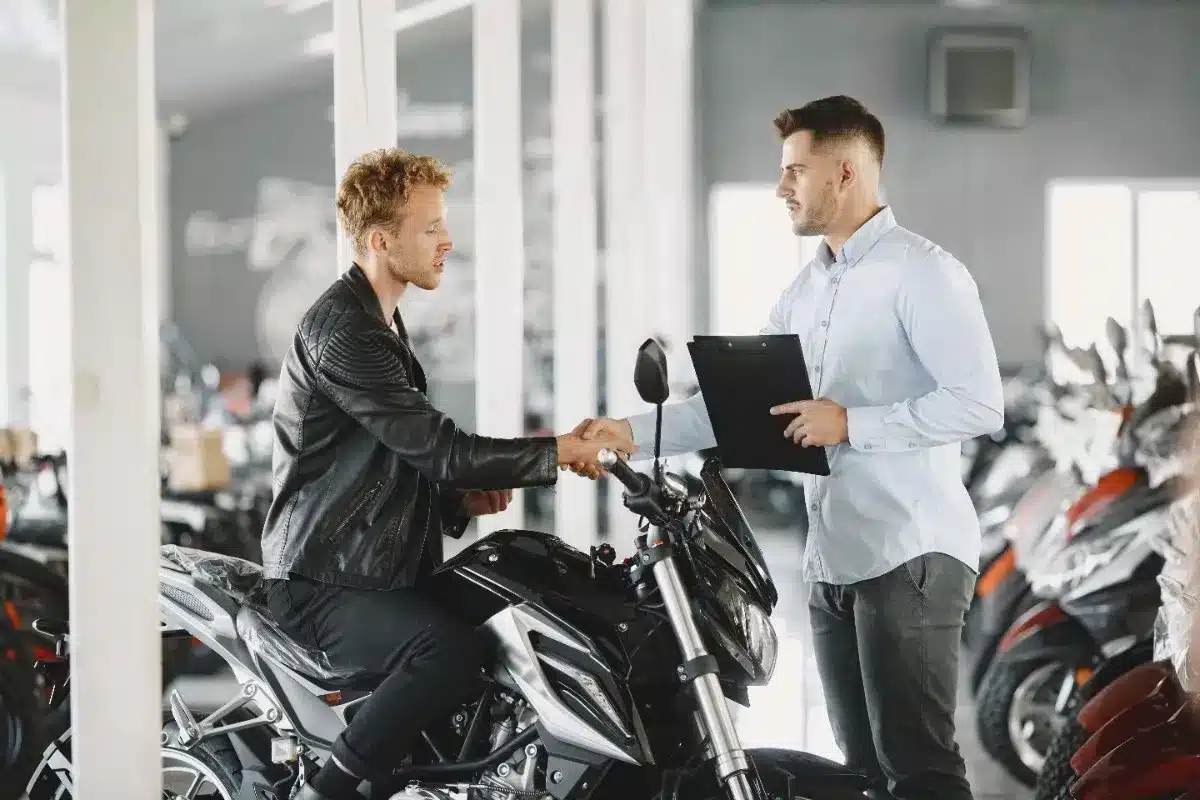
No U.S. state requires a motorcycle license to purchase a motorcycle, but what you can do next depends entirely on where you live.
Buying is legal. Registering, insuring, getting the bike home, and riding it are four separate questions with four different answers. Most guides stop once they confirm the purchase is fine, which is exactly where the confusion starts. This one covers all four steps, with links to the official registration sites for Arizona, California, Florida, Kansas, Missouri, South Carolina, Tennessee, and Texas.
This is general information, not financial advice.
Buying vs. Registering vs. Insuring vs. Riding: Four Different Rules
These four actions get treated as one decision by most buyers, but they are governed by completely different rules. The table below separates them so you can see which step you can take without a license.
| Action | License Required? | Notes |
| Buying | No | No state requires a motorcycle license to purchase. Dealerships will not ask for one. |
| Registering | Varies by state | Many states accept a standard driver’s license plus proof of insurance. Some require a motorcycle endorsement. See the state table below. |
| Insuring | No | Policies are available for unlicensed owners. A licensed household member is often listed as the primary operator. |
| Riding on public roads | Yes, in every state | Riding without a valid motorcycle license or learner’s permit is illegal on public roads in all 50 states, per the National Highway Traffic Safety Administration (NHTSA). |
Financing adds a separate layer. Most institutional lenders, including banks, credit unions, and original equipment manufacturer (OEM) financing arms, require a valid driver’s license for loan underwriting. That is a lender requirement, not a Department of Motor Vehicles (DMV) rule. Cash buyers and private lenders face fewer obstacles.
What About a Learner’s Permit?
With a learner’s permit, you can ride a motorcycle on public roads, but only under set conditions. Most states limit you to daylight hours, no passengers, and no freeways.
A permit is a step toward licensing, not a substitute for the full motorcycle endorsement. Because each state sets its own limits, it helps to check your state’s official site for the details.
State-by-State Registration Rules
Registration requirements are set by state motor vehicle agencies, not federal law, and they differ on licensing, insurance, and permit riding. State rules change, so it helps to check the official site for your state before you buy. The official sites for Arizona, California, Florida, Kansas, Missouri, South Carolina, Tennessee, and Texas are linked below.
| State | Official Source |
| Arizona | Arizona Motor Vehicle Division (MVD) |
| California | California DMV |
| Florida | Florida Department of Highway Safety and Motor Vehicles |
| Kansas | Kansas Division of Vehicles |
| Missouri | Missouri Department of Revenue |
| South Carolina | South Carolina DMV |
| Tennessee | Tennessee Department of Revenue |
| Texas | Texas DMV |
What If Your State Is Not Listed?
For all other states, the American Association of Motor Vehicle Administrators (AAMVA) state DMV directory is the place to find your state’s official motor vehicle site. It helps to confirm the rules before you buy.
How to Get a Motorcycle Home Without a License
You cannot legally ride a newly purchased motorcycle home on public roads without a valid motorcycle license or learner’s permit. That leaves three practical options, listed from easiest to least convenient:
- Trailer transport: Rent or borrow a motorcycle trailer and tow the bike home using any licensed driver. This is the simplest option and the one most buyers use.
- Professional delivery: Many dealerships offer delivery directly to your address or storage facility. Independent motorcycle transport companies also operate in most markets if you are buying from a private seller.
- A licensed rider takes it home: A friend, family member, or hired licensed rider can ride the motorcycle from the point of sale to wherever you plan to keep it. The bike must be insured before anyone rides it, so it helps to arrange coverage first.
It helps to confirm logistics before you finalize a private purchase, since the seller may not be willing to hold the motorcycle while you arrange transport.
Test Rides Before You Buy
Dealerships cannot legally let you test-ride a motorcycle without a motorcycle license or learner’s permit. Bring a licensed rider along to put the bike through its paces for you before you commit to the purchase.
Can You Register a Motorcycle Without a License?
Whether you can register a motorcycle without a license depends on your state, so it helps to confirm with your state’s official site. Many places require proof of insurance at registration, which means securing at least a storage or non-rider policy before visiting the DMV is a smart first step.
Unlicensed owners often find that vehicle storage and registration decisions go hand in hand, since the registered address and the storage location both need to be sorted before the bike goes on the road.
Insuring a Motorcycle Before You’re Licensed
Getting a quote or a policy is possible without a motorcycle license. Common options include:
- Licensed household member: List them as the primary operator.
- Storage or comprehensive-only policy: Covers theft and damage while the bike sits unused.
- Insurer for unlicensed owners: Some insurers write policies for unlicensed owners with named exclusions.
Coverage options vary by insurer and state, so contacting multiple carriers is worth doing before you settle on one.
Storing a Motorcycle While You Get Licensed
Getting a motorcycle license typically involves a written knowledge test, a skills test, and in most states a state-approved safety course. The full process takes several weeks depending on course availability and DMV scheduling. During that time, the motorcycle needs to be protected and maintained, not sitting on your driveway deteriorating.
Before putting the bike into storage, these steps keep it in shape:
- Fuel stabilizer: Add fuel stabilizer to a full tank and run the engine briefly to circulate it. This prevents varnish buildup in the carburetor or fuel injectors during a long idle period.
- Battery maintenance: Connect a trickle charger or battery tender to prevent discharge. A dead battery left for months can fail permanently.
- Tire pressure: Inflate tires to the manufacturer’s recommended pressure. Under-inflated tires develop flat spots when a motorcycle sits in one position for weeks.
- Cover or enclosure: If the bike will be outside, use a motorcycle cover rated for UV and water resistance. Enclosed storage eliminates this concern entirely.
For more on the mechanical risks of extended downtime, see how long bikes can sit unridden before you decide how much preparation is enough.
RecNation’s motorcycle storage facilities across 50+ locations offer covered and enclosed options that keep the bike protected and secure until you are ready to ride. If you cannot keep the motorcycle in a garage, or do not want it sitting exposed in a driveway while the licensing process plays out, a dedicated storage space solves that problem.
How Long Does It Take to Get a Motorcycle License?
The written knowledge test can usually be scheduled within a few days of deciding to start. A state-approved motorcycle safety course, which most new riders need to complete, often has wait times of several weeks depending on local availability.
From the moment you begin the process to holding a valid endorsement, most riders are looking at two to eight weeks. It helps to check your state DMV for current scheduling and course availability, as wait times shift throughout the year.
Steps to Get Your Motorcycle License
The general licensing path is consistent across most U.S. states, though specific requirements vary. Here is the standard sequence:
- Pass the written knowledge test: Do this at your state DMV to obtain a motorcycle learner’s permit, which allows you to operate a motorcycle on public roads under permit restrictions.
- Complete a state-approved motorcycle safety course: The Motorcycle Safety Foundation (MSF) Basic RiderCourse is accepted in most states and covers both classroom and on-cycle instruction.
- Pass the on-cycle skills test: Take it at the DMV, or use course completion to waive it where your state permits. Many states allow MSF graduates to skip the DMV road test.
- Apply for the motorcycle endorsement: Bring proof of course completion, your permit, and the required fees to the DMV. Your standard driver’s license will be updated with the motorcycle endorsement.
Some states require the safety course; others make it optional but offer incentives such as insurance discounts or fee waivers. It helps to check your state DMV for current requirements before you plan your timeline.
Do You Need a Motorcycle Safety Course?
The MSF Basic Rider Course is widely accepted, and in many states it waives the DMV skills test for new applicants. Some states mandate it as part of the endorsement process; others make it optional.
Either way, completing a motorcycle safety course before your first real-road ride is one of the most effective things a new rider can do. It helps to confirm with your state DMV whether the course is required and whether it allows you to skip the separate DMV skills test.
Final Thoughts
Buying a motorcycle before you are licensed is legal, but registration, insurance, and transport each follow their own rules. Sorting those out early keeps the purchase simple.
Once the bike is yours, it still needs a safe place to sit while you work through the permit, the safety course, and the DMV queue. RecNation motorcycle storage offers covered and enclosed spaces sized for motorcycles across 50+ facilities in Arizona, California, Florida, Kansas, Missouri, South Carolina, Tennessee, and Texas. Your bike stays protected and off your driveway until your endorsement arrives.
Frequently Asked Questions
Can you register a motorcycle without a motorcycle license?
Many states let you register a motorcycle with just a standard driver’s license and proof of insurance, so a motorcycle license is not always required. Some states do want an endorsement before they will title the bike. Your state’s motor vehicle agency website lists the current rules, and checking it before you buy saves you a surprise at the counter.
Can you get motorcycle insurance without a license?
Motorcycle insurance for an unlicensed owner is available from most major insurers, usually by listing a licensed household member as the primary operator or by issuing a storage-only or comprehensive policy. Terms and availability vary by insurer and state, so comparing several carriers shows what applies.
Can you finance a motorcycle without a license?
Financing a motorcycle without a driver’s license is difficult because banks, credit unions, and manufacturer financing programs typically require one for identity verification and underwriting. That requirement comes from the lender, not the DMV, so cash purchases or private financing are the more common routes for unlicensed buyers.
Can you ride a motorcycle on private property without a license?
Riding a motorcycle on private property without a license is generally outside state DMV licensing laws, which cover public roads. Local ordinances, homeowners association (HOA) rules, or an insurance policy’s terms can still limit where and how you ride, so it helps to check them first.
Do you need insurance if you only plan to store the motorcycle and not ride it?
Insurance is typically still needed for a stored motorcycle because most states require proof of coverage to complete registration. A storage or comprehensive-only policy also protects against theft, fire, and weather damage while the bike sits unused, which matters most for buyers waiting out the licensing process.


