Boat trailer storage means keeping your boat on its trailer in a rented space at a dedicated facility, and that space is priced by the combined length of the boat and trailer together. Sizing by hull length alone leads to booking the wrong band or paying for room you don’t need. This guide covers how to measure your rig correctly, which size band you need, what outdoor, canopy, and indoor storage each cost, and how to find a facility that fits your boat.
How Boat Trailer Storage Actually Works
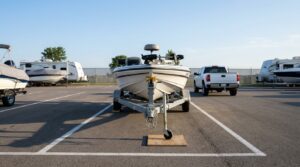
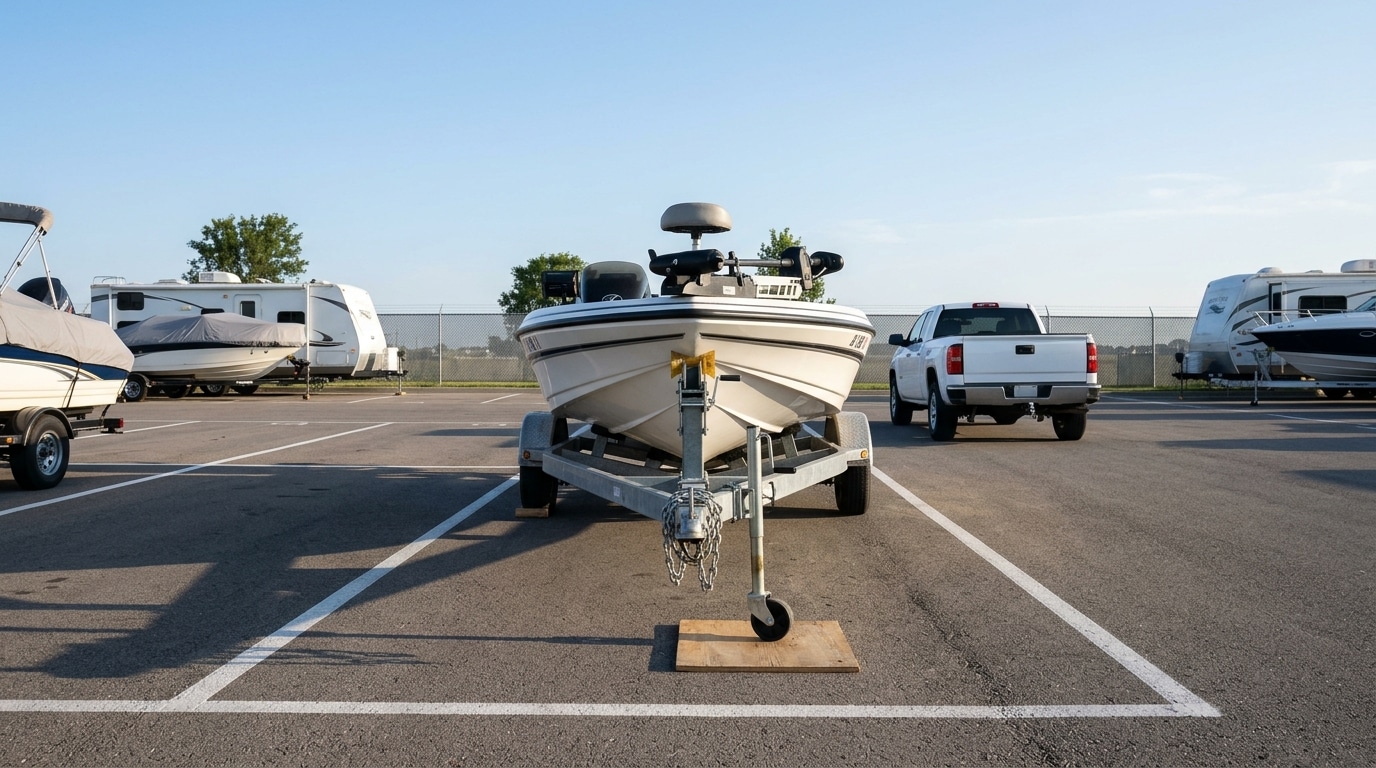
At a dedicated outdoor storage facility or gated storage facility, the boat never leaves its trailer. You drive the rig in, unhitch the vehicle, and the boat-and-trailer combination sits as a single unit in its assigned space. The facility charges you for the full footprint of that combined rig, not the hull length listed on your registration.
That distinction matters when you pick a space. A manufacturer’s listed length measures the hull only, and the trailer adds real length at the tongue and the winch post. A boat listed at 18 feet, for example, may need a 21-to-23-foot space once the trailer tongue is counted.
The table below maps common boat types to the space band they typically need once the trailer is counted.
| Boat Type | Typical Space to Rent |
| Jet ski / personal watercraft | Up to 20 ft (select locations) |
| Jon boat / small aluminum fishing boat | Up to 20 ft (select locations) |
| Bass boat / bowrider / smaller pontoon | 20 to 30 ft |
| Larger pontoon / cruiser / cuddy cabin | 30 ft and over |
Why the Trailer Tongue Changes Your Space Requirement
The trailer tongue is the steel arm that connects the trailer to your tow vehicle’s hitch. For a small boat, the tongue and winch post typically add 3 to 5 feet beyond the bow.
A bass boat listed at 20 feet on a standard roller trailer, for example, is likely to need a space in the 23-to-25-foot range once the tongue is counted. Measure from the front of the trailer coupler to the back of the motor or transom, then add a few inches of buffer. That is your true storage footprint, and it is the number to bring when you contact a facility.
Empty Trailer Storage vs. Boat-and-Trailer Storage
Most facilities rent boat-and-trailer spaces as the standard unit. Standalone empty trailer storage is a narrow exception, available only at the Ruskin, FL location. If you are storing a boat, plan on the combined rig as one unit.
Which Size Band Do You Need?
Facilities that specialize in RV and boat storage typically organize spaces into three bands. Matching your measured rig to the right storage unit size before you call saves time and avoids showing up with a rig that won’t fit.
The right space size for a boat depends on that combined length, and the three bands below show where common boat types land.
The Three Size Bands
Each band below lists the boat types that typically land in it. For each one, add 3 to 5 feet to your boat’s listed length before you choose a space.
- Up to 20 feet (select locations): This band covers jet skis on a single-axle trailer, jon boats, and small aluminum fishing boats. Not every facility carries this band, and it is available at select locations only.
- 20 to 30 feet: Bass boats, bowriders, center consoles in the mid-range, and smaller pontoons typically land here. A 20-foot bass boat with tongue added is likely to need a 23-to-25-foot space in this band.
- 30 feet and over: Larger pontoons, cruisers, cuddy cabins, and center consoles at the upper end of the size range fall into this band. If your hull is in the upper 20s, adding 3 to 5 feet for the trailer puts you near or past 30 feet.
What "Total Length" Means on a Storage Contract
Spaces are rented by the total length of the boat on its trailer. Some facilities measure tongue to transom while others measure only the hull, so it helps to ask which method applies when you book. Arriving with a rig that runs 2 feet longer than the contracted space creates a real problem on drop-off day.
Measuring Your Rig Before You Book
It helps to work through these two steps in order before you contact any facility:
- Hitch the trailer to your tow vehicle, then measure from the front of the trailer coupler (not the hitch ball) to the back of the outboard motor or transom.
- Add a few inches of buffer to that measurement.
That final number is what you give the facility when asking about available space.
Outdoor, Canopy, or Indoor: Choosing the Right Storage Type
The right storage type depends on how often you use the boat, how long it will sit between trips, and what your budget allows. The table below summarizes monthly storage rates by storage type, and the ultimate boat storage guide goes deeper on the full trade-off.
| Storage Type | Protection Level | Monthly Rate Range (Oct 2026) |
| Outdoor uncovered | Basic | $57 to $183 (most $78 to $126) |
| Outdoor canopy (covered) | Moderate | $99 to $351 (most $108 to $239) |
| Indoor garage | Highest | $114 to 701 for 15 x 50 ft |
All figures are industry estimates as of October 2026, and prices vary by location, size, and availability, so it helps to confirm current rates with the specific facility. Online web rates run about $20 a month below standard rates, and not every location offers all three storage types.
When Outdoor Storage Is Enough
An outdoor uncovered space at an outdoor storage facility suits owners who use their boat regularly through the season, typically monthly or more. The lower monthly storage rate is the trade-off for direct sun and weather exposure. A quality, fitted boat cover and periodic maintenance checks help reduce that exposure risk for active boaters.
When to Upgrade to Covered or Indoor Storage
Four situations tend to justify the higher monthly rate of covered storage units or an indoor space:
- Long off-season: Long-term boat storage stretching six months or more benefits from covered storage units or an indoor space.
- Strong sun exposure: Climates with strong ultraviolet (UV) exposure accelerate fading on upholstery and gelcoat.
- Sensitive cockpit features: Cockpits with upholstered seating, digital instrument clusters, or canvas enclosures degrade faster without shade.
- Hurricane season: In hurricane-prone coastal markets, indoor or canopy storage adds a meaningful layer of protection during storm season.
Marina dry storage is a different model available in some coastal markets, separate from trailer-based storage at a gated storage facility.
What to Check Before You Sign a Storage Agreement
Before you commit to a space, it helps to confirm these points with any facility. Having answers to each one before signing a storage rental agreement can prevent common friction points after move-in.
It helps to know the safest places to park a trailer in case a facility has no space, and the trailer anti-theft guide is a useful companion for securing the rig and judging a facility’s security features.
- Total space length vs. your measured rig: Confirm whether the facility measures tongue to transom or hull only, and that your measured total fits within the contracted space.
- Access hours: Ask whether hours match your boating schedule. A facility that closes before you typically return from a full day on the water creates a recurring problem.
- Proof of insurance: Ask whether the lease requires proof of insurance on the boat or the trailer.
- Fuel policy: Ask whether the facility has any rules about fuel in the tank before you arrive with a full tank, since many facilities restrict it.
- Gate access type: Keypad, mobile app, and staff-manned gates all differ in convenience. It helps to know what you are getting before you sign.
- Lease terms: Confirm whether month-to-month and longer-term leases are both available, and what the notice period is to end a month-to-month agreement.
If you plan to use a hitch lock or coupler lock while the trailer is stored, locking a trailer is worth a look first.
Insurance Questions to Ask Before You Store
Standard boat insurance policies vary in what they cover once a vessel is off the owner’s property. Some policies include storage insurance coverage while the boat sits at a commercial facility. Others require an endorsement specifically for off-premises commercial storage. It helps to confirm with your insurer before signing the storage rental agreement, and to ask the facility what liability coverage, if any, it carries for stored vehicles.
Preparing Your Boat Before Drop-Off
Most facilities expect the boat to be reasonably ready for extended storage before it arrives. The short version of preparing a boat for storage: flush the engine for outboards used in salt water, drain livewells and baitwells completely, disconnect the battery, and remove food, valuables, and anything that will attract pests.
Winterizing a boat trailer during cold-weather layup adds a few steps on the trailer itself. It helps to check tire inflation before the rig sits for months, as tires can flat-spot during extended stationary storage, and to lubricate wheel bearings before the layup period begins.
Where to Find Boat Trailer Storage Near You
Three practical variables narrow the field when you are comparing facilities: proximity to the launch ramp or marina you use most, access hours that fit your schedule, and confirmed availability in the size band your rig requires.
RecNation operates 70 locations across eight states and sizes boat storage spaces by the combined length of trailer and boat, covering all three size bands at participating locations.
When you are ready to rent, bring your trailer’s total measured length, proof of registration for the boat and trailer, and your preferred lease term. If you are still weighing where else a trailer can go, such as a driveway limited by homeowners association (HOA) storage restrictions, where to park your trailer is a helpful first read.
Proximity to Launch Ramps and Marinas
Owners who boat regularly prioritize a facility within a short drive of the ramp they use. Storing close to the water reduces pre-trip setup time and makes it realistic to get the boat out on a weekday morning without a long detour.
Availability and Size Band Limitations to Know
The under-20-foot band and covered options are not universal, and availability varies by facility. Because RV and boat storage facilities differ in the spaces they carry, checking online before you visit is the fastest way to confirm the space type and size you need.
Ready to Find Boat Trailer Storage?
The space you rent follows the combined length of the boat and trailer, so measuring tongue to transom is the step that keeps every other decision on track.
If you’re ready to find a space for your boat and trailer, RecNation boat storage offers outdoor, canopy, and indoor options across 70 locations in eight states, with spaces sized by the combined length of your rig. Use the location finder to check availability in your area and confirm the right size band before you arrive.
Frequently Asked Questions
How much does it cost to store a boat trailer per month?
Monthly boat trailer storage costs depend on the storage type: as of October 2026, outdoor uncovered spaces run roughly $57 to $183, canopy spaces about $99 to $351, and indoor garage spaces about $114 to $216 for most sizes. Prices vary by location, size, and availability, and online rates typically run about $20 a month lower than standard rates.
What size storage space do I need for a boat and trailer?
Choose a boat-and-trailer space by the combined length of the trailer and boat, not the hull length. For a small boat, add 3 to 5 feet to the hull length, then match the total to a band: up to 20 feet at select locations, 20 to 30 feet, or 30 feet and over.
Can I store my boat on its trailer in a regular storage unit?
Standard self-storage units are generally too low or narrow for a boat on a trailer, and many prohibit vehicles with fuel in the tank. Dedicated outdoor, canopy, or drive-through indoor spaces at a vehicle storage facility are the standard solution, as they are built for the full height, length, and width of a boat-and-trailer rig as a single unit.
Is outdoor or indoor storage better for a boat trailer?
Outdoor storage is better for a boat that gets regular use, while indoor or canopy storage is better for a boat that sits through a long off-season or in a high-exposure climate. Outdoor uncovered spaces cost less, and the extra monthly cost of covered or indoor space is most worthwhile for six or more months of storage or in a hurricane-prone coastal market.
What is the best way to store a boat trailer long term?
The best approach is to prep both the boat and the trailer before drop-off: flush and fog the engine, drain livewells and baitwells, disconnect the battery, and protect upholstery from UV damage. On the trailer, check tire inflation to prevent flat-spotting and lubricate the wheel bearings, and a dedicated gated storage facility typically reduces UV exposure and theft risk compared with a driveway over a full off-season.
Do I need insurance to store a boat at a storage facility?
Many facilities require proof of insurance on the boat, and sometimes on the trailer, before you can rent a space. Because off-premises coverage varies by policy, it helps to ask your insurer whether an endorsement is needed for commercial storage, and to ask the facility what liability coverage, if any, it carries for stored vehicles.