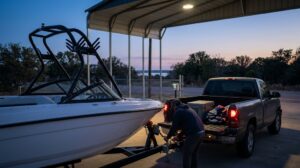
Allen, Texas, boat owners looking for storage near Lavon Lake will find their best options along the Wylie/Parker Road corridor. This stretch sits roughly halfway between Allen and the lake’s main access points. For most active boaters in the area, staging the boat closer to the water than to home is the right call.
The corridor between Wylie and St. Paul has multiple covered, enclosed, and open outdoor options, all within a few miles of the lake’s eastern ramps. This article covers where those options sit, which ramps they serve, and what you need to know about permits, registration, and insurance before you sign a lease.
Why Allen Owners Store Near the Lake Instead of at Home
The drive from Allen to Lavon Lake’s primary eastern access points runs 25 to 30 miles depending on the ramp. Towing a boat through Allen’s suburban streets at 6 a.m., setting up at the ramp, and then reversing the whole trip after a day on the water adds up fast. Storing your boat at a vehicle storage facility on the Wylie corridor instead cuts that morning haul to under 10 minutes and saves real wear on your tow vehicle and trailer over a season.
A closer staging point also means earlier water time on busy weekends. Launch queues at Lavon’s popular ramps build quickly on spring and summer mornings. A boater leaving from storage near the lake will beat that line, while someone trailering from Allen is likely still on 75.
The HOA Factor for Allen Residents
Many Allen neighborhoods have homeowners association (HOA) rules that prohibit storing a boat in the driveway or on the street. For those owners, off-site storage near the lake solves two problems at once: it removes the HOA compliance headache and puts the boat in a better position for regular use.
Lavon Lake Access Points Allen Boaters Actually Use
Lake Lavon is managed by the U.S. Army Corps of Engineers, Fort Worth District, which oversees public access, ramp locations, and recreational use on the reservoir. For Allen-side residents, the eastern and southern access points are the most practical, and two ramps in particular account for most of the traffic.
Collin Park Marina and East Fork Park
Two launch points account for most of the Allen-area boat traffic on Lavon Lake, and which one you’re closer to changes your morning by a meaningful margin.
- Collin Park Marina: Sits on the southern end of Lavon Lake and is the most heavily used launch point for Allen-area boaters. Offers a multi-lane boat launching ramp, parking for rigs, and marina amenities.
- East Fork Park: Located on the lake’s eastern side, this ramp serves as an alternative option, particularly useful when Collin Park’s lanes are backed up on busy weekend mornings.
A storage facility on the Wylie/Parker Road corridor puts you roughly 5 to 10 minutes from both access points. Trailering from Allen directly adds 25 minutes or more to that same run, a gap that compounds quickly across a full boating season.
Launch Permit Requirements
The U.S. Army Corps of Engineers operates the public ramps and parks on Lavon Lake directly and charges a day-use fee at most launch points, with an annual pass available as an alternative to paying per visit.
Fees and pass requirements change seasonally, so verify current requirements directly with the Army Corps before your first outing each year. Do not assume the fee structure or pricing from a prior season still applies.
Boat Storage Options Near Lavon Lake: What’s Available
Facilities along the Wylie/Parker Road corridor also serve recreational vehicles (RVs), offering the same three standard tiers for RV and boat storage: fully enclosed indoor storage, covered outdoor storage, and open outdoor storage. The right tier depends on your boat’s size, how often you use it, and how much North Texas weather exposure you’re willing to accept.
Enclosed (Indoor) Boat Storage
Protection: Puts your vessel inside a fully enclosed structure, shielded from UV exposure, rain, hail, and most theft opportunities.
Best for: Higher-value watercraft, larger boats that are difficult to cover adequately outdoors, and owners who prioritize maximum hull protection over the storage period.
Availability: Limited near Lavon Lake compared to the other tiers, especially for climate-controlled units, which fill well before spring. Reserve early if this is the tier you need.
Covered Outdoor Boat Storage
Covered boat storage is the most widely available middle-ground option along the Wylie corridor.
- Protection: A carport-style roof keeps UV and rain off the hull while leaving the unit open on the sides.
- Best for: Most Allen-area boat owners. Covered storage handles North Texas summer sun and most rain events well enough to protect the boat between outings, without paying for full enclosure.
- Hail consideration: Reduces, but doesn’t eliminate, hail exposure compared to open outdoor parking. If a major storm system is in the forecast, a good-quality boat cover adds a meaningful layer of protection under the canopy.
Open Outdoor Boat Storage
- Protection: None, full exposure to hail, UV, and rain.
- Best for: Owners who use their boat frequently throughout the season and keep it under a quality cover.
- Insurance note: Owners choosing this tier near Lavon Lake should confirm their watercraft insurance covers hail damage at an off-site storage location specifically.
Monthly storage rates vary by facility, unit size, and storage type. Many corridor facilities offer 24-hour access storage, which matters for anyone launching at first light. Contact facilities along the Wylie corridor directly for current pricing rather than relying on online estimates, which can be outdated.
Who’s Actually on This Corridor
A handful of operators anchor the Wylie/St. Paul stretch. Carefree Covered RV & Boat Storage, at 3830 Parker Road, is the largest by far, with roughly 500 covered and fully enclosed spaces and a second nearby lot it added in 2025 after its original site filled up. Wylie Bargain Storage & RV/Boat, a quarter mile up the same road at 3151 Parker, is the budget option, with covered parking priced below the corridor average. C&L Storage, on St.
Paul Road, is a smaller, family-run operation focused specifically on boat storage rather than splitting capacity across vehicle types. A few miles closer to the lake itself, Bee Line Storage in Lavon offers covered and outdoor spaces, though not enclosed.
Not everything marketed to Allen and Wylie boaters is actually on this corridor. Some facilities cast a wide service-area net that includes Allen and Wylie without being physically nearby, so confirm the actual address, not just the service list, before assuming a facility is the closest option.
Allen boat owners weighing these tiers can check what’s available at RecNation’s boat storage in Allen, the nearest facility, which offers covered and enclosed options designed for boats and other recreational vehicles.
Texas Boat Registration and What It Means During Storage
Many boat owners assume registration can lapse while the boat sits in paid storage over the off-season. Texas law says otherwise.
TPWD Certificate of Number (Boat Registration)
Under Texas Parks and Wildlife Code §31.021, all motorized vessels must maintain a current Texas Parks and Wildlife Department (TPWD) Certificate of Number regardless of whether the boat is actively on the water or sitting in a paid storage facility. Registration does not pause during off-season storage. Renewal is required every two years.
This isn’t just a technicality. If your boat needs to be moved, trailered for maintenance, or inspected at any point during the storage period, an expired registration creates immediate legal exposure. Check your current expiration date on the TPWD website before the boat goes into storage, and renew online if the certificate will expire before the next season.
Who Actually Insures Your Boat in Storage
Choosing the right storage tier is only half the off-season equation. Most boat owners assume a paid storage facility carries insurance that covers their vessel. That assumption gets expensive when something goes wrong.
What to Check on Your Watercraft Policy Before You Reserve
Storage facility insurance typically covers the physical property and structures, not the individual boats or equipment stored on site. If a hail storm damages your hull, a fire breaks out, or the boat is vandalized while in storage, the facility’s policy almost certainly will not pay your claim.
Your own watercraft or inland marine insurance policy is what protects the boat during off-site storage, but only if it includes off-premises coverage language. Before signing a storage lease, pull your policy and confirm the following:
- Off-premises coverage: Does the policy cover the vessel while stored at a third-party location?
- Insured value: Does the listed value match the boat’s current market value?
- Hail and theft: Does the policy cover hail damage and theft at a storage facility specifically?
Some gated storage facility operators require proof of insurance as a lease condition. Call your insurer before you reserve a unit to confirm coverage applies during the storage period, not after you’ve already signed.
Store Closer to the Water
Every extra mile back to Allen is time you’re not spending on the water, and every season without real protection is wear on the hull you can’t undo. If you’ve worked through the options above and want a storage setup that actually puts your boat within easy reach of Lavon Lake, RecNation boat storage in Allen is worth a look.
It specializes in vehicle storage, not converted self-storage units, with covered and enclosed options built for boats, so your hull, trailer, and gear get the protection they need between trips on the water. Check availability now; corridor units near the lake fill fast heading into spring.
Frequently Asked Questions
What is the closest boat storage facility to Lavon Lake for Allen residents?
The Wylie/St. Paul corridor along Parker Road is your best bet, most boat storage facilities serving Lavon Lake’s eastern access points cluster there. For Allen owners, this corridor sits roughly halfway between Allen and the lake, cutting the morning haul to under 10 minutes. Options include enclosed, covered, and open outdoor boat storage, though covered and enclosed units fill quickly ahead of peak season, so it’s worth contacting facilities directly and reserving early.
Do I need to keep my boat registered if it’s in storage in Texas?
Yes. Under Texas Parks and Wildlife Code §31.021, all motorized vessels must maintain a current TPWD Certificate of Number whether the boat is on the water or sitting in paid storage, registration doesn’t pause just because the boat isn’t in use. Texas boat registration renews every two years, so check your current expiration date on the TPWD website before the boat goes into storage for the season.
Is there covered or indoor boat storage available near Allen, Texas?
Yes. Multiple facilities along the Wylie/Parker Road corridor offer covered (carport-style, roofed) storage and fully enclosed indoor storage. Covered is the more widely available of the two and handles North Texas UV and most rain events well; enclosed offers maximum protection but has limited availability, so reserve well ahead of spring if that’s the tier you need.
Does the storage facility’s insurance cover my boat while it’s stored there?
In most cases, no. Storage facility insurance covers the physical property and structures, not individual boats or their contents. Your own watercraft or inland marine insurance policy is what protects the vessel during off-site storage, but only if it includes off-premises coverage, so review your policy and call your insurer to confirm before you sign a lease.
Can I store my RV and boat together at a storage facility near Allen, TX?
Many facilities in the Wylie area accommodate both RV and boat storage on the same property, though bay sizes vary, so confirm with the facility that it has space for both at your specific dimensions before assuming combo storage is available.
When should I reserve boat storage near Lavon Lake to guarantee a spot?
Late February or early March is the practical deadline if you want covered or enclosed storage near Lavon Lake for the spring and summer season. Facilities along the Wylie corridor fill up fast as boating season approaches, and open outdoor spaces go quicker than most owners expect, so if you stored the boat at home over the winter, don’t wait until April to start looking.