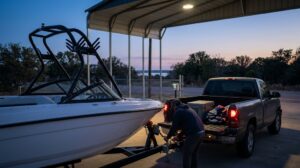
If hauling your boat back to Carrollton after every outing has started to feel like the worst part of owning one, you’re already thinking about this the right way. There are practical storage options between Carrollton and Lewisville Lake, and the right one depends mainly on how often you launch.
The three main formats to compare are marina slip rentals, covered land-based storage near the lake, and open outdoor storage. Each trades off differently on cost, convenience, and commitment, and the one that fits you depends on your typical use pattern.
Why Carrollton Owners Store Near the Lake Instead of at Home
From most Carrollton neighborhoods, Lewisville Lake access points in Denton County sit roughly 20 to 25 miles north via US-380 or FM 423. That’s not far, but a single outing can easily burn 45 to 90 minutes of round-trip tow time before you even count launch and retrieval.
Going out a few times a month during the season adds up to a real portion of your available weekend time, time you’re spending behind the wheel instead of on the water. Storing closer to the lake cuts that cost to nearly nothing. This isn’t only a boat consideration, either; owners of recreational vehicles (RVs) face the same math, so if you’re weighing RV and boat storage options near the lake instead of at home, proximity is usually the deciding factor.
The Time-Cost of Hauling from Carrollton
A typical Carrollton-to-Lewisville round trip with launch and retrieval can run two or more hours on a half-day outing. For owners who go out ten to fifteen times per season, that’s 20 to 30 hours a year spent behind the wheel of a tow vehicle instead of on the water. Storing near the lake reclaims that time entirely.
HOA and Driveway Restrictions in Carrollton
Many Carrollton subdivisions restrict or prohibit boat trailer parking in driveways and on residential streets. For those owners, off-site storage near the lake isn’t just a convenience upgrade. It’s the only practical option from the start.
The Three Main Storage Options Near Lewisville Lake
The format you choose will shape how quickly you get on the water, how much you pay, and how locked in you are. Here’s how each option actually works for a Carrollton owner making regular runs to the lake.
Marina Slip Rentals on Lewisville Lake
A marina slip keeps your boat in the water or on a lift, ready to go the moment you arrive. Launch logistics essentially disappear. That convenience is real, but it comes with trade-offs worth understanding upfront.
Cottonwood Creek Marina in Little Elm is the most prominent slip-rental option on Lake Lewisville, offering covered and open slips along with HydroHoist lift options. The catch is commitment: contracts run 12 months and are non-refundable, so the math only works if you’re launching often enough to justify locking in.
One thing surprises a lot of first-time slip renters: Lake Lewisville is a U.S. Army Corps of Engineers flood-control reservoir, and water levels can swing significantly depending on the season. Ask the marina directly how extended low-water periods affect lift and shallow-slip usability before you sign anything; it’s a reasonable question, and a good marina will have a real answer ready.
Covered and Enclosed Boat Storage Near I-35
Land-based boat trailer storage is where most Carrollton owners end up, and for good reason. Facilities near the I-35 corridor in Lewisville put you within 5 to 10 minutes of the lake’s main public ramps, which eliminates most of the hauling burden without locking you into an annual contract.
Covered boat and RV storage in this area spans a real range, from carport-style covered lots to fully enclosed, climate-controlled units sized for trailered boats, including larger vessels with wakeboard towers. That range matters because North Texas weather gives you two distinct things to protect against:
- UV exposure: Sustained summer sun degrades gelcoat, upholstery, and wiring on any boat left uncovered.
- Hail: A real, recurring risk in this region, not a rare event.
Covered storage units address both.
RecNation’s Carrollton facility offers covered and enclosed boat storage options sized for trailered vessels, with secure gated access and 24-hour availability. It’s a practical base for owners making regular runs to Lewisville Lake.
Open Outdoor Storage: The Trade-offs
Open, uncovered outdoor boat storage is the lowest monthly cost option near the lake, and for the right owner, it’s a genuinely reasonable one. If you’re launching most weekends and your boat is rarely sitting idle for more than a few days at a time, a quality fitted cover handles most of the exposure risk, and open storage is hard to beat on cost.
The trade-off shows up fast once that pattern breaks. North Texas summers are hard on any boat sitting uncovered for weeks at a stretch. Sustained UV exposure and periodic hail don’t pause just because your launch schedule slowed down for a busy month at work or an injury that kept you off the water.
That’s exactly when a fitted cover stops being enough, and it’s usually the owners who thought they’d be out “most weekends” who end up storing longer than planned. Open outdoor storage makes sense for owners who are actually on the water constantly, not for owners who hope they will be.
What to Know Before You Sign a Storage Contract
The questions that stall decisions aren’t usually about storage type. They’re about paperwork, insurance, and contract terms. Here’s what to expect before you sign anything.
Texas TPWD Registration: What Facilities May Check
Texas Parks & Wildlife Code Chapter 31 requires valid Texas Parks and Wildlife Department registration for all motorized boats operated on Texas waterways. Some boat storage facilities verify this at move-in as a condition of acceptance. Bring your current TPWD registration certificate, title, and hull identification number when you visit a facility for the first time. Showing up without them can delay the process.
Insurance: What Your Auto Policy Probably Doesn’t Cover
Texas does not require watercraft insurance by state law, per the Texas Department of Insurance. That said, most storage facilities require proof of coverage before move-in. A standard auto policy typically extends liability coverage to a trailered boat on the road, but it does not cover the vessel itself while it’s stored at a facility. Confirm that your watercraft policy includes storage coverage before you sign a storage unit rental agreement.
Contract Terms and Flexibility
Month-to-month agreements are the norm at land-based boat storage facilities near Lewisville. That flexibility matters when your launch frequency shifts across the season. Marina slip rentals are the exception. Annual non-refundable contracts are standard there, which is a real commitment if your plans change. Ask any facility about cancellation windows, transfer policies if you change vessels, and whether rates are locked for the contract term.
Lewisville Lake Access Points Closest to Carrollton-Area Storage
Knowing which ramp pairs with which storage location makes the proximity advantage concrete. The main public boat ramps Carrollton owners typically use are spread across the lake, and your storage location determines which one becomes your default launch point.
Ramps Near I-35 Storage Facilities
Owners storing near the I-35 corridor in Lewisville are typically within 5 to 10 minutes of East Hill Boat Ramp on the south shore, close enough that the drive from facility to launch barely registers. Two other ramps round out the main options: Little Elm Park, on the northwest arm of the lake via FM 423, and Stewart Creek Park, on the east side near FM 720.
For current ramp conditions and access details, the USACE Fort Worth District Lewisville Lake site and Texas Parks and Wildlife both publish updated information.
On-Site Launch at Lewisville Lake Marinas
For slip holders, the launch calculus is fundamentally different. The boat stays in the water or on a lift at the marina, ready when you arrive. There’s no ramp to navigate, no hooking up the trailer, and no waiting. For owners who are on the water multiple times per week, that difference in friction is exactly what justifies the cost and contract commitment of a slip over land-based storage.
Choosing the Right Boat Storage Setup for How You Actually Use the Lake
The right storage format comes down to how often you launch, not what sounds most appealing in theory. Refer to a vehicle storage guide if you want a broader look at the decision, but for Lewisville Lake use cases, here’s how it breaks down.
Frequent Boaters (Weekly or More)
If you’re out most weekends from April through October, a covered lot within 10 minutes of the ramp is the right balance of proximity, cost, and flexibility. A marina slip is worth the premium only if you’re at the lake multiple times per week and want zero preparation time between arrival and water. For most active boaters, covered land-based storage near I-35 hits the sweet spot.
Occasional Boaters (Monthly or Seasonal)
If you go out six to eight times per season, protection during long idle stretches matters more than launch-day convenience. That’s where UV and weather damage accumulate on a boat sitting uncovered or in an open lot. Covered or enclosed indoor boat storage with month-to-month terms gives you solid protection without locking you into an annual slip contract when your schedule is unpredictable. If you’re storing through winter or considering boat winterization before a multi-month idle, enclosed indoor boat storage provides the best protection and the most stable environment for the off-season.
Find Storage That Fits Your Launch Schedule
You’ve lost enough Saturdays to the drive already. Time to get them back. For Carrollton owners who’ve decided that lake-adjacent storage makes more sense than hauling home after every outing,
RecNation boat storage in Carrollton offers covered and enclosed options designed for trailered boats, with gated security and the kind of access that fits a Saturday-morning launch schedule. It’s a straightforward way to keep the boat closer to the water without committing to a marina slip contract. Check availability now.
Frequently Asked Questions
Where can I store my boat near Lewisville Lake?
Most options cluster in two places. Land-based covered and enclosed boat storage runs along the I-35 corridor in Lewisville, about 20 to 25 minutes from most Carrollton neighborhoods. If you’d rather keep the boat on the water, Cottonwood Creek Marina in Little Elm offers slip rentals and trailer storage for on-site launch access.
How much does boat storage cost near Lewisville Lake?
It depends mostly on how much protection you’re paying for. Open outdoor storage is the cheapest option. Covered carport-style and enclosed units cost more in exchange for UV and weather protection, and marina slip rentals sit at the top of the range, usually tied to an annual contract. Rates vary by vessel size and availability, so confirm current pricing directly with whichever facility you’re considering.
Is there covered or indoor boat storage near Carrollton, TX?
Yes. Covered and enclosed boat storage operates near Lewisville, roughly 20 to 25 miles north of Carrollton via US-380 or FM 423, with carport-style lots and enclosed units sized for trailered boats, including larger vessels with wakeboard towers. Carrollton owners have both land-based and marina-adjacent options within a reasonable drive.
Do boat storage facilities near Lewisville Lake require proof of registration?
Often, yes, so it’s worth having ready before you even start touring facilities. Texas law requires every motorized boat operated on state waterways to carry a valid TPWD registration, and plenty of facilities check for it as part of accepting a new vessel. Keep your registration certificate, title, and hull ID number together in one folder so you’re not digging for paperwork mid-conversation with a facility manager.
Do boat storage facilities near Lewisville Lake offer 24-hour access?
Many of the land-based facilities do, through gated entry, which matters if you like launching early or getting back late. Marina slip holders work within the marina’s own operating hours instead, and those vary by location. Confirm access hours directly with any facility before committing, especially if early-morning or evening retrieval is part of your routine.
Does Texas require boat insurance to store a vessel at a storage facility?
No, not by law. That said, it surprises a lot of first-time boat owners in practice.Texas leaves watercraft insurance optional, but skipping it usually isn’t realistic; most facilities won’t let you move in without proof of coverage. The bigger trap is assuming your auto policy already has you covered: it typically protects the boat while it’s being towed on a public road, but stops covering it the moment it’s parked and stored. Check with your carrier specifically about storage coverage, not just liability while in transit, before you sign anything.