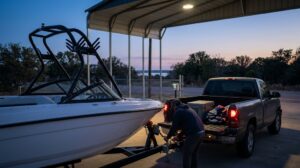
If you’re hauling your boat back to Denton after every outing on Lewisville Lake or Ray Roberts Lake, you’re adding an hour or more to every trip that didn’t need to be there. Storing your boat near the water you actually use solves that problem, but the right option depends on which lake you launch from, how often you go, and what storage format fits your situation.
This guide covers both lakes, breaks down the storage types you’ll encounter, and gives you what you need before signing anything.
Two Lakes, Two Sets of Storage Options
Denton sits at the center of North Texas lake recreation, between two of the region’s most-used recreational lakes, and they are not interchangeable from a storage standpoint. Lewisville Lake is roughly 25 miles south via I-35E. Ray Roberts Lake is approximately 15 miles north via US-380 and FM-455. Where you store your boat should follow which lake you use most.
The storage landscape at each lake looks different. Lewisville Lake has multiple private marinas operating under U.S. Army Corps of Engineers (USACE) shoreline permits, with slip rentals, dry stack options, and land-based facilities within a short drive of major launch ramps. For RV and boat storage customers, the Lewisville Lake corridor offers the widest variety of commercial storage formats in the area.
| Lewisville Lake | Ray Roberts Lake | |
| Distance from Denton | ~25 miles south via I-35E | ~15 miles north via US-380/FM-455 |
| Primary access points | Multiple public ramps, full-service marinas | USACE park ramps, limited commercial marina presence |
| Storage types available | Wet slip, dry stack, covered land, enclosed | Covered land, enclosed, secured facility storage |
| Marina storage availability | Yes, multiple operators | Limited |
Lewisville Lake Storage Overview
Lewisville Lake is the more commercially developed of the two for storage purposes. Multiple marinas operate under USACE shoreline management permits and offer slip rentals, dry stack retrieval, and trailered boat parking. Land-based storage facilities within a few miles of major ramps round out the options for owners who prefer not to use a marina.
Ray Roberts Lake Storage Overview
Ray Roberts Lake is a USACE-managed park, and its shoreline development is more restricted than Lewisville’s. The commercial marina footprint is limited. Most Denton boat owners who launch at Ray Roberts rely on secured land-based or nearby facility storage rather than on-water slip arrangements. This is the key practical difference between the two lakes, and it is the one no competitor addresses.
Understanding Your Storage Type Options
Before calling any facility, you should understand what the main storage formats actually involve, including where each one creates friction that a marina brochure will not mention.
Wet Slip Rentals
A wet slip keeps your boat in the water. You arrive, untie, and go. That convenience is the main reason owners pay the premium. The catch on a U.S. Army Corps of Engineers flood-control reservoir like Lewisville Lake is that pool elevation varies. In drought conditions, water levels can drop several feet below the conservation pool target, which can restrict boat launch ramp access, reduce hoist clearance, and in some cases leave slips partially inaccessible. You are paying for that slip whether the water cooperates or not.
Marina slip contracts at a Lake Lewisville marina typically run 12 months and are non-refundable. That structure makes sense if you’re on the water frequently. If you launch a few times a season, the math works against you quickly. A wet slip is the right choice for frequent launchers who use the lake regularly enough to justify locking in that commitment year-round.
Dry Stack Storage
Dry stack storage, sometimes called dry dock storage, keeps your boat on racks inside a marina building. A forklift crew pulls it when you call ahead and has it in the water by the time you arrive. Hull wear is lower than a wet slip because the boat is not sitting in water between uses.
The part first-time dry stack customers are often surprised by is the advance-notice requirement. You cannot simply show up and launch. You need to call ahead, sometimes the day before, and your access window follows marina operating hours. If you are a spontaneous launcher who decides to go out on short notice, that scheduling step adds friction. Dry stack is the right fit for owners who can plan ahead and want hull protection without keeping the boat in the water full-time.
Covered Outdoor Land Storage
Covered outdoor boat storage keeps your boat on its trailer under a steel canopy at a gated facility. This format gives you 24-hour access storage on your own schedule, with no marina operating hours and no dependence on lake water levels. Monthly storage rates at covered facilities typically run lower than marina slip rentals, and most facilities operate on monthly agreements rather than 12-month locked contracts.
This is the practical default for owners who launch from public ramps rather than marina ramps, and it works equally well near Lewisville Lake or Ray Roberts Lake. Denton boat owners looking for covered outdoor storage can find this format at RecNation’s covered boat storage in Denton, which offers gated and secured storage for trailered boats with access that fits around your schedule. Covered storage is the right fit for occasional and seasonal owners who want hull protection without a marina contract.
Enclosed and Indoor Boat Storage
Fully enclosed indoor boat storage puts your boat in a structure with walls and a roof. This is the highest level of protection outside a climate-controlled storage unit. UV degradation, hail damage, bird exposure, and ambient humidity are all reduced significantly compared to outdoor boat storage formats.
This format makes the most sense for boat winterization storage, long off-season layups, or owners with higher-value vessels or sensitive electronics and upholstery. If a pontoon boat storage situation is stretching into months of non-use, enclosed storage preserves the finish and interior better than any outdoor option. Climate-controlled storage takes that protection further for boats with temperature-sensitive components, though it comes at a higher cost.
What You Need Before You Sign a Storage Agreement
Showing up at a marina or a vehicle storage facility without the right paperwork can delay your move-in by days, whether that’s a marina office or a self-storage facility near the ramp. These three requirements come up consistently across both marina and land-based storage facilities in Texas.
TPWD Registration Requirements
Texas requires all motorized vessels to carry current registration through the Texas Parks and Wildlife Department. Under TPWD Title 31, Chapter 53, marinas and secured storage facilities are permitted to verify that registration at move-in before accepting a motorized vessel. A lapsed or missing registration will stop your move-in until the paperwork is current. If you recently purchased the boat and haven’t registered it yet, get that handled first.
Insurance and Liability Coverage
Most marina slip agreements require proof of liability insurance on the vessel. Many secured facility storage addenda require it as well. The specific minimum varies by facility, so confirm the requirement before you sign. Homeowner’s and renter’s policies sometimes exclude watercraft above a certain horsepower or value, which means your existing coverage may not meet the threshold. As a general practice, review your policy terms carefully. A standalone boat insurance policy is often the safer baseline for stored vessels. Confirm the facility’s specific coverage requirement before committing to any format.
Here is what to bring when you arrive:
- Current TPWD vessel registration with valid decal placement
- Proof of ownership or title
- Valid government-issued ID
- Proof of liability insurance on the vessel
- Any manufacturer’s certificate of origin if the boat has not been previously titled
Lake Lewisville Water Levels and What They Mean for Your Storage Choice
Lake Lewisville is operated by the U.S. Army Corps of Engineers for flood control. The conservation pool elevation target is approximately 522 feet above mean sea level, but drought conditions have pushed levels well below that in past years. When levels drop, the practical consequences are immediate: boat launch ramp access may be restricted, hoist clearance is reduced, and some slips become difficult or unusable.
This matters most before you sign a 12-month non-refundable marina contract. You can pay for access to a slip through a full dry season and have limited ability to use it. Covered outdoor and enclosed land-based storage options are unaffected by lake levels. Your boat stays accessible regardless of what the reservoir is doing. For current water level and operational data, the USACE Southwestern Division publishes Lewisville Lake elevation readings and ramp status updates.
How USACE Operations Affect Slip Access
Marinas on Lewisville Lake sit on Corps-managed shoreline, and their footprint isn’t entirely up to the marina operator. Under ER 1130-2-406, the Corps’s shoreline management framework, commercial marina facilities operate under a lease or use agreement with the Corps, and permanent anchoring systems or structural changes to slip facilities need Corps sign-off before work begins, not just the marina’s own approval.
If you’re considering a slip and the marina mentions modifications or additions, that approval sits with the Corps, not the marina. Low water conditions cascade into access problems that no modification can fix quickly, which is why the contract terms matter before you commit.
Choosing Storage Based on How Often You Launch
Your usage pattern matters more than monthly storage rates alone. The right storage format for someone who launches twice a month is not the right format for someone who goes out three times a year.
Frequent Launchers: Marina Storage Makes Sense
If you launch two to three times a month or more, marina slip or dry stack storage is likely worth the cost. The round-trip haul from Denton to either lake takes time, and if you are making that trip regularly, the time savings over a full season justify the higher monthly rate. Keep in mind that dry stack requires advance notice, which adds a scheduling step for anyone who makes spontaneous launch decisions. A wet slip gives you the most immediate access but carries the water-level variability risk described above.
Occasional and Seasonal Owners: Land Storage Is the Better Fit
If you launch monthly or less, covered outdoor or enclosed land storage near either lake delivers better value. You get hull protection without locking into a marina contract, and your access does not depend on marina operating hours or lake elevation. For owners storing through a North Texas winter, boat winterization storage in an enclosed unit keeps the hull and interior in better condition through the long idle stretch than any uncovered outdoor option.
Owners who use Ray Roberts Lake specifically tend to fall into this category. The lake’s limited commercial marina footprint makes gated and secured land-based storage the practical default, and the flexible monthly terms at Denton County storage facilities match that occasional-use pattern well.
Storage Near Both Lakes, Without the Marina Contract
For Denton boat owners who want to avoid marina contract terms and lake-level uncertainty, keeping your boat at a dedicated land-based storage facility gives you consistent access and hull protection regardless of what Lewisville Lake or Ray Roberts Lake is doing that season. RecNation boat storage in Denton offers gated, secured storage sized for trailered boats, with access that works around your launch schedule rather than marina hours.
Frequently Asked Questions
What are the best boat storage options near Lewisville Lake?
Boat storage near Lewisville Lake includes marina wet slips, dry stack storage at full-service marinas, covered outdoor land storage at gated facilities, and enclosed indoor units. Slip rentals offer the fastest water access but typically require 12-month non-refundable contracts. Covered land storage near public launch ramps is a flexible, lower-cost alternative with no marina-hour restrictions and no dependence on lake water levels.
Can I store my boat near Ray Roberts Lake year-round?
Yes. Ray Roberts Lake has a more limited commercial marina footprint than Lewisville Lake because it is a USACE-managed park with restricted shoreline development. Most owners who launch there rely on secured land-based storage facilities in the area, and those facilities offer year-round monthly terms with gated and secured access.
How much does boat storage cost near Lewisville Lake or Ray Roberts Lake?
Monthly storage rates vary by format. Marina wet slips run higher than covered outdoor land storage, which typically costs more than uncovered parking. Rates also shift with facility availability and boat size. Contact specific Denton County storage facilities directly for current pricing, as most provide online quotes or phone estimates without requiring a commitment.
Is covered or indoor boat storage available in the Denton area?
Both are available. Covered outdoor storage keeps your trailered boat under a steel canopy at a gated facility, offering meaningful UV and hail protection without a marina contract. Fully enclosed indoor boat storage is also available for owners who want maximum protection during off-season layup or extended periods of non-use.
What should I have ready before signing a boat storage agreement in Texas?
Bring current Texas Parks and Wildlife Department vessel registration with a valid decal, proof of ownership or title, a valid government-issued ID, and proof of liability insurance on the vessel. Most marinas and secured storage facilities require current TPWD registration before completing move-in for any motorized vessel. Confirm the specific insurance minimum with your facility, since homeowner’s policies may not meet the threshold required under a marina or storage agreement.