Total annual jet ski ownership costs in the U.S. typically run between $2,000 and $6,000 per year beyond the initial purchase price, and that range swings almost entirely based on how and where you store the craft. This guide covers every major expense from purchase through recurring annual costs, built for first-time buyers who want a realistic budget before they commit. If you’ve already looked up jet ski prices and now want the full picture, you’re in the right place.
What Does a Jet Ski Cost to Buy?
Before layering on annual expenses, you need a solid starting number. The jet ski purchase price varies more than most buyers expect, and the tier you buy into shapes every downstream cost, including insurance, storage, and maintenance.
Sea-Doo and Yamaha WaveRunner are the two dominant brands in the U.S. market, and their pricing at comparable spec levels is close. Whether you buy new or used matters as much as which brand you choose.
New Jet Ski Price Ranges by Category
New personal watercraft (PWC) prices fall into four broad tiers. Here’s what to expect across the range:
| Category | Typical Price Range | Examples |
| Entry-level / Rec-Lite | $8,000 to $10,000 | Sea-Doo Spark, Yamaha EX Series |
| Mid-range Recreational | $10,000 to $14,000 | Sea-Doo GTI, Yamaha VX Series |
| Performance | $14,000 to $18,000 | Sea-Doo RXP-X, Yamaha FZR |
| Luxury / Touring | $18,000 to $20,000+ | Sea-Doo GTX Limited, Yamaha FX Cruiser SVHO |
One cost buyers consistently undercount is the trailer. A PWC trailer is almost never included in the sticker price. Budget an additional $1,000 to $3,500 for PWC trailer costs, depending on whether you buy a basic single trailer or a heavier-duty aluminum unit.
Used Jet Ski Costs: What to Expect
The new vs. used jet ski decision comes down to upfront savings versus warranty coverage. Used models are commonly available from $3,000 to $12,000 depending on age, brand, and condition.
When evaluating used PWCs, engine hours are the most important indicator. On a 4-stroke engine, 100 or more hours is considered high mileage. Review the service history carefully and inspect the hull for stress cracks. J.D. Power Marine Used Values are a reliable reference point for used PWC pricing benchmarks when you’re verifying whether an asking price is fair.
Annual Jet Ski Running Costs Broken Down
The purchase price gets you on the water once. Everything that follows is what owning a jet ski actually costs. Knowing how much to budget for storage and other recurring expenses upfront is how you avoid an unpleasant surprise in year one.
Fuel Costs
Fuel consumption on a jet ski typically runs 3 to 4 gallons per hour, and some high-performance models require premium fuel. At a national average fuel price of around $3.50 per gallon (regular) or $4.00 per gallon (premium), 30 hours of riding costs roughly $315 to $480 in fuel alone.
If you ride 20 to 40 hours per season, budget $200 to $640 annually for fuel, depending on your engine and how hard you push it. Aggressive riding in open water burns toward the high end of that range.
Annual Maintenance Costs
Routine annual maintenance on a jet ski covers oil changes, spark plugs, filters, and a hull inspection. This typically runs $300 to $600 per year at a marine service shop. Deferred maintenance accelerates wear, particularly on wear rings and impellers.
Impeller and wear ring replacement is one of the most common unplanned costs on a used craft. Parts and labor typically run $150 to $400 per service. Factor it as a near-term probability on any used purchase with 80 or more hours logged. Annual maintenance costs also include battery maintenance and a basic bilge check.
Jet Ski Insurance Costs
Boat insurance premiums for a recreational personal watercraft typically run $150 to $500 per year for a standard liability and physical damage policy. Where you ride, your age, and your coverage level all affect the premium.
If the craft is financed, the lender will require comprehensive coverage, which removes the option to carry liability-only to save money. Riders in Florida and other coastal states generally pay more due to hurricane exposure. Boat insurance premiums at the higher end of the range are common in South Florida and along the Gulf Coast.
Winterization and Seasonal Layup
Winterization costs run $200 to $400 for professional service. The process includes flushing the engine, fogging internal components, draining all water systems, and stabilizing the fuel. Skipping winterization in any state with freezing temperatures is a high-risk decision that can result in cracked engine blocks and coolant system failure.
Even in mild climates like Florida and coastal Texas, a seasonal layup service is good practice if the craft will sit unused for months. Think of it as mandatory maintenance in cold-weather states and smart practice everywhere else.
Launching Fees and Waterway Access
Public boat ramp fees typically run $10 to $35 per launch. Many state and county parks sell seasonal launch passes for $75 to $200, which makes sense if you’ll be launching regularly at the same ramp. Some waterways, particularly those managed by the U.S. Army Corps of Engineers, require additional access permits or day-use fees.
If you ride 30 times per season at a facility charging $15 per launch, that’s $450 in launch fees alone. It adds up faster than most buyers anticipate.
Registration, Licensing, and State Fees
Every motorized personal watercraft in the U.S. must be registered in the state where it’s primarily used. Registration and licensing fees vary by state and recur annually, so they belong in your ongoing budget, not just your first-year calculation.
State Registration Fee Examples
Here’s a quick comparison across states where jet ski ownership is common:
| State | Annual Registration Fee Range | Notes |
| Florida | $25 to $85 | Based on vessel length; annual renewal required. Florida FWC vessel registration |
| Texas | $32 to $75 | Based on vessel class; biennial registration in some categories |
| California | $60 to $100+ | Calculated by vessel length and type; initial registration often higher |
| Tennessee | $15 to $55 | Annual registration via TWRA |
| South Carolina | $10 to $50 | Based on vessel length; SC DNR administers |
Some states also require operator safety certification for PWC riders below a certain age. In a few jurisdictions, all operators must hold a boater education certificate. Check your state’s requirements before you launch.
Note: These figures are a general reference point, not a substitute for checking directly with your state. Registration fees are set by vessel length class and sometimes bundled with additional service charges, so the exact amount for your specific jet ski can fall outside these ranges. Confirm current fees with your state’s boating or wildlife agency (FWC in Florida, TPWD in Texas, DMV in California) before budgeting the number into your first-year costs.
Required Safety Gear and U.S. Coast Guard Regulations
U.S. Coast Guard regulations require specific safety equipment aboard any registered PWC. A compliant gear set runs $150 to $400 depending on quality, and it’s a one-time cost. Required items include:
- Life jackets: One U.S. Coast Guard-approved personal flotation device per rider, plus one throwable device
- Fire extinguisher: Required on most enclosed-hull PWCs
- Sound-producing device: A whistle or horn meeting USCG specifications
- Visual distress signals: Required for nighttime operation on certain waterways
This is a mandatory upfront cost, not optional equipment. Budget it into your year-one total alongside the trailer.
Jet Ski Storage Costs: Your Biggest Variable
Storage is the line item that turns a manageable ownership budget into a difficult one, or doesn’t, depending entirely on your options. It’s also the cost that most buyers fail to research before they purchase. The right covered carport storage option can save you thousands annually compared to marina-based alternatives.
Jet ski storage fees vary more than any other recurring ownership cost. Here’s how the four main options compare.
Marina Wet Slip Storage
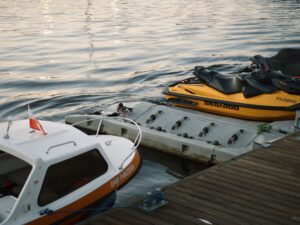
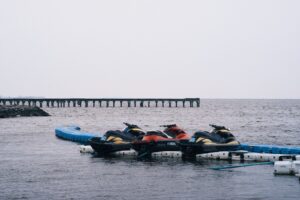
A wet slip keeps your jet ski in the water at a dock, available whenever you want it with no trailering required. It’s the most convenient option and the most expensive. In competitive coastal markets like South Florida, San Diego, and parts of the Gulf Coast, wet slip marina storage typically runs $200 to $500 per month, or $2,400 to $6,000 per year.
The craft’s constant water exposure accelerates hull wear and corrosion, particularly in saltwater environments. What you gain in convenience, you spend in both fees and accelerated maintenance costs.
Dry Stack Storage at a Marina
Dry stack storage keeps the craft out of the water on a rack system, launched by forklift when you’re ready to ride. It’s more protective than a wet slip, and typically costs $150 to $350 per month ($1,800 to $4,200 per year) in coastal markets. You do need to schedule launches in advance, which reduces spontaneity.
Availability is the main limitation. Many marinas have waitlists for dry stack spaces, particularly in South Florida and Southern California. If you can get a spot, it’s a meaningful step up in protection from wet slip storage.
Covered Vehicle Storage Facilities
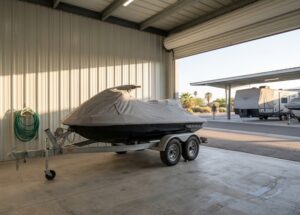
Dedicated vehicle storage facilities offer covered carport-style spaces or enclosed units sized for a jet ski on its trailer. This is the most practical option for owners who live inland or within a reasonable trailering distance of the water. Typical costs run $75 to $150 per month, or $900 to $1,800 per year, which is a fraction of marina pricing.
You get meaningful UV and weather protection, 7-day access without scheduling a forklift, and no water exposure between rides. RecNation Storage facilities offer covered and enclosed vehicle storage sized for a jet ski on a trailer, with access across Arizona, California, Florida, Texas, Tennessee, and other states where jet ski season matters. For most owners who aren’t keeping their craft at the marina full-time, this option offers the best balance of cost and protection.
Home Storage: Driveway or Garage
Home driveway storage has no monthly fee, but it comes with real trade-offs. Many homeowners association (HOA) communities prohibit visible watercraft storage on driveways, and violations can result in fines. If outdoor home storage is your only option, a quality fitted PWC cover ($100 to $250) provides baseline UV and moisture protection, but it doesn’t replicate enclosed storage protection.
Uncovered outdoor storage accelerates gelcoat fading, UV deterioration, and potential mold growth in humid climates. Garage storage works well where space allows, but a full-size jet ski on a trailer takes up a substantial footprint.
Storage Cost Comparison
| Storage Type | Typical Annual Cost | Protection Level | Convenience | Best For |
| Marina Wet Slip | $2,400 to $6,000 | Low (water/UV exposure) | High | Frequent riders at the marina |
| Dry Stack (Marina) | $1,800 to $4,200 | Medium | Medium | Coastal owners, if available |
| Covered Vehicle Storage | $900 to $1,800 | High | High | Most trailering owners |
| Home Driveway/Garage | $0 to $250 (cover) | Low to Medium | High | HOA-free properties with space |
Depreciation and the True Cost Per Hour of Ownership
Purchase price and annual running costs tell part of the story. Depreciation tells the rest. New PWCs lose roughly 20 to 30 percent of their value in the first year, which means a $12,000 jet ski becomes an $8,400 to $9,600 asset by the time season one ends. That loss is real whether you paid cash or financed.
How Quickly Do Jet Skis Depreciate?
The depreciation rate is steepest in year one, then flattens considerably. A well-maintained used craft with under 100 hours typically holds value reasonably well from year three onward. Buying a two-year-old jet ski with a full service history lets someone else absorb the steepest part of the depreciation curve.
For buyers committed to buying new, the financial strategy is to plan for multi-season ownership. Spreading the year-one depreciation loss across three or more seasons changes the math significantly.
Calculating Your Real Cost Per Hour
Here’s a worked example for a $12,000 new jet ski in its first year:
| Expense | Estimated Cost |
| First-year depreciation (20%) | $2,400 |
| Storage (covered facility) | $1,500 |
| Insurance | $400 |
| Fuel (25 hours at ~$3.80/gal) | $380 |
| Annual maintenance costs | $400 |
| Registration and winterization | $300 |
| Total Year-One Cost | $5,380 |
At 25 hours of riding, that works out to roughly $215 per hour of use. Compare that to jet ski rental rates of $80 to $150 per hour, and low-usage ownership is genuinely expensive on a per-hour basis. Ride 50 hours per season and your per-hour cost drops to around $108. The math improves substantially as usage increases and depreciation slows after year two.
Is Jet Ski Ownership Worth It? Honest Answers
The total cost of ownership is what matters here, not the sticker price. Working through the full budget, including storage, is how you arrive at an honest answer before you buy, rather than after.
For context on broader recreational boating expenses, the National Marine Manufacturers Association tracks annual PWC ownership costs and industry trends that are worth reviewing alongside the figures in this guide.
When Ownership Makes Financial Sense
Ownership typically works financially when several conditions are true together. You ride 40 or more hours per season consistently. You have access to boat and RV storage at a reasonable cost, not marina-slip pricing. You live within convenient trailering distance of quality riding water, and you plan to own the craft for three or more seasons.
When those conditions align, the per-hour cost comes down, the depreciation loss is spread across years, and ownership delivers genuine value over renting.
When Renting Might Be the Smarter Call
Renting makes more sense when your realistic riding window is fewer than 20 hours per season, your only storage option is a marina wet slip at $3,000 or more per year, or your commitment to the lifestyle is still uncertain. A single season of renting at $100 to $150 per hour for 20 hours costs $2,000 to $3,000, no depreciation, no storage, and no maintenance required.
Buyers who plan their storage solution before they purchase typically spend less and enjoy ownership more. It’s one of the most practical pre-purchase steps you can take.
Final Thoughts on Jet Ski Ownership Costs
Figuring out storage before you buy is one of the most practical steps you can take as a new owner. It affects your annual budget more than almost any other single decision. RecNation jet ski storage offers facilities across Arizona, California, Florida, Texas, Tennessee, and other states where jet ski season matters, at rates that are typically a fraction of what a marina slip costs in the same region. It’s a straightforward way to protect your investment without paying marina prices every month of the year.
Frequently Asked Questions
How much does it cost per year to own a jet ski?
Total annual ownership costs beyond the purchase price typically run between $2,000 and $6,000 per year in the U.S. The main recurring expenses are storage, fuel, insurance, maintenance, registration, and winterization. Owners in high-cost marina markets or those who ride frequently will land toward the upper end of that range.
Is it expensive to store a jet ski at a marina?
Marina wet slip storage in competitive coastal markets like South Florida or Southern California typically costs $200 to $500 per month, or $2,400 to $6,000 annually. Dry stack storage is somewhat less expensive at $150 to $350 per month but is not always available. Covered vehicle storage at a dedicated facility typically runs $75 to $150 per month, making it the most cost-effective option for owners who trailer their craft to the water.
What are the hidden costs of owning a jet ski?
The costs buyers most commonly overlook are winterization ($200 to $400 per season for professional service), annual registration renewal fees, public boat ramp launch fees ($10 to $35 per outing), and mandatory safety gear required by U.S. Coast Guard regulations ($150 to $400 for a compliant set). First-year depreciation, typically 20 to 30 percent of the purchase price, is also a real cost that cash and financed buyers alike tend to undercount.
How much does jet ski insurance cost annually?
Jet ski insurance typically costs between $150 and $500 per year for a standard policy covering liability and physical damage on a recreational personal watercraft. Boat insurance premiums are higher for riders in coastal states with hurricane exposure, younger riders, high-performance models, and financed craft. Lenders require comprehensive coverage on financed watercraft, which removes the option to carry liability-only policies to save money.
Is buying a used jet ski worth it to save on costs?
Buying used can significantly reduce your initial outlay. Used jet skis are commonly available from $3,000 to $12,000 versus $8,000 to $20,000 or more for new models. The financial advantage is strongest when the craft is two to four years old, because the steepest depreciation has already occurred. Before buying used, check engine hours, review service records, and have a marine technician perform a pre-purchase inspection, which typically costs $100 to $200.