The real question isn’t whether jet skis are fun. It’s whether the total recurring cost of owning one, once storage, insurance, maintenance, winterization, and depreciation are all added up, makes financial sense compared to simply renting. Most buyers focus on the sticker price and underestimate everything that comes after it.
This article gives you a concrete cost model so you can make that judgment yourself before you sign anything.
The Full Cost of Owning a Jet Ski, What Buyers Actually Pay
The purchase price of a new Sea-Doo or Yamaha WaveRunner typically runs between $8,000 and $20,000 depending on model and engine size. That number feels like the hard part. It isn’t.
The recurring costs, paid every year regardless of how often you ride, are where most buyers get surprised. Fuel and oil costs run $500 to $1,500 annually for moderate use. Annual maintenance costs, including routine hull maintenance and inspections, add another $300 to $800. Personal watercraft (PWC) insurance typically costs $200 to $500 per year for a standard policy. Registration and licensing fees vary by state but generally run $50 to $200 annually.
Storage is the variable that swings most dramatically by region and facility type. It deserves its own section below, but for budgeting purposes, plan for $600 to $6,000 per year depending on your situation.
Purchase Price vs. Total Cost of Ownership
The sticker price is the lowest-friction number in the jet ski ownership equation. Total cost of ownership over five years, including depreciation, storage, maintenance, PWC insurance, registration, and fuel, frequently equals or exceeds the original purchase price of the watercraft.
| Amount | |
| Purchase price | $12,000 |
| Annual recurring expenses | $3,000 |
| Recurring costs over 5 years | $15,000 |
| Total, before depreciation | $27,000 |
That’s not an argument against buying. It’s an argument for knowing the number before you commit.
Fuel, Oil, and Annual Maintenance Costs
Most personal watercraft engines consume between 1.5 and 3 gallons of premium unleaded fuel per hour at moderate throttle. At current fuel prices, a day on the water can cost $30 to $75 in fuel alone. Annual fuel and oil costs depend heavily on how often you ride and at what throttle level.
Routine annual maintenance costs include oil changes, spark plug replacement, and filter service. Impeller and pump maintenance is a periodic cost many first-time buyers overlook entirely. Impeller damage from debris or improper use can run $200 to $600 to repair, and it is not always covered under warranty.
| Cost Category | Typical Annual Range |
| Fuel and oil | $500 to $1,500 |
| Routine maintenance and hull maintenance | $300 to $800 |
| PWC insurance | $200 to $500 |
| Registration and licensing fees | $50 to $200 |
| Storage (see below) | $600 to $6,000 |
| Total (excluding depreciation) | $1,650 to $9,000 |
What Does Jet Ski Storage Actually Cost?
Jet ski storage costs are the line item with the widest range and the most regional variation. Where you live and what facilities are available near the water you ride will shape this number more than almost any other factor.
The table below shows the four main storage types and their typical monthly cost ranges. For a broader benchmark on how much you should expect to pay for storage across facility types, local rates will vary by market.
| Storage Type | Typical Monthly Cost | Notes |
| Outdoor trailer storage | $50 to $150 | Lowest cost; owner tows to launch |
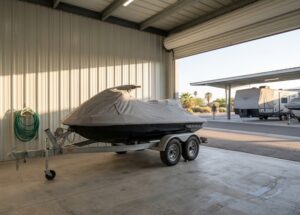
| Covered or carport storage | $100 to $200 | Weather protection without full enclosure |
| Indoor storage facility | $150 to $300 | Climate-controlled storage options available |
| Marina dry-stack storage | $200 to $500 | Launch convenience included; highest cost |
Annual jet ski storage costs therefore range from roughly $600 at the low end for basic outdoor trailer storage, up to $6,000 for marina dry stack storage in a high-demand coastal market. Over a five-year ownership period, that difference compounds to $27,000. It is the single largest variable in the ownership cost equation after the purchase price itself.
Marina Dry-Stack vs. Self-Storage: What You Give Up at Each Price Point
Marina dry-stack storage is priced for convenience: you call ahead, staff retrieve the jet ski with a forklift, and it’s in the water when you arrive. That service is worth something to owners who ride frequently and don’t want to hitch a trailer on a weekend morning, but annualized, marina storage fees at $300 to $500 per month exceed what most buyers budgeted.
| Marina Dry-Stack | Dedicated Vehicle Storage Facility | |
| Typical monthly cost | $300 to $500 | Lower, often well below dry-stack pricing |
| Launch convenience | Staff retrieve and launch for you | You trailer and launch yourself |
| Weather protection | Yes | Yes, with covered storage options |
| Best fit for | Frequent riders who value convenience | Owners who already have a trailer and are comfortable launching |
RecNation facilities, for example, offer covered and indoor options designed for personal watercraft at rates that typically fall well below marina dry-stack pricing. That gap matters when you’re comparing total annual ownership costs, since this is largely a cost decision, not a quality-of-storage one.
How Regional Climate Affects What You Pay
Florida and Texas owners can ride year-round, which means off-season storage is less of a defined period. The trade-off is that marina storage fees in South Florida markets are typically at or above the top of the ranges above. Coastal real estate costs drive marina pricing regardless of whether you’re storing a boat or a jet ski.
Owners in Tennessee, Missouri, or Kansas face a different cost structure. The riding season runs roughly five to six months, which limits annual fuel and maintenance expenses. But off-season storage for the remaining months is non-negotiable in freezing climates, and winterization becomes a required expense rather than an optional one. Indoor or climate-controlled storage is strongly advisable where temperatures drop below freezing.
How Storage Type Affects Your Insurance Coverage
Most PWC insurance policies include a provision requiring the owner to disclose where the watercraft is stored when not in use. This isn’t fine print that rarely matters. It’s a clause that can affect your coverage when you actually need it.
Storing a jet ski in an unlisted or unsecured location, such as an open trailer in a driveway or an informal arrangement with a neighbor’s property, can affect comprehensive coverage eligibility or alter deductible terms in the event of theft, vandalism, or weather damage. Insurers view secured storage facilities more favorably than informal arrangements.
Bonded marine storage facilities and enclosed vehicle storage facilities typically qualify as acceptable storage locations under most policy terms. According to the National Association of Insurance Commissioners, watercraft policy terms vary by state and insurer, so verifying storage requirements with your specific carrier is the only reliable approach.
What to Ask Your Insurer Before You Choose a Storage Option
Before committing to a storage arrangement, ask your insurance provider these specific questions:
- Does my policy require a disclosed storage address, and does that address need to be updated if I move the jet ski seasonally?
- Does outdoor versus indoor storage affect my comprehensive premium or deductible?
- Does storing in a non-marine facility (such as a vehicle storage lot) trigger any coverage limitations?
- Is off-season storage at a location different from my listed address considered a coverage gap under my current policy?
- What documentation does the insurer require to verify that the storage location meets policy standards?
The Break-Even Question, How Many Days on the Water Does It Take?
Here is the calculation most buyers never run before they sign. Take a mid-range jet ski purchased for $12,000, with annual recurring costs at a moderate storage rate:
- Storage: $150/month ($1,800/year)
- PWC insurance: $350/year
- Maintenance and fuel: $600/year for moderate use
- Registration and licensing: $100/year
- Total annual recurring cost, before depreciation: approximately $2,850
Divide that by the number of days ridden per year:
- At 15 days of use: $190 per use day
- At 10 days of use: $285 per use day
Compare that against rental rates of $200 to $500 per day in most markets. The math often favors ownership at 20 or more days of annual use. Below that threshold, renting versus owning a jet ski becomes a genuine financial question with no obvious answer in ownership’s favor.
Jet ski depreciation accelerates this threshold. According to J.D. Power powersports valuations, personal watercraft depreciate at roughly 10 to 15 percent per year in the early years of ownership:
- A jet ski purchased for $12,000 may be worth $8,000 to $9,000 after three years.
- That $3,000 to $4,000 in depreciated value is a real cost, even if you never write a check for it.
- It compounds against a rising total of storage and operating expenses.
Renting vs. Owning: When the Math Favors Each Option
Which option makes financial sense comes down to how often you’ll actually use it and what storage costs you.
| Ownership Makes Sense | Renting Makes Sense | |
| Usage frequency | 20 or more days per year | Under 15 days per year |
| Storage access | Under $200 per month | Not yet secured |
| Ownership horizon | Plan to keep it 4 to 5 years or more | Seasonal or occasional use |
| Typical profile | Families with multiple riders, owners near water they use regularly | Seasonal visitors, low-frequency users |
Ownership makes more financial sense when you ride 20 or more days per year, have access to storage under $200 per month, and plan to keep the jet ski for at least four to five years. Renting is objectively cheaper for seasonal visitors, low-frequency users, and buyers who haven’t secured a storage arrangement: rental rates are high per day, but there are no fixed carrying costs between trips.
Depreciation and Resale Value Over Time
Personal watercraft lose value fastest in the first three years of ownership. After that, the depreciation curve tends to flatten, particularly for well-maintained models. A jet ski stored properly, in a covered or indoor environment, and winterized correctly each season will retain more resale value than one stored outdoors and improperly maintained.
Storage quality is a direct input to resale value. That’s a return on the storage cost that buyers often ignore when they’re comparing a $100 per month lot to a $300 per month indoor facility.
Winterization, Registration, and the Costs Most Owners Forget
Two cost categories consistently catch buyers off guard: winterization and ongoing registration obligations. Both are real and recurring, and neither is optional in most situations.
What Winterization Actually Costs, and When DIY Makes Sense
Professional winterization at a marine dealer typically costs $150 to $350 per service visit, a similar range to our breakdown of what it costs to winterize and store a boat, if you’re comparing costs across watercraft types. The service includes fogging the engine with storage oil, stabilizing the fuel system, flushing the cooling system, and inspecting seals and the hull. Skipping it in a freezing climate can cause water trapped in the cooling system to expand and crack internal components.
DIY winterization can be done for $50 to $100 in materials if you’re comfortable with the procedure. The risk is warranty exposure. Under the Magnuson-Moss Warranty Act, a manufacturer cannot void a warranty simply because the owner performed their own maintenance. But the manufacturer can deny a warranty claim if they demonstrate that improper service caused the specific damage.
Before attempting DIY winterization, consult the manufacturer’s service documentation for your Sea-Doo or Yamaha WaveRunner model to confirm the correct procedure.
Registration Requirements During Long-Term Storage
Many buyers assume they can suspend or cancel their watercraft registration during off-season storage to save the annual fee. In most states, that assumption is wrong. Most states require active registration for any titled watercraft regardless of whether it is in active use or storage. Florida, for example, requires annual registration renewal under Florida Statute §328.48 regardless of the vessel’s operational status.
Deregistering during storage and attempting to reinstate later can trigger reinstatement fees and title complications. The annual registration and licensing fees ($50 to $200 depending on state) are a fixed cost of ownership, not an expense you can pause.
So Is It Worth It? An Honest Verdict
Jet ski ownership makes financial sense for a specific buyer profile. If you ride 20 or more days per year, have access to secure storage under $200 per month, live in a climate with a long riding season or have a concrete winterization plan, and are buying a model with a reasonable depreciation curve, the per-use cost is defensible.
It is harder to justify for buyers who will realistically ride fewer than 15 days per year, face marina storage fees above $400 per month, or are purchasing without a storage arrangement already confirmed. In those cases, the annual carrying costs frequently outpace the value delivered.
The storage decision should be resolved before you take delivery of the watercraft, not after. Knowing your monthly storage cost before you buy is the only way to run an accurate cost-per-use calculation. If you don’t have a confirmed storage option, you don’t yet have the full cost picture.
Questions to Ask Before You Buy
Answer these honestly before committing to a purchase:
- How many days per year will I realistically ride, accounting for weather, schedule, and seasonal access?
- What storage option is available to me, and what is the confirmed monthly cost?
- Do I live in a climate that requires winterization, and have I budgeted $150 to $350 per season for that service?
- What is my total annual cost (storage plus insurance plus maintenance plus registration), and how does that compare to rental rates in my area?
- Does my storage location satisfy my insurer’s policy requirements?
- What is the realistic resale value of this specific model in three to five years?
Final Thoughts on Whether Jet Ski Ownership Is Worth It
If you decide ownership makes sense, locking in your storage arrangement before you take delivery is one of the most practical steps you can take. RecNation jet ski and boat storage offers covered, indoor, and outdoor vehicle storage options across Florida, Texas, Tennessee, and other states where personal watercraft ownership is most common, with month-to-month flexibility and facilities designed specifically for recreational vehicles, not household goods.
Frequently Asked Questions
How much does it cost to store a jet ski per year?
Annual jet ski storage costs range from roughly $600 to $1,800 for outdoor trailer storage at a vehicle storage facility ($50 to $150 per month), up to $2,400 to $6,000 for marina dry-stack storage ($200 to $500 per month). Your actual cost depends on your region, the facility type, and whether you need year-round or seasonal off-season storage only. Indoor or covered storage typically falls between those two extremes at $100 to $300 per month.
Is it cheaper to rent a jet ski or buy one?
Renting is cheaper if you ride fewer than 15 to 20 days per year. Rental rates typically run $200 to $500 per day depending on the market, while total annual ownership costs, including storage, insurance, maintenance, fuel, and registration, commonly range from $2,500 to $5,000 or more before depreciation. If you ride frequently and have access to affordable storage, ownership costs less per day over time. For occasional users, renting avoids the fixed carrying costs that accumulate year-round regardless of use.
What are the ongoing maintenance costs of owning a jet ski?
Expect to spend $300 to $800 per year on routine maintenance for a well-maintained personal watercraft, including oil changes, spark plug replacement, hull maintenance, and filter service. Periodic costs like impeller and pump maintenance, battery replacement, and trailer service add to this in some years. Winterization adds $150 to $350 per season if you use a marine dealer, or $50 to $100 in materials if you perform the service yourself.
How do you store a jet ski for the winter?
Proper winter storage starts with a full winterization service: fogging the engine with storage oil, stabilizing the fuel system, flushing the cooling system with fresh water, and inspecting seals and the hull. The jet ski should be stored in a covered or indoor environment to protect against freeze damage, UV degradation, and rodent access. In climates where temperatures drop below freezing, indoor or climate-controlled storage is strongly recommended over outdoor trailer storage.
Is buying a jet ski a good investment?
A jet ski is not a financial investment. It depreciates at roughly 10 to 15 percent per year in the early years of ownership, according to J.D. Power powersports valuations. Whether it is a worthwhile personal purchase depends on how frequently you use it, your storage costs, and how long you plan to own it. Buyers who ride 20 or more days per year and have access to secure, affordable storage tend to find the per-use cost reasonable. Buyers who ride infrequently or face high marina storage fees often find that cumulative costs outpace the value they get from the watercraft.