Parking your all-terrain vehicle (ATV) safely involves a lot more than finding a flat spot and cutting the engine. Between unstable terrain that can send a 700-pound machine rolling, trailhead theft that happens in broad daylight, and local rules that can get your quad impounded overnight, there are real consequences for riders who haven’t thought this through.
This guide covers everything from legal parking locations to surface-by-surface stability tips, anti-theft layering, and when a dedicated storage facility is a smarter answer than any parking spot. If you’ve ever walked back to your ATV and felt relieved it was still there, this guide will replace that relief with a system.
Why ATV Parking Safety Matters More Than Most Riders Think
Most riders focus on what happens on the trail. What happens after the engine shuts off gets far less attention, and that’s where a lot of damage and loss actually occurs. ATV parking safety breaks down into two distinct risk categories, and understanding both is the foundation for everything else in this guide.
The Two Risk Categories: Physical and Security
Physical risks involve the ATV itself moving, tipping, or sinking after you’ve walked away. A four-wheeler parked on a grade without wheel chocks can roll. An ATV parked on saturated ground can sink several inches overnight. A machine positioned too close to another vehicle at a staging area can take a door’s worth of body damage from a careless neighbor. These are mechanical realities, not worst-case scenarios.
Security risks involve other people. Theft, vandalism, and unauthorized movement fall into this category. ATV theft is a real and ongoing problem at trailheads, staging areas, and residential driveways. The National Insurance Crime Bureau (NICB) tracks powersports vehicle theft annually, and ATVs consistently appear among the most frequently stolen recreational vehicles in the country. Unlike cars, ATVs can be loaded onto a truck in under two minutes without triggering an alarm.
If you’re newer to ATV riding or researching your ownership responsibilities more broadly, the how to transfer ownership of an ATV guide is a useful companion resource for understanding the documentation side of ownership.
Common Parking Incidents That Cause Damage or Loss
These scenarios aren’t hypothetical. They happen at trailheads and staging areas regularly:
- Rolling on a slope: An ATV parked on a 10-degree grade with a worn parking brake rolls into a drainage ditch while the rider is 20 minutes down the trail.
- Sinking on soft ground: A machine left overnight on wet grass sinks unevenly, tilting the frame and making the ATV impossible to move without another vehicle.
- Trailhead theft: A rider steps away for 40 minutes on a popular trail. When they return, the ATV is gone. No witnesses, no camera coverage, no recovery.
- Staging area contact damage: Two ATVs parked within arm’s reach of each other at an event. One gets bumped during loading, cracking the front fender of the other.
None of these require unusual bad luck. They require nothing more than skipping a two-minute parking routine.
Where You Can Legally Park an ATV
Before you think about stability or security, you need to know whether you’re allowed to park where you’re planning. ATV parking rules vary significantly by location type, and the consequences for getting it wrong range from a fine to having your machine impounded.
Trailhead and OHV Staging Area Rules
Designated trailhead parking areas are managed by land management agencies including the Bureau of Land Management (BLM), the USDA Forest Service, and state park systems. Most allow daytime ATV parking in designated areas, and many require a day-use fee or a valid OHV permit to use the lot. Overnight parking is a separate matter: many trailheads explicitly prohibit unattended vehicles after posted closing hours, and some prohibit overnight parking entirely regardless of permit status.
Rules vary by specific location even within the same land management agency. A BLM trailhead in Arizona may have different overnight policies than one in California. Before planning a multi-day trip that involves leaving your ATV at a trailhead, check the specific facility’s rules on the managing agency’s website or call the local field office directly. Violations can result in fines or impoundment, and “I didn’t know” won’t help you at the ranger station.
OHV staging areas typically offer more structured parking for trailers and tow vehicles, and some have designated secure areas or overnight camping with vehicle storage. These are generally the better option for multi-day rides.
Private Land, Residential, and Event Parking
Parking on private land with the owner’s permission is generally permissible, but confirm that permission explicitly before leaving your ATV. A handshake and a “sure, leave it here” can get complicated if something goes wrong.
Residential driveway parking is where many ATV owners run into unexpected problems. Most jurisdictions allow short-term driveway parking for off-road vehicles, but homeowners association (HOA) rules frequently impose restrictions that go further than local zoning. Some HOAs prohibit recreational vehicles and ATVs from being visible on the property at all. Check your HOA agreement before assuming the driveway is fair game, because violation notices and fines arrive whether you knew about the rule or not.
At riding events and organized competitions, parking is usually managed by event organizers with designated areas for ATVs, trailers, and tow vehicles. Follow posted event rules, and don’t assume that staging areas at private events operate under different theft risk than public trailheads. They don’t.
How to Park an ATV Safely on Different Surfaces and Terrain
Surface type is the biggest variable in physical parking safety. What works on a paved lot doesn’t work on a hillside, and what works on compacted dirt fails completely on saturated soil. Each surface has a primary risk, and each has a straightforward response.
Flat Hard Surfaces and Paved Areas
A paved or hard-packed surface is the most stable option for parking an ATV. The risk here is low, but it’s not zero. Engage the parking brake on any surface that has even a slight grade, including surfaces that look flat but drain slightly in one direction. Shift to park or first gear as a secondary measure.
On hot pavement, be aware that extended contact between a warm engine or exhaust and plastic undercarriage components can cause warping or discoloration over time. If you’re parking in direct sun for several hours, position the ATV so exhaust components aren’t resting directly against any plastic. Leave adequate space between your ATV and adjacent vehicles or equipment. A few extra feet at a staging area prevents the kind of contact damage that no lock in the world will stop.
Slopes, Hills, and Uneven Ground
This is where physical parking safety gets serious. The Consumer Product Safety Commission (CPSC) includes stability and terrain considerations in its ATV safety guidance, and for good reason: a rolling ATV is a serious hazard to anything in its path.
As a practical threshold, slopes steeper than roughly 15 degrees present meaningful rollaway risk for most ATVs, particularly heavier machines with lifted suspensions. A higher center of gravity lowers the tipping threshold. On any inclined surface, take all of the following steps before walking away:
- Engage the parking brake fully.
- Shift to first gear or park.
- Place wheel chocks behind the downhill-side tires. Chocks are inexpensive, lightweight, and take 10 seconds to deploy.
- Where possible, orient the ATV perpendicular to the slope rather than parallel, which reduces rollaway distance if the brake fails.
If you genuinely can’t find a level surface, use your tow vehicle or trailer as a backstop. Parking the ATV with the rear tires against the trailer or a fixed object limits rollaway distance. It’s not a substitute for chocks, but it’s better than nothing.
Soft Ground, Mud, and Sand
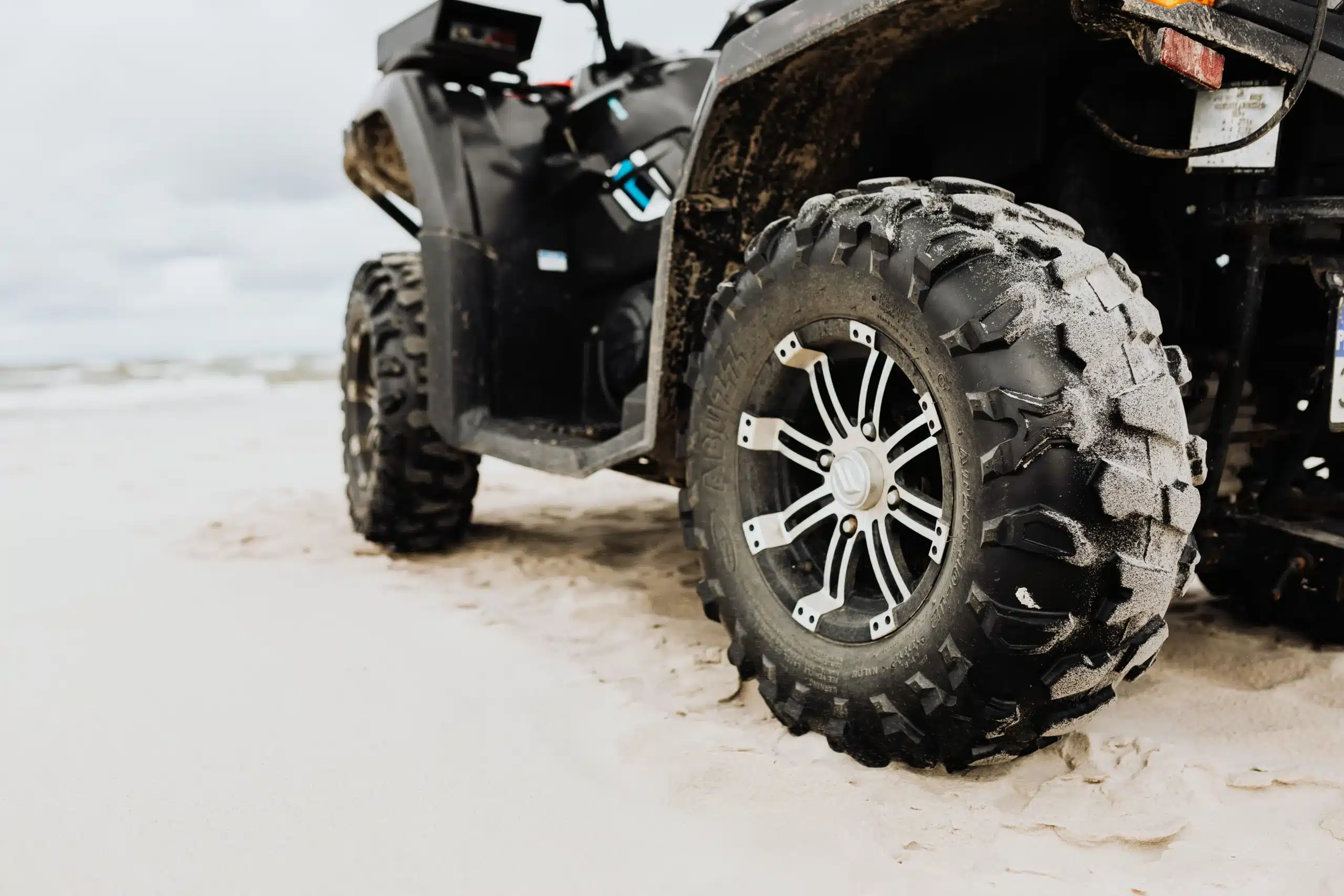
Soft ground, especially due to incessant rains, is a slow-motion problem. An ATV sitting on saturated grass, mud, or sand can sink several inches over the course of a few hours, especially under the heat and weight of a recently ridden machine. When the ATV sinks unevenly, the frame tilts, stress loads shift to the suspension, and getting the machine mobile again often requires another vehicle.
The fix is simple: carry a set of load-distribution boards, ramp sections, or rubber mats large enough to place under each tire contact point. These spread the machine’s weight over a wider surface area and prevent concentrated sinking. If you don’t have boards, spend 30 seconds scouting the area before you commit to a spot.
Compacted dirt paths, gravel patches, and rock outcroppings within the parking area are far more stable than they look compared to the surrounding soft ground. It’s worth the short walk.
Securing Your ATV Against Theft When Parked
A single lock on a trailhead ATV is a suggestion, not a deterrent. ATV theft prevention works as a layered system because determined thieves make quick work of a single measure, but consistently skip vehicles that require defeating multiple independent obstacles. The logic is simple: why spend five minutes on a well-secured ATV when there’s an unlocked one 50 feet away?
Physical Locks and Anchoring Methods
Build your anti-theft approach with at least two physical locks deployed at the same time:
- Disc or brake lock: Clamps onto a brake disc and prevents wheel rotation. Compact and fast to deploy. Use one on a front or rear wheel as the first layer.
- Chain or cable lock: A heavy chain threaded through the frame or rear rack and anchored to a fixed object significantly raises the effort required to move the ATV. When there’s no fixed post or anchor ring, run the chain through the trailer hitch receiver or around a tire-to-axle connection on your tow vehicle.
- Steering lock: If your ATV has a built-in steering lock or you’ve added an aftermarket handlebar clamp, use it. It’s not sufficient alone, but it adds another step a thief has to defeat.
The disc lock matters most when paired with an anchor chain. The chain alone keeps the ATV from being rolled away. The disc lock prevents it from being ridden off. Together, they require two separate tools and two separate approaches to defeat.
GPS Trackers and Deterrent Accessories
A GPS tracker doesn’t prevent theft, but it dramatically improves recovery odds. Mount the tracker in a non-obvious location, away from standard compartments that would be checked first. Frame cavities, under-seat brackets, or inside hollow bars are common covert mounting points. Keep the tracker registered and active before every ride, not just when you remember.
Visual deterrents add a layer before a thief ever touches your machine. A fitted cover with visible security branding signals that the owner takes security seriously. It also conceals the ATV’s make and model from casual observation, which reduces opportunistic targeting. A visible cable or chain lock at trailhead parking serves the same signaling function: it tells anyone looking that defeating this ATV requires tools and time.
Photograph your ATV before every trip. Store the serial number and VIN separately from the machine, either in a cloud document or on your phone. This information is required immediately when filing a police report, and having it ready reduces the lag between theft and official response.
What to Do If Your ATV Is Stolen While Parked
Act immediately. Every hour between the theft and the report increases the distance the machine can travel.
- File a police report as soon as you discover the theft. Provide the VIN, serial number, make, model, color, and any photos you have.
- Contact your insurance carrier with the police report number. Most policies require a report to process a theft claim.
- Activate your GPS tracker’s location services if you have one and share the data with law enforcement, not just with yourself.
- Notify the land management agency or event organizers if the theft occurred at a trailhead or staging area. They may have camera footage or incident records that aren’t immediately obvious.
Pre-Parking Checklist Before You Leave Your ATV Unattended
A two-minute parking routine run consistently prevents the incidents described throughout this guide. The checklist is simple enough to do mentally. The goal is to make it automatic.
Short-Stop Parking (Under 2 Hours)
For a quick break where you’ll be back within a couple of hours, run through these steps before walking away:
- Engage the parking brake. Always, on every surface, regardless of how flat it looks.
- Shift to park or first gear. This provides mechanical backup to the brake on any grade.
- Shut off the engine and remove the key. Pocket the key, don’t leave it in the ignition.
- Check the ground under the tires. Takes five seconds. If it’s soft, move or deploy boards.
- Apply your disc lock. Even for a 30-minute trail break. Opportunistic theft doesn’t wait for you to be gone overnight.
- Remove anything detachable and visible. Helmets left on the handlebar, gear bags clipped to the rack, and winch remotes sitting in the open invite theft even when the ATV itself is secured.
If you’re parking at a location with carport and covered storage available, use it for extended daylight stops, especially in high-sun environments where heat buildup on a parked machine is a real concern.
Extended or Overnight Parking
When you’re leaving the ATV for a full day, overnight, or longer, the short-stop checklist is the floor, not the ceiling:
- Deploy wheel chocks. Required on any surface with any grade. Worth doing on flat ground too if you’re leaving overnight.
- Apply your chain or cable lock anchored to a fixed object. The disc lock stays on. The chain adds the second layer.
- Cover the ATV. A fitted cover protects against weather and reduces the machine’s visibility as a target.
- Photograph the ATV before leaving. A time-stamped photo showing the locks in place and the machine’s condition is useful if a claim is ever needed.
- Confirm you’re within the posted parking time limit. If the trailhead closes at sunset, you need either a permit for overnight parking or a plan to return before then.
When a Parking Spot Isn’t Enough – ATV Storage as a Safer Alternative
Temporary parking works for temporary situations. When your parking needs become regular and the location is unsecured, unmanaged, or restricted by HOA rules, you’ve outgrown what a parking spot can provide.
Signs You Need More Than a Parking Spot
Honest answers to these questions will tell you whether you’ve crossed the threshold:
- HOA restriction: Your association prohibits ATVs in visible areas, or you’ve already received a notice.
- No secure garage: The ATV lives in a driveway, on the street, or in a backyard without fencing.
- Frequent multi-day trips: You regularly leave the ATV at a trailhead or staging area for 24 hours or more.
- Repeated theft concerns: You’ve had accessories stolen, attempted theft, or know someone in your riding group who has.
- Weather exposure: The ATV sits outside through full seasons without any structural protection.
- Storage at home isn’t viable: Space, neighborhood rules, or lease restrictions make home storage impossible.
Any one of these signals that the gap between “parking” and “secure storage” is costing you either money, stress, or both.
What to Look for in an ATV Storage Facility
A purpose-built ATV storage facility offers features that no trailhead lot, residential driveway, or event staging area can match. When evaluating options, look for:
- Perimeter fencing: A fully fenced facility raises the physical barrier against unauthorized access significantly.
- Camera surveillance: 24-hour camera coverage creates a documented record of access and deters opportunistic theft.
- Gated entry with access control: Keypad or card access limits who can enter to registered tenants.
- Surface type: Paved or compacted gravel surfaces are preferable to dirt lots that become soft in rain.
- Covered or enclosed options: Covered spaces protect against sun and weather. Enclosed units offer the highest protection for long-term storage.
- Access hours: Some facilities offer 24-hour access; others have staffed hours. Know which fits your riding schedule.
For riders who have reached the limits of driveway parking, trailhead lots, or a corner of the garage, ATV storage at RecNation provides a dedicated option built around vehicles like yours – not repurposed from a general self-storage unit. Secure fencing, camera coverage, and controlled access mean your ATV is protected between rides without you having to build a parking routine around hoping for the best.
Frequently Asked Questions About ATV Parking Safety
Is it safe to park an ATV on a slope or hill?
Parking an ATV on a slope is risky unless you take specific precautions. Engage the parking brake, shift into first gear or park, and place wheel chocks behind the downhill-side tires before walking away. On slopes steeper than roughly 15 degrees, the ATV may roll even with the brake engaged if the terrain shifts or the brake mechanism is worn. Find a flatter surface whenever possible, and treat wheel chocks as non-negotiable equipment for any inclined parking.
Can I leave my ATV parked overnight at a trailhead?
Most public trailheads do not permit unattended overnight parking without a permit, and some prohibit it entirely. Rules vary by land management agency – the Bureau of Land Management, Forest Service, and state park systems each set their own policies. Check the specific trailhead’s posted rules or the managing agency’s website before planning an overnight stop, and expect fines or impoundment if you exceed posted time limits.
What is the best way to lock an ATV when parked?
A single lock is not enough. Use a layered approach: a disc or brake lock on the wheel, a heavy chain or cable anchoring the ATV to a fixed object or trailer hitch, and a steering lock if your ATV has one. Add a GPS tracker mounted in a non-obvious location for recovery if the machine is moved despite the locks. Visible deterrents like a cover with a security logo can discourage opportunistic theft before a thief gets close enough to test your locks.
Can I park my ATV in my driveway or on the street?
Whether you can park an ATV on a residential driveway or street depends on your local zoning ordinances, HOA rules, and state laws. Most residential zones allow short-term driveway parking, but some HOAs explicitly prohibit ATVs from being stored or parked in visible areas. Street parking for a four-wheeler is generally not legal in most jurisdictions, and even where it isn’t technically prohibited, it exposes the machine to theft and weather. Check local ordinances and your HOA agreement before defaulting to driveway or street parking.
How do I park an ATV on soft or muddy ground without it sinking?
Park on a board, ramp plate, or load-distribution mat if the ground is soft. Soft surfaces like wet grass, mud, and sand allow ATV tires to sink over time, which can tilt the machine, stress the suspension, and make it difficult to move when you return. If no boards are available, scout for the firmest patch of ground within your parking area. Compacted dirt or gravel patches are significantly more stable than saturated soil.
When does it make more sense to use an ATV storage facility than a parking spot?
A storage facility is the better choice when you’re leaving the ATV unattended for more than a day or two, when your home doesn’t have a secure garage, or when your HOA restricts where you can keep the vehicle on your property. Dedicated ATV storage facilities offer features that no trailhead parking lot or driveway provides: perimeter fencing, camera surveillance, gated access control, and often covered or enclosed options that protect against weather. For riders who are between seasons or frequently visit a riding area on multi-day trips, a nearby storage facility is safer and more practical than relying on temporary parking.