Buying a jet ski triggers a specific set of legal obligations that start the moment you take ownership and continue every time you launch, tow, or park the machine. You need registration, required safety gear, insurance, a road-legal trailer, and a compliant place to store it.
This guide covers all of it in one place, so you are not piecing together answers from five different sources.
Step One: Register Your Jet Ski and Get the Title Right
Jet ski registration is mandatory in all 50 states. Under federal boating law, every motorized recreational vessel operated on public waterways must carry a valid registration number. The U.S. Coast Guard Boating Safety Division also requires the hull identification number (HIN) stamped on the craft to match the registration paperwork at all times.
Registration is handled at the state level, not federally. Depending on where you live, the process runs through the DMV, a department of natural resources, or a fish and wildlife commission. In Florida, jet ski registration is managed by the Florida Fish and Wildlife Conservation Commission. In California, vessel registration goes through the DMV. In Texas, it runs through Texas Parks and Wildlife. The process differs, but the requirement does not.
Most registrations must be renewed annually or biennially, and the current registration card must be onboard every time you ride. When you buy a used jet ski, completing the watercraft title transfer promptly is critical. If you delay, the previous owner stays on record and remains legally tied to the machine.
What Documents You Need to Register a Jet Ski
Gather these before visiting your state agency:
- Hull identification number (HIN): Located on the stern of the craft. Must match all paperwork.
- Proof of purchase or bill of sale: Confirms the transaction and establishes the sale price.
- Prior registration: Required for used jet skis to show the ownership chain.
- Valid government-issued ID: Required for the new owner’s application.
- Applicable fees: Vary by state; check your state’s boating authority website.
- Lien release: Required in some states if the jet ski was purchased with financing.
Do You Need a Separate Title for a Jet Ski?
Some states issue a watercraft title separately from registration, similar to a car title. Others treat registration alone as proof of ownership. Title matters for resale, insurance claims, and proving ownership if the jet ski is stolen or disputed. Check your state’s boating authority website to confirm whether a separate title applies in your state.
Step Two: Complete Boater Education and Operator Licensing
There is no single federal jet ski license, but many states have mandatory boater education laws that function as a legal prerequisite to operating a personal watercraft:
- California, Florida, Texas, and New York all require operators to complete a NASBLA-approved boater safety course and carry a boating safety certificate on the water. Failing to carry the card is a finable offense in those states, even if you completed the course.
- NASBLA, the National Association of State Boating Law Administrators, sets curriculum standards that individual states adopt. Approved courses are available online and in person, and a completed course from an approved provider satisfies the requirement wherever that state’s law applies.
- Age restrictions add another layer. Most states set a minimum operating age for PWCs, commonly between 14 and 16 for unsupervised operation. Some require adult supervision below a specific age.
- The two requirements apply simultaneously. A 15-year-old in a mandatory-education state needs both the completed course and to meet the age threshold.
State requirements change periodically, so verify current rules through your state boating authority or the NASBLA website.
Age Restrictions for Jet Ski Operators
Most states prohibit unsupervised PWC operation below a minimum age, typically 14 to 16 years old. Some states require a licensed adult aboard for younger riders, regardless of whether the minor has completed a safety course. Age restrictions and education requirements are separate legal obligations that must both be satisfied at the same time.
Step Three: Get Your Required Safety Equipment
Coast Guard regulations and state boating laws establish mandatory equipment requirements for all personal watercraft on public waterways. The list below covers what is legally required. Items like a waterproof phone case, dock line, or re-boarding ladder are practical but not federally mandated.
Legally required equipment:
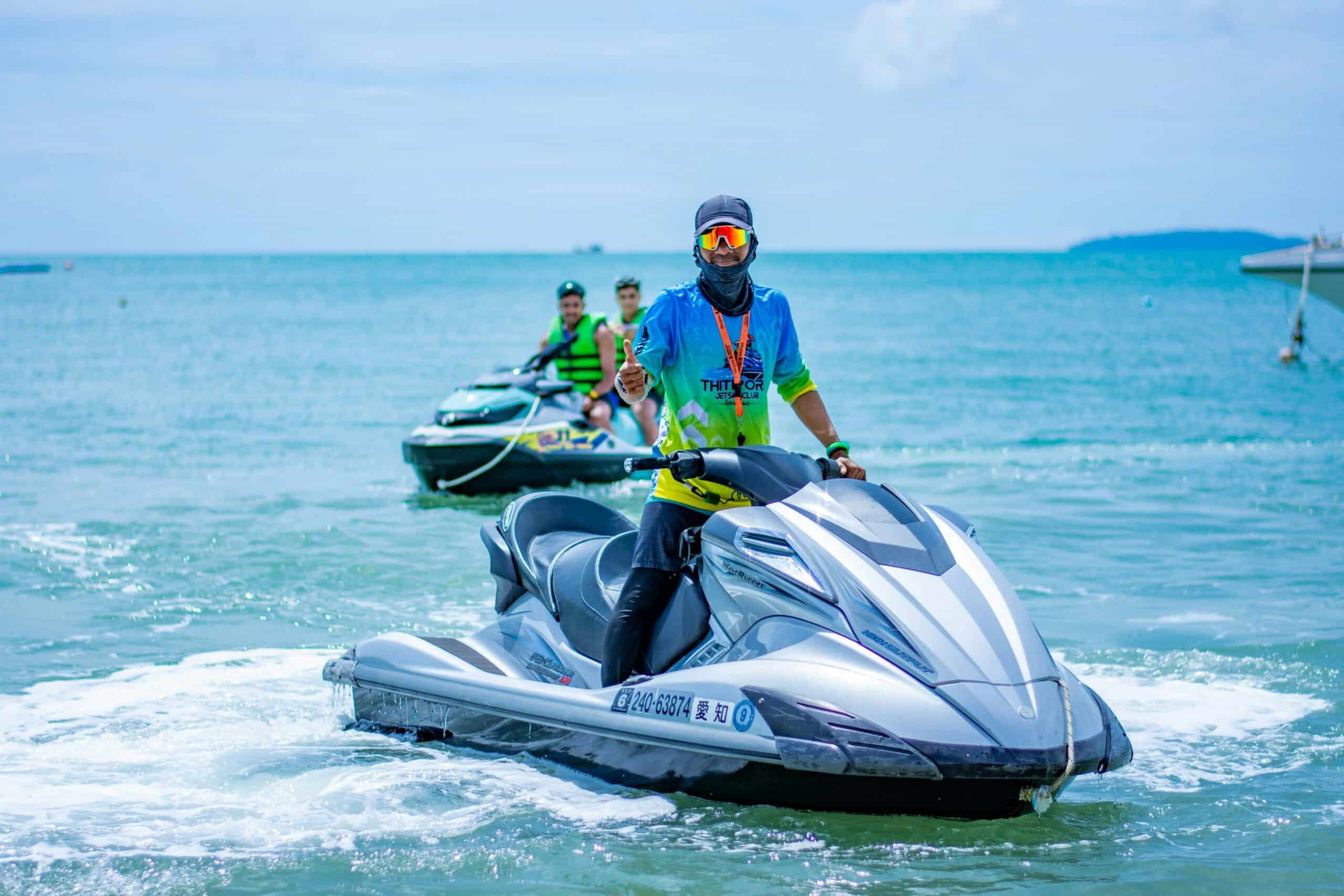
- Coast Guard-approved life jackets: One for every person aboard. Life jacket requirements on PWCs in most states now mandate that the jacket be worn, not just carried onboard.
- PWC safety lanyard (engine cut-off switch): Federal law requires this to be attached to the operator’s wrist or life jacket while underway. If the operator falls off, the engine stops.
- Sound-producing device: A whistle or air horn is required for vessels under 39.4 feet, which includes personal watercraft.
- Fire extinguisher: The fire extinguisher requirement applies to PWCs with enclosed engine compartments. Check your model’s Coast Guard classification to confirm whether this applies.
- Registration documentation: The current registration card must be onboard at all times.
Some states impose additional requirements. Carbon monoxide safety awareness rules apply in certain states for enclosed or docked operation. Noise ordinance compliance is enforced on specific waterways, particularly in residential lake communities. Check your state’s rules before your first ride.
Life Jacket Rules for Personal Watercraft
Federal law requires a wearable, Coast Guard-approved personal flotation device (PFD) for every person aboard a personal watercraft:
- Type I, II, III, or V PFDs are all accepted, with Type III being the most common style worn on jet skis for comfort and mobility.
- Inflatable PFDs are prohibited for PWC use, even though they’re approved for many other boating activities. If your PFD is inflatable, it doesn’t satisfy the requirement on a jet ski regardless of type.
- “Wear” versus “carry” is the critical legal distinction. A life jacket strapped to the hull does not satisfy the requirement in most states.
- This is a shift you should know about. Life jacket requirements for PWCs have moved specifically toward mandatory wear rules, so carrying one loose on deck is not enough.
The Kill Switch Lanyard Rule
The engine cut-off switch lanyard must be attached to the operator at all times while the jet ski is underway. If the operator is thrown off, the engine cuts automatically. Many states have added active enforcement of this rule in recent years, making it both a safety and a legal compliance issue on every ride.
Step Four: Sort Out Jet Ski Insurance
Personal watercraft insurance is not required by federal law, but some states mandate liability coverage. Arkansas and Utah are confirmed examples. Check your state insurance commissioner or boating authority to find out whether your state requires it.
Even where it is not legally mandated, insurance is practically necessary. Most marinas require proof of liability coverage before granting a docking permit or marina slip rental access. Without it, your PWC storage and launch options shrink significantly.
The homeowners policy gap catches many new owners off guard. Standard homeowners and renters insurance policies typically cover a jet ski while it is stored on your property, but liability coverage ends once the PWC launches on public water. The Insurance Information Institute notes that this gap is one of the most common coverage oversights among recreational vehicle owners.
A dedicated personal watercraft insurance policy covers liability for bodily injury and property damage to others, collision damage to the craft, and uninsured watercraft coverage. Personal watercraft insurance costs vary based on the craft’s value, the operator’s experience, the state, and the coverage limits selected.
What a Standard Homeowners Policy Usually Won’t Cover
Once your jet ski is on public water, your homeowners liability coverage typically does not extend to injuries or property damage caused by the craft. This is the single most important insurance fact for a new owner to understand. A separate personal watercraft insurance policy fills that gap and is worth getting regardless of whether your state legally requires it.
Step Five: Make Sure Your Trailer Is Road-Legal
A boat trailer is a separately registered vehicle in the eyes of state DMVs. Towing a jet ski on public roads with an unregistered or non-compliant trailer is a legal violation that has nothing to do with the jet ski’s own registration status. Both must be compliant independently.
The main compliance categories for trailer road legality are registration, lighting, brakes, and hitch rating. Trailer registration is handled through your state DMV, not the boating authority, and requires its own plate and registration document.
Lighting must meet NHTSA Federal Motor Vehicle Safety Standards, including functioning brake lights, tail lights, and turn signals. Some states require trailer brakes when the loaded trailer weight exceeds a threshold, commonly between 1,500 and 3,000 pounds depending on the state. A jet ski trailer loaded with a heavier personal watercraft may cross that threshold. Your tow vehicle’s hitch must be rated for the combined weight of the trailer and the loaded craft.
Before every tow, run through this checklist:
- Trailer registration: Current and displayed on the plate.
- License plate: Visible and securely attached.
- Lights: Brake lights, tail lights, and turn signals all functional.
- Hitch ball size: Matched to the trailer coupler.
- Safety chains: Crossed and secured to the tow vehicle.
- Tie-downs: Jet ski strapped securely at bow and stern.
Trailer Registration and Lighting Basics
Trailer registration is renewed through the DMV on the same cycle as your other vehicles. A valid registration sticker must be displayed. Functional brake lights and turn signals are a traffic enforcement requirement, not just a safety suggestion. A non-compliant trailer can generate a roadside citation regardless of how well-maintained the jet ski itself is.
Step Six: Choose a Legal Storage Option
Where you store a jet ski is not purely your decision. HOA watercraft rules, local zoning ordinances, and neighborhood covenants frequently restrict or outright prohibit storing recreational vehicles, trailers, or watercraft on residential property, in driveways, or visible from the street. This is the part of jet ski ownership that most guides skip entirely, and it catches new owners by surprise.
HOA rules vary widely:
- Some allow storage only in a fully enclosed garage.
- Others prohibit any trailer or recreational vehicle visible from the street, with violations resulting in fines.
- Municipal zoning codes can add a second layer of restriction on parking trailers or non-motorized equipment in residential front yards.
Before assuming your driveway is a legal storage option, review your HOA’s CC&Rs and your city or county zoning code.
Three practical PWC storage options are worth comparing:
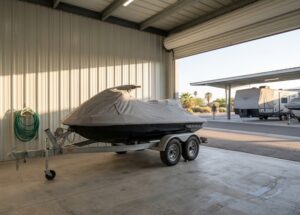
- Residential driveway or garage: Works where not restricted, but the jet ski is exposed to UV damage and weather without a quality cover.
- Marina slip rental: Offers convenient water access, but costs more, often requires proof of insurance, and availability varies by season.
- Dedicated storage facility: Provides the most consistent protection, whether as covered storage for recreational vehicles or enclosed indoor units. For owners who face HOA restrictions or simply want a more secure option than a driveway, boat and RV storage at a dedicated facility like RecNation provides security features and weather protection that residential storage cannot match.
Storage costs vary significantly across these three options. If you’re weighing the cost difference between a marina slip rental and a dedicated dry storage facility, reviewing how much you should expect to pay for vehicle storage can help you set a realistic budget.
HOA and Zoning Rules That Affect Jet Ski Storage
Common restrictions you may encounter include:
- Prohibitions on trailers visible from the street.
- Requirements that recreational vehicles be stored only in enclosed structures.
- Height or size limits on items in driveways.
Review your HOA CC&Rs and local municipal code before purchasing a jet ski if home storage is your plan.
Indoor vs. Outdoor Storage: What Protects a Jet Ski Best
The three storage tiers offer progressively better protection, and the differences matter most for owners deciding whether to stick with the driveway or step up.
| Driveway | Covered/Carport | Indoor Enclosed | |
| UV protection | None | Yes | Yes |
| Rain protection | None | Yes | Yes |
| Security | Low | Moderate | Maximum |
| Winterization | Exposed to freeze-thaw cycles | Partial protection | Temperature controlled |
Driveway storage leaves the jet ski exposed to UV degradation, rain, and potential theft. Covered or carport-style storage adds UV and rain protection with moderate security, while indoor enclosed storage provides maximum protection against environmental damage and security risks. Winterizing a jet ski is also more straightforward in an indoor environment, since the temperature is controlled and the craft isn’t subject to the freeze-thaw cycles that can damage the hull, engine block, or water lines.
Final Thoughts on Owning and Storing a Jet Ski
Once you have your registration, safety gear, insurance, and trailer compliance sorted, the last piece is finding a place to keep your jet ski that doesn’t put you sideways with your HOA or local zoning code. RecNation jet ski storage facilities offer covered and indoor storage options designed specifically for personal watercraft and trailers, so your jet ski is protected, secure, and ready when the season opens.
Frequently Asked Questions
Do you need a license to drive a jet ski?
There is no single federal jet ski license, but many states legally require PWC operators to complete a NASBLA-approved boater safety course and carry a boating safety certificate on the water. States with this requirement include California, Florida, Texas, and New York, among others. The minimum age to operate a jet ski unsupervised also varies by state, commonly between 14 and 16 years old. Check your state’s boating authority website for the specific rules that apply to you.
What safety equipment is required on a jet ski?
Federal law requires every person aboard a personal watercraft to have a Coast Guard-approved life jacket, and most states now require it to be worn, not just carried. The PWC’s engine cut-off switch lanyard must be attached to the operator while underway. You also need a sound-producing device such as a whistle or air horn, and depending on your model, a fire extinguisher. Your current registration documentation must also be onboard at all times.
Can you store a jet ski in a residential driveway?
It depends on your HOA rules and local zoning ordinances. Many homeowners associations prohibit recreational vehicles, trailers, or watercraft from being stored in driveways or visible from the street, and violations can result in fines. Some municipalities have similar restrictions under local zoning codes. Review your HOA’s CC&Rs and your city or county zoning rules before assuming driveway storage is permitted.
How much does it cost to insure a jet ski?
Jet ski insurance costs vary based on the value of the craft, your experience level, your state, and the coverage limits you choose. Standard homeowners insurance typically does not cover PWC liability on public water, so a separate personal watercraft insurance policy is often necessary even where state law does not mandate it. Get quotes from watercraft-specific insurers to compare options for your situation.
Do you need to register a jet ski in every state?
Jet ski registration is required in all 50 states for personal watercraft operated on public waterways. If you move to a new state or use your jet ski there regularly, you may need to re-register it in that state. Most states allow a short grace period for out-of-state visitors, but extended or full-time use typically triggers a local registration requirement. Check the boating authority in the state where you primarily use the craft.
What do you need to legally tow a jet ski on the road?
Your boat trailer must be registered with your state DMV and display a valid registration plate. It must have functioning brake lights, tail lights, and turn signals that meet NHTSA safety standards. Some states require trailer brakes if the loaded trailer weight exceeds a threshold, commonly 1,500 to 3,000 pounds depending on the state. Your tow vehicle’s hitch must be rated for the combined weight of the trailer and jet ski, and the craft must be secured with proper tie-downs before driving.