Most jet ski owners don’t think about storage until something forces the decision. You bought the watercraft, you’ve been riding it, and then suddenly your driveway isn’t an option anymore, or winter is coming, or your HOA sends a notice.
This guide maps the specific ownership moments that make jet ski storage necessary and explains which option fits each situation.
The Moment You Park It and Run Out of Space
A jet ski purchase often happens before the storage logistics are sorted out. That’s normal. What catches new owners off guard is how much physical space a personal watercraft actually occupies once it’s on a trailer in a residential setting.
A typical sit-down PWC on a trailer runs 10 to 12 feet long and 6 to 8 feet wide. That footprint eliminates most single-car garages the moment a second vehicle is already inside. Even with a two-car garage, there’s rarely enough clearance for two cars and a trailered watercraft without dedicated planning.
Driveway parking feels like the obvious short-term fix. In practice, it’s rarely a long-term option.
HOA and Municipal Restrictions
Many jet ski owners in planned communities discover storage restrictions after the purchase, not before. Homeowners association (HOA) covenants and municipal zoning codes commonly prohibit trailer-mounted recreational vehicles from sitting in a driveway for more than 24 to 72 hours. Some ordinances add visibility requirements, meaning if the unit can be seen from the street, it’s in violation.
Check your HOA covenants or local zoning code before assuming your driveway is a workable long-term solution. The restriction is usually already there.
Garage and Property Dimensions
A standard two-car garage will not comfortably accommodate two vehicles and a trailered jet ski without dedicated space planning. Vertical home garage storage racks exist but require at least 10 to 12 feet of ceiling height and floor reinforcement capable of supporting 800 to 1,000 pounds. Most residential garages don’t meet both requirements.
Recognizing the space problem early prevents a last-minute storage search at the worst possible time.
Your First Off-Season: When Seasonal Storage Becomes Necessary
The first off-season is the most common inflection point for jet ski storage decisions. Home storage is often physically impractical, legally restricted, or insufficiently protective once the riding season ends. If you need boat and RV storage facilities nearby, that realization usually hits hardest in October.
What counts as the “off-season” varies by climate. In cold-weather states, freezing temperatures create a hard deadline: water left inside the cooling system and exhaust can crack engine components. In warm states like Florida and Texas, the off-season is less about cold and more about months of non-use during travel, heat peaks, or schedule gaps. Both situations create the same need for a dedicated storage plan.
Leaving a personal watercraft in a marina slip year-round costs more than off-site storage and keeps the hull in constant water contact. That continuous exposure accelerates gelcoat wear and marine growth in ways that dry storage prevents entirely.
Cold-Weather Storage and Winterization
Winterizing a jet ski before sub-freezing storage is a maintenance requirement, not a precaution you can skip. The process involves flushing the cooling system, applying a marine-grade fuel stabilizer, and fogging the engine cylinders to prevent corrosion.
NMMA guidance on fuel stabilization supports treating ethanol-blend fuel storage as a standard maintenance step, not an optional one. E10 fuel begins to phase-separate within 30 days in a stored engine, and Rotax and Kawasaki four-stroke engines are particularly susceptible to fuel injector damage from degraded fuel during off-season storage.
Warm-Climate Off-Season Storage
Owners in Florida, Texas, Arizona, and similar states face a different version of the same problem. UV exposure during non-use periods accelerates hull gelcoat fading and seat foam degradation. Even without freezing temperatures, indoor or covered storage is the practical choice for any extended period of non-use. Watercraft depreciation accelerates when UV damage accumulates across multiple seasons without protection.
Life Changes That Force the Storage Decision
Some storage decisions aren’t seasonal. They’re triggered by a change in circumstances that removes whatever informal arrangement was working before. These are the scenarios competitors skip over. Each one is a realistic inflection point in PWC ownership.
- Relocating to a home without accommodation. A move to an apartment, condo, or property without a driveway or garage eliminates the informal storage setup entirely. Off-site storage becomes the only option.
- Purchasing a second jet ski. A two-jet-ski household needs 20 to 24 linear feet of trailer storage space at minimum. That exceeds most residential property limits and eliminates driveway storage entirely.
- Renting out a primary residence or vacation property. When the owner no longer occupies the space where the watercraft was stored, access disappears. This is one of the most overlooked triggers for a first storage facility inquiry.
- HOA enforcement of a previously ignored restriction. A neighbor complaint or new property management company can activate a restriction that was technically in place but never enforced.
- An insurance renewal that flags home storage. According to the Insurance Information Institute, personal watercraft stored off the owner’s property may fall outside standard homeowner or marine policy coverage. Storing at a facility without confirming off-site provisions can leave the unit underinsured.
Buying a Second Jet Ski
Doubling the fleet doubles the logistics. The space that worked for one trailered unit almost never works for two. A second jet ski is one of the most common triggers for a first-time storage facility inquiry, and the transition from driveway storage to a dedicated facility usually happens quickly once owners see the footprint required.
Moving or Renting Out Your Property
A home sale, rental arrangement, or move to a property without storage capacity creates an immediate gap. Watercraft maintenance and registration don’t pause because your living situation changed. Off-site storage fills that gap without requiring you to impose on a friend’s property or leave the unit exposed.
Which Storage Format Fits Your Situation
Once you’ve identified your scenario, the next step is matching it to a storage format. The options vary by cost, protection level, and convenience. Understanding the trade-offs helps you choose without overpaying for features you don’t need or underpaying for protection that lets the unit deteriorate.
For a full breakdown of what different formats typically cost, see how much storage costs.
| Storage Format | Protection Level | Approx. Monthly Cost | Best For |
| Outdoor open storage | Basic (gated security) | $50 to $150 | Dry climates, frequent access |
| Covered/carport storage | UV and weather protection | $100 to $200 | Most climates, mid-range budgets |
| Enclosed indoor storage | Full protection | $150 to $300 | Long off-seasons, high-value units |
| Marina rack storage | Convenient, not off-season | $200 to $400 | Active riders launching weekly |
Outdoor vs. Covered vs. Indoor Storage
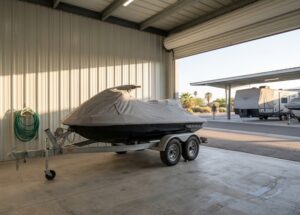
Outdoor storage at a gated facility is a real security upgrade over a residential driveway, even without a roof structure. Add a fitted jet ski cover and you’ve addressed most weather exposure in dry climates. Covered storage for recreational vehicles adds UV and precipitation protection at a moderate cost increase. Indoor storage eliminates UV, moisture, and security risk entirely.
Climate-controlled storage options within enclosed facilities are worth considering for owners in high-humidity or salt-air coastal environments where corrosion is a faster threat. If you’re looking for a facility built for recreational vehicles rather than a repurposed mini-storage lot, RecNation offers covered and enclosed options sized for trailered PWCs across multiple states.
Marina and Rack Storage
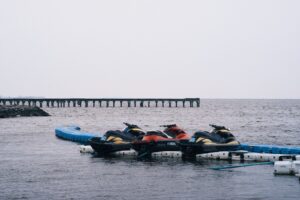
Marina storage works well for riders who launch several times a week and want minimal transit time. It’s not an off-season storage solution. Wet slip arrangements keep the hull in constant water contact, which accelerates wear and marine growth. Dry-rack storage at a marina is better for hull protection but typically costs more than a land-based self-storage facility offering equivalent coverage.
What to Do Before You Put Your Jet Ski in Storage
Preparation matters regardless of which storage format you’ve chosen. These steps apply to any storage period longer than 30 days. Some steps vary based on whether you’re using indoor or outdoor storage, and those distinctions are noted.
Fuel and Engine Preparation
The three most common reasons an owner returns to a non-starting engine after storage are skipped fuel treatment, unoiled cylinders, and a dead battery. Handle all three before the unit goes in.
- Add a marine-grade fuel stabilizer to a full tank and run the engine for 5 to 10 minutes to circulate it through the fuel system. Products like Star Tron or Sta-Bil Marine are formulated for ethanol-blend fuels. Automotive stabilizers are not a substitute.
- Fog the engine cylinders with fogging oil through the air intake to prevent internal corrosion during the storage period.
- Remove the battery and store it separately on a trickle charger. A battery stored in a discharged state sulfates and typically won’t recover.
Trailer and Cover Preparation
Trailer tires stored under static load for 90 or more days are at risk of flat-spotting. Tire manufacturer guidance recommends reducing tire pressure by 10 to 15 PSI or supporting the trailer frame on jack stands during long-term storage to prevent handling problems when the unit returns to road use.
A few more things to check before storage:
- Cover venting matters. A properly fitted jet ski cover with venting prevents moisture buildup beneath it. A non-vented cover in a humid environment can trap condensation and cause mold.
- Confirm your Hull Identification Number (HIN) and current registration. U.S. Coast Guard Boating Safety requires HIN documentation to accompany watercraft registration, and many storage facilities require proof of valid registration at intake. Having both ready prevents delays.
Final Thoughts on Jet Ski Storage Timing
RecNation Storage offers covered and enclosed jet ski storage at locations across Arizona, California, Florida, Texas, and other states, with unit sizes and access hours built around how recreational vehicle owners actually use storage. If your situation has reached the point where home parking is no longer practical, a dedicated facility keeps your investment protected and ready for the next season.
Frequently Asked Questions
Where is the best place to store a jet ski when not in use?
The best storage location depends on how long the unit will sit and what climate you’re in. For storage periods longer than 30 days, an enclosed indoor storage unit at a dedicated vehicle storage facility offers the best protection against UV damage, moisture, and theft. Outdoor storage at a gated facility is a practical and more affordable option in dry climates, provided the unit is covered with a fitted jet ski cover. Leaving a jet ski in a residential driveway is generally not recommended for extended periods due to HOA restrictions, weather exposure, and security risk.
Can you store a jet ski outside year-round?
In mild, low-humidity climates, outdoor storage with a quality cover is workable year-round, but it carries real trade-offs. UV exposure gradually degrades hull gelcoat and seat vinyl, and precipitation entering a poorly sealed cover can cause mold and interior moisture damage. In cold-weather states, outdoor storage requires complete winterization before temperatures drop below freezing, since trapped water in the engine block or exhaust can crack components. Most owners with high-value units move to covered or indoor storage for the off-season even in mild climates.
How much does it cost to store a jet ski at a marina or storage facility?
Costs vary by region, facility type, and storage format. Outdoor open storage at a land-based vehicle storage facility typically runs $50 to $150 per month. Covered or carport storage falls in the $100 to $200 per month range. Enclosed indoor storage units generally run $150 to $300 per month depending on unit size and location. Marina rack storage tends to be the most expensive option at $200 to $400 per month in most markets. Wet slip storage at a marina may also include launch fees and maintenance surcharges not included in the monthly rate.
Do I need a storage unit for my jet ski in the winter?
If you live in a climate where temperatures drop below freezing, off-site storage is strongly recommended unless you have a heated, enclosed garage at home. A jet ski left outdoors without proper winterization is at risk of engine block cracking from frozen water in the cooling system. Many municipalities and HOAs also restrict long-term driveway storage of trailered recreational vehicles, which can make a storage facility the only compliant option regardless of climate. Even in warm states, an indoor or covered storage unit protects the unit from UV exposure and theft during months of non-use.
What do I need to do before putting my jet ski in storage?
At minimum, complete these steps before any storage period longer than 30 days: flush the cooling system with fresh water, add a marine-grade fuel stabilizer to a full tank and run the engine briefly to circulate it, fog the engine cylinders with fogging oil to prevent corrosion, remove or trickle-charge the battery, and cover the unit with a fitted jet ski cover appropriate for your storage environment. For trailer storage lasting 90 days or more, reduce tire pressure by 10 to 15 PSI or support the trailer on jack stands to prevent flat-spotting. Confirm your jet ski registration is current before dropping the unit at a storage facility, as many require proof of valid registration at intake.