Covered boat storage (canopy) typically costs between $99 and $351 a month as of October 2026, with most spaces falling between $108 and $239 a month. If you’ve already decided you want some form of overhead protection, the real question is whether a canopy space gives your boat enough protection for the price. The alternatives are stepping up to a fully enclosed indoor garage or accepting the savings of outdoor uncovered storage.
This guide maps cost, protection level, and best fit by boat type across all three options so you can make that call with confidence.
What Covered Boat Storage Actually Is
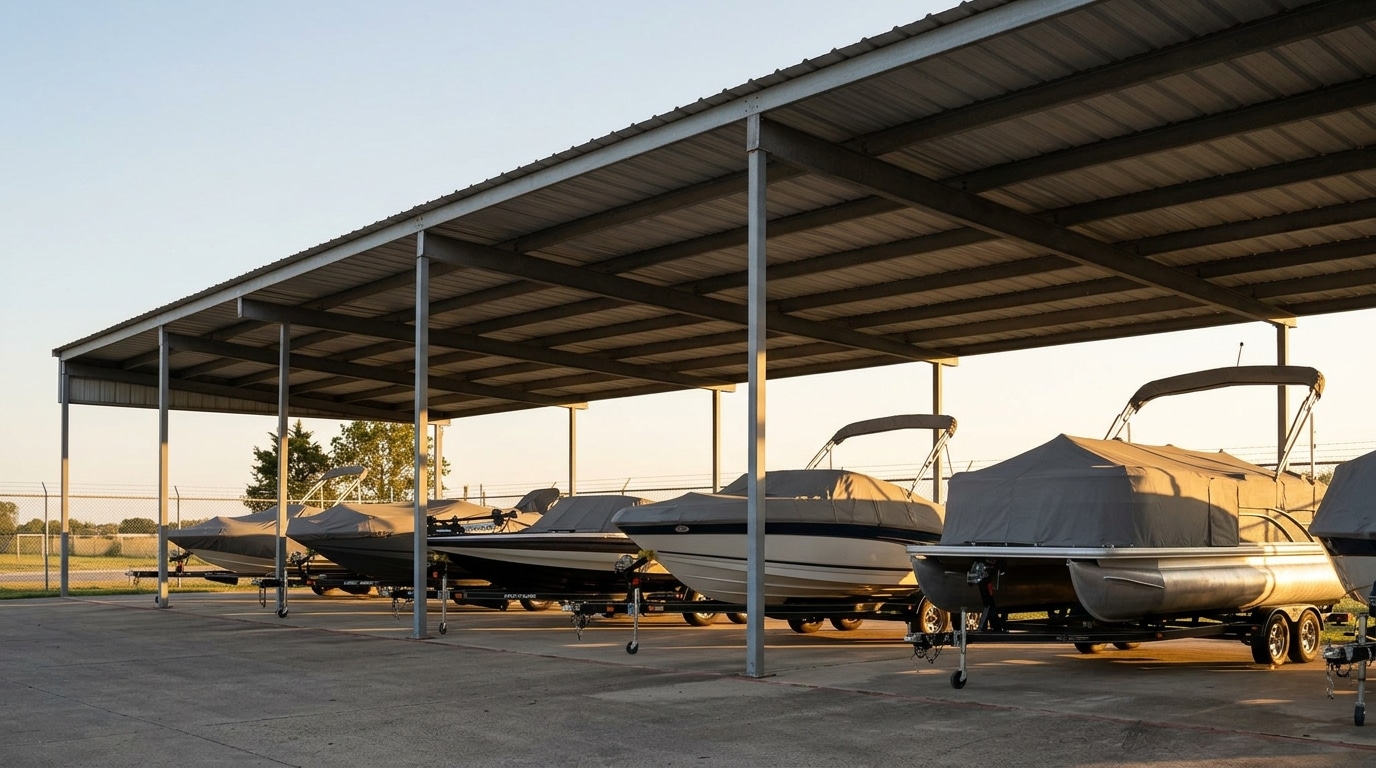
Covered boat storage is not a building. It is an open-sided roof structure, typically a metal canopy or carport-style frame, over a paved or gravel parking surface. Your boat stays on its trailer beneath the roof, with no walls on the sides.
That structure protects against some weather and leaves your boat exposed to the rest:
- What it protects against: Direct sunlight and rainfall coming straight down.
- What it cannot control: Wind-driven rain, humidity, temperature swings, and pests entering from the open sides.
Many first-time storage buyers miss the distinction between “covered” and “enclosed.” A canopy space and a fully enclosed indoor garage are different products at different price points. Because the sides of a canopy space stay open to the elements, a good-fitting boat canvas cover still matters, and types of boat covers and which fits your hull is a useful starting point.
What “Canopy” Means in Boat Storage Terms
A canopy space is an individual or grouped bay under a shared metal roof. The boat sits on its trailer on a surface below that roof, exposed on the sides. It is not a storage unit, not a shed, and not a garage.
What Covered Storage Does and Does Not Protect Against
Canopy storage provides ultraviolet (UV) protection from direct sun and blocks direct rainfall, two of the primary causes of gel coat oxidation and canvas degradation on stored boats. It does not control temperature, humidity, or moisture blown in from the sides, so it is not climate-controlled storage. For boats stored in humid coastal climates or for extended periods, that side exposure is the gap that separates canopy from fully enclosed indoor boat storage.
Covered Boat Storage Costs by Boat Size
Covered (canopy) boat storage runs approximately $99 to $351 a month as of October 2026, with most spaces priced between $108 and $239. All figures are industry estimates, and prices vary by location, size, and availability, so it helps to confirm current rates with the specific facility. Canopy rates are quoted per space, and the table below shows which trailer-length band your boat falls into.
| Space Band | Example Boat Types | Covered/Canopy Monthly Rate (Oct 2026) |
| Up to 20 ft (select locations only) | Jet skis, jon boats | $99 to $351 (most $108 to $239) |
| 20 to 30 ft | Bass boats, bowriders, smaller pontoons | $99 to $351 (most $108 to $239) |
| 30 ft and over (confirm by location) | Larger pontoons, cruisers, larger boats | $99 to $351 (most $108 to $239) |
It helps to confirm that a space up to 20 ft is available at your facility before reserving if you own a jet ski or jon boat. How to size a storage space for your boat goes into more detail on matching your boat to the right space.
How to Calculate the Space Size You Actually Need
Boat storage spaces are rented by trailer length, not hull length. That distinction affects which band you book.
A small boat on a standard trailer adds 3 to 5 feet to the hull’s printed length. A 20-foot bass boat will typically need a 23 to 25 ft space, putting it firmly in the 20 to 30 ft band. Before calling a boat storage facility, measure your trailer from the hitch coupler to the tail lights. It helps not to rely on the hull length printed on your registration.
Why Rates Vary Within the Same Band
Covered canopy rates fall across a wide range because location, local market demand, specific space dimensions, and facility amenities all affect pricing. Booking online typically saves about $20 a month compared to standard walk-in rates at the same facility.
Three-Way Comparison: Outdoor, Covered, and Indoor Boat Storage
The right storage tier depends on your boat’s value, hull material, climate, and how long it will sit between uses. Here is how the three options compare across those dimensions.
| Storage Type | Monthly Cost (Oct 2026) | Protection Profile | Best Fit |
| Outdoor uncovered | $57 to $183 | No overhead protection; full UV, rain, and debris exposure | Short-term storage, dry climates, budget-constrained owners |
| Covered/canopy | $99 to $351 (most $108 to $239) | Blocks direct UV and rain; sides open to wind and humidity | Most trailered bass boats, bowriders, and smaller pontoons |
| Indoor garage | $114 to $216 for most sizes, up to $701 for 15 x 50 ft | Full enclosure; blocks UV, rain, and wind-driven moisture | High-value boats, fiberglass hulls in humid climates, storage of 6 months or more |
Covered storage is the value middle ground for most trailered boat owners. It delivers meaningful UV and rain protection for roughly 0.26 more per square foot per month than outdoor uncovered ($0.58 versus $0.32 as of October 2026). RecNation, a vehicle storage specialist, offers covered boat storage spaces across 70 locations, with canopy spaces sized by trailer length across the standard length bands.
Indoor garage storage costs more but protects more completely. Full enclosure keeps out wind-driven rain, dust, and direct sun, which matters for fiberglass boat care and for boats stored six months or longer. Neither indoor garage nor canopy storage is climate controlled.
Marina storage, including dry stack storage, is a different model. Dry stack uses vertical racks at a marina and is not the same as canopy storage.
When Covered Storage Is the Right Call
Canopy storage is the practical sweet spot for bass boats, bowriders, and smaller pontoons in the 20 to 30 ft band. If you use the boat seasonally rather than year-round, and you want UV protection and direct rain coverage without paying for full enclosure, a covered space delivers that at a reasonable premium over outdoor uncovered rates.
When to Step Up to Indoor Storage
The case for indoor boat storage sharpens in these situations:
- High-value fiberglass hull: Paint and fiberglass preservation matters more as the boat’s value rises.
- Storage of six months or more: Longer periods add more seasons of exposure.
- Humid coastal market: Mold and oxidation are real seasonal risks.
- Insurance or loan terms: Some marine insurance policies and lender agreements include storage requirements, so it helps to ask your insurance broker or facility whether a given tier satisfies your policy terms.
If one of these situations applies to you, reasons to choose fully enclosed boat storage is a useful read before you decide whether the higher rate is worth it.
When Outdoor Storage Makes Sense
Outdoor uncovered storage is a legitimate choice in dry-climate markets, for short-term storage between seasons, for boats already protected by a heavy-duty boat canvas cover or shrink wrap, and for owners whose budget makes the covered premium a dealbreaker. The monthly savings over canopy storage are real, at roughly $0.26 less per square foot. The trade-offs are covered in outdoor boat storage pros, cons, and best practices, and how much boat storage costs per year adds the annual storage fees picture.
What to Check Before You Reserve a Covered Space
It helps to run through these checks before reserving a space at any boat storage facility, whether you call or book online. These seven checks apply to any covered storage facility:
- Trailer length, not hull length: Ask which length band your boat on its trailer falls into.
- Single-vehicle or shared canopy bay: A shared roof over multiple adjacent boats means less privacy and potentially more side exposure.
- Surface strength: Confirm the surface can handle your trailer tongue weight. A light gravel pad may shift under a heavy pontoon trailer.
- Boat cover policy: Ask about the facility’s policy on boat canvas covers. Some facilities require a cover under the canopy; most recommend one.
- Power hookups: Ask about hookups for a battery tender. They are not available at every facility, so confirm before you assume.
- Bay width: Check the bay width against your beam. A wide pontoon or sport boat with a large outboard swing may need a wider bay than the length band alone suggests.
- Access hours: Confirm access hours match your use pattern. Facility hours vary, and some locations have staffed and unstaffed access windows. It also helps to ask about security features such as gating and lighting while you are on the call.
A five-minute call or online check before you commit saves you from arriving with a boat that does not fit or needs equipment the facility cannot provide.
Measuring Your Boat Correctly for a Storage Space
Trailer length is the hull length plus 3 to 5 feet, so it helps to measure the actual trailer from the hitch coupler to the tail lights. Beam matters too, because a wide pontoon or sport boat may need a wider bay even if the length fits the band.
Preparing Your Boat for Covered Storage
Because canopy storage leaves the sides of your boat open to wind, dust, and weather, preparation matters more than it would for a fully enclosed indoor space. These steps keep your hull, engine, and canvas in good condition during storage, and everything you need to know about boat storage covers boat maintenance for every storage type if you want more detail.
It helps to complete these steps in order before you drop the boat at the facility:
- Engine flush: If the boat was used in saltwater or brackish water, flush the engine with fresh water. Salt residue accelerates corrosion in cooling passages.
- Fuel stabilizer: Add fuel stabilizer and run the engine briefly so it circulates through the fuel system. Stale fuel is a common boat maintenance problem after a long storage period.
- Battery: Disconnect the battery, or connect a maintenance charger if the facility offers power hookups. Without a trickle charge, a marine battery can lose charge over a long storage period.
- Water systems: Drain livewells, bilges, and freshwater systems completely. Standing water promotes mold and can crack fittings if temperatures drop.
- Hull wax: Apply a UV-protective wax or polish to the hull for added boat hull protection. This matters more in covered storage than in fully indoor storage because some UV still enters from the open sides.
- Cover: Fit a quality canvas cover or boat shrink wrapping over the top. A fitted cover is a main defense against wind-driven rain, bird droppings, insects, and dust in a canopy space.
- Valuables: Remove electronics, fishing gear, life jackets, and other valuables before drop-off.
- Trailer: Check tire pressure and wheel bearing grease. Flat-spotted tires and dry bearings are common after a long storage period on a stationary trailer.
Covering Your Boat Under a Canopy
A fitted canvas or mooring cover is still worthwhile even when your boat is under a roof. The open sides of a canopy bay expose the cockpit and deck to wind-driven rain, dust, bird droppings, and insects throughout the storage period. Boat winterization prep in colder climates adds another reason to cover thoroughly: a canvas cover helps keep moisture from collecting in the cockpit and bilge area during temperature swings.
Final Thoughts on Covered Boat Storage
Covered storage fits most trailered boats that need sun and rain protection without the cost of full enclosure, and indoor or outdoor storage can be the better fit depending on your boat’s value, climate, and how long it sits.
For boat owners who have worked through the comparison and decided covered storage is the right fit, RecNation boat storage offers canopy spaces across 70 facilities in Arizona, California, Florida, Kansas, Missouri, South Carolina, Tennessee, and Texas. Spaces are sized by trailer length across the standard length bands, so the right fit for a bass boat, bowrider, or pontoon is straightforward to confirm before you reserve.
Frequently Asked Questions
How much does covered boat storage cost per month?
A covered canopy space typically costs $99 to $351 a month as of October 2026, and most land between $108 and $239. Rates depend on trailer length, location, and availability, and booking online at many facilities saves roughly $20 a month versus standard walk-in rates.
What is the difference between covered and indoor boat storage?
The difference is the walls: covered storage puts a roof over the boat while the sides stay exposed to wind, humidity, and temperature changes, and indoor garage storage encloses the boat on all sides to keep out wind-driven moisture, dust, and direct sun at a higher monthly cost. The right choice depends on your boat’s value, hull material, and how long it will sit between uses.
Is covered boat storage worth it compared to outdoor storage?
For most trailered boats stored through a full season, covered storage is worth the premium over outdoor, because UV exposure is a leading cause of gel coat oxidation and canvas degradation. The gap is about 0.58 versus $0.32 as of October 2026), a reasonable trade-off for a boat that will sit unused for three months or more.
What size space do I need for my boat?
The space you need follows your boat’s trailer length, not its hull length, so add 3 to 5 feet to a small boat’s hull length. Bass boats, bowriders, and smaller pontoons typically fall in the 20 to 30 ft band, jet skis and jon boats fit spaces up to 20 ft at select locations, and larger boats require 30 ft or more.
How do I prepare my boat for covered storage?
Flush saltwater from the engine and cooling system, add fuel stabilizer and run the engine briefly, disconnect the battery or connect a maintenance charger if hookups are available, and drain livewells and bilges completely. Because canopy storage is open on the sides, fit a quality canvas cover or shrink wrap over the boat to guard against wind-driven rain, dust, and birds. Remove all electronics and valuables before drop-off.