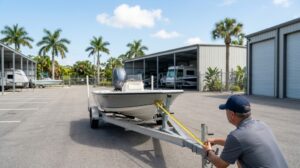
Boat storage costs roughly $57 to $700 or more per month depending on storage type, boat size, and location. This guide breaks down monthly rate ranges by storage type, maps those ranges to real vessel categories, and shows how to calculate your annual cost before you book.
What Boat Storage Costs at a Glance
The table below gives you a fast reference before you dig into the detail. Prices vary by location, size, and availability, so treat these as working ranges, not guarantees.
| Storage Type | Monthly Range | Annual Estimate (12 Months) | Best For |
| Outdoor uncovered | $57 to $183 | $684 to $2,196 | Budget-conscious owners; dry climates |
| Outdoor canopy (covered) | $99 to $351 | $1,188 to $4,212 | Most recreational boat owners |
| Indoor garage | $114 to 216 (most sizes); up to ~$701 for 15 x 50 ft | $1,368 to $8,412 | High-value vessels; harsh winters |
| Marina slip (wet storage) | Varies widely by region and slip size | See section below | Frequent seasonal users |
All figures are industry estimates as of October 2026, so it helps to confirm current rates with the specific facility before you book. Online booking at many facilities runs about $20 per month below standard rates.
What drives the spread within each row is a combination of boat size, geographic location, and storage type. The size-band section below explains exactly where your vessel falls.
How to Read These Ranges
Monthly storage rates shown here assume you pay month to month. Your annual storage fees are simply the monthly rate multiplied by the number of months you store. If you use the boat only May through September, that is five months of storage fees, not twelve. The key is to calculate your space requirement from your boat size and length measured on the trailer, not hull length alone. That distinction is explained in the next section.
Boat Size Bands and What They Mean for Storage Cost
Boat storage is priced by the length of the space, and that length is determined by your boat’s trailer length, not the hull measurement printed on the spec sheet. For boat trailer storage, the trailer itself adds approximately 3 to 5 feet to what you need on the ground.
| Size Band | Trailer Length | Vessel Types That Fit | Storage Tier |
| Small | Up to 20 ft (select locations) | Jet skis, jon boats | Select locations only |
| Mid | 20 to 30 ft | Bass boats, bowriders, smaller pontoons | Outdoor, canopy, or indoor |
| Large | 30 ft and over | Larger pontoons, cruisers, cabin boats | Confirm by location |
Each band below shows which vessels fit, which space to ask for, and the monthly range to expect as of October 2026:
- Small (up to 20 ft): Jet skis and jon boats fit this band, and the space to ask for is up to 20 feet on the trailer. Spaces here are available at select locations, with outdoor uncovered rates running $57 to $183 per month.
- Mid (20 to 30 ft): Bass boats are the vessel type tenants name most, and most of them fall in this band once measured on the trailer. RecNation’s 70 facilities offer boat storage spaces in this band, and bass boats are among the most commonly stored vessels. Pontoon and bowrider owners should measure the full trailer rig before booking, since a 22-foot pontoon often needs a 25 to 27 foot space. Rates run $57 to $183 for outdoor uncovered, $99 to $351 for canopy, and $114 to $216 for most indoor garage sizes.
- Large (30 ft and over): Larger pontoons, cruisers, and cabin boats need spaces of 30 feet or more, which are available at select locations that carry longer bays. Rates in this band depend on the facility and storage type, so the ranges above are a starting reference and calling ahead saves a wasted trip.
Why Trailer Length Changes Your Space Requirement
A 20-foot bass boat sits on a standard trailer with a tongue that extends the total rig to roughly 23 to 25 feet. That is why a rig like this needs a space of about 23 to 25 feet, not 20. It helps to give the facility your full trailer length, not your hull length, when asking about monthly storage rates and availability.
A full walkthrough of space size for a boat covers more sizing examples if you want them.
Spaces at Select Locations
The smallest size band (under 20 feet) is not available at every facility. Spaces in that band are mostly uncovered and exist at select locations suited for jet skis and jon boats. Very large spaces for boats over 30 feet are also location-specific, so it helps to confirm availability for your size band directly with the facility when you book.
Outdoor, Covered, and Indoor Storage Compared
Choosing between outdoor uncovered, canopy, and indoor storage comes down to how much protection your boat needs and what you are willing to pay for it. The right tier depends on your climate, how long the boat sits between uses, and the vessel’s value. Comparing boat storage options in more depth helps if you want a full type-by-type view.
Outdoor Uncovered Storage
Outdoor boat storage has the lowest monthly rate range, running $57 to $183 per month as of October 2026. It works well for boats stored short-term or in dry inland climates where sun intensity and rain frequency are lower.
- Cost: Lowest tier; most accessible for budget-conscious owners.
- Protection: No roof or walls; full exposure to ultraviolet (UV) light, rain, and debris.
- Best for: Short-term storage, dry climates, and owners who cover their boat with a quality weatherproof cover.
- Trade-off: UV exposure wears on gelcoat, vinyl seating, and canvas faster in an open space than in covered or indoor storage.
Outdoor Canopy (Covered) Storage
Covered boat storage adds a roof structure above the vessel while leaving the sides open to airflow. Monthly rates run $99 to $351 as of October 2026, putting it in the mid-tier for most recreational boat owners.
- Cost: Mid-range; a middle ground between uncovered and indoor.
- Protection: Roof blocks direct sun and rain; sides remain open to wind-driven moisture.
- Best for: Most recreational boat owners in most US climates.
- Trade-off: Not fully enclosed; a boat cover underneath the canopy adds meaningful protection in humid or coastal environments.
Indoor Garage Storage
Indoor boat storage encloses the vessel on all four sides, providing the highest level of protection from UV, rain, and wind-driven moisture. Monthly rates run $114 to $216 for most sizes, up to approximately $701 for a 15 x 50 foot space, as of October 2026.
- Cost: Highest tier; best justified for higher-value vessels or harsh winter climates.
- Protection: Full enclosure; maximum defense against UV, rain, and weather events.
- Best for: Owners of higher-value vessels, owners in markets with severe winters or frequent storms.
- Trade-off: Highest monthly rate; not every facility carries the full range of indoor bay sizes.
Marina Slip Rental vs. Dry Land Storage
The question of wet slip versus dry land storage is really a question about how often you use the boat. Marina storage fees and dry land monthly storage rates serve different ownership patterns, and the yearly cost of owning a boat puts both in the context of broader ownership costs.
Dry stack storage at marinas operates differently from a self-storage unit on a boat storage facility lot. Dry stack facilities use forklift systems to store boats vertically in multi-story racks, which is a convenience-oriented format suited to frequent users who want the boat in the water on demand.
| Cost Dimension | Marina Slip (Wet Storage) | Dry Land Storage |
| Monthly rate | Higher; varies by region and slip length | $57 to $351 for outdoor and canopy spaces |
| Launch fees | None per trip | Ramp or launch fees may apply each trip |
| Convenience | In-water; immediate access | Requires trailering to launch ramp |
| Winter viability | Dependent on climate and marina policy | Year-round in most markets |
| Best for | Frequent seasonal users | Infrequent users; seasonal storage only |
When a Marina Slip Makes Financial Sense
A marina slip typically costs significantly more per month than dry land storage, but it eliminates haul-out fees and launch costs. If you use the boat very often, the slip premium can offset the cost of repeated ramp fees and trailering. The break-even point depends on your local launch fees and the slip rate in your market.
When Dry Land Storage Wins on Cost
Dry land storage suits owners who use the boat fewer than 10 to 15 days per season, where launch costs are unlikely to exceed the slip premium. Owners who use the boat only occasionally rarely recoup the slip premium through saved launch fees. Cold-climate owners also face the problem of winter in-water storage being unavailable or inadvisable, making dry land storage the practical baseline through the cold months. Outdoor uncovered or canopy storage is the more cost-effective path for seasonal-only users in most markets.
Annual Add-On Costs to Budget For
The monthly storage rate is not the full annual picture. Add-on services and supplies add to the annual total, so it helps to budget for them up front.
Common add-on costs to budget separately include:
- Winterization: Engine flushing, fogging oil, antifreeze, and fuel stabilization performed before cold-weather storage. Winterization costs vary by engine type and whether you hire a technician or do it yourself.
- Shrink wrapping: A plastic wrap applied over the hull and deck for winter outdoor storage. Shrink wrapping protects against moisture intrusion and debris accumulation and is priced by boat length.
- Haul-out and launch fees: Charged by marinas or facilities that move your boat between water and storage using lifts or cranes. These are line items separate from your storage rent.
- Boat cover or tarp: A quality weatherproof cover extends the viability of an outdoor uncovered space. A purpose-fit cover costs more upfront but lasts longer than a generic tarp.
- Boat insurance: Boat insurance requirements for storage may affect your coverage needs, and boat insurance cost breaks down what boat owners typically pay.
Together, these add-ons often equal or exceed one to two months of base storage fees, so they belong in any annual storage budget.
Winterization and Shrink Wrapping
Winterization and shrink wrapping are separate costs from your monthly storage rent. If you store outdoors through winter, both are worth factoring into your annual budget from day one. For the process, timing, and cost variables, winterizing and storing a boat goes through each step.
Storing a Boat at Home: The Real Costs and Restrictions
Home storage avoids monthly facility fees, but whether it is an option depends on local rules and on how well you can protect the boat at home. Cheapest way to store a boat lays out the full range of low-cost options if you want to compare.
HOA and Zoning Rules to Check First
Many homeowners associations (HOAs) and incorporated municipalities restrict residential boat storage by vessel size, duration, or visibility from the street. Some prohibit it outright for vessels over a certain length. It helps to check your HOA covenants and local zoning ordinances before assuming your driveway or yard is an option. The rules vary significantly from one jurisdiction to the next, and violations can result in fines.
If Home Storage Is Allowed
If your location permits it, home storage comes with its own trade-offs: weather and UV exposure, potential impact on neighbors, and the logistics of moving a trailered boat in and out of a residential property. These steps help:
- Cover: A quality, purpose-fit weatherproof cover helps reduce UV and moisture damage.
- Surface: Keeping the boat on a level, stable surface helps prevent hull stress and trailer corrosion.
- Visibility rules: It helps to confirm whether local rules limit how long the boat may remain visible from the street.
- UV budget: It helps to budget for UV damage to gelcoat and canvas that covered storage would prevent.
How to Reduce Your Annual Boat Storage Cost
If you have priced storage and found it higher than expected, several straightforward adjustments can trim the annual bill without compromising protection. These strategies apply nationally and do not require switching facility types:
- Book early or off-season: Demand is lower outside the peak boating season, which gives you more room to compare options.
- Choose outdoor uncovered storage if your climate and boat support it: A dry inland climate with low UV intensity reduces the value gap between uncovered and canopy storage.
- Opt for seasonal rather than year-round storage if the facility allows it: Paying for five months instead of twelve is a major cost lever for owners with a defined boating season.
- Book online: Facilities that offer web rates typically charge about $20 per month less than the standard walk-in rate, as of October 2026, which adds up to $240 over a full year.
- Use a boat cover in an outdoor uncovered space: A quality cover extends the viability of the lowest-cost storage tier without upgrading to a canopy space.
- Ask about multi-month prepayment discounts: It helps to ask whether the facility offers a discount for paying several months in advance.
The ultimate boat storage guide goes deeper on preparation and cost reduction if you want the full picture.
Seasonal vs. Year-Round Contracts
Paying only for the months the boat is in storage is cheaper than a 12-month booking, as long as the facility offers month-to-month terms. A 12-month booking makes more sense when the boat stays in storage all year. It helps to ask what your location allows before you decide.
Ready to Put a Number to Your Storage?
Your monthly rate follows your trailer length and storage type, and add-ons and contract length decide what you pay over a full year.
If you are ready to put a number to your specific boat and start comparing spaces, RecNation offers boat storage across 70 facilities in outdoor uncovered, outdoor canopy, and indoor garage configurations, with spaces sized for vessels from jet skis up to large cruisers. Rates as of October 2026 start at approximately $57 a month for outdoor uncovered and vary by location, size, and availability. Booking online typically saves about $20 a month off the standard rate.
Frequently Asked Questions
How much does it cost to store a boat per month?
Boat storage costs roughly $57 to $351 per month for outdoor uncovered and canopy-covered spaces, and $114 to $700-plus per month for indoor garage spaces, based on October 2026 rate data. Smaller vessels like jet skis fall toward the lower end of each range, while larger cruisers and pontoons push toward the top. Prices vary by facility, region, and availability, so it helps to confirm current rates with your chosen facility.
What is the difference between covered and indoor boat storage?
The difference is the walls: canopy storage puts a roof over the boat with the sides open, while indoor garage storage encloses it completely, which gives maximum protection from UV and rain at a higher monthly cost. Canopy storage is usually enough for mild climates and moderate budgets, and indoor storage is worth the premium for higher-value vessels or harsh winters.
How much space does a bass boat need at a storage facility?
A bass boat usually needs a space in the 20 to 30 foot band, because the trailer adds roughly 3 to 5 feet to the hull length. A 19-foot bass boat, for example, typically needs a 22 to 24 foot space, so it helps to give the facility your full trailer length rather than the hull measurement when you book.
Is marina slip rental cheaper than dry land storage?
Marina slip rental is generally more expensive per month than outdoor or covered dry land storage, but it eliminates haul-out and launch logistics each time you use the boat. Owners who use the boat 20 or more days per season can offset the slip premium through launch-fee savings, while owners under 10 days per season typically find dry land storage more cost-effective.
Can I store my boat at home to save money?
Home storage can save the monthly facility fee, but many HOAs and local municipalities limit residential boat storage by vessel size, duration, or street visibility, so it helps to check HOA covenants and local zoning rules first. Where it is allowed, a quality weatherproof cover and a level, stable surface are the minimum protections, and where it is not, outdoor uncovered facility storage is typically the lowest-cost alternative.
How does boat size affect storage cost?
Storage facilities charge by the length of the space, which is set by your trailer length rather than hull length alone. The trailer adds roughly 3 to 5 feet, so a 25-foot pontoon may need a 28 to 30 foot space. Larger length bands cost more per month, so measuring your full rig before booking helps you avoid being billed for a larger space than you need.