RV and boat storage in Ellenton typically runs from under $100 to $450 or more per month. Three things move your bill the most. They are the protection level you choose, how long your vehicle is, and when you sign up. Rates can also rise during snowbird season, from October through March. The sections below show where your vehicle is likely to land.
Ellenton RV and Boat Storage Price Ranges
These figures reflect the coastal Manatee County market. They are not statewide or national averages. Public listings put average RV storage here at roughly $90 to $180 a month, and larger or protected spaces cost more. These are industry estimates, so confirm current monthly storage rates with any facility.
| Vehicle Length | Outdoor Uncovered | Covered Carport | Fully Enclosed |
| Under 20 ft | $60 to $95/mo | $115 to $160/mo | $180 to $250/mo |
| 20 to 30 ft | $95 to $130/mo | $150 to $190/mo | $250 to $350/mo |
| 31 to 40 ft | $130 to $175/mo | $185 to $230/mo | $350 to $450/mo |
| 40+ ft | $160 to $200+/mo | $220 to $275+/mo | $400 to $500+/mo |
These are industry estimates for the Ellenton area. Contact the facility to confirm current rates for your vehicle’s length and storage type.
What Storage Type Actually Means
Before you compare prices, make sure you know what you’re pricing. Storage here comes in three tiers, and each protects differently. They are all part of the covered and enclosed storage options you’ll see in this market:
- Outdoor uncovered: An open paved or gravel space with no overhead structure.
- Covered carport: A roof with open sides, so wind and blowing moisture still reach the vehicle.
- Fully enclosed: A building with walls and a roof around the vehicle.
Many owners confuse covered with enclosed. On the coast, the difference matters. A carport blocks direct sun and rain. It does not stop wind-driven debris or salt air the way a building does.
Why Larger Vehicles Cost Significantly More
Many facilities use per-foot storage pricing. A 40-foot Class A motorhome is not just a little more than a 25-foot travel trailer. It may sit in a different bracket. A vehicle that measures 31 feet pays the 31 to 40 ft rate, even one foot past the cutoff. Check where your full length falls against each facility’s tiers.
What Drives Your Rate Up or Down in Ellenton
Once you’ve seen the table, the next question is where your situation lands in each range. RV and boat storage rates aren’t fixed. Five factors push them up or down:
- Vehicle length: This is the biggest driver. A few feet over a cutoff can move you up a bracket, so measure before you call.
- Storage type: Covered usually costs more per month than uncovered, often $50 or more, and enclosed costs more still. In Ellenton, Florida’s UV, salt air, and hurricane season make that gap easier to justify.
- Lot position: Drive-through spaces let you pull straight in and out. They often cost a little more than pull-in spots.
- Snowbird demand: From October through March, Manatee County storage fills faster. Month-to-month availability shrinks, and pricing gets less flexible.
- Contract length: Month-to-month costs more per month than an annual contract at the same facility. Annual terms may carry early-termination fees.
Florida’s Climate Makes Storage Tier More Consequential
Florida’s UV levels are among the higher ones in the continental U.S. The EPA UV Index explains the scale. Sustained UV wears down roof seals, boat gelcoat, and rubber faster than in northern climates. Salt air near Tampa Bay can also speed corrosion on trailer frames, hinges, and electrical connections.
Hurricane season runs June through November. Uncovered lots leave a vehicle exposed to wind-driven debris for that whole window. These conditions return every year and add real maintenance costs.
Snowbird Season and Demand Cycles
Snowbirds fill Ellenton storage lots from October through March. Seasonal residents arrive in waves, and spaces go fast. If you need boat storage starting in November, reserve in September. Waiting until you arrive can leave you with fewer choices and tighter pricing.
How to Measure Your RV or Boat Before Getting a Quote
Storage facilities price by overall length, not just the length of the vehicle body. If your measurement is off, the rate can change on drop-off day. Measure first, then call for a quote.
RV Measurement: What to Include
RVs don’t all measure the same way. The right starting point depends on what you own. Use the steps for your type:
- Motorhomes (Class A, B, C): Measure bumper to bumper, including any front cap overhang.
- Fifth wheels and gooseneck trailers: Measure from the king pin overhang at the front to the rearmost point.
- Travel trailers: Measure from the hitch coupler to the rear bumper. Include any rear cargo carrier or bike rack.
Round up a foot or two. Facilities size spaces to the declared length with little margin.
Boat and Trailer Measurement: What to Include
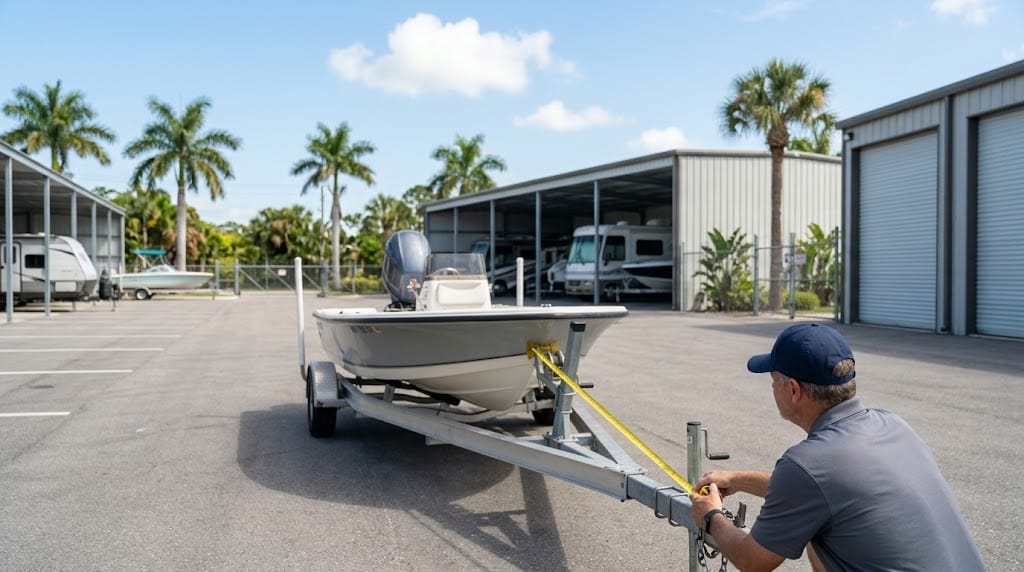
Hull length is the number on the spec sheet, but it understates the space a boat on a trailer needs. For boat trailer storage, measure overall length instead:
- Start at the tongue: Measure from the tip of the trailer tongue.
- End at the farthest rear point: Include the outboard motor at full tilt and any swim platform or bracket.
- Add front extensions: Include any bow pulpit that extends past the hull.
Give the facility that total, not the hull length.
Contract Terms and Florida’s Storage Lien Law
A storage agreement is more than a monthly bill. In Florida, it also affects what happens if you miss a payment. Our guide to how much it costs to store a vehicle covers general pricing. Here, we focus on the Florida terms that can cost you.
Florida’s Self-storage Facility Act gives a storage operator a lien on property kept at the facility. You can read it in Florida Statutes Chapter 83, Part III. If payments lapse, the facility can sell the property after written notice and advertisement. That matters more when the stored item is a $40,000 recreational vehicle (RV) or a $30,000 boat than when it’s a unit of boxes.
Month-to-Month vs. Annual Agreements: Which Makes Sense for You
If you store year-round, an annual contract’s lower effective rate is usually the better deal. Seasonal users may prefer month-to-month. Boaters who pull the boat out for summer avoid paying for empty months. Run the math. If an annual rate saves $20 a month, you need about 10 months of storage to break even once any early-termination fee counts.
Before you sign, confirm these points:
- Lien notice timeline: What are the notice and sale steps if a payment lapses?
- Early-termination fee: Does an annual agreement carry one?
- Gate access hours: What are the hours, and is 24-hour access offered?
- Insurance requirement: Does the facility require proof of insurance?
- Drive-up storage access: What access options exist for your vehicle?
Insurance Considerations for Stored Vehicles in Florida
Many boat and RV policies have lay-up or storage clauses. These can reduce coverage when the vehicle isn’t in active use or isn’t at your address. A stored RV hit by a fallen tree may not be fully covered if the policy treats it as inactive. Confirm your policy’s storage terms with your carrier before you sign. Ask whether fire, theft, and weather damage are covered at a storage location.
Is Covered Storage Worth the Extra Cost in Ellenton?
The price gap is real. Covered usually costs $50 or more per month above uncovered, and enclosed costs more still. So is the extra cost worth it? That depends on three things: how long you store, what your vehicle is worth, and what the climate will do to it.
In coastal Manatee County, covered storage is easier to justify than in many markets. Here are three reasons:
- UV exposure: It wears down roof seals, sidewalls, and gelcoat faster than in northern climates.
- Salt air: Near Tampa Bay, it can speed corrosion on unprotected metal.
- Hurricane season: From June through November, uncovered lots face wind and debris risk.
Storing under six months and using the vehicle often? Uncovered space can be a defensible trade-off. Storing six months or longer, especially through hurricane season? Covered storage is a better investment against repair costs.
What Covered Storage Actually Protects Against
A carport-style space shields your vehicle from direct UV, falling rain, and bird debris. It does not fully stop wind-driven rain, salt air, or flying debris in a storm. Only an enclosed building does that. Covered beats nothing, but enclosed is the tier that keeps coastal air and storm wind off your vehicle.
Want to see what that costs locally? RecNation’s nearest facility is about 5.7 miles away in Bradenton. It has uncovered, covered canopy, and indoor garage spaces. Across RecNation’s facilities around Ellenton, uncovered spaces start at about $36 a month, covered canopy at about $211, and indoor garage at about $429. Those are starting prices, and they vary by facility and unit size. Check current rates and availability for RV and boat storage near Ellenton.
Long-Term Cost Math
Say covered storage costs $60 more per month than uncovered. That is $720 a year. A boat gelcoat repair from UV crazing can run roughly $500 to $2,000 or more. An RV roof seal replacement after UV damage can run several hundred dollars or more. One avoided repair can pay back the premium, especially for vehicles stored through Florida’s summer.
Final Thoughts on RV and Boat Storage Costs in Ellenton
Ready for a real number? RecNation’s nearest facility is about 5.7 miles away in Bradenton. It is fully fenced, with video monitoring and 24-hour gate access available on request. Choose uncovered, covered canopy, or indoor garage space. Check current pricing and availability for RV and boat storage near Ellenton. Then match your budget to the protection your vehicle needs in Florida’s climate.
Frequently Asked Questions
How much does it cost to store an RV per month in Ellenton, FL?
Expect roughly $60 to $200 or more a month for uncovered RV storage, depending on length. Smaller units start around $60 to $120. A 30 to 40-foot rig can reach $150 to $200 or more. Covered space usually costs $50 or more above uncovered, and enclosed units for large motorhomes can top $400. These are estimates, so ask for a quote based on your exact length.
What is the difference between covered and enclosed boat storage in Ellenton?
Covered boat storage is a carport-style roof with open sides. It blocks direct UV and rain, but wind-driven moisture and salt air can still reach the boat. Enclosed storage puts the boat inside a sealed building, so it is protected from UV, rain, wind debris, and salt air. On the coast, that difference matters most for long stays.
Are there outdoor RV storage options near Ellenton that are cheaper than indoor facilities?
Yes. Uncovered outdoor space is the cheapest option in Ellenton, and some spaces start below $100 a month. The trade-off is year-round exposure to UV and salt air. If your RV will sit through hurricane season, weigh the savings against possible repair costs.
What size storage space do I need for my boat or RV in Ellenton?
Choose a space based on your vehicle’s overall length, not its body length. For an RV, measure bumper to bumper, including the hitch or king pin. For a boat on a trailer, measure from the tongue tip to the farthest point at the stern, with the motor tilted up. Add a couple of feet for maneuvering. An accurate number keeps you out of a larger, pricier tier.
Do RV and boat storage facilities in Ellenton offer month-to-month rental agreements?
Yes, many Ellenton facilities offer both month-to-month and annual agreements. Month-to-month suits seasonal users. Annual contracts usually carry a lower effective monthly rate, but they may include early-termination fees. Florida’s Self-storage Facility Act also gives operators a lien on stored property, so staying current on payments matters under either type.
Do I need insurance to store my RV or boat at a storage facility in Ellenton?
Often, yes. Many facilities require proof of insurance, so ask before you sign. Your own policy matters too, since some include lay-up clauses that reduce coverage when a vehicle isn’t in active use. Ask your carrier whether fire, theft, and weather damage are covered at a storage location, and whether the stored address changes your limits or deductibles.