North Port sits at the southern edge of Sarasota County, well within the Gulf’s salt-air corridor. In most of the country, choosing between covered and enclosed storage is a minor cost decision. In North Port, it’s a question with real consequences for your vehicle’s condition after a six-month idle period.
Southwest Florida combines year-round humidity above 70%, salt air drifting inland from Charlotte Harbor and the Gulf of Mexico, and a June through November hurricane season. The wrong storage tier here isn’t a minor inconvenience. It’s a source of mold, corrosion, and weather damage you may not discover until it’s already expensive to fix. This guide gives you a direct, climate-specific answer for your vehicle type.
What “Covered” and “Enclosed” Actually Mean (Not Just a Checkbox)
Storage facilities in North Port use “covered” and “enclosed” as marketing labels, but the physical structures behind those labels vary significantly. Before comparing the two, it helps to understand what you’re actually looking at when you pull into each type of bay, and how that compares to what you might already have at home.
If you’ve got a carport or a garage and are wondering whether either one measures up, our comparison guide on carport versus garage for long-term vehicle storage breaks down that exact comparison.
Covered Storage: What You’re Actually Getting
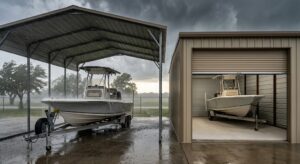
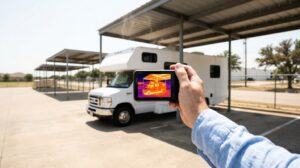
Two questions settle what you’re actually renting, no matter what the listing calls it: are the sides open, and is there a door that locks? Covered storage is a carport-style or open-bay structure, a roof over a parking pad with open or partially open sides. The roof blocks direct sun and catches rainfall before it hits your vehicle directly. What it doesn’t do is seal out humidity, salt air, or wind-driven rain, none of which need a straight vertical path to reach the vehicle.
Facilities aren’t consistent about what “covered” means, which is exactly why those two questions matter more than the label. Some call a bay “covered” when it has a roof and three walls with a partial front opening. Others mean nothing more than a canopy over an open pad. Our guide on what enclosed vehicle storage actually means lays out the fuller comparison if you want to see exactly where the line sits before you sign anything.
Enclosed Storage: What Makes It Different
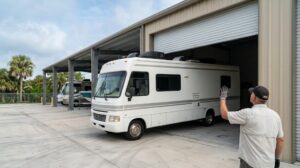
The sealed perimeter is what separates this tier from covered, full stop. Enclosed storage means four walls, a roof, and a rollup or swing door, a bay with no open side at all. That seal is what dramatically reduces humidity ingress and keeps salt air off your vehicle’s components during a long idle period, something a roof alone can’t manage.
One thing enclosed doesn’t automatically include is climate control. Temperature inside still moves with the outside weather. What it does eliminate is airflow, and since air circulation through a sealed bay is minimal, moisture and salt exposure drop off right along with it, even with no HVAC running at all.
| Feature | Covered Storage | Enclosed Storage |
| Roof | Yes | Yes |
| Wall coverage | Open or partial sides | Four walls, sealed perimeter |
| Door/access | No door, or partial front opening | Rollup or swing door, lockable |
| Humidity control | None | Partial (no active regulation, but significantly reduced ingress) |
| Salt-air protection | None | Significant |
| Wind/debris protection | Minimal | Strong |
| UV protection | Partial (direct sun blocked) | Full |
The distinction isn’t just marketing language, either. Under the wind-load engineering standards the Florida Building Code incorporates, ‘open,’ ‘partially enclosed,’ and ‘fully enclosed’ structures are calculated differently because they handle wind pressure differently; the same physical gap that lets salt air and humidity through also changes how a structure performs in a storm. If the code treats the difference as structurally meaningful, it’s worth treating the same way in your storage decision.
What North Port’s Climate Does to a Vehicle in the Wrong Storage Tier
This is where the abstract tier difference becomes concrete for a recreational vehicle (RV), boat, or car alike. North Port’s tropical climate creates four specific damage mechanisms, and each one behaves differently depending on whether your vehicle is in covered outdoor storage or a sealed enclosed unit.
Humidity and Mold: The Year-Round Problem
Humidity damage in North Port isn’t a seasonal risk, it runs year-round. North Port’s relative humidity stays above 70% for most of the year, peaking through summer, and a covered bay does nothing to slow that moisture-laden air from reaching what’s inside the vehicle.
- Upholstery, carpet, and foam insulation absorb moisture directly from ambient air with no barrier in the way.
- Wood substrates inside an RV or boat cabin take on the same exposure over time.
According to EPA mold and moisture guidance, mold colonies can establish within 24 to 48 hours at sustained relative humidity above 70%. A vehicle sitting in a covered bay through a North Port summer isn’t just at risk of mold, it’s in near-ideal conditions for it. Enclosed storage creates a near-sealed environment that significantly slows that humidity ingress, even without active climate control.
Salt Air: The Slow Damage Most Owners Don’t See Until It’s Too Late
The Gulf of Mexico’s salt corridor extends well inland through Charlotte County, particularly during onshore wind events. Salt particulates deposit on metal surfaces, rubber components, painted finishes, and seals, and a covered bay with open sides offers no meaningful barrier to any of it.
The components that fail quietly, and cost the most when they do, are:
- Wheel bearings
- Brake hardware
- Hitch receivers
- Electrical connectors
- Slide-out rails on recreational vehicles (RVs)
- Stainless fittings on boats
Salt corrosion is cumulative and largely invisible until it reaches structural or mechanical components. By the time you see it, the repair bill is already significant. Corrosion prevention at the storage tier level is far cheaper than addressing it after the fact.
Hurricane Season: When “Covered” Becomes Irrelevant
The June through November hurricane season runs directly through the window when many North Port owners have their vehicles in storage, which makes this the mechanism where tier choice matters most. According to the Florida Division of Emergency Management wind zone map, North Port sits in Wind Zone III, meaning covered structures at storage facilities must be engineered to withstand sustained tropical-storm-force winds. Open sides, however, still allow wind-driven rain and debris to reach your vehicle during a storm.
During a named storm or even a strong tropical weather event, the distinction between covered and enclosed storage is sharpest:
- Enclosed walls block wind-driven rain and flying debris outright.
- An open-sided covered bay does not, regardless of how well its roof is rated.
Which Storage Tier Does Your Vehicle Actually Need?
If you’ve been weighing the cost difference between covered and enclosed storage in North Port Florida, this section gives you a direct answer by vehicle type. For owners navigating North Port’s land development restrictions on residential vehicle storage, or those without a covered driveway option, RecNation’s nearest storage options serving the North Port area offer both covered and enclosed configurations, and in this climate, the tier you choose matters more than it would in most other markets.
| Vehicle Type | Recommended Tier | Primary Reason |
| RVs and motorhomes | Enclosed | Roof seals, slide-out gaskets, and interior surfaces are all high-risk for humidity and salt-air damage |
| Boats (with cabin or outboard motor) | Enclosed | Outboard carburetors, electrical connectors, and marine upholstery degrade rapidly in salt-air exposure |
| Bare aluminum skiffs (short-term) | Covered | No interior surfaces at risk; acceptable if accessed frequently |
| Classic and collector cars | Enclosed only | Brake components, leather interiors, and painted finishes cannot tolerate sustained humidity above 70% |
| Daily-use or frequently accessed cars | Covered | Acceptable if the vehicle isn’t sitting idle more than 30 to 60 days |
| Seasonal cars (3+ months idle) | Enclosed | Brake rotors, rubber seals, and interior materials degrade during extended idle periods |
| Utility trailers (bare metal) | Covered | Often acceptable with no interior components at risk |
| Enclosed cargo trailers / trailers with wiring | Enclosed | Wiring harnesses and wood floors are high-risk in humid, salt-adjacent markets |
RVs, Motorhomes, and Travel Trailers
Enclosed is the default recommendation for any RV in North Port. The components that fail fastest in covered outdoor storage are the ones most expensive to repair: EPDM roof seals, slide-out weather-stripping, and underbelly vapor barriers. Florida humidity works into every gap in an RV’s envelope during a long storage period, and salt air accelerates the degradation of every rubber seal exposed to it.
Class B camper vans are more resilient than larger Class A or Class C units because their construction is more vehicle-like. Even so, the humidity argument applies to any interior with upholstery, cabinetry, or foam. If your RV is sitting through summer or hurricane season, enclosed storage is the right call.
Boats and Personal Watercraft
Covered storage is defensible for an active boater pulling the boat every few weeks. For anything sitting more than 60 days, enclosed is the right call. Outboard motors are especially vulnerable to salt-air corrosion on carburetor components and electrical connectors, and a boat cover over a covered bay does not substitute for a sealed environment during an extended idle period.
For more on protecting your watercraft during storage, see North Port storage options covering RV and boat storage in the area.
Classic Cars and Collector Vehicles
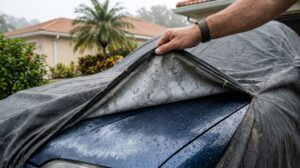
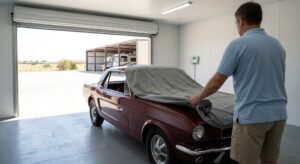
No exceptions in this climate: enclosed only. A breathable car cover inside a covered bay is not a substitute for a sealed perimeter when ambient humidity exceeds 70% for months at a time. Moisture still infiltrates through the cover’s fabric. Brake rotors and calipers begin to corrode during idle periods even with a cover in place.
For a full breakdown of what classic car long-term storage requires in a Florida climate, that guide covers the full preparation and protection checklist.
Insurance Implications Most Storage Customers Don’t Know About
Storage costs are only part of the equation. Your storage tier affects more than your vehicle’s condition. It can affect what you pay annually for coverage and how a claim is evaluated after a storm. Vehicle storage cost comparisons often focus only on the monthly rental rate, but the insurance picture shifts that calculation.
How Carriers Define “Garaged” vs. “Covered” vs. “Outdoor”
Insurance underwriting uses these three terms with specific meanings that don’t always match how a storage facility markets its tiers, and knowing the difference matters before you assume your coverage lines up with what you’re renting.
Personal vehicle, RV, and boat insurance policies in Florida typically distinguish between three storage categories when setting comprehensive rates and evaluating claims:
- Outdoor: No overhead cover at all.
- Covered: A roof present, though carriers may classify this differently depending on the policy.
- Garaged/enclosed: Fully enclosed with a lockable door, which is what “garaged” generally means in policy language, and it aligns with what enclosed storage actually provides.
Carriers such as Progressive and BoatUS document rate differentials based on storage type, though specific terms vary by policy and should be confirmed with your own carrier.
The distinction matters most after a storm. A vehicle stored in an enclosed unit during a named storm has a more defensible claim than one stored in a covered bay where wind-driven rain or debris entered through open sides. I
If you’re storing a vehicle off your home driveway, which is common given North Port’s land development code restrictions on residential vehicle storage, your home policy almost certainly does not follow the vehicle to a commercial storage facility. Your vehicle or marine policy is the coverage that applies, and its storage-type classifications matter. Coverage terms vary by carrier; verify your specific policy before assuming your storage tier qualifies as “garaged.”
What to Ask Before You Reserve a Storage Bay in North Port
Once you’ve settled on a storage tier, the next step is evaluating specific facilities. Not every self-storage facility distinguishes these tiers clearly. Some North Port and Charlotte County area facilities list “covered” and “enclosed” as co-equal amenity checkboxes without distinguishing their physical structures. Ask for physical descriptions, and confirm storage unit size against your vehicle’s actual dimensions, before signing a rental agreement.
Red Flags in Facility Listings
Two patterns should prompt follow-up questions before committing. First, a facility that lists “covered” and “enclosed” as separate options without explaining the structural difference between them. Second, a facility that claims “hurricane-rated” covered storage without specifying the wind load standard. Neither is necessarily a dealbreaker, but both require more information before you sign.
You can use these questions with any facility you’re evaluating:
- What is the wall configuration on your covered bays? Open on all sides, two walls, or three walls? The answer tells you how much salt air and wind-driven rain can reach your vehicle.
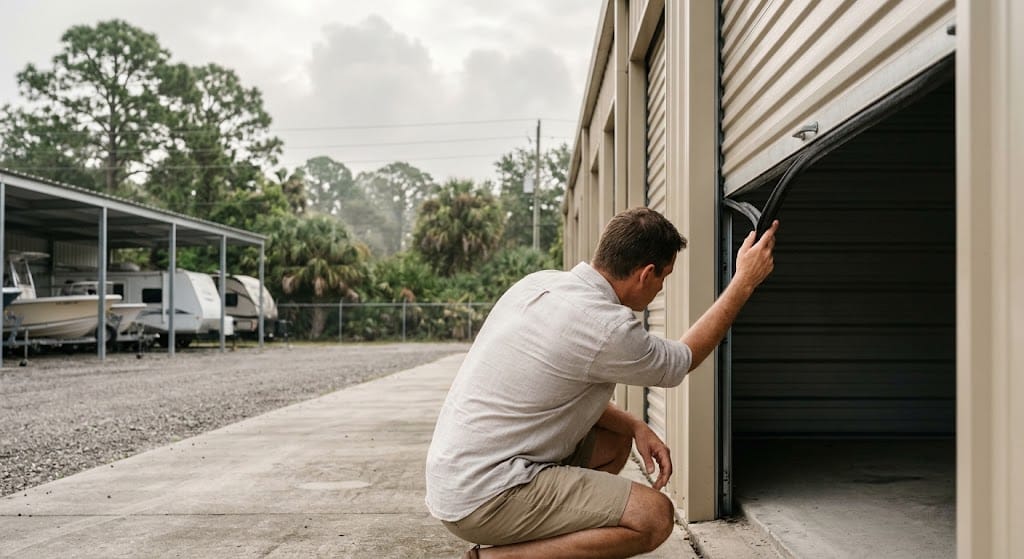
- Do your enclosed units have rollup or swing doors with a weather seal, or a partial front opening? A partial opening still allows humidity and salt air to enter.
- What is the wind rating or building code compliance of your covered structures? Relevant for any vehicle stored through hurricane season.
- Is there humidity or climate control in the enclosed units, or is it ambient? Enclosed without climate control still provides significant protection; knowing which you’re renting helps set expectations.
- Does the facility carry liability insurance for vehicles stored on-site? Understand whether the owner’s own policy is the only coverage that applies.
- What is the process for vehicle access during a hurricane watch or warning? Can you retrieve your vehicle before the storm, and how much notice do you need?
Pest control is worth a separate question if you’re storing an RV or boat with a fabric interior. Enclosed storage limits pest entry significantly compared to covered bays, but ask whether the facility has an active pest management program.
Matching Your Storage Tier to North Port’s Climate
Six months from now, your vehicle will show you exactly which tier you chose, in mold, corroded fittings, or neither. You’ve seen what humidity, salt air, and hurricane-season wind actually do to the specific components of RVs, boats, and collector cars over that kind of idle period, and none of it is hypothetical in this climate. The right tier is the one that addresses those specific risks for your vehicle type, not the one with the lower monthly rate.
For owners who want to stop guessing and start protecting, RecNation RV storage in North Port provides enclosed and covered storage options sized for RVs, boats, and large vehicles, with the access and security infrastructure that matters when a storm is named and you have 48 hours to make a decision. Reserve the tier that actually matches your risk, before hurricane season decides it for you.
Frequently Asked Questions
Is covered or enclosed storage better for protecting a boat in North Port, Florida?
Usually enclosed, past a certain point. A boat pulled and used every few weeks doesn’t sit long enough for salt air to do real damage, so covered storage works fine for that owner. Once a boat sits idle for two months or more, especially through summer or hurricane season, outboard motors, stainless fittings, and electrical connectors start absorbing salt exposure that a boat cover alone can’t stop, and that’s when enclosed earns its cost.
How does Florida humidity affect items stored in covered versus enclosed units?
It does a lot more damage under cover than most owners expect, because a roof alone doesn’t touch the humidity itself. North Port’s air regularly sits above 70% relative humidity, and a covered bay traps nearly the same moisture load as being outside, which is exactly the condition mold, warped wood, and degraded rubber seals need. An enclosed unit’s sealed walls cut off most of that moisture exchange, even without any active climate control running.
What is the difference between covered and enclosed storage in North Port, FL?
The short version: covered is a roof with open sides, enclosed is four walls and a locking door. That gap barely matters somewhere dry. In North Port, it’s the difference between a vehicle that survives a six-month storage stretch intact and one that comes out with mold, corroded metal, and seals that no longer hold, because the open sides on a covered bay let humidity and salt air reach the vehicle exactly the same way they would outdoors.
Is climate-controlled storage worth the extra cost in Southwest Florida?
For most vehicles, no, not before you’ve upgraded from covered to enclosed first. Climate control earns its cost for classic cars with leather interiors, RVs storing electronics, or anything with components that degrade at sustained high temperatures. For everything else, the jump from covered to enclosed already handles the two risks that matter most here, humidity ingress and salt-air contact, without needing active regulation. If your budget only stretches to one upgrade, enclosed comes before climate-controlled.
Can I store an RV in covered storage during North Port’s hurricane season?
Not much, once a storm is actually approaching. A roof holds up fine on a clear day, but the open sides on a covered bay do nothing to stop wind-driven rain or flying debris once a system moves through, which is exactly why most facilities either recommend or require pulling the RV out before a watch or warning goes up. An enclosed unit’s four walls handle that same event without needing you to move the vehicle at all. Ask any facility about their storm-access policy and whether an enclosed upgrade is available before you commit.
What should I store in an enclosed unit versus covered outdoor storage in Florida?
Enclosed makes sense for anything with organic interior materials, upholstery, carpet, foam, wood, exposed metal components that are expensive to replace, or any vehicle sitting for three months or more. Covered works for bare utility trailers with no interior, or vehicles used often enough that salt air and humidity never get time to establish damage. North Port’s June-through-November hurricane season is one more reason to move anything you value into an enclosed unit during that window specifically.