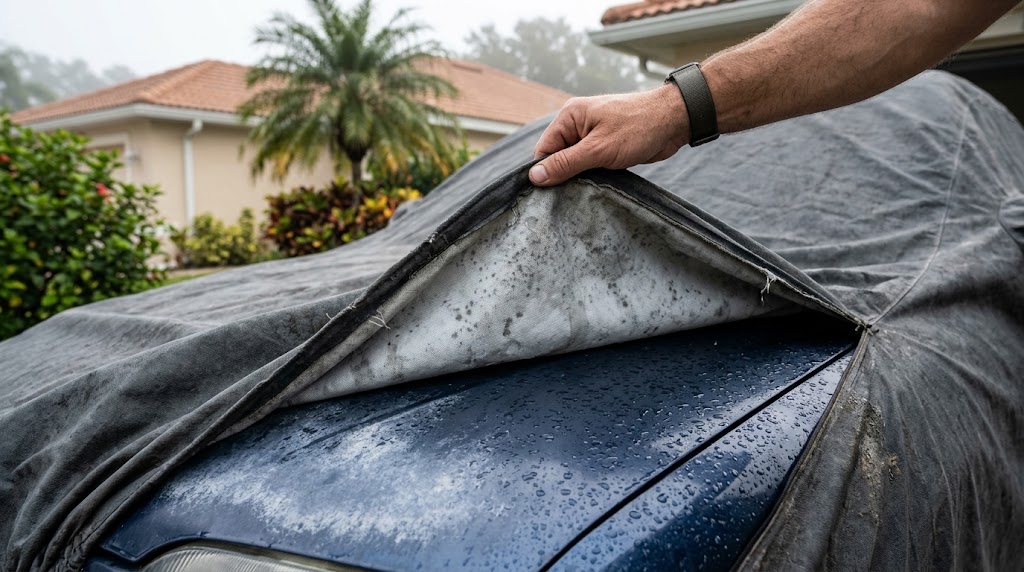
Driveway storage in Ellenton, Florida is free and easy. Over time, though, the local climate makes it expensive. Most owners don’t notice until they’re holding a repair estimate. Ellenton’s Gulf Coast climate, with high humidity, intense UV, and salt air, does measurable damage to vehicles parked in driveways year-round.
This guide breaks down the real cost-benefit comparison between driveway storage and a local facility, including Manatee County rules that may affect your options.
Why Ellenton’s Climate Is Harder on Parked Vehicles Than Most People Expect
Ellenton’s location puts vehicles in a tough spot year-round. The area sits close enough to Tampa Bay and the Gulf Coast that salt air can reach driveways across the county, not just near the waterfront. Three climate factors do the damage, and they act at the same time on any idle vehicle:
- Coastal humidity: Tampa Bay area humidity typically runs in the 70s percent annually and higher on summer mornings. Inside a closed vehicle, that moisture has nowhere to go. Mold and mildew can take hold in upholstery, headliners, carpet, and stored gear within a single off-season.
- UV exposure: Florida’s summer UV index often reaches the “very high” to “extreme” range on the EPA UV Index. At that level, clear coat breaks down and chalks, dashboards and seats fade, and rubber seals harden and crack on a vehicle sitting still in the sun.
- Salt air damage: Airborne salt settles on metal surfaces, brake lines, exposed fasteners, and any chipped paint, and it acts as an electrolyte that speeds oxidation. The resulting rust and corrosion tends to be faster than in inland Florida.
For a practical overview of what long-term outdoor exposure does to different vehicles, our long-term vehicle storage guide breaks it down by category.
Humidity and Mold Risk for Vehicles in Long-Term Outdoor Storage
Relative humidity above about 70 percent can support mold on upholstery, foam padding, headliners, and carpet. A vehicle sealed on a driveway for 60 to 90 days of the off-season has warmth, moisture, and a dark enclosed space, everything mold needs. Remediating mold and mildew in a recreational vehicle (RV) or boat interior can run from hundreds to thousands of dollars depending on severity, which is a real cost anchor against the idea that driveway storage is free.
UV Exposure and What Florida Sun Does to Paint and Interiors
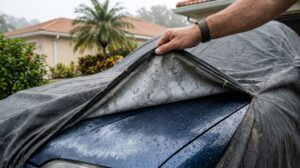
Florida sun damage builds faster on dark or unprotected surfaces. No vehicle is immune at these UV levels. Paint oxidation shows up as chalky, faded clear coat. It usually can’t be fixed without repainting. Interior fading on dashboards and seats is slow but permanent unless you replace the material. A car cover cuts direct UV, but it does nothing for humidity or salt air. It can also trap heat inside, which wears on seals and adhesives.
The Driveway Option: Where It Works and Where It Breaks Down
The driveway has a legitimate case. It’s free, it’s right there, and for vehicles used regularly, movement and airflow interrupt most of the passive damage from humidity and salt air. The real question is where the threshold sits for your vehicle and how you use it.
When a Driveway Is Genuinely Fine
Driveway storage isn’t always a bad call. If your situation matches the points below, your driveway can hold up fine.
- Daily-use vehicles: Driving at least several times a week keeps air moving and interrupts humidity buildup.
- Short stays: Two to four weeks at most, with a vehicle in good condition and no existing seal or paint problems.
- Permitted carport shade: A permanent, permitted carport structure reduces direct UV exposure.
- A humidity plan: Interior desiccant products and regular ventilation add protection alongside physical cover.
When the Driveway Becomes the More Expensive Option
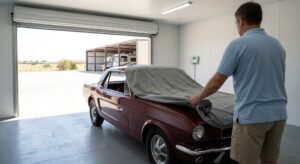
The math turns against the driveway when these outdoor parking risks apply. Vehicles that sit idle for 30 days or more collect humidity, salt, and UV damage without a break. Boats, RVs, classic cars, and trailers have more surface area and more vulnerable materials. Vehicles with paint chips or aging rubber are already at risk.
Vehicle depreciation from cosmetic and mechanical damage shows up at resale, and the cumulative cost of repainting, mold remediation, and undercarriage corrosion repair can exceed several seasons of storage fees. Our guide on parking a commercial vehicle in a residential area is worth a look if the vehicle in question is a work truck or trailer.
Manatee County Rules and HOA Restrictions That Affect Driveway Storage
Before you treat the driveway as free, check two layers of rules. Either can turn free storage into an ongoing fine that costs more than a monthly storage unit.
What Manatee County Code Says About Outdoor Vehicle Storage
Unincorporated Ellenton falls under Manatee County’s Land Development Code and zoning rules, which regulate certain vehicle types, trailers, and portable storage on residential property. Boats, RVs, and larger trailers may need screening or a permitted structure, and details differ by zoning district. Verify the specifics with Manatee County Code Enforcement instead of assuming what is allowed.
HOA Rules in Ellenton’s Planned Communities
Homeowners association (HOA) covenants in planned communities around Ellenton commonly go further than county code. They often restrict visible boat or RV storage on driveways, require rear-yard placement for trailers, or ban certain vehicle types from street visibility. Your covenants, conditions, and restrictions (CC&Rs) are the controlling document, and the HOA handles enforcement directly.
Fines can be recurring, and a single season of them for a prohibited vehicle can exceed a year of storage fees.
Insurance and Liability: The Coverage Gap Most Owners Don’t Know About
Many owners assume their homeowners insurance covers whatever is parked on their property. That assumption is often wrong, and during hurricane season the exposure is real.
What a Standard HO-3 Policy Typically Covers (and Excludes) for Outdoor Vehicles
A standard HO-3 homeowners policy generally excludes motor vehicles from personal property coverage. Boats, all-terrain vehicles (ATVs), trailers, and RVs usually need their own auto, marine, or RV policy to be properly covered. Skip that policy, and a boat in your driveway may get nothing from your homeowners insurer if wind or flood damages it in hurricane season. Even a comprehensive policy can attach conditions about where and how the vehicle is stored. Many owners only learn this after a loss.
How Storage Facility Tenant Protection Plans Work in Florida
Storage facilities commonly offer optional protection plans that cover stored property against risks like fire, flood, and theft, and the terms vary by provider. A driveway has no equivalent layer. A protection plan is not a substitute for a specialty auto or marine policy, so read what it covers before you rely on it.
Making the Decision: A Simple Framework for Ellenton Vehicle Owners
If any of the facility triggers below apply to you, a storage facility is likely the right call. If none apply, a well-maintained driveway setup may be enough. For a broader look at the trade-offs, the is vehicle storage worth it article walks through the full analysis.
Signs a Storage Facility Is the Right Call for Your Vehicle
If any of these apply to you, a storage facility is likely the right call. You can check them in about a minute:
- Idle for 30 days or more: This is the clearest trigger for compounding damage.
- RV, boat, trailer, or ATV: High surface area and multiple vulnerable materials make these especially prone to humidity, UV, and salt air.
- Close to salt water: Most of Ellenton is near enough that salt air is a year-round condition, not a seasonal one.
- HOA restrictions on outdoor storage: A facility removes the fine risk.
- Resale value to protect: Resale value protection depends on keeping cosmetic and mechanical condition intact.
- No covered carport or garage: Full sun and open air is the harshest setup in this climate.
- Hurricane season approaching: Storm and hurricane protection is something a residential driveway cannot offer.
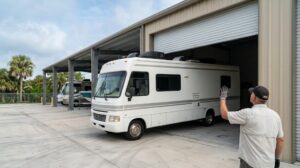
If any of these boxes apply to you, RecNation can help. Its nearest facility is about 5.7 miles away in Bradenton. It offers vehicle storage near Ellenton. Options include covered canopy and indoor garage spaces for RVs, boats, trailers, and other vehicles.
When a Driveway Setup Can Work in Florida’s Climate
A driveway setup is acceptable when all of these are true together: you drive the vehicle weekly, it sits under a permanent permitted carport, you carry a specialty auto or marine policy covering it at your address, and your HOA and county rules allow it. If one is missing, the risk shifts. A car cover alone is not enough for long idle stretches in Ellenton’s coastal humidity, since it cuts UV contact but does nothing for moisture, salt deposits, or storms.
Want a middle ground? Covered outdoor storage options protect better than a bare driveway. They also cost less than an enclosed unit. An enclosed storage unit goes further. It blocks UV, limits humidity swings, and keeps salt air off the vehicle. With a humidity-controlled environment, it also helps keep mold in check. It shelters your vehicle from storms too, which is the end point of the climate case above.
Final Thoughts on Driveway vs. Storage Facility in Ellenton
If you’ve worked through this comparison and the decision is clear, the next step is straightforward. RecNation’s nearest facility, about 5.7 miles away in Bradenton, offers dedicated vehicle storage near Ellenton built for the long-term protection an Ellenton driveway can’t provide, given its coastal humidity, salt air, and hurricane season risk. Getting your vehicle out of the elements is one of the more cost-effective maintenance decisions you can make in this climate.
Frequently Asked Questions
Is it bad to leave your car in the driveway in Florida’s humidity?
For a daily driver, parking in the driveway now and then is fine. Regular driving keeps air moving, so humidity doesn’t settle in. The trouble starts when a car or trailer sits idle for 30 days or more. In constant humidity, mold can grow inside and metal parts can corrode. Near Tampa Bay, salt air adds a second source of corrosion. It keeps working even between rainstorms.
How does UV exposure in Florida affect a car’s paint and interior?
Strong summer UV breaks down clear coat and causes paint oxidation that shows up as chalking or fading and typically can’t be reversed without repainting. Inside, UV degrades dashboard materials, fades seats and door panels, and dries out rubber weatherstripping until it cracks. A cover cuts direct UV contact but doesn’t relieve the heat building inside the cabin.
What are the benefits of using a storage facility in Ellenton over parking in a driveway?
An enclosed or climate-controlled unit removes UV exposure, humidity swings, and salt air contact, the main variables that wear on a parked vehicle here. It also takes the vehicle out of your driveway during named storms. For owners in HOA communities, a facility replaces a recurring fine risk with a fixed monthly fee.
Does coastal salt air cause rust damage to vehicles in Ellenton, FL?
Yes. Airborne salt settles on the undercarriage, brake lines, fasteners, and any chipped paint, then speeds oxidation because it acts as an electrolyte. Vehicles in enclosed units avoid that deposit, while vehicles in a driveway pick it up between every wash, so rinsing the undercarriage regularly helps if you park outside.
How much does climate-controlled vehicle storage cost near Ellenton, Florida?
Pricing depends on unit size, features, and storage type. As a rough guide, open outdoor spaces in Manatee County often run around $60 to $100 or more per month, while enclosed or climate-controlled units run roughly $150 to $300 or more. These are industry estimates, so confirm current rates with the facility for your vehicle’s dimensions, and weigh them against a single repair bill.