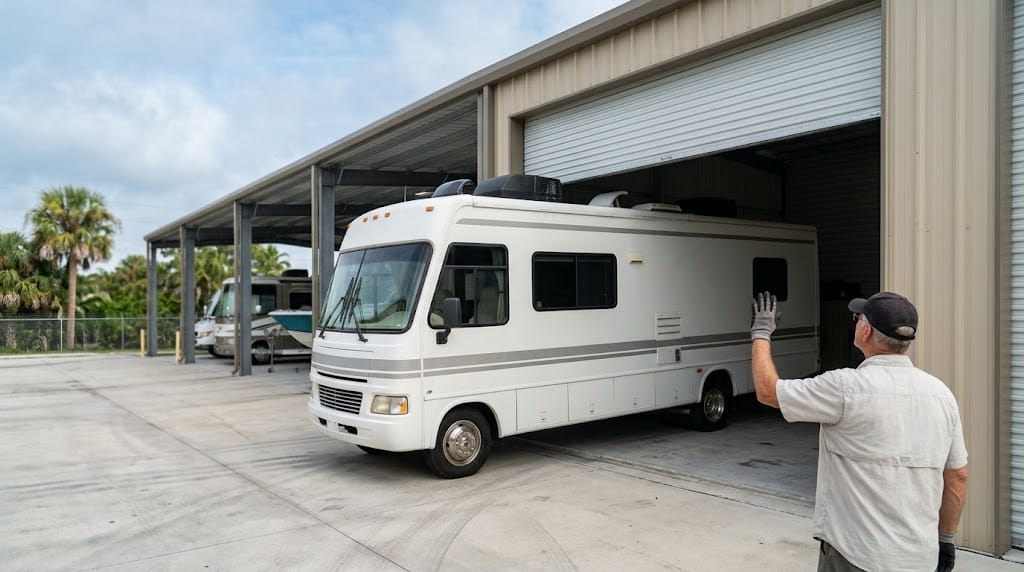
In Ellenton, enclosed storage is the stronger choice for high-value and corrosion-sensitive vehicles. Covered storage still makes sense for some vehicles and budgets. The choice matters more here than inland because Ellenton sits close to Tampa Bay and the Manatee River, where salt air can drift ashore. Hurricane season adds more risk, because it runs six months. This guide matches each threat to the storage tier that handles it.
What Covered and Enclosed Storage Actually Mean
Facilities sometimes use these two terms interchangeably, but the structural difference is significant. Understanding what enclosed vehicle storage means before you book prevents a costly mismatch between what you expect and what you get.
Covered Storage
Carport and covered storage puts your vehicle under a roof or canopy with open or partially open sides. It blocks direct overhead sun and rain, but wind-driven rain, airborne salt, and debris can still reach the vehicle. Access is usually easy for tall or wide vehicles because there is no door to clear, and this is often the lower-cost tier.
Enclosed Storage
Enclosed storage is a fully walled and roofed unit with a roll-up or swing door that isolates the vehicle from ambient air, moisture, and weather. Enclosed is not automatically climate-controlled, since temperature and humidity regulation is a separate premium feature. Fixed door dimensions, often 12 to 14 feet in height, also affect whether a larger vehicle fits.
| Feature | Covered | Enclosed |
| Roof | Yes | Yes |
| Sides | Open or partial | Full walls |
| Door | None | Roll-up or swing |
| Climate control | No | Optional (added cost) |
| UV protection | Partial (overhead only) | Full |
| Salt air barrier | No | Yes |
| Typical access | Drive-through or pull-in | Through door opening |
Ellenton’s Three Environmental Threats, and What Each Does to a Stored Vehicle
Ellenton’s climate is not a one-problem climate. Three threats are at work, and each hits a stored vehicle in a different way. For context on how this compares with leaving a vehicle at the curb, see covered outdoor storage vs. street parking.
Florida Humidity and Mildew Risk
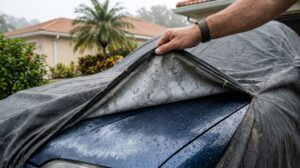
Florida humidity in Manatee County often sits above 70 percent, and summer mornings run higher still. At those humidity levels, mold and mildew can develop on canvas, upholstery, and wood trim within weeks, whether the vehicle is outside or inside a storage unit.
Covered storage allows airflow, which slows mildew by keeping moisture from stagnating, though it does nothing to lower ambient humidity. Enclosed storage seals out outdoor air but can trap moisture inside the unit without ventilation. Only climate-controlled storage actively manages humidity levels rather than just limiting outside exposure.
Salt Air Corrosion Near Tampa Bay
This is the threat that generic Florida humidity content tends to ignore. Ellenton’s position near Tampa Bay means onshore breezes can carry chloride-laden air inland, so salt exposure is not limited to beachfront parking. Any partially exposed vehicle stored in the area can pick it up.
Chloride deposits drive corrosion and rust on trailer wheel bearings, outboard motor housings, wiring harness terminals, aluminum frames, and chrome fittings. Those parts are expensive to repair and degrade quietly during a long idle period. Covered storage does not reduce chloride exposure because the sides stay open, while enclosed storage creates a physical barrier that limits salt contact.
Hurricane-Season Wind Load and Debris
The National Hurricane Center places the Atlantic hurricane season at June 1 through November 30. For Manatee County, that is six months of real storm risk. Many open canopies are not built to the wind standards that hurricane-resistant buildings must meet under the Florida Building Code. In a strong storm, a canopy can fail and leave your vehicle exposed to wind-driven rain and debris.
No surface storage eliminates all storm risk in a major hurricane. Still, an enclosed masonry or steel-framed building provides materially more structural resistance than an open-sided canopy, and that difference matters across a season that covers half the year.
How Solar Intensity in Manatee County Changes the Covered-vs-Enclosed Math
Florida’s sun is a documented material-degradation factor for vehicles without full UV ray protection, not just a comfort issue. A useful reference point for the carport vs. garage for long-term storage question is how UV exposure compounds across a multi-month idle period.
What Peak Sun Hours Mean for Your Vehicle’s Surface
National Renewable Energy Laboratory solar data puts this part of Florida at roughly 5.5 peak sun hours per day, among the highest solar irradiance in the continental United States. In direct sun, a dark vehicle surface can get hot enough to speed gel coat oxidation on fiberglass, clear coat failure on paint, vinyl trim shrinkage, and rubber seal wear.
Covered storage blocks overhead sun but leaves the vehicle’s sides open to angled morning and afternoon UV. Enclosed storage removes UV exposure entirely.
The Cost of UV Damage vs. the Cost of Enclosed Storage
Restoring oxidized gel coat on an RV or boat hull can cost hundreds to thousands of dollars depending on surface area, and correcting clear coat on a collector car can run into the thousands. These are predictable outcomes for vehicles with partial UV exposure across a couple of seasons in this climate.
The monthly premium for enclosed over covered storage is typically modest by comparison. For a high-value vehicle stored six months or longer, the math often favors the enclosed tier before the first repair bill arrives.
Which Storage Type Does Your Vehicle Actually Need: A Decision Framework
Here the three threats become a concrete recommendation for your asset. First, a note on insurance: some Florida comprehensive policies can treat covered and enclosed storage differently when handling claims for water intrusion, hail, or UV damage, so confirm your policy terms with your insurer, and consider the Florida Office of Insurance Regulation as a general resource. For a broader look at how storage type affects overall cost, our vehicle storage cost guide covers the variables.
RVs and Motorhomes
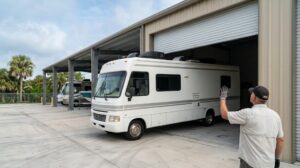
For Class B and Class C recreational vehicles (RVs), enclosed storage is the right call, since salt air and UV attack exterior finishes, wiring, and rubber seals during a long off-season. Many Class A motorhomes stand 12 to 13 feet or more with rooftop equipment, so they may not clear an enclosed door. In that case covered storage may be the only structurally feasible option, so measure at the tallest point and confirm clearance with the facility.
Boats and Boat Trailers
If your boat has an outboard motor and sits from November through April, choose enclosed storage. Over a long idle stretch, salt air attacks motor housings and trailer wheel bearings, and a roof alone won’t stop it. RecNation’s nearest facility, about 5.7 miles away in Bradenton, offers covered canopy and indoor garage options. You can see what’s available on its RV and boat storage in Ellenton page, and confirm unit sizes and current availability with the facility. Covered storage works for a boat only if you visit often enough to inspect it and treat the parts prone to corrosion.
Classic and Collector Cars
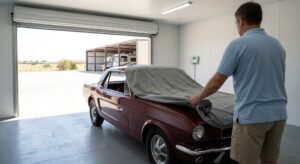
Enclosed storage is the firm recommendation here. UV and humidity are the main threats, and the cost of paint or interior moisture damage is high compared with the monthly difference between tiers. A classic car sitting in an open-sided covered space for six months is accumulating surface and trim wear every week.
Motorcycles, ATVs, and Utility Trailers
Covered storage is generally adequate for motorcycles, all-terrain vehicles (ATVs), and utility trailers, which have smaller surface areas and are built to tolerate outdoor conditions. The exception is chrome and aluminum on motorcycles, which benefit from enclosed storage when the bike sits unused for a full season, since salt air can corrode exposed metal even without direct water contact.
Physical Fit: Does Your Vehicle Actually Fit in an Enclosed Unit?
Choosing the right tier only matters if your vehicle can get through the door. This is a pre-booking step many owners skip until they arrive at the facility.
RV Height and Door Clearance
Roll-up doors at many vehicle storage facilities run roughly 12 to 14 feet of clearance. Many Class A motorhomes reach 12 to 13 feet or more once rooftop air conditioners, vent covers, and antennas are included, so the overlap is narrow. Measure your RV at its tallest point, account for every rooftop accessory, and confirm door height and interior ceiling clearance with the facility.
Boats on Trailers with Towers or T-Tops
A 20-foot boat on a standard trailer fits within most enclosed unit clearances. Add a T-top, hardtop, or radar arch and the total height can climb past 12 feet. Covered storage has no door clearance limit, so it is often the default for taller setups, and some covered facilities offer drive-through configurations that simplify access for long trailers and fifth wheels.
Final Thoughts on Covered vs. Enclosed Storage in Ellenton
Salt air, humidity, and a six-month storm season all work on a parked vehicle. If your RV, boat, or collector car will sit for months, that is the case for enclosed storage. You can start with RecNation’s nearest facility, about 5.7 miles away in Bradenton. It has covered canopy and indoor garage units, and its Ellenton storage page is the place to check what’s open. Before you reserve, ask about door clearance and current pricing for your vehicle.
Frequently Asked Questions
Is covered or enclosed storage better for boats and RVs in Florida?
For most boats and RVs stored in coastal Manatee County, enclosed storage gives stronger protection against salt air corrosion, UV, and hurricane-season debris. Covered storage makes sense when the vehicle is too tall for enclosed doors or when you use and inspect it often enough to stay ahead of corrosion and sun wear. Matching the tier to how long the vehicle sits is the practical test.
How does Florida humidity affect items in covered versus enclosed storage?
High humidity promotes mildew on upholstery, canvas, and wood trim in both types of storage. Covered storage allows airflow that can slow buildup, while enclosed storage can trap moisture if the unit is not ventilated or climate-controlled. For vehicles stored through summer, placing desiccant absorbers or a portable dehumidifier inside adds a layer of moisture damage protection in either tier.
What is the difference between covered and enclosed storage units?
A covered unit shelters the vehicle from above while the sides stay open, so it does not seal out wind-driven rain, salt air, or debris. An enclosed unit has walls and a lockable door that isolate the vehicle from outdoor conditions. Enclosed does not automatically mean climate-controlled, so ask whether a specific unit manages interior temperature and humidity.
Does enclosed storage prevent mold and mildew in Ellenton, Florida?
It reduces exposure to outdoor humidity, but it does not eliminate the risk by itself. A vehicle sealed in an unventilated unit can trap residual moisture and develop mildew on interior surfaces and soft materials. A climate-controlled unit, or a standard enclosed unit with moisture absorbers inside the vehicle, is the most effective approach through humid summers.
How much does covered versus enclosed storage cost in Ellenton, FL?
Covered storage typically costs less per month than enclosed, with the gap depending on unit size, amenities, and demand. Because rates change and vary by facility, confirm current pricing directly with the storage provider. Weigh the premium against the cost of one repair, such as gel coat restoration, outboard corrosion damage, or interior mildew cleanup.