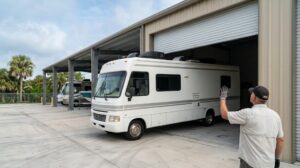
In Cape Coral, the choice between covered and enclosed storage is not a question of preference or budget alone. It is a climate decision. Salt air from the Gulf of Mexico and the Caloosahatchee River, sustained humidity that rarely drops below 70%, and a six-month hurricane season create real, predictable damage risks for any boat, recreational vehicle (RV), or vehicle sitting idle.
Covered storage reduces some of those risks. Enclosed storage eliminates most of them. This guide explains the difference, walks through which tier actually fits your vehicle and storage duration, and shows you what the cost gap buys you in protection.
Why Cape Coral’s Climate Makes This Decision Different
Cape Coral’s geography is the reason this decision looks different than it would inland, and it starts with location. The city sits at the mouth of the Caloosahatchee River, less than 15 miles from the Gulf of Mexico, close enough that salt-laden coastal air circulates through the entire metro year-round, not just along the waterfront. According to NOAA climate data, Southwest Florida’s coastal stations record average annual relative humidity well above 70%, climbing toward 80% during summer’s wet season.
Sustained humidity at those levels does measurable damage to a stored vehicle over time, and it shows up in more than one place at once.
- Mold and mildew: Develop inside upholstered seating, carpeting, and engine compartments within weeks when moisture has nowhere to escape.
- Pest activity: The same humid conditions that invite mold also make pest control in storage a real consideration for any vehicle left idle for months.
- Rubber and wiring: Gaskets, wiring insulation, and flexible seals absorb moisture and degrade across a multi-month storage period.
- Bare metal: Oxidation accelerates on any surface that stays damp.
Salt Air and Humidity: The Two-Front Problem
Covered storage handles some of what Cape Coral’s climate throws at a vehicle, but salt air and humidity are two separate threats that a roof alone doesn’t stop, and each one works differently.
- Salt air: Deposits on metal surfaces and initiates galvanic corrosion on electrical terminals, trailer frames, and outboard engine components. This doesn’t require rain or direct ocean spray, it happens through ambient airflow alone, which is why a vehicle under a covered canopy with open sides still gets full salt air exposure even with a solid roof overhead.
- Humidity: Drives a parallel set of failures, mold growth, material degradation, and moisture damage to electronics and upholstery. Covered storage blocks direct UV and keeps rain off the vehicle, but it does nothing to reduce the ambient humidity the vehicle sits in.
June Through November: What Hurricane Season Adds to the Equation
Cape Coral sits inside Lee County, one of Southwest Florida’s most hurricane-exposed coastal counties. Hurricane Ian made direct landfall here in September 2022. The storm produced catastrophic wind and storm surge damage across the area. Covered canopy structures are open-sided by design. During a named storm event, that design does not seal against wind-driven rain, airborne debris, or flooding. A vehicle stored under a canopy during a major storm has meaningful exposure on three sides.
Enclosed buildings built to Florida Building Code wind-load standards offer a structurally different level of protection during a named storm. Post-Ian local amendments in Lee County tightened those requirements for storage occupancy structures. That gap in structural performance is worth factoring into any storage decision made during hurricane season.
What “Covered” and “Enclosed” Actually Mean at a Storage Facility
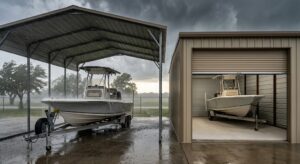
These two terms get used loosely across facility listings, and in Cape Coral’s climate, the difference actually matters. The table below puts the tiers side by side, but if you want the fuller picture first, carport and covered storage structures and what is enclosed vehicle storage both cover what each tier physically is before you start comparing facilities.
| Storage Type | Structure | Sides Open? | Rain Protection | Salt Air / Humidity Protection | Storm Protection | Relative Cost |
| Open outdoor | No roof or walls | Yes | None | None | None | Lowest |
| Covered | Roof only | Yes | From direct rainfall | Partial (UV ray protection, reduced splash) | Minimal | Mid |
| Enclosed | Roof + four walls + door | No | Full | Full | Significant | Higher |
Note that terminology varies by facility, and not every self-storage facility uses these terms the same way. Some operators use “covered” to describe partially walled spaces. Before assuming you are getting full enclosure, ask specifically whether the unit has four walls and a lockable door.
The Middle Cases: Partial Enclosures and Hybrid Structures
Some Cape Coral storage units feature three-wall structures or enclosed bays where a vehicle’s bow or hitch extends past the door. The practical test: is the hull, cab, or cargo area fully inside a sealed structure during a storm? If any significant portion of the vehicle extends into open air, the protection level is closer to covered than enclosed for both corrosion and storm purposes.
Climate-Controlled Storage: When It’s Worth the Premium
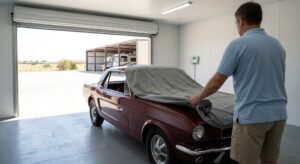
Climate-controlled storage adds active heating, ventilation, and air conditioning (HVAC) to an enclosed unit, regulating both temperature and humidity inside the space. For most boats and RVs stored with proper prep, a standard enclosed unit is sufficient; the premium isn’t necessary. It’s worth paying for three situations specifically: collector cars, vehicles with sensitive electronics, and anything stored for 12 months or longer where preventing mold and mildew in upholstered interiors during Cape Coral’s long humid season matters.
Matching Your Vehicle and Storage Duration to the Right Tier
The right tier depends on three factors: what you are storing, how long it will sit, and whether any portion of the storage period overlaps with hurricane season. Here is how those factors play out for the most common vehicle types in Cape Coral.
Boats and Marine Craft
Salt air is the primary threat to a stored boat. Outboard engines, wiring terminals, trailer frames, and marine hardware are all vulnerable to rust and corrosion through sustained ambient exposure. For boats stored more than a month in Cape Coral, enclosed storage eliminates rather than merely reduces that exposure. Covered boat storage is better than open outdoor parking, but the open sides allow ambient salt air to continue acting on components throughout the storage period.
RVs and Travel Trailers
Florida humidity is the dominant long-term threat to RVs stored in coastal Southwest Florida. Slide-out seals, roof membranes, and interior fabrics all absorb moisture across extended storage periods. Covered RV storage protects the roof from UV and direct rain, but it does nothing for the ambient humidity the vehicle sits in across a full off-season.
Enclosed storage is the better option for any RV stored through the wet season or across multiple months. Most enclosed units still offer drive-up access, so you’re not trading loading convenience for protection. Snowbirds and occasional-use owners storing from spring through fall get hit with both high humidity and hurricane season at once, which puts them squarely in the enclosed tier. If you’re storing an RV near Cape Coral and want a facility with multiple protection tiers in one location, RecNation’s nearest RV and boat storage, about 10 miles away in Fort Myers, is worth checking for current availability and unit sizes.
Motorcycles, ATVs, and Smaller Vehicles
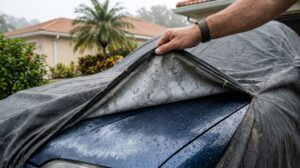
Motorcycles, all-terrain vehicles (ATVs), and other smaller vehicles are easier to prep with covers and corrosion inhibitors, which makes covered storage a reasonable middle-ground for short dry-season storage. Owners storing across any portion of hurricane season, or for longer than two months, get the same benefit from enclosed storage that boat and RV owners do: the vehicle is sealed away from ambient salt air and wind-driven rain.
The Insurance and Building Code Layer Most Owners Miss
Two things most owners never check before signing a storage lease, and both can matter more than the monthly rate.
- Insurance coverage: Many marine and RV insurance policies, operating within Florida’s broader insurance code under Florida Statute §627, condition comprehensive storm coverage on where the vehicle is stored during a named storm event. Whether a covered canopy counts as “enclosed” for this purpose is set by the individual policy, not a uniform state standard. A canopy is an open-sided structure and may not meet your policy’s definition, which could limit coverage for wind or water damage sustained during a hurricane. Review your policy’s definition of “protected” or “enclosed” storage with your insurer before choosing a tier.
- Building code: Enclosed storage structures in Cape Coral and Lee County must comply with Florida Building Code Section 311 governing storage occupancy classifications, plus post-Ian local amendments tightening wind-load requirements. A fully enclosed block or steel building built to those revised standards performs materially differently during a major storm than an open canopy structure. Ask any prospective facility for their building’s wind-load specification as part of your due diligence.
For more on how coverage and storage location interact, this guide on keeping a car in storage without insurance covers related policy considerations.
What to Ask Your Insurance Provider Before You Choose a Tier
None of this matters if you’re guessing at what your policy actually says, so get the answer straight from the source. Bring these three questions to your insurer before signing a storage agreement:
- Does my policy define “enclosed storage,” and does a covered canopy meet that definition?
- Is my comprehensive coverage valid if the vehicle sustains damage during a named storm while stored under a covered canopy?
- Does the policy require me to move the vehicle to an enclosed facility before a storm watch is issued?
Why Cape Coral’s Zoning Code Matters to This Decision
Cape Coral’s Land Development Code Section 2-238 restricts outdoor storage of RVs, boats, and trailers on residential properties in most zoning classifications within the city. For many residents, off-site storage is not a preference.
It is a legal requirement. If you are still deciding between keeping a vehicle at home and renting a storage space, the ordinance may remove that choice entirely. Verify your specific zoning district’s rules directly with the city.
What Covered and Enclosed Storage Costs in Cape Coral and What That Gap Actually Buys You
Outdoor boat storage in Cape Coral averages approximately $194 per month, according to RentCafe’s Cape Coral storage data. Covered storage runs meaningfully higher, and fully enclosed storage higher still. Rates vary by facility, unit size, and current availability, so contact facilities directly to confirm current pricing rather than relying on aggregated estimates. A vehicle storage cost guide can help you benchmark what to expect across different tiers and markets.
The more useful comparison is not monthly rate against monthly rate. It is monthly rate against the realistic cost of what each tier leaves unprotected.
| Damage Scenario | Realistic Repair Cost Range |
| Outboard engine corrosion repair | $500 to $2,000+ |
| RV interior mold remediation | $1,000 to $5,000 |
| Storm damage to an unprotected vessel | Partial to total loss on a $30,000 to $150,000+ asset |
*All pricing figures are estimates. Confirm current rates directly with the storage facility.*
The Real Cost of Underprotection in a Coastal Market
Three damage scenarios are realistically likely in Cape Coral’s climate, not rare worst-case outcomes.
- Outboard corrosion: Sustained salt air exposure in covered storage accumulates across months of idle time, attacking wiring terminals and metal hardware even when the engine isn’t running.
- RV interior mold: Develops quickly in a humid coastal climate when the vehicle is sealed for the season without adequate preparation or an enclosed space.
- Wind-driven rain penetration: During a tropical storm or Category 1 hurricane, rain can reach a vehicle stored under an open-sided canopy from multiple directions at once.
Each of those scenarios carries a repair cost that dwarfs any monthly premium paid for enclosed storage. A storage unit cost comparison looks different once the downside risk of the cheaper tier gets factored into the equation.
Choosing the Right Tier for Cape Coral’s Climate
Cape Coral’s humidity, salt air, hurricane exposure, and municipal zoning code together make this a more consequential storage decision than it would be in an inland market. The tier that fits your situation depends on your vehicle type, how long it will sit, and what your insurance policy says about storm-event coverage.
If you are ready to move from the decision to the rental, RecNation’s nearest facility, about 10 miles away in Fort Myers, offers covered and enclosed options for boats, RVs, and other vehicles, with the security features and access that Cape Coral owners actually need year-round.
Frequently Asked Questions
What is the difference between covered and enclosed storage in Cape Coral?
Covered storage is a roofed structure with open or partially open sides, it protects against direct sun and rainfall but leaves the vehicle exposed to ambient air, salt air from the Gulf of Mexico, and wind-driven rain. Enclosed storage is a fully sealed building: four walls, a roof, a lockable door. In Cape Coral’s coastal climate, that distinction matters because salt air and sustained humidity keep working on a vehicle under a covered canopy even after direct rain is blocked.
Is climate-controlled storage worth it in Cape Coral, Florida?
For most boat and RV owners here, standard enclosed storage is the right tier as long as the vehicle is properly prepped before storage. Climate-controlled, which actively regulates temperature and humidity inside the unit, earns its premium for collector cars, vehicles with sensitive electronics, or anything stored 12 months or longer. Shorter stays with thorough prep don’t need it.
Does Florida humidity damage vehicles in a storage unit?
Yes, and it happens faster than most owners expect. At Cape Coral’s humidity levels, which regularly exceed 70%, moisture has nowhere to go inside a stored vehicle, and mold takes hold in upholstery and carpet within weeks rather than months. Sealing the vehicle inside an enclosed unit cuts that risk substantially by removing the ambient humid air it would otherwise sit in; climate-controlled storage adds active humidity regulation on top of that for the most sensitive vehicles or the longest storage windows.
Does my boat insurance cover storm damage if my boat is in covered storage?
It depends entirely on your specific policy’s wording, there’s no single Florida-wide rule that settles this. Some insurers treat any roofed structure as sufficient; others require four walls and a locked door before storm coverage applies. Call your insurer, name your storage tier specifically, and get their answer in writing before hurricane season starts, not after a storm has already passed through.
Can I store my RV or boat at home in Cape Coral?
In most cases, no. Cape Coral’s Land Development Code Section 2-238 restricts outdoor storage of RVs, boats, and trailers on residential properties across most zoning classifications in the city, so many residents need off-site storage by ordinance, not by choice. Check your specific zoning district’s rules with the City of Cape Coral if you’re unsure whether your property is affected.
How much more does enclosed storage cost than covered storage in Cape Coral, Florida?
Outdoor boat storage runs about $194 a month in Cape Coral, with covered and fully enclosed costing progressively more on top of that baseline, exact rates depend on the facility, unit size, and what’s currently available, so a phone call beats an online estimate every time. Measured against the alternative, outboard corrosion repairs commonly run $500 to $2,000, RV mold remediation $1,000 to $5,000, and a storm-damaged, uninsured boat can mean losing a vehicle worth tens of thousands of dollars outright. The monthly gap between tiers is usually smaller than any one of those repair bills.