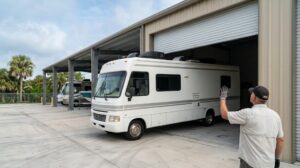
In Allen, Texas, the choice between covered and enclosed storage is not a preference question. Summer highs regularly exceed 100°F, and Collin County logs some of the highest hail frequencies in the Dallas-Fort Worth region. Most Allen residents can’t store an RV, boat, or high-value vehicle at home in the first place, HOA covenants see to that. Picking the wrong storage tier anyway can cost you thousands before the season ends.
This guide breaks down what each tier actually protects against, where it falls short, and which option fits your vehicle and budget.
What “Covered” and “Enclosed” Actually Mean (They’re Not the Same Thing)
These two terms appear on nearly every self-storage facility website, often side by side, and many owners assume “covered” means fully protected. It doesn’t. The physical difference between the two is significant, and in Allen’s climate, that difference determines how much damage accumulates during a storage season.
Covered Storage: What It Is and What It Isn’t
The name suggests full protection. It isn’t, and that gap is exactly where damage gets in during an Allen summer.
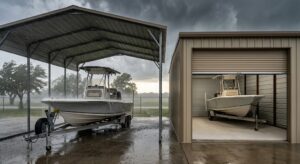
Carport and covered storage is exactly what the name implies at first glance: a roof structure, typically metal or polycarbonate, with open sides. Your vehicle sits underneath it, shaded but not shut in, which sounds like enough protection until you look at what actually gets through those open sides.
- What it blocks: Direct sunlight and rain falling straight down.
- What it doesn’t block: Wind, blowing rain, dust, and hail, all of which reach the vehicle through the open sides.
- The honest verdict: It’s an upgrade from leaving a vehicle completely exposed, but it is not a substitute for enclosure. No resistance to side-driven weather, no barrier against temperature-driven air circulation, no protection when a storm rolls in at an angle.
Enclosed Storage: Full Isolation From the Elements
This is the tier that actually closes every gap covered storage leaves open. Enclosed storage puts your vehicle inside four walls, a roof, a floor, and a roll-up or swing door, sealed off from the outside entirely.
- What it eliminates: UV rays, hail, wind-driven debris, and the ambient heat exchange that seeps in through a covered structure’s open sides.
- What it fits: Everything from motorcycles up to Class A motorhomes and large boats on trailers, unit sizes scale to the vehicle.
One tier sits on top of this. Climate-controlled storage adds active temperature and humidity regulation inside an already-enclosed unit, worth the extra cost for electronics, leather interiors, or anything stored through a full year rather than just a season.
For more on how enclosed storage works in practice, see what enclosed vehicle storage is.
| Feature | Covered | Enclosed |
| Roof | Yes | Yes |
| Walls | No | Yes |
| Floor | No (usually gravel or pavement) | Yes |
| Hail protection | No | Yes |
| UV ray protection | Partial (top only) | Full |
| Wind and debris protection | No | Yes |
| Climate control option | No | Yes (as an add-on tier) |
| Drive-up access | Yes | Yes (unit-dependent) |
What Allen’s Climate Actually Does to a Stored Vehicle
The damage that North Texas weather conditions inflict on a stored vehicle is not dramatic or sudden. Most of it builds quietly over four to six months, and by the time you pull the vehicle out, the seals are cracking, the upholstery is stiff, and the battery is dead.
Heat and UV: The Slow Damage Most Owners Don’t See Coming
The numbers here aren’t abstract, they translate directly into what happens inside a parked vehicle. According to National Weather Service Fort Worth climatological data, Allen averages more than 60 days per year at or above 95°F, with July and August regularly reaching 100°F to 105°F. Inside a closed RV or boat parked under a carport-style covered structure, interior temperatures on peak summer days can reach 150°F to 160°F, and that heat does real damage, not just discomfort.
- Seals and plastics: Rubber roof seals on recreational vehicles (RVs) soften and crack; dashboard plastics warp and off-gas.
- Upholstery and batteries: Adhesive bonds in upholstery degrade, and battery self-discharge accelerates to the point of permanent capacity loss.
UV does its own damage on top of the heat, and a covered structure barely slows it down, sunlight enters freely from the open sides, hitting the vehicle laterally rather than from directly overhead.
- Boats: Gel coat on a fiberglass hull fades and oxidizes.
- RVs: Exterior paint loses gloss and begins to chalk.
- Tires: Sidewalls crack from sustained UV exposure.
This is cumulative, seasonal damage that reduces resale value and shortens component life, not a single event you repair and move past.
Hail: The Single-Event Risk That Covered Storage Can’t Stop
Heat builds slowly. Hail doesn’t, and a carport roof does nothing to stop it. The NOAA Storm Events Database documents Collin County as a consistent high-frequency hail zone, with multiple recorded large-hail events (at or above one inch in diameter) in recent years.
- RVs: Roofs puncture.
- Trailers: Aluminum skins dent.
- Boats: Fiberglass hulls crack.
- Motorcycles: Fairings total out.
A carport roof offers no meaningful resistance here; the vehicle sits exposed on all sides, and hailstones falling at an angle pass right under the canopy edge. Damage like this typically runs into thousands of dollars per event, and it arrives without warning. Enclosed storage eliminates the exposure entirely.
Why So Many Allen Residents Need Off-Site Storage in the First Place
Most Allen vehicle owners aren’t choosing off-site storage because they prefer it. They’re choosing it because their HOA covenant or the city’s property maintenance code doesn’t give them another option.
HOA Covenants and City Code: The Rules That Apply to Most Allen Homeowners
Allen is a dense suburban city with a high concentration of homeowners association (HOA)-governed subdivisions, and most of them address this directly. Communities including Twin Creeks, Watters Crossing, and similar master-planned neighborhoods commonly write RV, boat, trailer, and commercial vehicle storage restrictions into the covenant itself, covering driveways and side yards, not just the street. The City of Allen’s Code of Ordinances, Chapter 6 (Nuisance and Property Maintenance), backs this up for properties without an HOA. You can review the City of Allen municipal code portal directly.
Allen’s proximity to Lake Lavon adds another layer: boaters in the Fairview, Parker, and Allen corridor need RV and boat storage that’s accessible for weekend trips, not just compliant with the covenant. Check your specific covenant documents before assuming home storage is allowed; violations typically mean a fine and a compliance deadline, not a warning you can ignore.
Covered vs. Enclosed Storage: A Decision Matrix by Asset Type and Budget
The right storage tier depends on what you’re protecting, how long it will sit, and how much replacement or repair would cost if something went wrong. The table below matches common vehicle types to a recommended tier with brief reasoning.
| Asset Type / Scenario | Recommended Tier | Why |
| RV or motorhome valued above $50,000 | Enclosed | Heat, UV ray damage, and hail risk all justify the premium |
| Boat on trailer valued above $20,000 | Enclosed | Hail risk to hull, UV damage to upholstery and gel coat |
| Motorcycle or all-terrain vehicle (ATV), high-value or classic | Enclosed | Vulnerable to UV and hail; high resale sensitivity |
| Motorcycle or ATV (utility, lower-value) | Covered | Acceptable trade-off for assets without sensitive interiors |
| Cargo or utility trailer | Covered | No interior to protect; hail exposure is a dent, not a total |
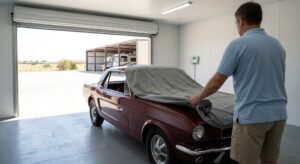
| Classic or collector car | Enclosed or climate-controlled | Finish, rubber, and electrical systems need full isolation |
Quick Note: For a deeper look at how these options affect your overall costs, the vehicle storage cost guide walks through pricing variables across storage types and vehicle sizes.
High-Value Vehicles: When Enclosed Storage Is the Only Logical Answer
A storage unit cost comparison makes the most sense when you factor in what you’re protecting. For RVs, boats, and collector cars valued above $30,000 to $40,000, the monthly premium difference between covered and enclosed storage is often in the range of $30 to $80. One hail event or a summer of accumulated UV damage on a high-value RV roof or fiberglass hull can cost far more than that annual premium gap. Verify current monthly storage rental rates directly with the facility, as pricing varies by unit size and market.
For Allen owners storing a boat, RV, or high-value vehicle, RecNation’s nearest facility, about 9 miles away in nearby Wylie, offers both covered and enclosed options sized for large vehicles, including drive-up enclosed units accessible for weekend Lake Lavon runs.
Budget-Sensitive Scenarios: When Covered Storage Is a Reasonable Trade-Off
Covered storage isn’t the wrong answer in every situation. A utility trailer, a lower-value ATV, or a vehicle stored briefly during milder weather can be a reasonable fit for the covered tier. The exposure risk is real, but for these assets, the replacement cost often doesn’t justify the enclosed premium.
The math changes with the storage window. Texas summer heat in Allen runs long, typically May through September, and a vehicle sitting under a carport for five months carries meaningfully more risk than one stored for six weeks in the fall. The right tier follows the actual exposure window, not the monthly rate alone.
What Your Insurance Policy and Lender May Require
Many RV and marine insurance policies under comprehensive coverage distinguish between a vehicle stored in an open-sided carport structure and one stored in a fully enclosed building when evaluating weather-related claims. The specific language varies by carrier, but the distinction exists and can affect how a hail damage or water intrusion claim is evaluated.
Questions to Ask Your Insurer Before You Sign a Storage Lease
Before you commit to a storage tier, call your insurance carrier and work through these questions:
- Does my policy distinguish between covered and enclosed storage for weather-related claims? Ask specifically whether a carport-style structure qualifies as adequate storage under your comprehensive coverage terms.
- Does storing in an open-sided structure affect my coverage for hail or wind damage? Get a direct answer, not a general reassurance.
- Does my lender’s security agreement specify enclosed or secure storage? If you’re financing an RV or boat, the lender’s security agreement may set a minimum storage standard.
- What documentation does the facility provide that confirms the storage type? Your insurer or lender may need written confirmation of what tier you’re using.
The Texas Department of Insurance provides consumer guidance on recreational vehicle and inland marine policy endorsements, a useful starting point before you call your carrier. For more on coverage questions related to stored vehicles, see whether a car in storage needs insurance. Whatever your insurer tells you, get it in writing before you sign a storage lease, a verbal answer won’t help you if a claim gets disputed later.
Choosing the Right Storage Tier for Allen’s Climate
Choosing the right storage tier for an Allen vehicle comes down to one question: what’s it going to cost you if you’re wrong? For anything you’ve financed, insured comprehensively, or expect to sell someday, one hail season or a summer of accumulated UV damage can cost more than years of the enclosed premium combined.
RecNation’s nearest facility, about 9 miles away in nearby Wylie, provides enclosed and covered options built for large vehicles, RVs, boats on trailers, and everything in between, so your asset is actually protected against what Collin County summers deliver. Check current availability now, before the next 100°F stretch or hailstorm makes the decision for you.
Frequently Asked Questions
Is covered or enclosed storage better for protecting my vehicle in Allen, Texas?
For high-value vehicles, enclosed. Allen’s summer highs regularly exceed 100°F, and Collin County is a documented high-frequency hail zone, both of which a carport-style structure leaves you exposed to through its open sides. Covered storage still makes sense for lower-value utility trailers without sensitive interiors to protect.
What is the difference between covered, enclosed, and climate-controlled storage?
Covered means a roof with open sides, blocking sun and vertical rain but not hail or side-driven weather. Enclosed means four walls and a door, isolating the vehicle from all exterior conditions. Climate-controlled adds active temperature and humidity regulation inside an enclosed unit, worth it for leather interiors, electronics, or anything that needs stable conditions year-round.
How much does covered storage cost compared to enclosed storage in Allen, TX?
Enclosed typically runs $30 to $80 more per month than covered for a vehicle-sized unit, though the exact gap depends on size and facility, so confirm current rates directly. For anything valued above $30,000 to $40,000, that monthly difference is usually small next to what a single hail claim or a summer of UV damage costs in repairs or lost resale value.
Does Texas heat damage vehicles stored in non-climate-controlled units?
Yes, and it adds up fast. A roof-only structure does nothing to stop cabin temperatures from climbing into the 150s on Allen’s hottest days, and at that range, seals crack, dashboard plastics warp, upholstery adhesive fails, and batteries lose capacity. Full enclosure cuts that heat buildup by blocking the open-side airflow that lets it in; climate control goes further and holds a stable temperature for materials that can’t tolerate the cycling at all.
Is enclosed storage worth the extra cost for RV and boat storage in Allen?
For most owners, yes. A hail-cracked fiberglass hull or a failed RV roof seal typically costs more to fix than the annual premium gap between covered and enclosed, and Collin County’s hail frequency makes that a real risk, not a hypothetical one. If you’re financing or carrying comprehensive insurance, check whether your policy factors storage type into weather claims, too.
Can I store my RV or boat at home in Allen, Texas?
For most residents, no. Allen’s HOA-governed subdivisions typically write RV, boat, and trailer restrictions into the covenant itself, and the city’s property maintenance code backs that up where there’s no HOA. Pull your specific covenant before assuming you’re the exception, violations usually mean a fine and a deadline to move it, not a warning you can ignore.