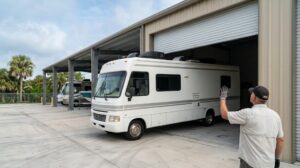
In Pearland, Texas, enclosed storage is the minimum viable choice for most vehicles stored longer than a few weeks. Sustained summer heat, Gulf Coast humidity that stays high for much of the year, and a Brazoria County hail season that can produce damaging events all make that verdict clear. This is not a market where “covered is probably fine” holds up under scrutiny. The climate math here is specific, and it points in one direction.
What “Covered” and “Enclosed” Actually Mean at a Pearland Facility
Before comparing the two, it helps to confirm you’re working from the same definitions facilities in this area use. The terms sound self-explanatory, but the protection gap between them is larger than most owners expect until they’re standing in front of both structures.
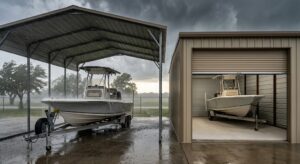
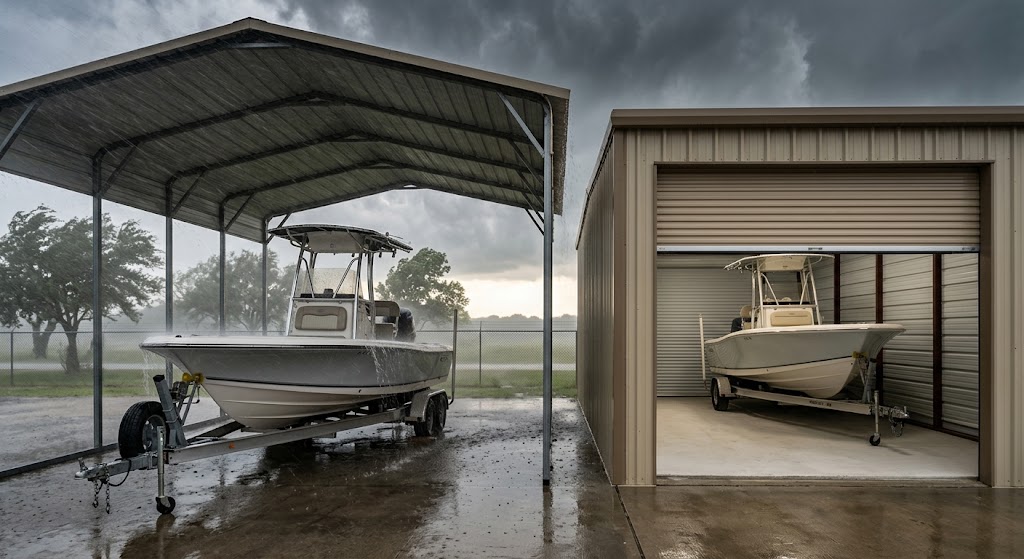
- A carport or covered storage space is a roofed, open-sided structure. It blocks direct overhead sun and rainfall from above, but the sides remain open. Wind-driven rain, humidity exchange with the surrounding air, and hail arriving at an angle all pass through freely. For Pearland’s Gulf Coast weather conditions, that matters significantly.
- An enclosed vehicle storage unit is a fully walled structure with a lockable door. It provides full-perimeter protection from weather exposure and meaningfully reduces the rate at which outside humidity enters. Storage security features are also substantially stronger, since a locked, walled unit is harder to access than an open bay.
Climate-controlled storage is a third distinct tier. It adds active temperature and humidity regulation inside an enclosed space. In Pearland’s year-round high-humidity environment, it is the only option that actively manages interior moisture rather than just reducing weather exposure passively.
Here is how the three tiers compare for Pearland and Brazoria County owners:
| Feature | Covered | Enclosed | Climate-Controlled |
| Weather protection | Overhead only | Full perimeter | Full perimeter + active regulation |
| Humidity defense | None | Partial | Active management |
| Hail protection | Overhead only | Complete | Complete |
| Storage security features | Basic | Lockable door | Lockable door |
| Best fit (Pearland climate) | Frequent-use vehicles | Most vehicles 30+ days | Collector cars, recreational vehicles (RVs), boats off-season |
| Monthly storage rental | Lowest tier | Mid-range | Highest tier |
Rates vary by facility, unit size, and vehicle dimensions. It helps to confirm current pricing directly with facilities in the Pearland and Brazoria County area.
What Pearland’s Climate Actually Does to a Stored Vehicle
Understanding the protection tiers is one thing. Understanding what Pearland’s specific weather does to a vehicle left in the wrong tier is what actually resolves the decision.
Heat and UV Damage
Pearland summers are hot and humid. Inside a vehicle sitting on an exposed pad, interior temperatures can climb very high even under a covered structure, because heat buildup continues regardless of overhead shade. Rubber seals crack, vinyl dashboards warp, and lithium battery management systems in modern RVs have thermal thresholds that sustained heat exposure can permanently degrade.
Ultraviolet (UV) ray protection is a separate but related problem. The Houston-Pearland corridor receives intense year-round UV index readings that drive cumulative paint oxidation, gel coat chalking on fiberglass boat hulls, and fabric fading. A covered structure slows that process but does not stop it. Temperature fluctuations between scorching days and cooler nights also accelerate rubber and seal degradation over a full season.
Humidity and Mold Risk
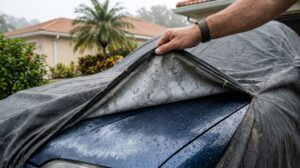
Pearland’s proximity to the Gulf Coast keeps ambient humidity high for much of the year. A vehicle stored in a covered-but-open structure continuously exchanges air with that humid environment. Mold and mildew prevention becomes nearly impossible under those conditions without sealed walls or active climate control.
Humidity damage can develop within weeks, not months, and it shows up in different places depending on the vehicle:
- RVs: Slide-out compartment seals, carpet backing, upholstery foam, and insulation.
- Boats: The bilge, electronics bays, and upholstered seating.
Enclosed storage reduces the rate of air exchange significantly, and climate-controlled storage actively manages it.
Hail Exposure in Brazoria County
Brazoria County is exposed to hail events, and the National Oceanic and Atmospheric Administration (NOAA) Storm Events Database lists the ones recorded there. Large hailstones can dent paintwork, fracture fiberglass, crack skylights, and damage RV air conditioner shrouds.
Covered storage has one core weakness: direction. When hail arrives with any wind, it enters through the open sides instead of falling straight down. Enclosed storage removes that exposure entirely.
For outdoor storage in this county, hail is the most unpredictable and costly risk that covered-only storage leaves unaddressed.
Which Storage Type Is Right for Your Vehicle
If you have read this far, you know Pearland’s climate is not neutral toward lower-protection storage. Here is the asset-type-by-asset-type verdict. The ultimate guide to vehicle storage covers broader preparation considerations, but for Pearland specifically, the climate drives the tier recommendation.
| Vehicle Type | Minimum Recommended Tier | Primary Damage Risk |
| Class A / Class C motorhome | Enclosed (climate-controlled for 60+ days) | Roof seam failure, slide-out mold, lithium system degradation |
| Fifth wheel / travel trailer | Enclosed | Hail damage, humidity infiltration through seals |
| Boat / personal watercraft | Enclosed | Bilge mold, electronics corrosion, upholstery degradation |
| Painted daily-use car | Enclosed (30+ days) | Paint oxidation, UV fade, hail denting |
| Collector or classic car | Climate-controlled | Humidity corrosion, paint damage, sensitive component protection |
| Motorcycle / all-terrain vehicle (ATV) | Covered (frequent use); enclosed (seasonal) | Hail damage during multi-week idle periods |
There is no RecNation facility inside Pearland. RecNation’s nearest facility, 8.5 miles away in Houston at 8750 Galveston Rd, has covered and enclosed spaces, so you can match your vehicle to the protection level the verdict above identifies. See RV and boat storage near Pearland.
RVs and Motorhomes
The verdict for RVs is enclosed at minimum, with climate-controlled RV storage strongly recommended for anything stored longer than 60 days. Roof seam integrity is the first casualty of Pearland’s Texas heat combined with UV exposure. When those seams crack, moisture infiltrates the wall structure, and mold follows within weeks in this climate.
Lithium battery systems in modern motorhomes have thermal management requirements that sustained extreme interior heat can compromise permanently.
Boats and Personal Watercraft
Enclosed boat storage is the honest recommendation for anything kept in Pearland longer than a few weeks between outings. Gulf Coast ambient humidity creates mold conditions in bilges and upholstery that covered storage simply cannot address.
Electronics compartments and wiring harnesses also corrode in sustained high-humidity environments. Fiberglass hulls chalked by UV and dented by hail lose resale value that is expensive and sometimes impossible to fully restore.
Cars, Collector Vehicles, and Motorcycles
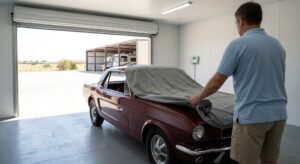
For painted daily-use vehicles stored more than 30 days, enclosed storage is the minimum. UV ray protection and hail coverage are the primary drivers. For collector or classic vehicles, climate-controlled storage addresses the humidity-driven corrosion that enclosed-but-unregulated storage still allows.
Motorcycles and ATVs used frequently can get by with covered storage, but for seasonal storage spanning multiple months, hail risk alone makes enclosed the better call.
The Cost-vs-Damage Tradeoff: What Cheaper Storage Actually Costs in Pearland
The monthly cost difference between covered and enclosed storage in Brazoria County is real, and monthly rates vary by facility, so it helps to confirm current pricing directly. Before committing to covered storage to save that amount each month, it helps to weigh it against the specific repair costs Pearland’s climate generates. For a full breakdown of how vehicle storage pricing is structured, refer to RecNation’s how much vehicle storage costs.
When the Price Difference Is Worth It
The monthly premium for enclosed storage is a fixed, predictable cost. Hail repair, mold remediation, and paint restoration are not, and they often arrive together after a single bad weather event. Choosing the right tier up front is the more controllable way to manage that risk, and your own insurance policy is the safety net if damage does occur.
Insurance and Storage Type
The storage type you choose can affect how a Texas vehicle or RV insurance policy responds to a weather-related claim. Covered-but-open structures do not prevent the wind-driven hail exposure that enclosed storage eliminates, and that distinction can become relevant during the claims process.
The Texas Department of Insurance provides general guidance on comprehensive coverage conditions, and it is worth asking your insurer directly how your chosen storage tier affects your specific policy before a claim arises. This is not legal or insurance advice; it is a practical flag that the decision has downstream effects worth investigating.
Why Pearland Residents Often Can’t Store at Home
Many Pearland owners are not choosing between home storage and a facility as a preference. They are being required off their driveways by homeowners association (HOA) covenants or municipal code. That context sharpens the covered-vs-enclosed decision considerably. For more on what that situation looks like compared to other options, see covered storage vs. street parking.
HOA Restrictions in Pearland’s Master-Planned Communities
Many master-planned communities in the Pearland area have HOA covenants that restrict or prohibit RVs, boats, and oversized vehicles on residential driveways or visible from the street. These rules vary by community and are updated periodically, so it helps to check your HOA’s governing documents for the exact language that applies to you. A neighbor’s situation does not always reflect your own covenant.
If your HOA restricts parking, off-site storage is already a given. The real decision is which protection tier suits your vehicle, based on what Pearland’s climate does to one left in the wrong tier.
City of Pearland Parking Rules
Beyond HOA rules, the City of Pearland’s own rules regulate vehicle storage on residential property. It helps to confirm the current provisions through the city’s official code portal or by contacting the planning department directly, as ordinance language changes.
HOA restrictions and city ordinances operate independently, and both may apply to your situation simultaneously.
Final Thoughts
You have worked through the climate conditions, the protection tiers, the asset-type verdicts, and the cost-vs-damage tradeoff. The next step is finding a facility that has the configuration your vehicle requires.
RecNation storage near Pearland puts you at RecNation’s nearest facility, 8.5 miles away in Houston, which offers covered and enclosed options for RVs and boats on a fenced, gated, camera-monitored lot. Matching your asset to the right protection level before the next hail season is the decision this article was built to help you make.
Frequently Asked Questions
What is the difference between covered and enclosed storage in Pearland, TX?
Covered storage in Pearland is a roofed, open-sided structure that blocks overhead sun and rain, while enclosed storage adds walls and a lockable door for full-perimeter protection. Climate-controlled storage goes a step further by regulating interior temperature and humidity, which suits collector vehicles and extended off-season storage.
Is climate-controlled storage worth it in Texas?
Climate-controlled storage is worth the cost in the Houston-Pearland area for vehicles stored longer than 30 days, collector vehicles, electronics-heavy RVs, and boats between seasons. High ambient humidity can create mold conditions even inside walled units, and active climate control is the tier that manages that moisture directly.
What type of storage is best for boats and RVs in the Houston area?
Enclosed storage is the minimum recommended tier for boats and RVs kept in the Houston-Pearland area for more than a few weeks. Gulf Coast humidity, summer heat, and hail exposure make covered-only storage a weak fit for large, higher-value vehicles, and climate-controlled enclosed storage is the preferred choice for off-season storage.
How much does covered storage cost compared to enclosed storage in Pearland?
Enclosed storage in Pearland typically carries a higher monthly rate than covered storage, and climate-controlled units add a further premium. Rates vary by facility, unit size, and vehicle dimensions, so it helps to confirm current pricing directly. Weighing the premium against potential hail repair, mold remediation, or paint restoration shows whether it is worth it for a given vehicle.
Does Texas humidity damage items stored in covered but not enclosed units?
Texas humidity can damage items in covered but not enclosed storage, because an open-sided structure lets the vehicle exchange air with the surrounding atmosphere continuously. Mold and mildew can develop in RV interiors, boat bilges, and upholstery within weeks, and enclosed storage reduces but does not eliminate that risk.
Can I store my RV at home in Pearland?
Storing an RV at home in Pearland depends on HOA covenants and City of Pearland rules, which operate independently of each other. Many master-planned communities restrict or prohibit RVs and oversized vehicles on residential driveways, so the HOA governing documents and the city’s official code portal are the two sources to confirm.