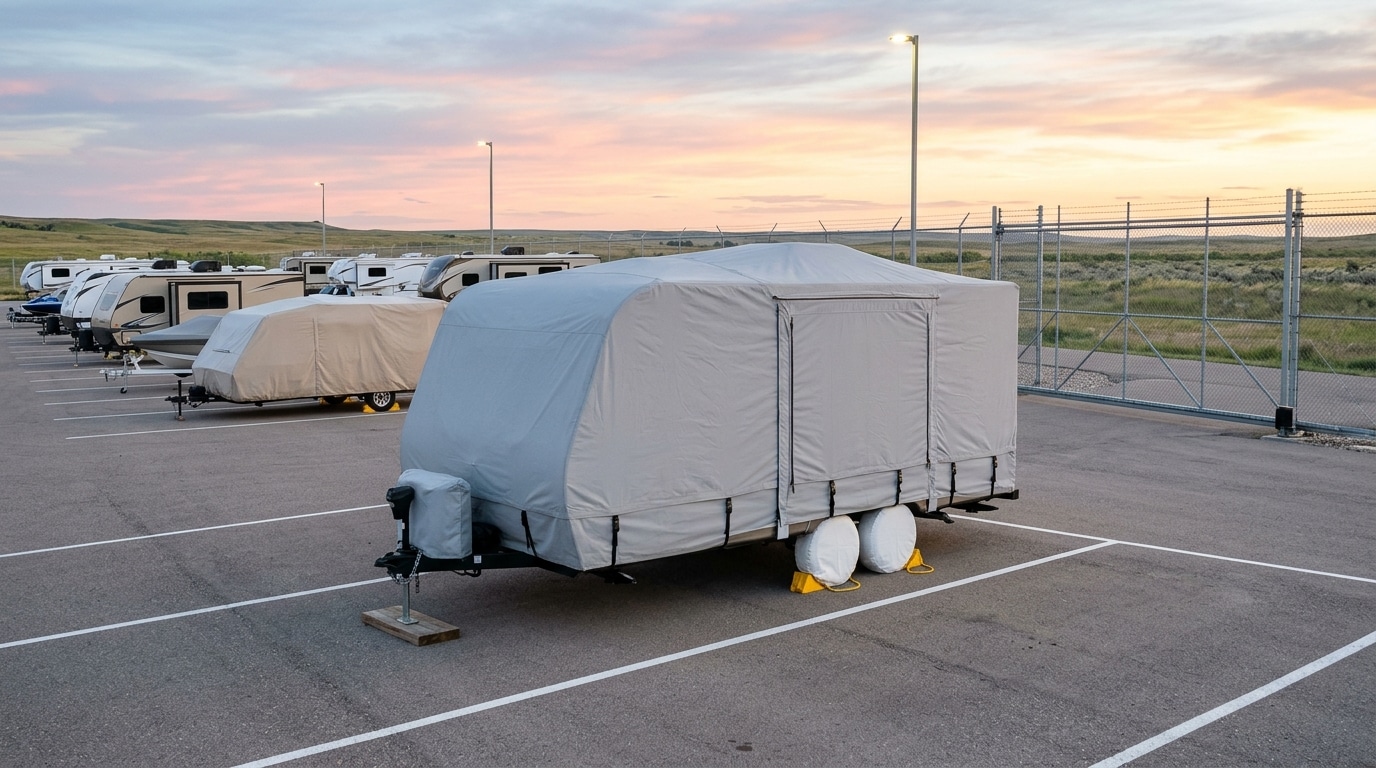
Outdoor recreational vehicle (RV) storage at a managed facility typically costs $57 to $183 a month for uncovered spaces as of October 2026, making it the most affordable storage tier available for motorhome and travel trailer storage. Whether you are weighing a commercial facility against your driveway, or trying to understand what risks come with open-lot storage, the answer depends on your situation, your homeowners association (HOA), and how much protection your rig actually needs.
What Outdoor RV Storage Costs
Outdoor uncovered storage is the entry-level tier for recreational vehicle storage, running about $0.32 per square foot per month as of October 2026. That figure is the clearest cost anchor for comparing options. Space length and local market demand are the two biggest drivers of variation within the uncovered tier, and how rates break down by size and location shows the pattern in more detail.
Booking online typically saves around $20 a month compared to standard walk-in rates. All figures are industry estimates, and prices vary by location, size, and availability, so it helps to confirm current rates with the specific facility.
Outdoor Uncovered vs. Covered vs. Indoor: At a Glance
The right tier depends on how long you plan to store, what climate you are in, and what level of protection your RV needs. The table below shows monthly storage rates and cost per square foot for all three tiers.
| Storage Tier | Monthly Rate Range | Cost per Sq Ft/Month | What It Provides |
| Outdoor uncovered | $57 to $183 (most RV spaces $78 to $126) | ~$0.32 | Open-lot space, no roof, lowest cost |
| Outdoor canopy | $99 to $351 (most $108 to $239) | ~$0.58 | Roof structure blocks direct sun and rain |
| Indoor garage | $114 to $701 | ~$0.63 | Fully enclosed, highest protection |
All figures as of October 2026.
What Space Size Do You Need?
RV spaces at managed facilities start at 20 ft. Teardrops, pop-ups, and camper vans fit in a 20 to 25 ft space. Larger rigs, including fifth wheels, Class A motorhomes, and long travel trailers, need longer spaces. It helps to measure your RV’s total length including any hitch, tow bar, or tongue before booking.
Why Many RV Owners Can’t Store at Home
Two layers of rules can keep an RV off your driveway. Homeowners association (HOA) covenants commonly prohibit parking an RV in a driveway or anywhere visible from the street, and many municipalities add their own zoning codes that restrict residential RV parking separately.
These HOA RV parking restrictions and municipal codes can apply at the same time. Even if your HOA is silent on RVs, your city or county may not be, and a local ordinance can still apply if your neighborhood has no HOA at all. The rules in your jurisdiction matter more than general assumptions, and whether outdoor RV storage at home is a viable option is easier to judge once you have read them.
When home storage is legally off the table, a commercial outdoor storage facility is the practical answer for recreational vehicle storage, not just a convenience.
What to Check Before Storing Your RV at Home
It helps to work through these checks before assuming your driveway is a legal option:
- HOA covenants, conditions, and restrictions (CC&Rs): Review them for any language about recreational vehicles, parking visibility, or size limits.
- Local zoning code: Search your city or county’s municipal code online. Look for sections on vehicle parking, residential storage, or recreational vehicle regulations.
- Neighborhood association status: Confirm whether a homeowners association governs your property, even informally.
- Driveway surface and drainage: Confirm the surface is paved, level, and appropriate for the weight of a loaded RV over an extended period.
The Real Risks of Outdoor RV Storage
Outdoor storage is a legitimate, widely used option for motorhome and travel trailer storage. It is not a last resort. But managing it well means knowing what can go wrong and acting before damage sets in.
UV and Weather Damage
Prolonged direct sun degrades rubber roof seals, sidewall caulking, and siding finishes over one to three seasons of unprotected exposure. The damage is cumulative and not always obvious until a seal fails during rain. Fitting a quality RV-specific cover and applying ultraviolet (UV) protectant to rubber seals before long-term storage are two practical countermeasures. Material rating and fit matter as much as price, so what to look for in an RV cover is worth reading before you buy.
Moisture and Condensation
Moisture finds its way in through deteriorated seals and inadequate ventilation, leading to mold, mildew, and interior surface damage over a full storage season. Before placing your RV in storage, inspect every roof and sidewall seal for cracking. Leave roof vents slightly open with vent covers in place, and place desiccant packs inside the cabin to manage humidity during storage.
Pest Entry
An unoccupied RV stored outdoors is an attractive nesting site for mice, wasps, and other pests. A single season of rodent infestation can cause costly wiring and interior damage. Seal every exterior opening before storage, including plumbing vents, exhaust outlets, and gaps around slide-outs. Sealing entry points and using deterrents are both part of keeping mice and rodents out of a stored RV.
Tire Flat Spots
Stationary weight on tires over months of storage creates flat spots that cause vibration and can shorten tire life. The fix is straightforward: move the RV a few feet every four to six weeks, or place tire cradles under each wheel before storage begins. For cradle sizing and placement, how to prevent flat spots on RV tires goes into more detail.
Surface and Leveling Issues
Soft, uneven, or unpaved surfaces can cause frame stress or gradual sinking during long-term vehicle storage. A paved storage lot or compacted gravel surface distributes weight evenly and reduces the risk of settling. Managed outdoor RV storage facilities typically use paved or compacted gravel lots, which are more stable than residential dirt or grass, and the best surface for your RV to sit on during storage is worth understanding before you choose a space.
Driveway Storage vs. a Managed Outdoor Facility
If home storage is legally permitted, you are still making a practical trade-off. A residential driveway offers convenience, but a managed outdoor RV storage facility offers a more controlled environment. The differences between home and facility storage go beyond cost, and comparing RV storage types and what each offers helps if you are still weighing the options.
RecNation operates outdoor storage facilities at 70 locations across Arizona, California, Florida, Kansas, Missouri, South Carolina, Tennessee, and Texas, with RV storage options including spaces starting at 20 ft for smaller rigs like teardrops and pop-ups, and longer spaces for full-size motorhomes and fifth wheels.
The table below compares home driveway storage to a managed outdoor facility across the factors that matter most for long-term vehicle storage.
| Factor | Home/Driveway | Managed Outdoor Facility |
| Security | Depends on what the owner has set up | Gated storage lot with perimeter lighting typical; specific features vary by facility |
| Surface quality | Varies: concrete, asphalt, grass, or dirt | Typically paved or compacted gravel |
| Access | Unlimited but no structured hours | Facility hours vary; ask about 24-hour access storage before renting |
| Pest and weather environment | Fully exposed; no management | Open lot; grounds maintenance varies by facility |
| Insurance considerations | Check your policy for storage-related terms | Ask your insurer whether a managed facility affects your coverage |
| HOA and zoning compliance | May violate local rules | Avoids the home-parking compliance issue |
Insurance provisions vary by policy, so it helps to check your own RV insurance terms before choosing a storage location.
What to Look for When Choosing an Outdoor Storage Facility
Not every gated storage lot is the same. It helps to use these criteria when evaluating facilities:
- Gated access and lighting: Confirm the facility has a secured entrance and perimeter lighting as baseline storage unit security features.
- Surface type: Ask whether spaces are paved, compacted gravel, or unpaved dirt.
- Space sizing options: Confirm available lengths match your rig. Spaces for motorhome and travel trailer storage typically start at 20 ft.
- Access hours: Ask specifically about 24-hour access storage if you travel on irregular schedules.
- Proof of insurance and registration: Some facilities require current insurance and registration on file before renting.
- Proximity to home or travel route: Finding RV storage near me is more than convenience; a facility on your regular route makes pre-trip access practical.
Preparing Your RV for Outdoor Storage
RV winterization and storage preparation done thoroughly before drop-off protects your investment through the full storage period. It helps to work through these steps before locking the gate:
- Clean the interior and exterior thoroughly: Food residue and moisture left inside attract pests and promote mold.
- Inspect and re-seal cracked caulking: Check every roof seam and sidewall joint. Cracked caulking is an open invitation for water and pests.
- Disconnect the battery or connect a battery maintainer: A discharged battery left over months of storage can be damaged beyond recovery.
- Fill the tank and add fuel stabilizer if storing for more than 30 days: Untreated fuel degrades and can clog the fuel system.
- Check tire pressure and address flat spot risk: Set pressure to the manufacturer’s recommended level, then place tire cradles or plan to move the RV periodically.
- Seal all exterior openings: Cover plumbing vents, roof vents, exhaust outlets, and any gaps around slide-outs or entry points.
- Fit a quality RV-specific cover for uncovered spaces: A properly sized cover blocks UV and reduces moisture infiltration.
- Photograph the RV’s condition before storage: Document every panel, seal, and accessory in case a damage question arises later.
Ready to Get Your RV Off the Driveway?
Outdoor storage is a sound choice for RV owners who cannot store at home, want to keep monthly costs reasonable, and are willing to prepare the rig properly before dropping it off.
If you are ready to get your RV off the driveway and into a secure, managed space, RecNation RV storage offers outdoor uncovered spaces starting at roughly $0.32 per square foot per month as of October 2026, with locations across Arizona, California, Florida, Kansas, Missouri, South Carolina, Tennessee, and Texas. Spaces start at 20 ft for smaller rigs and scale up for larger motorhomes and fifth wheels. Prices vary by location, size, and availability.
Frequently Asked Questions
How much does outdoor RV storage cost per month?
Expect about $57 to $183 a month for an outdoor uncovered RV space at a managed facility as of October 2026, with most RV-size spaces running $78 to $126. Prices vary by location, space length, and availability, and booking online can reduce the rate by roughly $20 a month at some facilities.
What is the difference between outdoor uncovered, covered canopy, and indoor RV storage?
The three tiers differ in how much protection the RV gets: outdoor uncovered storage is an open lot with no roof at about $0.32 per square foot per month, covered canopy storage adds a roof that blocks direct sun and rain at $108 to $239 a month for most RV-size spaces, and indoor garage storage fully encloses the RV at up to $701 a month for the largest spaces, as of October 2026. Indoor storage offers the highest protection and also the highest cost.
Can I store my RV in my driveway if my HOA prohibits it?
Storing an RV in a driveway your HOA prohibits it from using violates the HOA agreement and can lead to fines or a legal dispute, and city or county zoning rules can restrict residential RV parking even without an HOA. A managed outdoor storage facility is the practical solution when home storage is not legally permitted.
How do I prepare my RV for long-term outdoor storage?
Preparing an RV for long-term outdoor storage comes down to cleaning it inside and out, re-sealing cracked roof or sidewall caulking, disconnecting or maintaining the battery, adding fuel stabilizer for storage beyond 30 days, checking tire pressure, sealing exterior openings against pests, and fitting a quality RV-specific cover on uncovered spaces. Photographing the RV’s condition before drop-off is also worth doing in case a damage question arises later.
Is outdoor RV storage safe and secure?
A managed outdoor RV storage facility typically provides a gated storage lot and perimeter lighting as baseline security. Specific features vary by facility, so it helps to ask what a location offers before renting, and to review your RV’s insurance policy for any storage-related requirements before committing to a space.
What size space do I need for outdoor RV storage?
Outdoor RV storage spaces at managed facilities start at 20 ft, which suits teardrops, pop-ups, and camper vans, while larger rigs such as travel trailers, fifth wheels, and Class A motorhomes need longer spaces. It helps to measure your rig’s total length, including any hitch or tow bar, and ask the facility to match it to the right space.