The best RV storage keeps your rig secure, protects it from the weather at the level your climate demands, and sits close to where you travel so getting in and out is easy. Whether that means an open outdoor space, a covered canopy, or a fully enclosed unit comes down to your climate, how long the RV sits, and what it is worth.
This guide covers the main storage types, what each one typically costs, how to size a unit to your RV, and how to find the right option near you. Work through it in order and you will reach a clear decision instead of a longer list of questions.
What Makes RV Storage Good
Before you compare facilities, it helps to know what separates good RV storage from a spot that merely fits the rig. Four things matter most, and you can check every one before you book.
1. Security you can verify
Good storage starts with a secured site, not an open lot or a residential street where an unattended rig is an easy target. Before you book, look for a specific set of security features:
- Gated, controlled entry so only tenants reach the storage area, ideally with app or keypad access that logs each visit.
- Continuous video monitoring across the lot and entry points, not a single camera at the office.
- A fully fenced, well-lit perimeter that removes easy access after dark.
- Individual unit security for enclosed storage, such as your own lockable door.
App-controlled gate access is a particularly good sign, because it records who enters and when. RecNation facilities include 24/7 gated access on request, continuous video monitoring, fenced perimeters, and mobile app gate control.
2. Protection from the elements
The second factor is how much the facility shields the rig from sun, rain, and temperature swings, which is where the storage type comes in. Outdoor, covered, and enclosed options protect an RV to very different degrees, and the right level depends on your climate and how long the rig sits. The next section breaks down all three.
3. Access and flexible terms
You will pull the RV out for trips, so easy access matters as much as protection. Look for 24/7 access and month-to-month terms rather than long contracts, so you can switch unit types between your active season and the off-season without penalty.
4. Transparent pricing
Good facilities show their pricing and let you start without a long-term commitment. That makes it easy to try one protection level and move up or down as you learn what your rig and climate actually need.
Is It Better to Store an RV Inside or Outside?
For most owners, enclosed indoor storage protects an RV best, but it is not always necessary. The right choice depends on your climate, how long the rig sits, and its value, and the three common options protect the RV to different degrees.
Outdoor storage
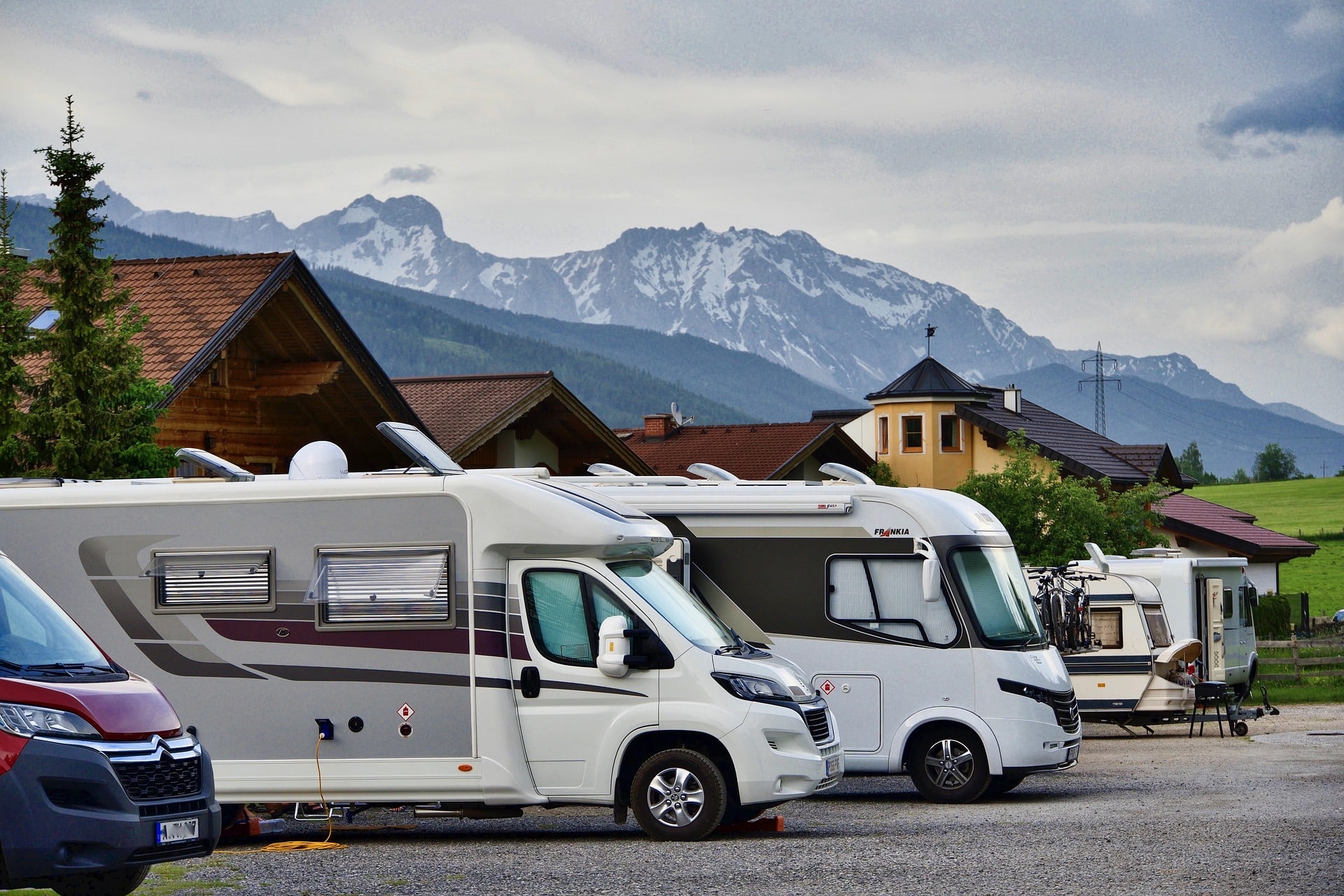
Outdoor storage is an open, paved space inside a secured and fenced facility. It is the most affordable option and the easiest to access, and it suits shorter-term storage, drier climates, and rigs you use often. The tradeoff is exposure, so a quality cover is worth adding if the RV will sit for a while.
Covered storage
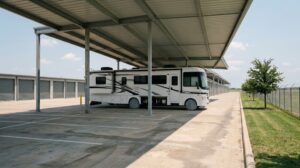
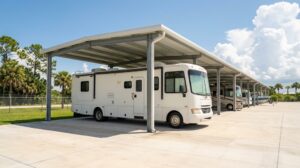
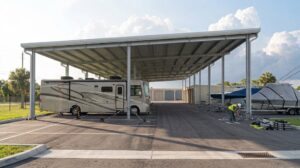
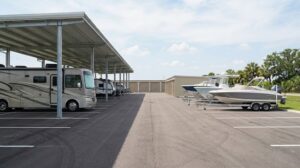
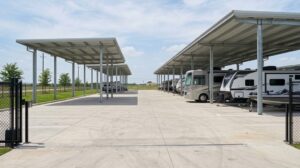
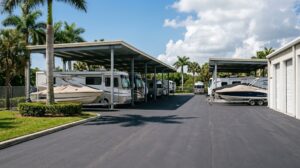
Covered storage adds a roof over the space while leaving the sides open. It blocks direct sun and most rain, which is a meaningful upgrade in high-UV states like Arizona, California, and Texas, where prolonged sun exposure dries out roof sealants, hardens seals, and fades finishes over time. For many owners it is the balance point between price and protection.
Enclosed storage
Enclosed storage places the RV inside a fully walled and gated unit, protected from sun, rain, dust, and prying eyes. It is the right choice for higher-value rigs, specialty finishes that degrade under UV, long-term storage, and severe-weather markets. It costs more than the other two, but for a rig you want to protect through a full season it usually earns the difference.
| Storage type | Weather protection | Best fit |
|---|---|---|
| Outdoor | Open to the elements | Short-term, dry climates, frequent use |
| Covered | Roof overhead, open sides | Sun and rain protection, high-UV states |
| Enclosed | Full four-wall protection | Long-term, high-value rigs, severe weather |
How to choose between them
Match the protection level to three things: how long the rig will sit, your climate, and what the RV is worth.
- Choose outdoor for shorter-term storage, milder or drier climates, and rigs you pull out often, especially paired with a quality cover.
- Choose covered in high-UV or high-heat regions like Arizona, California, and the Southwest, where sun is the main threat and a roof removes most of it.
- Choose enclosed for higher-value rigs, specialty finishes, long off-season storage, and severe-weather markets, where full protection earns the premium.
When two options seem close, let the rig’s value decide. The price gap between tiers is small next to the cost of a damaged roof membrane, oxidized fiberglass, or a failed slide-out seal.
How Much Does RV Storage Cost?
RV storage typically runs from about $50 a month for an open outdoor space up to $500 or more for a large enclosed unit, depending on the protection level, the size of your rig, and your local market. Outdoor parking sits at the low end, covered units in the middle, and enclosed units at the top because they add the most protection.
Three things move the price: the protection level, the size of your rig, and local demand. Protection level sets the tier, while a longer rig and a higher-demand market move you up within it. Metro and coastal markets, like Fort Myers or Sacramento, run higher than rural ones.
| Storage type | Typical monthly range | Best-fit note |
|---|---|---|
| Outdoor (uncovered) | $50 to $200 | Lowest cost, easiest access |
| Covered | $100 to $300 | Roof blocks sun and most rain |
| Enclosed (indoor) | $150 to $500 or more | Most protection, high-value or long-term |
Within each tier, a larger rig and a higher-demand market push you toward the top of the range, so a compact camper in a rural area sits near the bottom while a large Class A in a coastal metro sits near the top. The most accurate way to see real pricing is to search your city.
Region is the other big lever. Coastal and major-metro facilities cost more than rural ones because land is pricier and demand for covered and enclosed space is higher, which is why the same unit can differ by a hundred dollars or more between markets. Rates vary by facility too, so two RecNation locations in different cities will not match exactly.
A few things beyond the base rate can affect what you pay, so it is worth asking before you book:
- Access level: 24/7 access is standard at some facilities and a paid upgrade at others.
- Power: covered or enclosed units with an outlet for a battery tender can carry a small utility charge.
- Insurance: some facilities ask for proof of coverage on a stored RV.
- Term: month-to-month keeps you flexible, while a longer commitment sometimes earns a lower rate.
The Best Way to Store an RV
The best way to store an RV is to match the protection level to your climate, size the unit correctly, and prep the rig before it sits. The prep is straightforward and lines up with storage guidance best practices from facilities like RecNation and RV makers themselves. A few steps keep it in good shape while it is parked:
- Clean and dry the exterior and roof first, because trapped dirt and moisture sit against seals and finishes and speed up the wear you are trying to prevent.
- Match the protection to the climate: covered or enclosed storage in high-UV or severe-weather regions, or a breathable cover outdoors, since a cheap non-breathable cover traps moisture and scuffs the finish.
- Inflate the tires and take weight off where you can, because tires lose pressure and can develop flat spots when a heavy rig sits in one place for months.
- Disconnect or tend the batteries so they do not discharge and degrade while parked, and top up fluids so nothing sits low over the off-season.
- Close vents, seal entry points, and remove all food, because an unattended RV is an easy target for rodents and insects looking for shelter.
- Pick a unit with room to spare so you can walk all four sides, run a periodic check, and pull in and out without scraping.
For a rig that sits through a full off-season, covered or enclosed storage does most of this work for you by keeping sun and weather off the RV in the first place. Over a long stretch, it still helps to check on the rig once or twice rather than leaving it untouched until spring.
What Size Storage Do I Need for My RV?
Size the unit to your RV’s full length, then add a few feet for access. Measure bumper to bumper and include the tongue, any rear overhang, and racks. RecNation offers vehicle spaces from 10×10 up to 10×50, so there is a fit for everything from a camper van to a large Class A motorhome.
As a rough guide, camper vans and smaller Class B rigs fit a 10×20 or 10×25, most Class C motorhomes and shorter fifth wheels suit a 10×30, and larger fifth wheels and Class A motorhomes from 35 to 45 feet need a 10×40, 10×45, or 10×50. If you are close to a size boundary, choose the larger unit rather than forcing a tight fit.
You can compare the full range on the RV storage page and read the RV dimensions guide to confirm the right fit before you book.
How to Find the Best RV Storage Near You
Once you know the protection level and unit size you need, the last step is finding a secure facility near where you keep the rig. RecNation operates multiple facilities across all major US states, with high-demand RV storage in metros like Houston, Dallas, Tucson, and Kansas City, plus dozens of other locations. Protection levels vary by facility, so confirm outdoor, covered, or enclosed availability on your city’s page before booking.
Because RV storage is a local decision, the most accurate pricing and availability come from your own city rather than a national average. When you compare facilities, a few features separate good storage from a spot that merely holds the rig:
- Gated, controlled entry with app or keypad access that logs each visit.
- Continuous video monitoring across the lot and entry points, not a single camera at the office.
- Month-to-month terms so you are not locked into a long contract and can move between protection levels as your needs change.
- 24/7 access so you can pull the rig on your schedule, not the facility’s business hours.
- A size that fits your rig with room to spare, from 10×10 up to 10×50 for larger Class A motorhomes.
Reserve RV Storage Near You
Once you know your protection level and unit size, the last step is locking in a spot. RecNation offers month-to-month terms, so you’re never stuck in a long contract as your needs change season to season.
Search RV storage near you to compare real pricing and availability today.
Frequently Asked Questions
What is the best type of RV storage?
Enclosed storage protects an RV best, since it shields the rig from sun, rain, dust, and unauthorized access. Covered storage is a strong middle option in high-UV climates, and outdoor storage is the most affordable choice for shorter-term needs or drier regions. The best type for you depends on your climate, how long the RV sits, and its value.
Is it better to store an RV inside or outside?
Inside, or enclosed, storage gives the most protection and is the safer choice for higher-value rigs, long-term storage, and severe-weather markets. Outside storage costs less and is easier to access, and it works well for shorter-term storage in milder climates, especially with a quality cover.
How much does RV storage cost?
RV storage typically ranges from about $50 to $200 a month for outdoor parking, $100 to $300 for covered, and $150 to $500 or more for enclosed, depending on your rig’s size and your region. Metro and coastal markets run higher than rural ones, so searching your city gives the most accurate current pricing.
How much does it cost to store a 20-foot RV?
A 20-foot RV fits a 10×25 or 10×30 unit and sits toward the lower end of each tier, roughly $50 to $150 a month outdoors, $100 to $200 covered, and $150 to $300 or more enclosed, depending on your market. Search your city for a current quote.
What is the best way to store an RV long term?
For long-term storage, choose covered or enclosed protection so sun and weather do not degrade the roof and seals over months, size the unit with room to spare, and prep the rig by cleaning it, caring for the tires and batteries, and sealing it against pests. Month-to-month terms let you keep it stored only as long as you need.
What size storage unit do I need for my RV?
Measure your RV’s full length including the tongue and any overhang, then add a few feet for access. Camper vans and small rigs fit a 10×20 or 10×25, most Class C motorhomes suit a 10×30, and larger fifth wheels and Class A motorhomes need a 10×40 to 10×50.
How do I find RV storage near me?
Search by your city to see facilities, unit sizes, and current pricing in your area rather than relying on a national average. Look for 24/7 gated access, video monitoring, and month-to-month terms so you can reach the rig on your schedule without a long commitment.