Fort Lauderdale’s hurricane season runs May through November, and Broward County’s coastal conditions ask more of an RV in storage than most Florida guides account for. Salt-laden air off the Atlantic eats away at seals and metal, ambient humidity sits above 70% for months at a stretch, and storm surge risk comes down to where your recreational vehicle (RV) actually sits relative to FEMA flood zone designations. This checklist walks you through every step before you hand off your keys for the season.
Start Before the Season, Not When a Storm Is Named
The Atlantic hurricane season officially runs June 1 through November 30, but South Florida sees tropical activity before that date, and Fort Lauderdale’s practical prep window is late April to early May, before a named storm forces your hand.
Once a storm is tracking toward Broward County, your preparation window closes fast: storage facilities may restrict access, suppliers sell out of tarps and desiccants, and prep work done in wind and rain is rushed and incomplete. Broward County Emergency Management and the National Hurricane Center both publish seasonal outlooks worth reviewing as you plan your timeline.
The May-November Window and What It Means for Your RV’s Systems
Six months of dormancy in South Florida’s heat and humidity hits every major system on your RV, not just the obvious ones:
- Batteries can lose significant charge within 8 to 12 weeks without a maintenance tender.
- Tires develop flat spots under static load over several months.
- Rubber seals exposed to salt air and UV without treatment become brittle by the time you return.
Planning around the full six-month window, not a shorter storage period, changes what you do to each system before storage.
Why Waiting for a Named Storm Is Too Late
Once a storm organizes and tracks toward the coast, prep stops being a checklist and becomes a logistics problem:
- Anchoring hardware disappears from local stores.
- Moving services become unavailable or prohibitively expensive.
- Facility access may lock down entirely to protect staff.
The prep work in this guide takes time to do correctly, and none of it can be done in a 48-hour warning window.
Verify Your Storage Location’s Flood Zone Before You Commit
Flood zone designation is the one piece of hurricane preparedness most RV owners skip entirely, and it matters more than almost any other factor. When evaluating RV and boat storage facilities in the Fort Lauderdale area, confirming the flood zone status of the property’s address should come before you sign a seasonal contract.
Broward County participates in FEMA’s National Flood Insurance Program, and Flood Insurance Rate Maps (FIRMs) are publicly accessible, letting you verify any address in minutes.
How to Look Up a Fort Lauderdale Storage Facility on FEMA’s Flood Map Service Center
- Navigate to FEMA’s Flood Map Service Center at msc.fema.gov.
- Enter the storage facility’s full street address in the search field.
- Open the Flood Insurance Rate Map panel for that address.
- Read the zone designation printed on the map layer for that parcel.
Broward County’s GIS portal offers an additional local flood layer if you want to cross-reference the FEMA data at the county level.
What AE, VE, and X Zone Designations Mean for an RV Stored at Ground Level
Each FEMA zone carries a different risk level for a ground-level vehicle:
- VE zones: Coastal high-hazard areas subject to wave action during major storms, the highest surge and wave risk of any FEMA designation.
- AE zones: Carry a 1% annual flood probability with established base flood elevations; the facility’s floor elevation relative to the base flood elevation (BFE) matters significantly here.
- X zones (shaded or unshaded): Lower risk, and generally safer for ground-level vehicle storage.
An RV can’t be elevated off the ground the way a building’s first floor can, which makes zone designation more consequential for your vehicle than it would be for a structure.
Exterior Prep: Salt Air, Seals, and Storm Surface Reduction
Salt is the exterior’s biggest enemy here, and it doesn’t need ocean-side parking to reach your RV. Fort Lauderdale’s proximity to the Atlantic means salt deposition happens well inland across Broward County, settling on roof seams, slide-out rails, and rubber seals, and left unaddressed over a six-month storage window, it accelerates corrosion and seal brittleness faster than Central Florida conditions do.
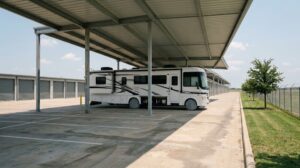
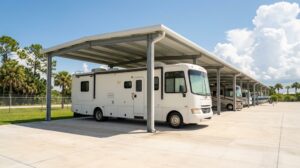
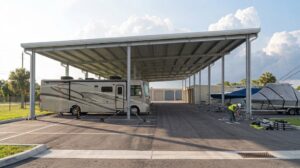
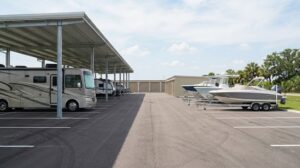
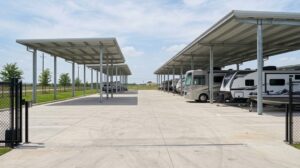
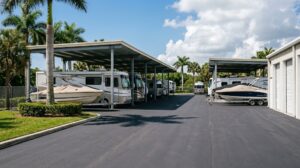
Choosing covered RV storage reduces UV and salt-air exposure on your roof and exterior surfaces throughout the season, which lowers how much seal maintenance you’ll need at the end of the window.
Washing for Salt Removal, Not Just Cleanliness
A standard wash removes dirt but leaves salt residue behind. Before storage:
- Wash the exterior with a dedicated RV cleaner.
- Follow with a thorough freshwater rinse-down focused on wheel wells, slide-out rails, and the roofline, areas that trap salt particulates that will corrode metal and degrade rubber if they sit for months.
- Pay particular attention to any unpainted aluminum trim or exposed fasteners.
Roof Seals and Seams Inspection Before Storage
Roof seal failure during storage allows water intrusion that goes undetected for months. Before the RV goes in:
- Walk the roof if it’s safely accessible, and inspect every seam, vent collar, and AC unit base for cracking or separation.
- Apply a self-leveling lap sealant rated for South Florida UV to any compromised area.
Fort Lauderdale’s summer rainfall intensity means even a small gap becomes a significant leak by September. This is one step you should not defer until after the season.
Awning Retraction, Skirting Removal, and Wind Load Reduction
An extended awning in a tropical storm becomes a structural liability. Before storage:
- Confirm awning retraction is complete and that the travel lock is engaged.
- Remove all exterior accessories that are not permanently mounted: outdoor furniture, mats, grills, and any detachable vent covers.
- If your RV has skirting, remove it, eliminating another surface that catches wind and can damage the lower body panels under storm load.
The goal throughout is minimizing the RV’s effective wind surface area before any storm approaches.
Mechanical and Systems Prep for a Six-Month Dormancy
Everything that runs, holds fluid, or carries a charge needs a plan for six months of standing still. For broader context on preparing a vehicle for long-term storage, the vehicle storage guide covers general principles that apply across vehicle types; the steps below focus on what six months of South Florida heat and humidity specifically does to each major RV system.
Fuel, Generator, and Engine: Treating Systems That Will Sit Idle
Before storage:
- Add a fuel stabilizer to the tank and run the engine long enough to circulate it through the full fuel system. A full tank minimizes the air space where condensation can form over months.
- Apply the same principle to the generator: run it with stabilizer-treated fuel, then let it run until it has circulated through the carburetor.
Generator fuel stabilizer treatment is a small step that prevents a difficult-starting or varnished fuel system when you return in November.
Battery Management in South Florida Heat
Fort Lauderdale’s heat accelerates battery self-discharge at a rate that surprises most owners: a battery left unattended without a maintenance tender or shore power connection can drop below recovery threshold in 8 to 12 weeks.
- If your facility offers electrical hookup: use it.
- If not: connect a smart maintenance tender before storage.
Battery disconnect alone reduces parasitic drain but does not eliminate it on all RV models, so disconnect is a minimum step, not a complete solution.
Water System, Water Heater, and Propane Shutoff
Freshwater system winterization in South Florida means draining for heat, not freezing temperatures:
- Drain the fresh water tank and all lines completely, then add a sanitation treatment to prevent mold and bacteria growth in the line walls over months of stagnant warmth.
- Drain and bypass the water heater.
- Close the propane tank shutoff valve at the tank itself, and don’t leave any propane appliance in standby mode.
Propane left flowing to pilot lights or refrigerators during unattended storage is a fire and leak risk.
Securing Your RV Against Wind: Anchoring and Storm Positioning
An RV is a large wind sail, and without a rated tie-down system, the lateral and uplift forces in a major storm can shift, tip, or structurally damage it. Anchoring is where many owners assume the storage facility has it handled, and many are disappointed to find out otherwise.
What a Rated Tie-Down System Actually Consists Of
A compliant system has three parts:
- An anchor point in the ground.
- A connector, strap, chain, or cable, rated to the appropriate tensile load.
- A secure attachment point on the RV frame.
Tie-down straps and anchoring systems vary widely in rated capacity, and the rating must match the vehicle’s weight class. Not all RV storage facilities include anchoring in the base contract, ask explicitly before signing, and ask for the wind load rating of the anchor system in use.
If you’re evaluating Fort Lauderdale-area options, RecNation’s nearest facility, in Boynton Beach about 25-30 miles north, offers covered storage. It’s worth checking its own specific flood zone designation using the lookup steps above before assuming it matches Fort Lauderdale’s risk profile. You should also ask any facility you’re considering exactly what storm-prep services and anchoring options are included in your contract before hurricane season opens.
Ground Composition in Broward County and Why It Matters
Much of Broward County sits on sandy soil and oolitic limestone substrate, and lightweight twist-in stakes lose holding strength quickly in that ground, making them inadequate for hurricane-force loads. Commercial auger-style anchors driven to adequate depth in compacted substrate or welded concrete-mounted anchor points, provide reliable holding in South Florida conditions.
If you’re managing your own anchoring rather than relying on a facility system, consult the RVIA’s owner resources or your manufacturer’s manual for weight-class-specific recommendations.
Interior Protection: Humidity, Moisture, and Pest Exclusion
A sealed RV, Fort Lauderdale’s summer humidity, and six months of no airflow are a mold problem waiting to happen. The Atlantic coast exposure produces more consistently high overnight humidity than Central Florida conditions, even during dry spells.
Moisture and Mold Prevention in Fort Lauderdale’s Summer Humidity
- Desiccants: Place multiple calcium chloride desiccant absorbers in sleeping areas, closets, and the bathroom. Silica gel alone saturates quickly in Fort Lauderdale’s ambient humidity and isn’t sufficient for a six-month window.
- Airflow: Leave interior cabinet doors and closet doors slightly open to allow air circulation rather than creating isolated humid pockets.
- Covers: If your storage is outdoor or open-sided, use a breathable cover rather than an impermeable tarp.
Moisture and mold prevention depends on airflow as much as it depends on desiccants. Also before storage: remove all perishable food completely, remove or treat any fabric items prone to mildew, and don’t leave windows cracked, which creates water intrusion and security risk in an unsecured outdoor environment.
Pest Exclusion for Long-Term Unattended Storage
Rodents and insects can cause thousands of dollars in wiring and upholstery damage during six months of unattended storage:
- Seal every plumbing penetration, the refrigerator exterior vent, drain vents, and any gap around slide-out seals.
- Place steel wool at any opening larger than a quarter inch.
- Use peppermint-based repellents inside the cabin.
- Confirm whether your facility allows perimeter rodent bait stations.
Insurance and Documentation Before You Walk Away
Assuming your existing RV policy covers hurricane damage during storage is a mistake many owners make, and only discover after a storm. Two things close that gap: knowing what your policy actually covers, and having the right paperwork in place before you leave.
What Your RV Policy Covers During Storage and What It Doesn’t
The storage facility’s property insurance covers the facility’s structures, not your vehicle. Your RV’s comprehensive coverage handles storm damage to the vehicle itself, but only if your policy is active and complete, and Florida RV and marine policies often carry a separate named storm deductible that’s materially higher than the standard comprehensive deductible. Call your insurer before the season begins to confirm your deductible structure and that comprehensive coverage applies during unattended storage.
Insurance Documentation to Complete Before You Leave
Before you leave the RV for the season:
- Photograph the interior and exterior thoroughly, and save those images in a cloud account off the vehicle.
- Confirm registration is current. Florida Statute §320.02 requires registration for vehicles operated on Florida roads, and keeping your RV’s registration active avoids any lapse or compliance question when you’re back on the road after the season.
- Leave a copy of the registration, proof of insurance, and the storage facility’s address with a trusted contact who can act on your behalf if a storm requires emergency facility access.
What Separates a Good Season From a Bad One
Putting in the time before the season starts is what separates an RV that comes out of storage in good condition from one that doesn’t. If you’re looking for a secure place to store your RV through the Atlantic hurricane season, RecNation’s nearest facility, in Boynton Beach, offers covered storage options designed for large vehicles in South Florida’s coastal environment, worth a look once you’ve confirmed its flood zone against your own risk tolerance.
Frequently Asked Questions
Where is the safest place to store an RV during a hurricane in Fort Lauderdale?
A covered or enclosed RV storage facility located outside a FEMA-designated Special Flood Hazard Area offers the best protection in Fort Lauderdale. Verify any facility’s flood zone by entering its address at msc.fema.gov. Covered storage reduces wind and debris exposure, while an X-zone location lowers surge risk. Confirm whether the facility includes storm anchoring services before signing a seasonal contract.
Should I leave my RV slide-outs open or closed during hurricane season storage?
Slide-outs should always be fully retracted before long-term storage. Extended slide-outs expose the slide seal perimeter to UV degradation, salt air, and rain intrusion over months, and they increase the RV’s wind load surface area in a storm. Retract all slides, lubricate the rails before closing, and confirm the travel locks are engaged. Check your manufacturer’s owner’s manual for any model-specific slide-out storage position.
How do I anchor my RV to withstand hurricane-force winds in South Florida?
Anchoring an RV to withstand hurricane-force winds in South Florida requires commercial auger-style anchors driven to adequate depth, not lightweight twist-in stakes. Much of Broward County sits on sandy soil where shallow anchors lose holding strength quickly. Ask any RV storage facility exactly what anchoring system is included in your contract and what its rated tensile strength is. If you’re managing your own system, use a hurricane tie-down kit rated for your vehicle’s weight class and install it before the season opens.
What should I remove or secure inside my RV before hurricane season?
Before hurricane season, remove all perishable food, beverages, and any items that can spill or grow mold over six months, along with valuables like electronics and important documents. Leave interior cabinet doors slightly open and place calcium chloride desiccant absorbers in sleeping areas, closets, and the bathroom to manage Fort Lauderdale’s high ambient humidity. Do not leave windows cracked, as open windows invite water intrusion and pests in an outdoor storage environment.
Does RV insurance cover hurricane damage in Fort Lauderdale?
Whether RV insurance covers hurricane damage in Fort Lauderdale depends on your specific policy. Most comprehensive RV policies cover storm damage, but some carry named storm exclusions that limit payout on wind damage regardless of deductible. Review your policy’s storm-specific terms with your insurer directly rather than assuming standard comprehensive coverage applies during unattended storage.