Outdoor RV and boat storage in Fort Lauderdale typically starts around $600 per month for a basic uncovered space, and rates climb significantly from there based on vehicle size, storage type, and how close the facility sits to the water. That floor price surprises a lot of owners, and it’s not a fluke. This guide breaks down what you’ll actually pay by storage tier and vehicle length, explains why Fort Lauderdale’s market prices the way it does, and covers the contract terms that can quietly raise your real monthly cost.
What You’ll Actually Pay for RV and Boat Storage in Fort Lauderdale
The pricing table below reflects current market ranges for boat storage in Fort Lauderdale and RV storage across Broward County facilities. These are market-rate ranges, not a single facility’s published prices. Use them as a benchmark when comparing quotes.
| Storage Type | Under 20 ft | 20 to 30 ft | 30 to 40 ft | 40+ ft |
| Uncovered outdoor lot | $600 to $750/mo | $700 to $950/mo | $900 to $1,200/mo | $1,100 to $1,500+/mo |
| Covered / canopy | $750 to $950/mo | $900 to $1,150/mo | $1,100 to $1,450/mo | $1,350 to $1,800+/mo |
| Fully enclosed / indoor | $1,100 to $1,400/mo | $1,300 to $1,700/mo | $1,500 to $2,200/mo | $2,000 to $2,500+/mo |
Note: Some facilities in Fort Lauderdale use per-foot storage pricing instead of fixed-tier rates. Outdoor lots typically run $8 to $15 per foot per month, with enclosed bays running higher.
Facilities near the Intracoastal or with marina access tend to command a 20 to 40% premium over comparable inland facilities for the same storage type.
Uncovered Outdoor Lot Storage
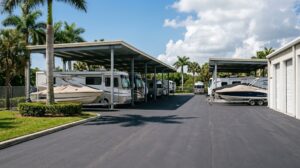
Uncovered outdoor lot storage is the entry-level tier in Fort Lauderdale: a paved or gravel space with no overhead protection, and it’s also the most common storage type available, a direct result of zoning limits on where facilities can legally operate.
Basic outdoor lot storage near Fort Lauderdale starts at $600 per month minimum for facilities far from the water, a figure that tracks with current facility data in the area. Inland Broward County locations may run toward the lower end of the range; waterfront-adjacent outdoor spaces push toward the top.
Covered and Canopy Storage
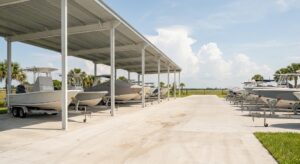
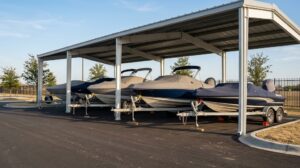
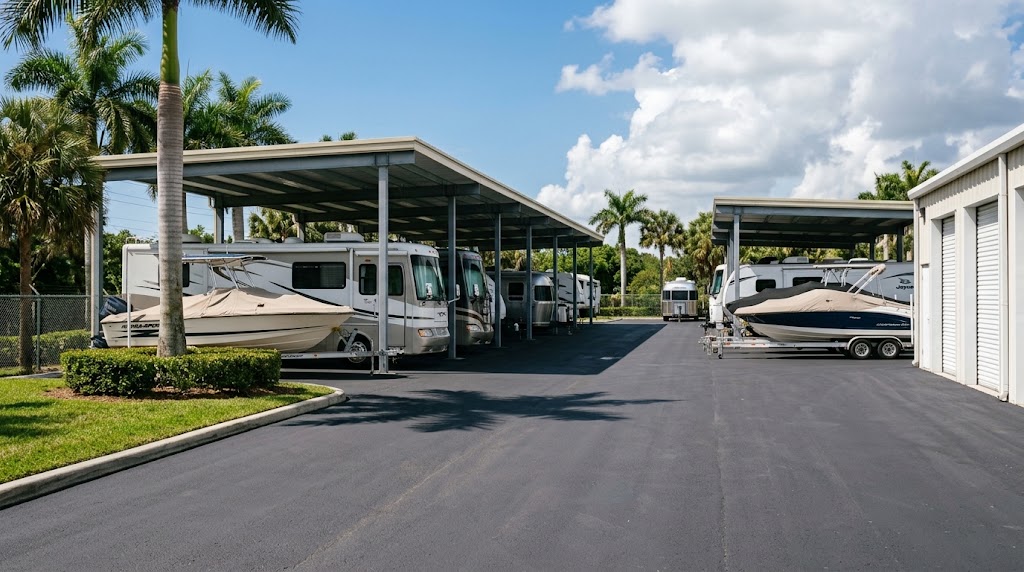
Covered and canopy storage adds a carport-style structure or fabric canopy overhead without fully enclosing the vehicle, typically running $100 to $250 more per month than an equivalent uncovered space at the same facility.
In Fort Lauderdale, this tier is worth serious consideration even for owners who might skip it in a cooler market. Year-round UV intensity degrades gel coat, upholstery, awnings, and RV exterior materials at a rate that northern owners are often not prepared for.
Covered overhead protection also reduces exposure to wind-driven debris during Atlantic hurricane season. For more detail on what’s available, see covered storage options for your boat or RV.
Fully Enclosed and Indoor Storage
Fully enclosed storage places your vehicle inside a walled bay or building, with indoor climate-controlled storage sitting at the top of this tier and especially rare in Fort Lauderdale. Prices for large vehicles in enclosed Fort Lauderdale facilities typically run $1,500 to $2,500+ per month.
Supply is limited because zoning and land cost make enclosed large-vehicle facilities expensive to build and operate in Broward County. When indoor bays are available, they tend to fill quickly, so if this is the tier you need, contacting facilities well ahead of your intended move-in date is practical, not optional.
Why Fort Lauderdale Storage Costs More Than You Might Expect
Fort Lauderdale’s storage market costs more than most owners expect because of three structural drivers working together, not because facilities are simply charging what the market will bear:
- Zoning restrictions that limit where outdoor recreational vehicle storage can legally operate.
- Land costs near the Intracoastal that get passed through to monthly rates.
- Snowbird season demand that spikes availability pressure for six months of the year.
Understanding these drivers helps you evaluate whether a quote is reasonable or whether it reflects a specific facility’s premium location or pricing strategy. For a broader look at RV and boat storage across South Florida storage options, the pricing context differs meaningfully by county.
Broward County Zoning and Supply Constraints
Broward County’s zoning restrictions are the first driver: the Land Development Code restricts outdoor recreational vehicle storage to specific zoning districts, which limits the number of facilities that can legally operate within Fort Lauderdale’s zip codes, particularly those closest to the water.
- Fewer legal locations mean lower supply relative to demand.
- That dynamic keeps monthly storage rates elevated compared to inland Florida counties where land use codes are less restrictive.
If your search for outdoor storage space keeps returning the same handful of facilities, that’s why. The market isn’t hiding options; there genuinely aren’t many.
Seasonal Demand and Snowbird Pricing
Roughly October through April, Fort Lauderdale’s storage market tightens:
- Seasonal residents move boats into active use.
- Northern owners who winter in South Florida arrive with vehicles that need space.
That surge in demand puts upward pressure on both availability and seasonal storage rates at most Broward County storage facilities. Month-to-month spaces at a secure gated facility can be hard to find once snowbird season starts, signing an annual storage contract before late September gives you the best combination of rate stability and guaranteed availability before demand peaks.
Dry-Stack Marina Storage vs. Land-Based Lot Storage: They’re Not the Same Product
Fort Lauderdale has one of the densest marina markets in the country, and many owners receive quotes from both marina dry storage facilities and land-based lot operators without realizing the pricing models are structurally different. A lower monthly base rate at a marina doesn’t necessarily mean a lower total monthly cost:
| Dry-Stack Marina Storage | Land-Based Lot Storage | |
| Monthly base rate | Often lower (mid-tier range) | Fixed by space type and size |
| Per-launch fee | $25 to $75 per use | None |
| Est. monthly total (4 launches) | Base + $100 to $300 | Base rate only |
| Advance scheduling required | Yes, typically 24 to 48 hours | No |
| Vehicle types accepted | Boats only | Boats, RVs, trailers, other vehicles |
How Dry-Stack Pricing Works
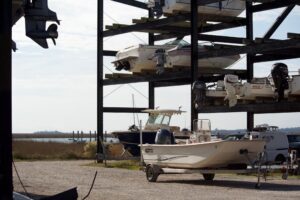
Marina dry storage works differently from a flat monthly rate, and that difference is exactly where the sticker shock comes from. Your boat sits racked in an enclosed structure, and every time you want to use it, staff pull it out and launch it by forklift, then rack it again when you’re done. That launch and retrieval isn’t included in the base rate, it’s billed separately, typically $25 to $75 each time.
So the quoted monthly rate is really a floor, not the total. A boater going out twice a week pays that base rate plus $200 to $600 more per month in launch fees. A boater going out twice a month adds only $50 to $150. Same facility, same base rate, wildly different actual cost, because the fee scales with how often you actually use the boat, not with the size of the boat or the length of the contract.
That’s the piece wet slip vs. dry storage comparisons usually leave out: the number that changes your total cost isn’t the monthly rate at all, it’s how often you go out.
When Land-Based Storage Makes More Sense
Land-based lot storage is the better choice in several scenarios. RV owners have no dry-stack option at all; this is exclusively a boat storage product. Boat owners who launch infrequently will almost always pay less on a land-based outdoor storage space with predictable monthly costs.
Land-based facilities also accept vessels that aren’t currently seaworthy, which dry-stack typically won’t. Boats under repair, with registration issues, or with hull damage are generally not accepted at marina dry-stack facilities. And for owners who want 24-hour access storage without scheduling a forklift in advance, a land-based RV storage facility with gate access is the more practical day-to-day setup.
What to Watch for in Your Storage Contract Before You Sign
Fort Lauderdale storage contracts carry terms that owners in other states may not have encountered before. These four items can materially change your total cost or create unexpected obligations.
Hurricane Season Policies and What They Mean for Your Wallet
- Evacuation clauses: Many Fort Lauderdale facilities require owners to remove vessels or RVs during a named storm watch. Failure to comply may void liability protections or result in the facility moving the vehicle at the owner’s expense. Ask how much advance notice the facility provides and how much time you have to retrieve your vehicle.
- Storm-season surcharges: Some facilities charge a separate hurricane season fee not included in the quoted monthly rate. This is sometimes listed as an annual add-on. Confirm whether the rate you’re quoted is the full cost or a base figure before surcharges.
- Liability waivers during storm events: Storage contracts commonly include language limiting the facility’s liability for storm damage, separate from the lien-enforcement rules that govern what happens if you fall behind on payment. Review the specific language in your contract rather than assuming the facility covers damage during a named event.
Insurance and Registration Requirements
- Proof of insurance: Most Fort Lauderdale storage facilities require current comprehensive vehicle insurance as a condition of storage. Some specify minimum coverage amounts. If your boat or RV insurance has lapsed, reinstate it before you expect to move in.
- Florida vessel registration: Many facilities require current Florida registration and will not accept unregistered vessels. Under FWC Chapter 328, vessels used primarily in Florida must be registered through the Florida Fish and Wildlife Conservation Commission.
- Out-of-state titles: If you recently relocated to Florida or purchased a boat still titled in another state, you may need to complete a Florida title transfer before a facility will accept the vessel. Confirming this before you call a facility saves time.
How to Get the Best Rate on Fort Lauderdale RV and Boat Storage
You’ve made it this far, you understand how much this actually costs and why. Now here’s how to actually do something about it. For broader context on how much it costs to store a vehicle across different facility types, the same framework applies here.
- Sign an annual contract before snowbird season: Late September is the practical deadline. Month-to-month availability at most Broward County storage facilities tightens once October arrives, and rates reflect that demand. Locking in an annual rate before the window closes gives you both price certainty and guaranteed space.
- Compare inland facilities against waterfront-adjacent ones: The price delta for the same storage type can run $150 to $300 per month. If you don’t need to be close to a launch ramp, an inland outdoor storage space may be a significant savings over a facility near the Intracoastal.
- Ask directly about move-in specials: Fort Lauderdale facilities occasionally run first-month discounts or referral promotions that aren’t listed on their websites. A direct phone call asking about current availability and pricing often surfaces options that online searches miss.
- Match your storage type to your actual launch frequency: An owner who goes out six times a year doesn’t need dry-stack and will pay unnecessarily for its cost structure. An owner who goes out weekly should model total monthly costs including per-launch fees before assuming dry-stack is cheaper.
- Verify what’s included in the base rate: Some facilities charge separately for 24-hour access storage, electricity hookups for RV batteries and appliances, or wash-down pads. Others bundle these into the monthly rate. RecNation’s nearest facility, in Boynton Beach about 25-30 miles north, publishes clear rate structures and includes gated access and surveillance monitoring in its base pricing, worth a look if the drive works for your situation.
Timing Your Contract for Off-Peak Savings
The snowbird demand window runs roughly October through April, and everything about your negotiating position changes depending on which side of it you’re on. Before that window opens, facilities have more available inventory and more flexibility on rate negotiation. After it opens, month-to-month spaces at a secure gated facility are genuinely scarce in some Fort Lauderdale zip codes.
Signing in September buys you more than just a better rate, it gives you time to work through insurance and registration requirements without feeling rushed by a move-in deadline.
Comparing Inland vs. Waterfront Facilities
Whether the waterfront premium is worth paying comes down to one thing: how often you actually use the boat. If you’re out frequently, need quick access to a launch ramp, or the boat is your primary recreational activity, time and convenience justify the cost differential.
If you launch a handful of times per year, or you trailer to a ramp that isn’t adjacent to your storage facility anyway, that premium is buying you proximity you’re not using. An inland Broward County RV storage facility at $150 to $300 less per month often delivers the same functional outcome.
What Honest Pricing Actually Looks Like in Fort Lauderdale
Finding honest pricing for boat storage in Fort Lauderdale takes more than a phone call, the market is genuinely constrained, contracts carry real obligations, and the gap between a quoted rate and your actual monthly cost can be significant. RecNation’s nearest facility, in Boynton Beach, offers transparent monthly rates, a gated and monitored facility, and no hidden storm-season add-ons, so you know what you’re paying before you sign, worth comparing against your specific drive-time tradeoff.
Frequently Asked Questions About RV and Boat Storage Costs in Fort Lauderdale
How much does it cost to store an RV per month in Fort Lauderdale?
RV storage in Fort Lauderdale typically starts around $600 per month for a smaller vehicle in a basic uncovered outdoor lot. Larger Class A motorhomes or fifth wheels in the 35 to 45 foot range generally run $900 to $1,500+ per month depending on facility, storage type, and proximity to the Intracoastal. Covered or enclosed storage adds $100 to $500 or more per month on top of outdoor lot rates.
What is the difference between dry-stack storage and land-based lot storage for boats?
Dry-stack storage and land-based lot storage for boats differ in both access and pricing structure. Land-based lot storage means your boat sits on a paved or gravel surface at a dedicated storage facility, and you access it yourself whenever the gate is open. Dry-stack storage means your boat is stacked in a marina’s enclosed rack structure and launched by forklift on request, so the monthly base rate may appear lower, but you pay a per-launch fee of $25 to $75 every time you go out and again when the boat is returned. For boaters who launch frequently, dry-stack costs can exceed land-based lot storage on a total monthly basis.
Do Fort Lauderdale storage facilities require boat or RV insurance?
Yes, most Fort Lauderdale storage facilities require proof of comprehensive vehicle insurance as a condition of renting a space, for both boats and RVs. Some facilities specify minimum coverage amounts. If your boat or RV insurance has lapsed, you’ll need to reinstate it before most facilities will accept the vehicle. Ask about specific requirements when you call to confirm availability.
Can I store a boat in Fort Lauderdale if it’s still titled in another state?
Storing a boat in Fort Lauderdale while it’s still titled in another state depends on the facility, some will accept it, some won’t, and a few will ask for extra documentation before they say yes. Florida requires vessels used primarily in the state to be registered through the Florida Fish and Wildlife Conservation Commission under FWC Chapter 328, so the safest move if you recently relocated or bought a boat still titled elsewhere is to get that registration sorted before you start calling facilities, since that’s what most of them will actually check first.
Is covered storage worth the extra cost in Fort Lauderdale?
Covered storage is worth the extra cost in Fort Lauderdale for most owners. The UV exposure and hurricane-season debris risk that make it optional in a cooler market are exactly what make it worth paying for in Broward County.