Boat prices range from under $1,000 for a basic jon boat to well over $1 million for a large offshore cruiser or yacht. But the purchase price is only part of what you need to plan for. This guide covers what every major boat type costs to buy new and used, what annual operating costs look like broken down by category, how financing compounds the total over the life of a loan, and what to expect from depreciation by boat type.
By the end, you will have a complete picture of what boat ownership actually costs, not just what you pay at the dealership.
Boat Prices by Type: What You’ll Pay at the Dealership
The boat type comparison below gives you a realistic starting point. These are representative ranges, not fixed prices. Engine type, hull material, hull length, and included electronics all push prices higher or lower within any category. For fishing and center console boats, an outboard motor is often sold separately from the hull and can add $5,000 to $30,000 to the base price depending on horsepower.
| Boat Type | Typical New Price | Typical Used Price |
| Jon boat (basic aluminum) | $1,500 to $5,000 | $500 to $2,500 |
| Kayak / canoe | $300 to $3,000 | $100 to $1,500 |
| Aluminum fishing boat | $10,000 to $30,000 | $4,000 to $15,000 |
| Pontoon boat | $20,000 to $60,000 | $8,000 to $35,000 |
| Center console boat | $25,000 to $80,000 | $10,000 to $50,000 |
| Bowrider / deck boat | $20,000 to $55,000 | $8,000 to $30,000 |
| Sailboat (entry to mid-range) | $15,000 to $120,000 | $5,000 to $75,000 |
| Offshore cruiser / yacht | $150,000 to $1,000,000+ | $75,000 to $600,000+ |
According to the National Marine Manufacturers Association, the recreational boating industry sells hundreds of thousands of new powerboats and sailboats annually, with most retail transactions concentrated in the $20,000 to $70,000 range for powered vessels.
New vs. Used Boat Prices
Buying used means someone else already took the hit on the most expensive year of ownership.
| Factor | New Boat | Used Boat (2-3 years old) |
| Price | Full retail | 20 to 40 percent less |
| First-year depreciation | You absorb the full 20 to 30 percent hit | Already absorbed by the previous owner |
| Pre-purchase survey | Not typically needed | Recommended, $15 to $25 per linear foot of vessel length |
That survey cost is worth it. It often surfaces deferred maintenance or hull issues that change the negotiation. Timing matters too: our guide on what time of year boats are cheapest can shave thousands off either a new or used purchase.
What Affects the Price of a Boat?
Several variables push a boat’s price above or below the midpoint of its category:
- Hull length: Longer boats cost more to build, store, and operate. Each additional foot adds meaningful cost.
- Engine type and horsepower: A larger outboard motor or twin-engine configuration can double the propulsion cost alone.
- Hull material: Fiberglass is the most common and most expensive. Aluminum is lighter, less expensive, and more durable in freshwater.
- Included electronics: Factory chartplotters, fish finders, and stereo systems add $2,000 to $10,000 on mid-range boats.
- Brand reputation: Established brands like Grady-White, Boston Whaler, and Malibu hold value and command higher initial prices.
- Year and condition: A well-maintained five-year-old boat can outperform a neglected two-year-old model on inspection.
The True Cost of Owning a Boat: Annual Expenses to Plan For
The purchase price gets you on the water. Boat ownership costs are what keep you there or push you out. A commonly cited rule of thumb is that annual operating costs run 10 to 20 percent of a boat’s purchase price. On a $40,000 boat, that means $4,000 to $8,000 per year in expenses beyond the loan payment. The sections below break out each cost category with specific numbers.
Boat Insurance Costs
Annual boat insurance typically runs $200 to $500 for smaller vessels valued under $20,000. For larger or higher-value boats, including center console boats, cruisers, and sailboats over 30 feet, premiums of $1,000 to $3,000 per year are common.
Premiums depend on the boat’s value, the owner’s experience, the body of water, and whether the vessel is trailered or kept at a marina. Most marinas require proof of liability coverage before issuing a slip. Agreed-value policies pay out the insured amount if the boat is a total loss, while actual-cash-value policies pay the depreciated market value, which is typically less.
Boat Maintenance and Repair Costs
Annual boat maintenance costs for a mid-range powerboat run $1,000 to $3,000. Routine items include oil changes, impeller replacement, zinc anodes, and bottom paint for boats kept in saltwater.
Major repairs in any given year can push that figure significantly higher. A raw-water pump failure, gelcoat repair, or upholstery replacement can add $500 to $2,000 in a single season. Setting aside a maintenance reserve of $500 to $1,000 per year on top of routine costs is a standard recommendation among experienced boat owners.
Fuel Costs
Fuel costs are the most variable line item in any boating budget. A typical outboard motor burns 3 to 8 gallons per hour depending on engine size and cruising speed. At current marine fuel prices, a full day on the water can cost $50 to $200 in fuel alone.
How often you go out and how hard you run the throttle determines where your annual fuel bill lands. Light weekend use on a smaller boat might cost $500 to $1,000 per season. A larger twin-engine boat used regularly can easily hit $3,000 to $5,000 in fuel annually.
Boat Storage Costs
Boat storage costs vary significantly based on how and where you store the vessel:
- In-water slip at a marina: $300 to $1,500 per month depending on market and slip size. Marina fees include water access and convenience but represent the highest storage cost.
- Dry stack storage: $150 to $400 per month. The facility launches and retrieves the boat by forklift, keeping it off the water between uses.
- On-land storage at a dedicated facility: $50 to $200 per month. This is the most cost-effective option for seasonal and occasional users.
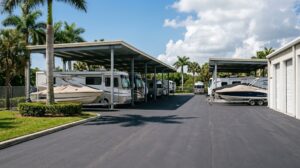
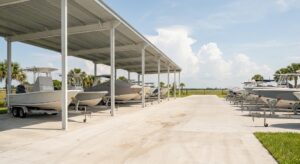
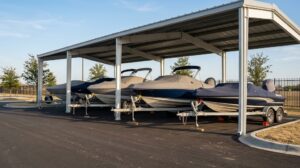
For a deeper breakdown of what these numbers look like over a full year, see our guide on how much it costs to store a boat per year. For boat owners who use their vessel seasonally or want to avoid marina fees year-round, covered land storage is often the smartest choice. RecNation boat storage offers secure, covered options at facilities across multiple states, with flexible month-to-month access that works well for trailerable boats and seasonal use patterns.
Winterization and Seasonal Costs
In colder climates, winterizing a boat costs $300 to $600 and includes flushing the engine, fogging the cylinders, draining the water system, and covering or shrink-wrapping the hull. This cost is easy to overlook in a budget because it is seasonal, not monthly.
In warm-weather states like Florida, Texas, and parts of California, winterization is minimal or unnecessary. But UV protection, hull cleaning, and hurricane preparedness carry their own costs in those markets.
Registration, Taxes, and Licensing Fees
Boat registration fees are set at the state level, not federally. Annual fees vary by hull length and propulsion type and can run from under $20 in some states to over $150 in others. The U.S. Coast Guard National Vessel Documentation Center handles federal vessel documentation for commercially operated or interstate vessels, but most recreational boats are registered through state agencies such as Florida Fish and Wildlife or Texas Parks and Wildlife.
Sales tax at purchase is a one-time but significant cost, typically 6 to 9 percent of the purchase price depending on the state. If you are buying a boat in one state and registering it in another, verify both states’ requirements before closing. Some states also require a boater education certificate through an approved course. The BoatUS Foundation offers courses for approximately $25 to $50.
How Much Does It Cost to Finance a Boat?
Marine loans are available through banks, credit unions, and dedicated marine lenders, with terms typically ranging from 10 to 20 years and current boat loan interest rates running from 7 to 15 percent depending on the vessel’s age, loan size, and the borrower’s credit profile.
The monthly payment isn’t the number that matters most, the total repayment is. A $40,000 boat financed at 10 percent over 15 years runs about $430 a month and $77,400 total, meaning roughly $37,400 in interest on a boat that cost $40,000. Shortening the term to 10 years raises the payment to about $529 but cuts total interest to around $23,500.
Buyers with strong credit often qualify for rates under 8 percent, and a down payment of 20 percent or more reduces total interest paid and may satisfy lender requirements on higher-value boats.
New vs. Used Boat Financing Terms
Vessel age changes what a lender will actually offer:
| Vessel Age | Financing Impact |
| Newer (under 10 years) | Better rates, longer terms, collateral holds value predictably |
| 10 to 15 years old | Higher rates, shorter maximum terms |
| Over 15 years old | Some lenders won’t finance at all |
Used boat buyers sometimes find better overall value by paying cash or by negotiating the purchase price down enough to offset the higher financing cost. It’s worth working through whether paying cash for a boat actually beats financing once opportunity cost is factored in. A well-maintained used boat purchased below market can be a better financial outcome than a new boat purchased at full retail with a 15-year loan.
Do Boats Hold Their Value? Understanding Depreciation
Boats are depreciating assets, similar to cars, not investments in the financial sense, something we’ve covered in our article on whether a boat is a good investment. A new fiberglass powerboat typically loses 20 to 30 percent of its value in the first year and stabilizes near 50 percent of its original value by year five, based on conventions used in the NADA Marine Appraisal Guide and BUC Used Boat Price Guide.
Boat depreciation is not uniform across all types:
- Aluminum fishing boats and pontoon boats generally depreciate more slowly, since they’re lower-cost, high-demand craft with broad buyer pools.
- Well-maintained sailboats, particularly bluewater-capable models with established brand reputations, can hold value more steadily than comparable powerboats.
The used market benefits buyers who absorb someone else’s first-year drop, the same principle that applies when buying a used car instead of new. A two- or three-year-old boat in good condition often represents the strongest price-per-quality ratio available. Proper storage, regular maintenance, and avoiding cosmetic damage are the primary factors within an owner’s control that slow the depreciation curve.
| Boat Category | Approx. Year 1 Value Loss | Approx. Value at Year 5 |
| Fiberglass powerboat | 20 to 30% | ~50% of original |
| Aluminum fishing boat | 10 to 20% | ~65% of original |
| Pontoon boat | 15 to 25% | ~60% of original |
| Sailboat (established brand) | 10 to 20% | ~65% of original |
| Offshore cruiser / yacht | 20 to 35% | ~45% of original |
How Storage and Maintenance Affect Resale Value
A boat stored outdoors without a cover shows UV damage, faded gelcoat, and deteriorated upholstery faster than one kept in a protected environment. Dealers and private buyers routinely discount vessels with visible neglect, which means poor storage choices compound the natural boat depreciation curve.
Boats kept in covered storage options or enclosed land facilities consistently show better cosmetic condition at resale than vessels kept on open lots or at uncovered marina slips. The difference in resale price often exceeds the cost of the storage itself over the ownership period.
How to Set a Realistic Boat Budget
A useful financial benchmark: total annual boat ownership costs, including the loan payment and all operating costs, should ideally not exceed 5 to 10 percent of gross annual household income. For a household earning $80,000 per year, that suggests a total annual boat budget of $4,000 to $8,000.
Run the numbers against a specific target. A $40,000 boat financed at 10 percent over 15 years costs approximately $430 per month in loan payments, or $5,160 per year. Add $4,000 to $6,000 in annual operating costs and the total annual cost lands between $9,160 and $11,160. For many households at that income level, that exceeds the guideline. Knowing this helps you understand how much storage costs and how to adjust each line item before you commit.
The adjustments that move the needle most: buy used to reduce the loan, choose a smaller engine to reduce fuel costs, and use land storage instead of a marina slip. The right boat is often one size or one price bracket below what a buyer first targets. The ongoing costs of a slightly smaller boat are meaningfully lower without substantially reducing the experience on the water.
First-Year Costs vs. Ongoing Annual Costs
The first year of boat ownership is almost always the most expensive. After that, the total cost of ownership becomes more predictable.
| Cost Category | Year 1 (One-Time + Annual) | Year 2 Onward (Annual) |
| Down payment (20% on $40k boat) | $8,000 | N/A (one-time) |
| Sales tax (at ~7%) | $2,800 | N/A (one-time) |
| Registration (initial) | $50 to $150 | $20 to $150 |
| Safety gear and equipment | $500 to $2,000 | N/A (one-time) |
| Pre-purchase survey (if used) | $300 to $750 | N/A (one-time) |
| Insurance | $200 to $3,000 | $200 to $3,000 |
| Maintenance | $1,000 to $3,000 | $1,000 to $3,000 |
| Storage | $600 to $2,400 | $600 to $2,400 |
| Fuel | $500 to $5,000 | $500 to $5,000 |
| Loan payment (annual) | $5,160 | $5,160 |
Year 1 front-loads the financial commitment. From Year 2 onward, the costs are predictable and manageable if you planned for them at purchase.
Final Thoughts on What a Boat Really Costs
Once you have a clear picture of what a boat costs to buy, finance, and operate, storage is one of the few ongoing costs you have direct control over. RecNation boat storage provides covered, secure facilities designed specifically for larger recreational vehicles, with locations across Arizona, California, Florida, Texas, and beyond. It is a straightforward way to protect a significant investment and keep the boat in good condition between seasons.
RecNation boat and RV storage is a straightforward way to protect a significant investment and keep the boat in good condition between seasons.
Frequently Asked Questions About Boat Costs
What is the average cost of a boat for a beginner?
For first-time buyers, a used aluminum fishing boat or basic pontoon boat typically runs $5,000 to $20,000. A used 14-foot jon boat with a small outboard can be found for under $3,000 in most markets. Beginners are generally better served by a smaller, used vessel that keeps the initial boat purchase price manageable while building experience on the water.
How much does it cost to maintain a boat per year?
Annual boat maintenance costs for a mid-range powerboat typically run $1,000 to $3,000, covering routine items like oil changes, impeller replacement, zinc anodes, and bottom paint for saltwater boats. Experienced owners commonly set aside an additional $500 to $1,000 per year as a reserve for unexpected repairs, since a single issue like a failed raw-water pump or electrical fault can add several hundred dollars to any given season.
Is it cheaper to buy a new or used boat?
A used boat typically costs 20 to 40 percent less than a comparable new model. Buyers who purchase a two- to three-year-old vessel absorb none of the first-year depreciation, which can be 20 to 30 percent of the original value on fiberglass powerboats. Used boats may need a pre-purchase survey and more immediate maintenance, but a well-maintained used boat from a reputable source usually represents better value for the money.
How much does boat insurance cost per year?
For boats valued under $20,000, annual premiums often run $200 to $500. Larger or higher-value vessels, including center console boats and sailboats over 30 feet, commonly carry premiums of $1,000 to $3,000 per year. Rates depend on the vessel’s value, the owner’s boating experience, the waters where the boat will be used, and whether it is trailered or docked at a marina.
What are the hidden costs of owning a boat?
The costs that catch most first-time buyers off guard include boat storage fees ($50 to $200 per month for land storage, $300 to $1,500 per month for a marina slip), annual winterization ($300 to $600 in colder climates), boat registration fees ($20 to $150 or more annually depending on the state), safety gear and equipment ($500 to $2,000 at purchase), and first-year depreciation on a new boat (20 to 30 percent of purchase price). Together, these can add $3,000 to $8,000 or more to the first year of ownership on top of the loan payment.