In Frisco, Texas, summer does more damage to a parked recreational vehicle (RV) than winter does in most of the country. Winterization gets most of the attention, but the real threat here is heat: 90 to 120 days of 100°F-plus temperatures from June through August that destroy rubber seals, degrade batteries, crack tires, and warp interiors.
If your spring trips are done and the rig is about to sit until fall, a generic winterization checklist won’t protect it. This guide is built for Frisco’s climate specifically, sequenced system by system so you can follow it step by step before you leave the rig for the summer.
Why Summer Storage Is Harder on Your RV Than Winter Storage
Most RV owners treat cold-weather prep as the high-stakes season. In Frisco, that assumption costs money, because North Texas heat causes a different kind of damage than freezing does, and it builds up over time rather than striking all at once. A 90 to 120 day storage period at sustained highs of 100 to 105°F puts your rig through conditions that degrade several systems at once, not just one.
The difference comes down to speed. A frozen water line fails fast, and you see it right away. Heat damage works the opposite way: slow, cumulative, and often invisible until you pull the rig out in fall. That’s why long-term vehicle storage in a climate like Frisco’s needs a different approach, one built around thermal stress instead of freezing thresholds.
What 100°F Heat Does to Specific RV Components
The following components are most vulnerable to North Texas summer temperatures:
- Roof membrane adhesives: EPDM and TPO membranes can soften and separate at sustained temperatures above 100°F, allowing water intrusion that compounds during fall rains.
- Rubber slide-out seals: Heat hardens rubber seals faster than UV alone, causing cracks and compression failure that let in moisture and pests.
- AGM (absorbent glass mat) battery banks: Accelerated self-discharge begins above 95°F, and sulfation can permanently reduce capacity in batteries left at a partial state of charge.
- Tire sidewalls: Ozone cracking accelerates under UV exposure and static load, especially on asphalt that amplifies ground-level heat.
- Interior finishes: Adhesives on wood laminate and cabinetry fail above 130°F. Upholstery cracks and dashboard surfaces warp when interior temperatures exceed 150°F in a sealed RV.
Check Your HOA Rules Before You Store On-Site
Frisco, Texas is one of the most heavily homeowners association (HOA)-governed cities in the Dallas-Fort Worth area. A large share of Collin County developments include CC&Rs that restrict or prohibit long-term RV parking on driveways or residential lots. Before you spend an afternoon prepping your rig for driveway storage, verify that driveway storage is actually an option.
The City of Frisco municipal code includes nuisance and property maintenance provisions, specifically Chapter 122, that limit how and where recreational vehicles can be parked on residential property. Check your HOA CC&Rs and the city’s municipal code portal for current language before assuming your driveway is available. If on-site storage is restricted, off-site professional storage isn’t a preference. It’s the required solution.
What to Do If Your HOA Prohibits RV Storage
First, get the prohibition confirmed in writing from your HOA management company. Then check whether your development allows exceptions for enclosed garages, rear lots, or screened storage structures. If no exception applies, evaluate off-site RV storage facilities in the Frisco area. Many Frisco owners use nearby facilities not by preference, but because on-site parking isn’t permitted under their CC&Rs.
Exterior Prep: Roof, Seals, and UV Protection
Work the exterior from the top down before you move to any internal system. Roof issues discovered after storage has started are far more expensive to address than ones caught in the driveway. Here’s the sequence:
- Inspect the roof first: Look for lifted seams, cracked lap sealant around vents and the AC unit, and any spot where membrane adhesive has softened or bubbled. Reseal any compromised seam before storage, not after; a small gap that only weeps slowly in mild weather can cause real damage across 90 days of North Texas heat.
- Treat the seals next: Apply a UV-stable rubber conditioner to all slide-out gaskets and window seals before you close everything up. This slows heat-hardening and extends seal life through the summer.
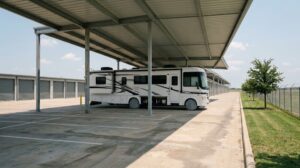
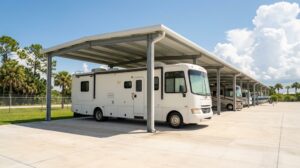
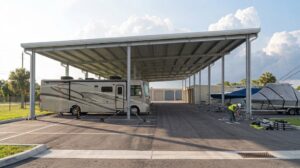
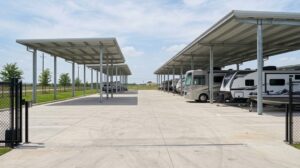
- Consider covered storage: Covered storage options put a roof overhead on the rig year-round, which cuts the thermal load on these components from the start.
Choosing the Right RV Cover for North Texas Heat
If your rig is going into uncovered outdoor storage, an RV cover is worth the investment only if it’s the right type. Look for one that’s breathable and UV-reflective, since that combination lets moisture escape while deflecting radiant heat.
A standard poly tarp does the opposite: it traps heat, raises interior temperatures, and accelerates the degradation it’s supposed to prevent. The spec that matters is a rating for UV protection and heat reflectance, not just moisture resistance. Covered or enclosed storage sidesteps this decision entirely and keeps exterior surfaces 20 to 40°F cooler than direct sun exposure.
Roof and Seal Inspection Checklist
Work through these inspection points before closing up:
- Slide-out seal flexibility (press the rubber with your thumb; it should compress and recover)
- Window frame caulking for gaps or shrinkage
- Fiberglass exterior panels for delamination or bubbling
- Slide-out lubrication on all moving components before retracting
Photograph any damaged areas before storage. That record tells you whether conditions have worsened when you return in fall.
Tire and Suspension Prep for Extended Summer Storage
RV tires sitting stationary on hot Texas asphalt for 90 or more days face two compounding threats. Static load deforms heat-softened rubber at the contact patch, causing flat-spotting. UV exposure and thermal cycling drive the second threat, ozone cracking, which works into the sidewall regardless of tread depth or tire age.
Tire Industry Association storage guidelines recommend tire covers, surface protection between the tire and asphalt, and tire pressure adjustment for extended storage. The right approach for Frisco’s summer: inflate to the upper end of the manufacturer’s recommended PSI range before storage to compensate for pressure loss over time, but do not exceed the sidewall maximum. Heat causes air pressure to rise temporarily, then drop as ambient temperatures swing overnight. Starting at the upper range gives you a buffer.
Tire Storage Checklist for Frisco’s Summer Climate
Before you park the rig:
- Inflate all tires to the upper end of the manufacturer’s recommended range
- Install UV-opaque tire covers on every tire
- Place plywood or foam pads under tires if parking on asphalt
- Retract all slide-outs completely
- Check hydraulic leveling jack pressure; avoid leaving jacks bearing full weight for 90-plus days without a mid-season check
Re-inspect tires at the 45-day mark if you’re storing for a full summer. Catching a developing crack or pressure loss mid-season is far cheaper than replacing a sidewall-failed tire in the fall.
Battery, Electrical, and Solar System Storage
Battery maintenance during a Frisco summer is one of the most consequential prep steps, and it differs significantly based on battery chemistry. The shared problem across all types is heat-accelerated self-discharge. An RV interior that reaches 150°F in direct Texas sun creates conditions that damage battery banks even when the coach is not in use.
For AGM and lead-acid batteries, the critical threshold is 95°F. Above that temperature, self-discharge accelerates, and a battery left at partial charge begins sulfating. Sulfation permanently reduces capacity and is not reversible. According to the Battery Council International, AGM batteries should be fully charged before storage and maintained with a smart trickle charger if possible.
For owners with a solar panel array, a solar-to-battery trickle charge can maintain battery health during storage. This requires the battery management system (BMS) to remain active and functional in the heat, so confirm your BMS is rated for the temperatures your storage location will reach.
AGM vs. Lithium Battery Storage in Texas Heat
- AGM batteries: Fully charge before storage. Maintain with a smart trickle charger if accessible, or disconnect to prevent parasitic drain. Degrade fastest above 95°F at partial charge.
- Lithium (LiFePO4) batteries: Store at approximately 50% charge, not full. Disconnect if no BMS is actively monitoring. Handle heat better than AGM overall, but degrade above 113°F with sustained exposure.
Disconnect the chassis battery if the RV will sit for more than 60 days without a charge cycle. Replace smoke and CO detector batteries before storage so the rig is ready to use when you retrieve it.
Water System, Holding Tanks, and Propane
Any residual moisture in your freshwater lines, water heater, or holding tanks becomes a bacterial incubator when interior temperatures climb above 120°F. A water system flush is not optional for Frisco summer storage. It’s the step that determines whether your rig smells like a storage shed or a usable camper when you open it in October.
Water System Flush and Sanitization Steps
Any moisture left in the lines when you close up the RV turns into a bacterial breeding ground once interior temperatures climb through a Frisco summer. Six steps, done in order, get the system clean and keep it that way until fall.
- Drain the freshwater tank completely using the drain valve or low-point drains.
- Mix a sanitization solution: one-quarter cup of household bleach per 15 gallons of tank capacity.
- Add the solution to the tank and run it through all lines by opening each faucet in sequence until you smell bleach at every fixture.
- Let the solution dwell in the system for 12 hours.
- Flush the system completely with fresh water until no bleach odor remains.
- Open all low-point drains and leave them open during storage so air circulates through the plumbing.
Drain and flush black and gray holding tanks at a proper dump station before storage. Add a tank treatment to prevent residual odor and microbial growth. Leaving tanks sealed and untreated in 100°F-plus conditions creates a significant problem on retrieval.
Propane System Pre-Storage Checklist
LP-gas pressure rises as ambient temperature increases. A propane tank that is 80% full at 70°F will see meaningfully elevated pressure on a 105°F afternoon. Per NFPA 1192, propane systems in recreational vehicles require shut-off procedures before extended storage.
Before closing up:
- Turn off the main propane valve at the tank
- Inspect the pressure-relief valve for corrosion or weeping
- Check regulator connections for corrosion or cracking
- Confirm all appliance pilot lights are off
Do not leave the propane system energized during storage. Propane tanks left on through a Texas summer raise both safety and equipment risks.
Interior Prep: Ventilation, Pest Prevention, and Climate Protection
Closing your RV completely tight traps humid air and creates condensation cycles as the interior heats and cools through summer days and nights. Interior ventilation matters even during storage. Leave roof vent covers slightly open with screens in place to allow airflow without creating a pest entry point. Place desiccant packs or a product like DampRid in the sleeping area, bathroom, and kitchen.
Close all blinds and shades before storage to reduce radiant heat gain on upholstery, dashboards, and cabinetry. Interior temperatures in a sealed RV in direct sun can exceed 150°F, which will crack dashboards and warp wood laminate over a 90-day period. Empty the refrigerator, clean the interior thoroughly, and leave the refrigerator door slightly ajar, secured with a bungee cord to prevent mold.
Pest Prevention Before Closing Up
Frisco’s summer heat drives rodents toward cooler shelter. A parked RV is a prime target if entry points aren’t sealed.
- Remove all food, pet food, and scented products from the interior
- Block plumbing penetrations, cable pass-throughs, and slide-out seal gaps with steel wool or foam backer rod
- Place peppermint oil-soaked cotton balls and cedar sachets in cabinets and under beds
- Check slide-out seals for gaps where small rodents could enter
- Add fuel stabilizer to your generator’s fuel system if the generator will sit unused for the summer
Before you lock the door, do a final walkthrough for anything edible, damp, or scented. Those three conditions are what pests need to establish themselves.
Ready to Store Your RV in Frisco?
Prepping an RV for a Frisco summer takes more deliberate effort than standard cold-weather prep, but the payoff is real. Get through the steps above, and the roof, tires, batteries, and interior will hold up through 100°F-plus temperatures and 90-plus days of North Texas UV. The only decision left is where to store it. For owners comparing options beyond Frisco, the full RV storage guide covers the key decision points for each storage tier.
The right tier depends on how much protection the prep above needs to keep working through September.
- Uncovered outdoor: Costs the least and works fine with a quality UV-reflective cover, as long as every prep step above gets followed.
- Covered carport-style: Cuts real UV and thermal exposure, keeping interior temperatures typically 20 to 40°F lower than a rig left in direct sun.
- Enclosed: Goes further still, blocking UV, heat, hail, and pests entirely and removing the need for an exterior cover altogether.
- Climate-controlled: A step up from standard enclosed units, worth the added cost for a higher-value rig sitting through the full Texas summer.
Don’t let a summer of Texas heat undo the work just put in. RecNation’s nearest facility, about 13 miles away in Plano, gives the rig dedicated, secured space built for North Texas summer conditions, so the prep actually holds until fall.
Frequently Asked Questions
How do you prepare an RV for summer storage in hot climates like Frisco, Texas?
Summer prep in Frisco is about heat and UV, not freezing. You’ll want to flush and sanitize the water system, inflate tires to the upper end of the manufacturer’s recommended range and cover them with UV-opaque tire covers, reseal any cracked roof lap sealant, get the batteries charged or configured for storage, turn off the propane valve, and either invest in a UV-reflective breathable RV cover or go with covered or enclosed storage. The common thread across all of it is protecting against thermal stress and ozone cracking, since those are the failure modes that actually show up after a North Texas summer.
Should I disconnect my RV battery during summer storage?
For most owners storing more than 60 days, yes. Leaving a battery connected and untouched through a Texas summer accelerates self-discharge no matter the chemistry, so AGM batteries need either a smart trickle charger or a full disconnect, while lithium batteries actually do better disconnected at a partial charge than left sitting full. Either way, keeping the rig in shade or enclosed storage slows that degradation further, regardless of which battery type you’re working with.
How do I protect my RV from heat damage during long-term storage?
Three steps do most of the work here: choose covered or enclosed storage, apply UV-stable conditioner to every rubber seal and slide-out gasket before you close up, and close the interior blinds to cut down on radiant heat gain. Roof protection deserves its own mention too, inspect and reseal any compromised lap sealant before the heat season starts, since a small gap that’s barely noticeable in mild weather can turn into a real leak after months of 100°F-plus exposure.
Do I need to flush my RV water system before summer storage?
Yes, and it matters more here than it would in a cooler climate. A sealed RV interior above 120°F turns any moisture left in the freshwater lines, water heater, or holding tanks into a bacterial incubator well before fall. The process itself is straightforward: drain the freshwater tank, run a diluted bleach solution (one-quarter cup per 15 gallons of tank capacity) through the lines, let it dwell for 12 hours, flush completely, then leave the low-point drains open for the rest of the storage period.
Can I store my RV in my driveway in Frisco, Texas?
Possibly, but a lot of Frisco homeowners can’t. Most Collin County subdivisions have recorded covenants barring long-term RV parking on driveways or residential lots outright, and the City of Frisco municipal code adds its own property maintenance restrictions under Chapter 122. It’s worth checking both your HOA rules and the city’s code before you assume driveway storage is even on the table. If it turns out on-site parking isn’t allowed, off-site storage isn’t just the convenient option; it’s the only one that keeps you compliant.
What are the best RV storage facilities in Frisco, TX?
Look past standard self-storage units and toward facilities actually built for large vehicles. Covered storage gets you meaningful protection from Frisco’s UV and hail exposure with a roof overhead; enclosed storage takes that further and drops the need for an exterior cover entirely. Whichever tier you land on, confirm the facility can actually fit your RV’s length and height before you commit to a spot.