You’re parking your RV for hurricane season in Sarasota, and you need a real plan before you hand over the keys, not another generic checklist. Gulf salt air, subtropical humidity that holds above 75 percent through November, and a six-month storm window starting June 1 make standard recreational vehicle (RV) storage advice fall short here. This guide covers the full prep sequence, from exterior to engine to paperwork, built specifically for Southwest Florida conditions. Follow it from top to bottom before your rig sits for the season.
When to Start Your Hurricane Season Prep in Sarasota
The National Hurricane Center sets the official hurricane season window as June 1 through November 30, but June 1 is already too late to start prepping. Aim for mid-May at the latest, ideally three to four weeks out, since Sarasota’s heat and humidity build fast that month and storage facilities fill up for summer.
The real reason for the head start, though, is time to fix what you find. If you discover a failing roof seal, a degraded battery, or a coolant issue during inspection, you want a week to address it, not a frantic afternoon before you leave. For broader context on long-term storage planning beyond hurricane season prep, the vehicle storage guide is worth a look.
Snowbirds vs. Year-Round Sarasota Owners
Snowbirds have it easier here than they realize: heading north in April or early May already forces the issue, so storage prep just needs to happen before you leave, not as a separate task you have to remember later. Year-round owners don’t get that built-in deadline, which is exactly the trap: it’s tempting to wait and watch the forecast instead.
That instinct runs out of runway fast. Once a named storm is within 72 hours of the area, safe pre-storage prep isn’t practical anymore, so “wait and see” only works until it very suddenly doesn’t.
Exterior Prep: Salt Air and UV Are Already Working Against You
Sarasota’s proximity to the Gulf means salt deposits accumulate on exterior surfaces even without direct ocean contact. Airborne salt aerosols travel several miles inland and accelerate oxidation on aluminum trim, corrode slide-out mechanisms, and degrade rubber seals faster than in non-coastal environments. The sequence below matters: wash before you seal, inspect before you cover.
- Wash the full exterior, including the roof: Use a salt-removing wash product before applying any protective wax or sealant. Skipping the roof is a common mistake, and salt residue left under fresh sealant continues to degrade the surface beneath it.
- Inspect every rubber seal and gasket around windows, doors, and slide-outs: Treat with a UV-protectant rubber conditioner. Salt air and UV together accelerate rubber breakdown faster than either factor alone.
- Conduct a full roof sealant inspection: Probe existing sealant for cracks or separation and reapply where needed. Dicor self-leveling lap sealant is a commonly used product for RV roofs, though other brands exist.
- Retract awnings fully and confirm locking mechanisms are engaged: Awning retraction is non-negotiable. An awning left deployed in tropical storm-force winds of 39 mph or higher will likely be destroyed and can cause collateral damage to the RV body.
- Remove or stow all exterior accessories: Mats, chairs, hose reels, and satellite dishes become projectiles in high winds. If it can move, it needs to come off or go inside.
Roof Sealant Inspection: What to Look For
Failed sealant shows specific physical signs: discoloration around seams, sealant that feels hard or brittle instead of slightly flexible, and visible cracking or separation at edges. A single overlooked crack left unsealed through a six-month storage period allows progressive water damage with every rain event. Sarasota averages over 55 inches of rainfall annually, most of it concentrated in the June through September period, which means water damage prevention starts here.
Slide-Outs: Retract, Seal, and Protect
Slide-outs should always be retracted for hurricane season storage, regardless of facility type. Extended slides increase the RV’s wind-load profile, and the seal edges are a common water infiltration point if not treated before retraction. Lubricate the slide-out mechanism with a silicone-based lubricant before retracting to prevent the mechanism from seizing during storage.
Engine, Generator, and Fuel Prep: Florida’s Ethanol Problem
Florida’s ethanol-blended gasoline is the fuel prep problem most storage guides skip entirely. The state’s ethanol mandate was repealed in 2013, but the practical reality hasn’t changed: pure gas stations remain rare in Florida, so the vast majority of Sarasota-area pumps still dispense E10 or E15 ethanol-blended gasoline by default.
That ethanol absorbs atmospheric moisture and can phase-separate, meaning the ethanol and gasoline split into distinct layers, in as few as 30 days under Florida’s humidity levels. Phase-separated fuel damages carburetors and fuel system components and won’t combust reliably after months of storage. Think of it like salad dressing left in the cabinet: the layers settle and separate, and shaking them back together doesn’t fully work once that’s happened.
Here’s how to prevent it:
- Add a fuel stabilizer: Use a marine-grade or ethanol-specific stabilizer, such as Star Tron or Sta-Bil Marine formula, added to a full tank before storage.
- Circulate the treated fuel: Run the engine and generator for 10 to 15 minutes after adding stabilizer so it reaches the entire fuel system.
- Change the oil and filter before storage, not after: Used oil contains combustion acids that accelerate internal corrosion during an extended storage window.
- Check and top off coolant: Use the manufacturer-specified ratio.
Generator-Specific Prep
Many RV owners treat the generator as an afterthought during storage prep. It shouldn’t be. Run the generator under load for 30 minutes before storage and confirm the stabilizer has been added to the generator fuel. If the generator will sit more than 90 days, consult the manufacturer manual about carb drain procedures
A generator that fails to start post-storm is not a minor inconvenience. In Sarasota after a major storm, power outages can last days to weeks, and a non-functional generator eliminates a critical backup resource.
Battery, Electrical, and Plumbing: What Happens in Six Months
Six months of inactivity in Sarasota’s heat, where summer ambient temperatures regularly exceed 90°F and enclosed spaces climb even higher, is enough to accelerate two things at once: battery discharge and organic growth in plumbing systems. These are the two systems most likely to fail during extended storage, and both are straightforward to address before you park.
Battery Disconnect vs. Battery Tender: Which to Use
There’s one question that decides it: does the facility offer shore power?
- Shore power available: Use a smart battery tender set to maintenance mode. This keeps the battery at full charge and significantly extends battery life.
- No shore power available: Disconnect the negative terminal. A battery left disconnected in Florida summer heat will typically self-discharge within 8 to 12 weeks, and a deeply discharged lead-acid battery may not recover.
- Limited sun exposure during facility: A small solar trickle charger works as a middle-ground option when the facility allows it.
Battery disconnect is the floor, not the goal. Use a tender or maintainer when you have the option.
Freshwater Tank and Plumbing Drain-Down
Stagnant water in a holding tank through a Florida summer produces ammonia-level odors and biological growth that is difficult to fully remediate. Freshwater tank draining follows this sequence:
- Drain the fresh water tank completely.
- Open all faucets and low-point drains until water stops flowing.
- Drain and bypass the water heater.
- Pour a small amount of RV-safe antifreeze into drain P-traps. The goal in Florida is not freeze protection but preventing organic growth and sewer gas infiltration through dried traps.
Close the main propane valve at the tank before storage. This addresses propane tank safety by preventing slow leaks through regulator or appliance connections during the storage period.
Tie-Downs, Wheel Chocks, and Storm Anchoring in Sarasota
This is the step most owners skip, and it’s the one that directly affects insurance claim validity later. No code actually mandates tie-down specs for privately stored RVs, but plenty of insurance policies do, many require documented evidence of tie-down or anchoring before they’ll process a named-storm claim.
Start with ratcheting tie-down straps rated for hurricane-force loads, run from the RV frame to ground anchor points at the facility. Chock every tire regardless of whether the parking brake is engaged, since Florida heat and humidity can seize a parking brake and hand you a second problem when you come back for the rig. Stabilizer jacks come last: retract them before a storm event, since left extended, they act as wind levers on soft or saturated ground.
Photograph the whole setup before you leave. It feels unnecessary until the day an insurer actually asks for proof of pre-storm preparation, which happens more often than most owners expect.
What to Ask Your Storage Facility About Anchoring
Since those anchor points usually come from the facility, not something you supply yourself, it’s worth confirming what you’re actually getting before you sign anything. Before signing with any RV storage facility in Sarasota, ask these three questions:
- Does it provide ground anchor points or tie-down rings?
- What’s its FEMA flood zone classification? Check the facility’s address at FEMA’s Flood Map Service Center, Zone AE or VE carries higher flood exposure risk during named storms.
- Does it have documented Florida hurricane preparedness protocols?
Most legitimate operations in Sarasota will answer all three without hesitation, and if one won’t, that’s worth noting on its own. For a broader read on flood risk by area, Sarasota County’s emergency management resources are worth a look too.
Insurance and Documentation Before You Park
This is the step most RV owners skip entirely, and the one that can cost them the most. Standard RV insurance policies frequently include two types of clauses relevant to stored vehicles.
Named-storm exclusions limit coverage for damage from a specifically named hurricane, sometimes requiring documented preparation steps for the exclusion not to apply. Vacancy or non-use clauses may reduce or limit coverage when a vehicle has been in storage beyond a specified period without documented condition reports.
Before storing, take these steps:
- Read your actual policy documents, not just the summary sheet: Confirm what these clauses actually say for your specific coverage.
- Call your insurer directly: Ask whether named-storm claims require proof of preparation steps.
- Keep the storage facility contract and address on file with the insurer: Confirm the facility address is registered as the vehicle’s location during storage.
- Know where to go for disputes: Florida’s Office of Insurance Regulation at floir.com is the oversight body for policy complaint or clarification questions.
What to Photograph Before You Leave
Remember, insurance documentation starts with photos. Capture the following before you park:
- All four exterior sides of the RV
- The roof, if safely accessible
- Each tie-down point and strap connection
- The retracted awning and all slide-outs in the closed position
- The odometer reading
- The battery disconnect or tender setup
- The closed propane valve at the tank
Smartphone cameras timestamp photos automatically. Back them up to cloud storage, not only to the phone that may be lost or damaged in the same storm.
Outdoor vs. Covered Storage in Sarasota: What the Difference Actually Means
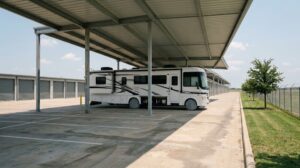
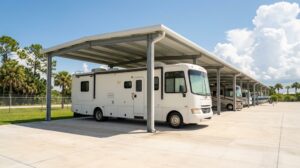
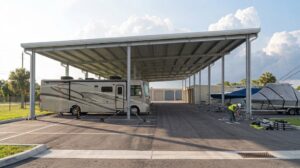
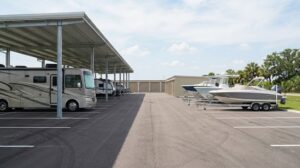
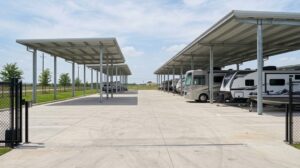
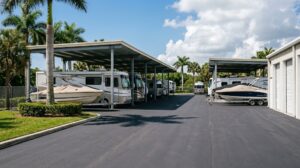
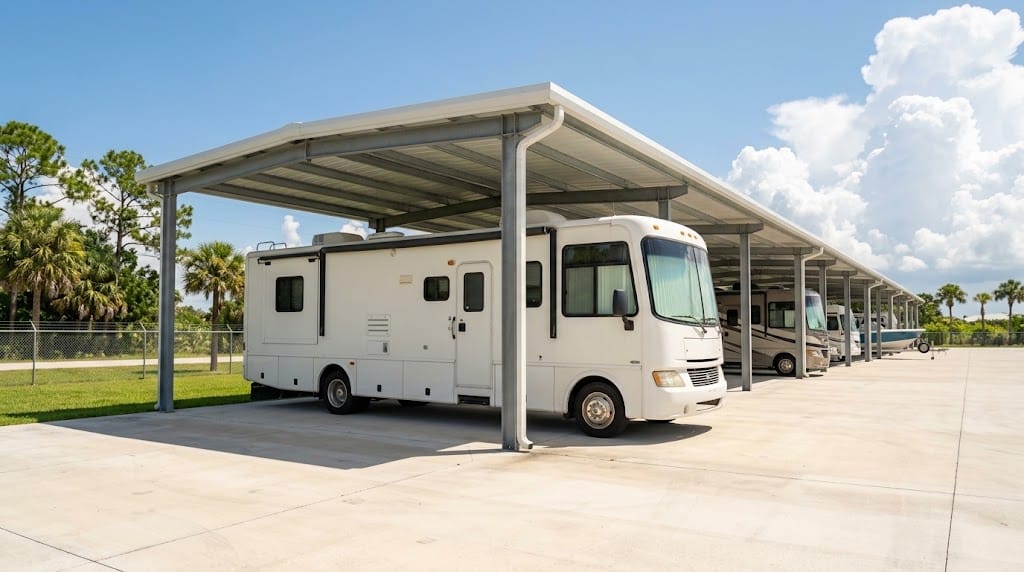
Every prep step in this guide is the floor, not the ceiling, for any storage type. What actually changes between facility types is which steps carry the most urgency and where your risk concentrates. Covered RV and boat storage options range from fully enclosed buildings to open-sided carport structures, and each one shifts your prep priorities differently.
Outdoor uncovered storage takes the full hit: maximum UV exposure, maximum salt air contact, full wind loading risk. Every step in the checklist applies here at its highest urgency.
If you go this route, an RV cover is strongly recommended, but it has to be breathable. A non-breathable cover traps humidity instead of blocking it, which just accelerates mold growth in Florida’s climate.
Carport and covered storage significantly reduces UV and direct rain exposure and offers moderate wind protection, though full prep is still required, covered isn’t a shortcut. Whether you still need a cover comes down to the structure itself: enclosed enough on the sides to block salt air, you can skip it; open-sided, it’s still worth using.
Enclosed storage offers the highest protection against UV, salt air, and wind loading, and exterior weathering stops being much of a concern. What doesn’t go away is interior prep, plumbing drain-down, battery maintenance, and pest prevention all still apply in full.
Replace with: “That middle ground, real protection against UV and salt air without the cost or commitment of a fully enclosed unit, is exactly what covered storage is built for. RecNation’s nearest facility, about 65-75 miles south in Fort Myers, offers covered RV storage for owners who want that trade-off, worth checking its own flood zone classification using the steps above before assuming it matches Sarasota’s risk profile.
Quick reference: Storage Type At a Glance
| Risk Category | Outdoor Uncovered | Covered | Enclosed |
| UV exposure | Maximum | Significantly reduced | Highest protection |
| Salt air exposure | Maximum contact | Reduced, depends on structure | Highest protection |
| Wind loading risk | Full risk, highest urgency | Moderate protection | Highest protection |
| RV cover needed | Strongly recommended, breathable | Optional, depends on open sides | Not needed |
| Interior prep required | Full checklist applies | Full checklist applies | Full checklist applies |
Mold and Mildew Prevention Inside the RV
Storage type barely matters here: a Florida summer is enough to turn any RV interior into a mold risk on its own. Moisture above 60% relative humidity inside an enclosed RV can support mold growth on soft surfaces within weeks, and Sarasota’s ambient outdoor humidity regularly exceeds 75% in summer. Take these steps before closing up:
- Leave interior cabinet doors and closets open to allow air circulation.
- Place DampRid or equivalent desiccant containers in multiple locations. Electric dehumidifiers require power and won’t work in most storage situations.
- Remove all food, beverages, and organic materials.
- Clean cushions, mattresses, and curtains before storage. Mold and mildew prevention on soft surfaces is far easier than remediation after six months.
Where Your RV Rides Out Hurricane Season in Sarasota
Hurricane season doesn’t wait for anyone to feel ready, so the sooner this is handled, the better. RecNation’s nearest facility, in Fort Myers, is built for large vehicles, not adapted from a self-storage lot with a few extra-long spaces bolted on, worth a look once you’ve weighed the drive against your own risk tolerance. The access, surface quality, and lot design are what an RV owner actually needs, not an afterthought.
Frequently Asked Questions
How do I protect my RV from hurricane winds in Florida?
Protecting an RV from hurricane winds in Florida means retracting all awnings and slide-outs, using ratcheting tie-down straps rated for high-wind loads to anchor the RV to ground points at your storage facility, and placing wheel chocks on all tires. Remove or secure any exterior accessories that could become projectiles, including satellite dishes, mats, and hose reels. Photograph your setup before leaving so you have dated documentation if you need to file an insurance claim after a storm.
Should I store my RV indoors or outdoors during hurricane season in Sarasota?
Enclosed storage is the better choice for hurricane season in Sarasota if you want the highest protection against wind, UV, and salt air, though covered carport-style storage is a practical middle ground that significantly reduces UV and direct rain exposure. Outdoor uncovered storage is the highest-risk option and requires the most thorough prep, including a breathable RV-rated cover and full tie-down anchoring. Interior prep steps, including plumbing drain-down, battery maintenance, and mold prevention, apply equally to all three storage types.
What is the best way to secure an RV during a hurricane?
The best way to secure an RV during a hurricane is to retract all awnings and slide-outs, engage wheel chocks on all four tires, and use heavy-duty ratcheting tie-down straps run from the RV frame to dedicated ground anchor points at the storage facility. Ask the facility in advance whether they provide anchor rings, as not all do. Document the tie-down setup with date-stamped photos and store those images in cloud backup, since some RV insurers require proof of pre-storm preparation before honoring a named-storm claim.
How do I prepare my RV roof for hurricane season?
Preparing an RV roof for hurricane season starts with inspecting the sealant around all seams, vents, skylights, and antenna mounts before storage. Look for sealant that feels hard or brittle, shows visible cracking, or has separated from the surface, and reapply self-leveling lap sealant wherever it shows signs of wear. In Sarasota, UV intensity and salt air degrade sealant faster than in most U.S. climates, so an annual inspection before hurricane season storage is the minimum.
Does RV insurance cover hurricane damage in Florida?
Whether RV insurance covers hurricane damage in Florida depends on your specific policy. Many RV insurance policies include named-storm exclusions that limit coverage for damage from a specifically named hurricane, and some include vacancy or non-use clauses that affect claims when a vehicle has been in storage for an extended period. Review your actual policy documents before parking for hurricane season, and call your insurer to ask directly whether named-storm claims require documented proof of preparation steps. Florida’s Office of Insurance Regulation at floir.com handles disputes and clarification questions.
When should I start preparing my RV for hurricane season storage in Sarasota?
Start preparing an RV for hurricane season storage in Sarasota no later than mid-May, at least two to three weeks before the June 1 season start. This gives you time to identify and address mechanical or sealing issues, book a storage spot before facilities fill for summer, and complete the full prep checklist without rushing. If you’re a snowbird leaving Sarasota in April, complete your storage prep before you depart rather than leaving it for a return trip. Waiting until a storm is already tracking toward the area leaves too little time to do the job properly.