Parking a recreational vehicle (RV) for summer in Pearland means leaving it through one of the harshest storage environments in the country. Cracked seals, dead batteries, mold-spotted interiors, and sun-degraded tires are all realistic outcomes if you skip the right prep steps. This guide walks through every task category, calibrated specifically for Pearland’s sustained heat, Gulf Coast humidity, and punishing ultraviolet (UV) exposure, so your rig comes out ready to roll in the fall.
Why Pearland’s Summer Is Harder on a Parked RV Than You Might Think
Pearland sits in one of the most demanding summer storage climates in the United States. National Oceanic and Atmospheric Administration (NOAA) climate normals for the Houston-Galveston region show long, hot, humid summers. Combine that with very high temperatures and strong summer UV, and you have a three-front threat that most generic storage guides ignore entirely.
Radiant heat is the piece most RV owners underestimate, because asphalt pads get far hotter than the air on a typical Pearland afternoon. That ground-level heat does three kinds of damage:
- Tire sidewalls: It attacks them directly from below.
- Roof sealants: It softens them.
- Chassis: It bakes into the structure from the ground up.
For RV and boat storage in South Texas, this is the dominant damage mechanism, not cold.
Heat, Humidity, and UV: the Three-Front Problem
Each threat has a primary target: radiant heat attacks tires and sealants; Gulf Coast humidity creates active mold-growth conditions inside a sealed interior; UV radiation degrades roof membranes, exterior paint, and sidewall materials. The prep checklist below is structured around all three, in order.
Water System Prep for a Hot-Weather Layup
Summer water system prep is not winterization. There is no freeze risk, but stagnant water sitting in hot lines breeds bacteria and odor quickly. These steps come before pulling into any storage space:
- Drain and flush the fresh water tank: Empty it completely, then flush with clean water. Do not leave any standing water inside.
- Drain the water heater: Shut the heater off and let it cool before opening the drain plug. Leave it in bypass mode for storage.
- Blow out or flush all water lines: Compressed air works well here. Leave drain valves open after clearing the lines.
- Dump the black and gray tanks at a certified dump station before storage: See the note below on where to dump.
- Leave gray and black tank valves closed during storage: Open valves invite pest entry through drain lines. This is one of the most common prep mistakes in RV forums.
Where to Dump Your Tanks Before Storage
Dump black and gray tanks at an approved dump station before storage, not at a storage lot. Certified dump stations are available at RV parks, campgrounds, and some gas stations. Storage lots are not set up to receive RV waste, so no discharge should happen on site.
Battery and Fuel Care in South Texas Heat
Heat accelerates battery self-discharge faster than most owners expect. A fully charged 12-volt (12V) house or chassis battery left in summer heat can lose charge within weeks without intervention, and a deeply discharged battery risks permanent capacity loss. It helps to review the full vehicle storage guide for additional long-term storage guidance on electrical systems.
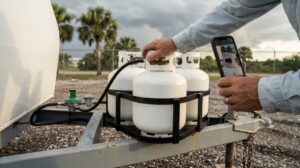
How you protect the battery depends on whether your storage space has power. You have two options:
- With hookups: Connect a smart maintenance charger with a float mode. A trickle charger without float will overcharge the battery, and heat amplifies that damage.
- Without hookups: Disconnect the negative terminal and plan monthly recharge visits with a portable smart charger.
For fuel, these steps keep the system healthy:
- Add a stabilizer rated for 12+ months before your last drive to the facility.
- Run the engine for 10 to 15 minutes to circulate stabilized fuel through the system.
- Run the generator briefly on the same stabilized fuel.
Fuel blended with 10% ethanol (E10), standard at Texas pumps, degrades faster in heat.
What to Do If Your Storage Space Has No Power Hookup
Without power, the goal is to slow the battery’s discharge and catch it before it drops too low:
- Disconnect the negative battery terminal before parking.
- If possible, store the battery itself somewhere cool, such as an air-conditioned garage.
- For storage periods beyond 60 days, schedule monthly check-ins with a portable smart charger.
A disconnected battery still loses charge in the heat, only more slowly, so those monthly check-ins matter even when everything is switched off.
Interior Prep: Stopping Mold and Heat Damage Before It Starts
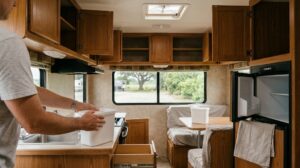
Interior temperatures in a parked camper on a Pearland summer day can get extremely hot. That heat combined with high outdoor humidity creates real mold-growth risk inside a sealed coach. These steps go in order:
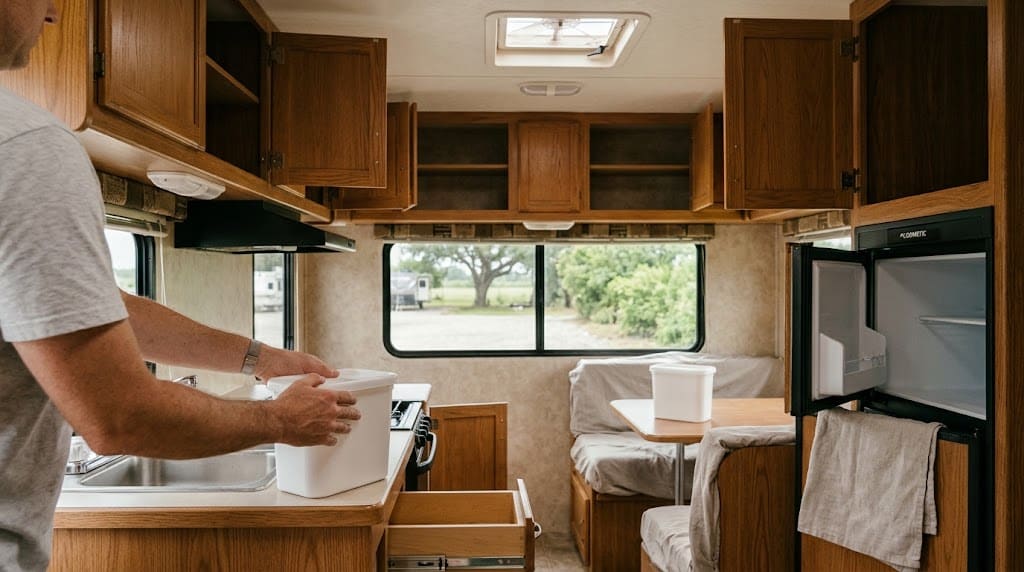
- Clean and dry every surface: Wipe down cabinets, counters, and cabinet interiors. Any food residue or moisture feeds mold in a sealed, hot interior.
- Remove all food, consumables, and heat-sensitive items: Candles, crayons, wax-based toiletries, and temperature-sensitive medications all degrade or melt.
- Place desiccant moisture absorbers throughout the interior: DampRid or an equivalent product should go in each sleeping area and in the main cabin. Pearland’s summer humidity makes this a required step, not a precaution.
- Crack roof vents slightly for passive airflow: Leave vent covers closed enough to block rain but open enough to allow circulation. Do not open windows; those are pest entry points.
- Cover upholstered surfaces with light fabric: UV-blocking fabric covers slow vinyl cracking and fabric fading caused by ambient heat, even without direct sunlight inside the coach.
Pest Prevention for Pearland Storage
South Texas storage comes with real pest pressure. These steps reduce the chance of rodents and insects moving in:
- Sealing: Seal all exterior openings, including plumbing penetrations, slide-out gaps, exhaust ports, and vent openings, with steel wool, expandable foam, or mesh rated for pest exclusion.
- Traps: Place mouse traps or bait stations in basement compartments and under the chassis.
- Deterrents: Peppermint oil on cotton balls near entry points is a widely used rodent deterrent, but it needs refreshing every 2 to 3 weeks in summer heat.
- Food: Remove all pet food, birdseed, and food packaging.
- Inspections: Check and re-seal entry points on every storage visit.
Exterior, Seals, and Tires: Protecting What the Sun and Heat Attack Most
The exterior prep priority in Pearland is UV and heat degradation. Summer thunderstorms are a secondary concern, and proper sealing addresses both. Exterior prep runs in this order:
- Wash the exterior: This removes road film and oxidation. UV turns that surface grime into permanent damage if it sits all summer.
- Inspect and re-apply lap sealant: Check the roof, windows, and slide-out edges. Sealant softens and pulls from seams in sustained heat, and any gap left open invites both water and pests.
- Apply a UV-protective wax or RV exterior protectant: Cover sidewalls and accessible roof surfaces.
- Fully retract all awning fabric: Extended fabric absorbs UV stress and develops mildew in Pearland’s humidity.
Tire Protection Under South Texas Summer Heat
RV tires parked on Pearland asphalt face three simultaneous threats: UV ozone cracking of the sidewall, static flat-spotting from prolonged load without rotation, and compound softening when pavement gets very hot. These steps come before parking:
- Place UV-rated tire covers on every tire, not just the road-side ones.
- Use tire leveling boards under each wheel to reduce heat transfer from asphalt and limit flat-spot deformation.
- Inflate to the manufacturer’s recommended pounds per square inch (PSI). Check the sidewall for the correct figure.
- Avoid repositioning the RV repeatedly without allowing tires to warm and re-round first.
Tires stored in direct summer sun without covers can show visible sidewall cracking within a single Pearland season.
Roof Seals and Slide-Out Gaskets
It helps to inspect all roof penetration seals around air conditioning (AC) units, vents, and antennas before storage, along with the slide-out rubber gaskets. Heat causes rubber to harden, shrink, and pull away from contact surfaces.
Applying a rubber conditioner (not petroleum-based) to slide gaskets before parking helps. Any lifted or cracked lap sealant is best re-sealed with a self-leveling RV sealant rated for high heat, since standard caulks can soften and run in Pearland’s summer conditions.
Covered vs. Enclosed Storage: Which One Your Prep Work Earns
The level of protection your storage space provides changes which prep steps carry the most urgency. Each storage type shifts the burden between the owner’s prep work and the structure itself:
- Uncovered lot: Exposes your RV to full UV and radiant heat with no mitigation. Prep must compensate by being thorough on tire covers, exterior UV protectant, and sealant inspection. Nothing is optional when there is no overhead protection.
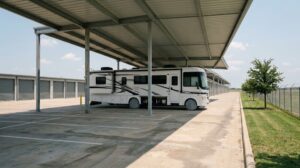
- Covered storage: A roof with open sides, as in covered storage for your RV, blocks most direct UV on the roof and meaningfully reduces surface temperatures. It does not eliminate the need for tire covers or interior moisture control, but it slows the degradation rate significantly.
- Enclosed storage: Adds full UV protection, pest exclusion, and significant interior heat reduction. Prep steps are the same, but the urgency of each one is lower when the rig is shielded from the outside environment.
Once you know which tier fits your rig, you do not have to commit to one blind. RecNation’s Houston facility at 8750 Galveston Rd offers both covered and enclosed spaces, so you can match the structure to the prep work you are willing to do. You can see its options through RV storage near Pearland.
At-Home Storage in Pearland: What the Code Actually Says
Many Pearland RV owners assume driveway storage is a fallback option. It often is not. The City of Pearland and many homeowners associations (HOAs) in Brazoria County restrict or prohibit RV storage on residential lots and driveways.
It helps to check the City of Pearland municipal code and your HOA’s covenants, conditions, and restrictions (CC&Rs) before parking at home for the summer. A code violation on top of an improperly prepped rig sitting in the driveway is a double problem worth avoiding.
Final Thoughts
You have worked through the checklist: water systems drained, battery managed, interior moisture controlled, tires covered, seals inspected, and storage type selected. Getting the prep right before a Pearland summer is the difference between an RV that comes out of storage ready to roll and one that needs repairs before it leaves the lot.
Need a place to park your rig through the summer heat? RecNation RV storage near Pearland points you to RecNation’s nearest facility, 8.5 miles away in Houston. It offers covered and enclosed spaces built for the long vehicles that do not fit easily anywhere else. It helps to reserve your space before summer heats up.
Frequently Asked Questions
What’s the average cost to store an RV in the Pearland area?
RV storage near Pearland costs more as the protection level and RV length increase. Uncovered lots are the lowest tier, covered carport spaces sit in the middle, and enclosed units are the highest. A 40-foot Class A motorhome costs more to store than a 24-foot travel trailer, and rates shift with seasonal demand, so it helps to confirm current pricing with the facility.
Do I need to winterize my RV if I’m storing it for the summer in Texas?
Standard winterization, meaning antifreeze in the water lines, is not needed for summer RV storage in Pearland because there is no freeze risk. Summer storage calls for its own heat-season prep: draining the lines and water heater, adding fuel stabilizer, placing moisture absorbers, and protecting tires and seals from UV and heat.
How often should I check on my RV during summer storage?
Checking on a stored RV at least once a month through the June to September window catches problems early. Each visit covers battery charge, pest deterrents, and a walk around the exterior for new seal gaps or tire changes, which keeps small issues from compounding over a full summer of heat and humidity.
Can I store my RV in my driveway in Pearland?
Storing an RV in a Pearland driveway may be restricted by both City of Pearland rules and HOA covenants, so it is not safe to assume it is allowed. Rules range from time limits to outright prohibition, and the HOA’s CC&Rs and the city’s municipal code show what applies to a specific address before the season starts.
Will summer heat kill my RV battery even if the RV is parked?
Summer heat can drain a parked RV battery quickly, and a battery left to discharge fully may come back with permanently reduced capacity. A smart maintenance charger on a powered storage space prevents that, and without power, disconnecting the negative terminal and recharging monthly with a portable smart charger does the same job.
What is the best type of storage for an RV in a hot climate like Pearland?
Covered or enclosed storage is the best fit for an RV in Pearland’s summer heat. Covered spaces block direct UV on the roof and lower surface temperatures, while enclosed storage adds full UV protection, pest exclusion, and heat reduction inside the bay. Uncovered lots cost the least but leave the full burden on owner prep such as tire covers, exterior protectant, and thorough sealing.