To prep your recreational vehicle (RV) for summer storage in Celina, wash and seal the exterior, shut down the propane and battery, drain the water system, protect the tires, and block pests before you walk away. Most online checklists were written for Florida owners fighting salt air and hurricane season, but Collin County brings 100°F heat, intense ultraviolet (UV) exposure, hail, and homeowners association (HOA) rules that Florida guides never mention.
This checklist follows the order you would actually work through on prep day, so you can run it start to finish in your driveway.
Why Celina’s Summer Climate Changes Everything About RV Storage Prep
From June through August, Collin County daytime highs regularly reach 100°F or more during heat waves, and UV index readings are often in the very high to extreme range. The heat is dry rather than humid, and severe thunderstorms and hail can arrive with little warning. That mix punishes tire sidewalls, roof sealants, battery electrolyte, and propane system components first, so this RV maintenance checklist is built around them.
Large rigs also need more than a general storage unit offers. For RV and boat storage built around long, tall vehicles, dedicated facilities are a different category of solution from general self-storage.
What 100°F Heat Actually Does to a Parked RV
A sealed RV acts like an oven, and its interior can run far hotter than the outdoor reading. That heat cracks dashboard and vinyl surfaces, softens window seals and trim adhesives, drains battery fluid, and raises pressure in the propane system. Anything you leave inside, from food to cosmetics, can spoil or melt.
HOA and City Rules That May Decide Where You Store It
Many newer planned communities in Celina restrict or prohibit visible RV storage, and your deed restrictions control even where city rules are more permissive. Celina’s parking ordinance allows an RV on a residential driveway but prohibits parking it elsewhere in the front yard, requires other storage in a screened rear yard, caps a lot at four recreational vehicles or trailers, and limits street parking to 72 hours.
Texas Property Code Chapter 202 lets an HOA enforce its covenants in court. Pull your HOA documents before you spend Saturday prepping, because the answer may send you to a commercial facility.
Step 1: Exterior Wash, Wax, and Seal Inspection
Start with the exterior, because grime bakes on fast in summer heat. Work through these tasks in order:
- Wash the full exterior: Road grime, bug residue, and tree sap bake into fiberglass and paint under summer heat and become etched stains by fall.
- Apply a UV-protective wax or sealant: Cover every painted and fiberglass panel for UV protection through the months you will not be looking at it.
- Inspect every gasket and seal: Check the rubber around windows, doors, slides, and vents. North Texas UV breaks down aged sealant faster than milder climates do, and a crack found in October usually started as a micro-gap in May.
- Handle awning care: Retract and secure the awning, clean the fabric before you roll it, and check the arm hardware for loose fittings. Never leave an awning extended, since a single Collin County thunderstorm can destroy it overnight.
Our vehicle storage guide covers general long-term protection practices, such as cover choices and what to check on monthly visits, if you want more detail on keeping a stored rig in shape beyond this summer checklist.
Roof Inspection and Sealant Touch-Up
Walk the roof carefully, spreading your weight, and check every seam, vent cover, skylight edge, and antenna mount for cracked or lifted caulk. Use Dicor lap sealant or an equivalent RV-rated product, never silicone or household caulk. A small gap left under North Texas UV can become a water intrusion failure by September, and a roof inspection costs far less than a delamination repair.
Step 2: Engine, Fuel, and Mechanical Prep
Motorized RV owners have extra tasks before leaving the rig for a month or more. Work through these in sequence:
- Stabilize the fuel: Gasoline engines stored more than a month need a quality fuel stabilizer run through the system. Diesel is more stable, but a biocide additive helps over multi-month storage.
- Change the oil and filter: Old oil carries combustion acids that corrode engine internals during long idle periods, so change it before storage.
- Check engine fluid levels: Inspect coolant, brake fluid, power steering fluid, and washer fluid. Heat stresses the cooling system even on a parked vehicle if the coolant is marginal.
- Service the generator: Run it under load for at least two hours each month, or add fuel stabilizer to the generator carburetor if you will not return during storage.
If your tow vehicle will be stored alongside a fifth wheel or travel trailer, follow the same fuel and fluid steps for it.
Propane System Shutdown for Texas Summer Heat
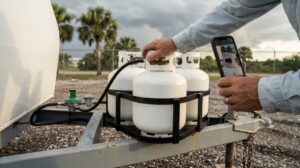
Propane is the system most owners overlook before summer storage, and heat is what makes it matter. The National Fire Protection Association (NFPA) 58 Liquefied Petroleum Gas Code calls for storing cylinders where they are not exposed to excessive temperature rise and keeping cylinder valves closed. A sealed compartment in direct Texas sun heats quickly, and rising heat raises the pressure inside a propane tank.
Turn off every liquefied petroleum (LP) gas appliance at the appliance switch and close the main tank valve. If the space is unventilated, move your propane tanks to a shaded, ventilated spot, and never leave them in an airtight compartment. If your facility requires tanks removed, bring a small wrench on move-in day.
Step 3: Battery Disconnect and Electrical System Shutdown
Above 90°F, a 12V absorbent glass mat (AGM) or flooded lead-acid battery self-discharges much faster than in mild weather. A battery that holds its charge for weeks at 70°F can be deeply discharged and sulfated in a shorter stretch of Texas summer, which is why battery disconnect is one of the highest-priority steps here.
Your options, in order of preference:
- Connect a smart battery maintainer if your storage site offers shore power.
- Disconnect the negative terminal if it does not, and return periodically to charge the battery.
- Remove the battery to a climate-controlled space for the best long-term outcome.
Before you do any of these, shut down parasitic loads. Clocks, carbon monoxide detectors, LP leak detectors, and slide-out memory systems all draw power when the RV looks off, so cut them at the disconnect or fuse level. Lithium iron phosphate (LiFePO4) batteries handle heat and self-discharge better, but they still store best at 50 to 80% charge rather than 100%.
Checking Shore Power Availability at Your Storage Facility
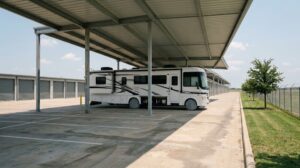
If you are moving to a commercial site, ask whether it offers electrical hookup before you sign. A site with 30-amp service lets a smart battery maintainer run continuously, which removes the need for visits just to charge the battery. RecNation’s nearest facility, about 10.6 miles away in Anna, offers covered canopy and indoor garage RV storage, so ask about electrical hookups when you call.
Step 4: Plumbing, Tanks, and Moisture Control
Work through the water system in this order:
- Drain and sanitize the freshwater tank: Bacteria multiply quickly in warm, stagnant water, and a partly filled tank will be badly contaminated by fall.
- Flush and treat the holding tanks: Residue left in black and gray tanks at high temperatures produces hydrogen sulfide gas and speeds corrosion.
- Drain or bypass the water heater: A full tank sitting for months wears down the anode rod and causes odor and mineral buildup.
- Turn off the water pump.
For moisture and mold prevention inside the coach, leave cabinet and refrigerator doors open, place desiccant packs in closets and storage bays, and remove all food. Interior humidity is less of a threat in dry North Texas heat than in Florida, but a small roof leak in a sealed, hot RV can still grow serious mold by September.
Interior Ventilation in a Sealed RV During Summer Heat
Leaving vents open invites pests and rain, and sealing the RV completely builds a greenhouse effect. Roof vent covers, such as the widely available Camco-style covers, allow passive interior ventilation while blocking rain and pests. Without them, trapped heat damages vinyl, the adhesives holding trim and flooring, and anything temperature-sensitive left inside.
Step 5: Tire, Slide-Out, and Chassis Prep
Tires take the worst of a North Texas summer, because sun and heat work on the sidewalls whether or not the RV moves. Start here, since tire damage builds quietly over weeks and is hard to spot until it’s too late. Work through these steps in order:
- Set tire pressure near the sidewall maximum: Inflate to the maximum cold pressure on the tire sidewall, not the vehicle placard, which is load-adjusted. Higher storage inflation resists flat-spotting, which can develop in a matter of weeks on a stationary rig, so check your tire manufacturer’s guidance.
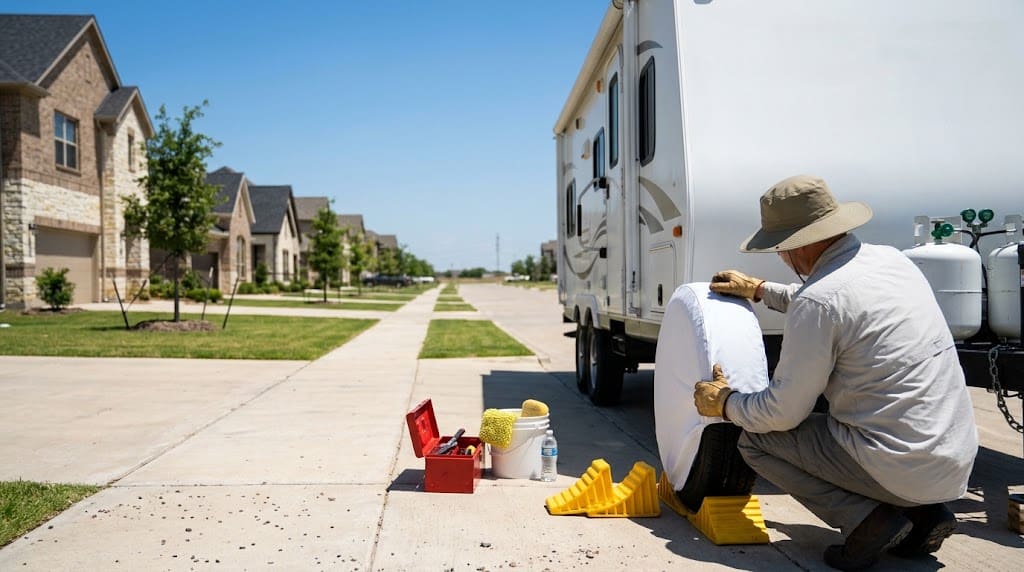
- Install UV-blocking tire covers: UV sidewall cracking is a common failure in North Texas, and a tire that looks fine can have compromised structure after one unprotected summer.
- Retract all slides and handle slide-out maintenance: Clean the seals and apply the manufacturer’s recommended lubricant, since dry seals bind and tear after months of heat.
- Level the RV: Leveling reduces frame stress, but do not leave full weight on the stabilizer jacks, which are not rated for long-term loads.
- Use wheel chocks instead of the parking brake: A brake left engaged on the same surface for months can cause drum corrosion and shoe adhesion.
Protecting the Exterior from North Texas Hail
Collin County sees significant hail, especially in spring and early summer, and an RV in open storage is a direct target. The most effective single defense is covered storage options rather than a bare lot.
If an outdoor storage facility is your only choice, buy a heavy-duty padded RV cover marketed for hail or impact resistance. A standard breathable cover does not stop hail, so check the product description before you buy.
Step 6: Pest Prevention Before You Walk Away
North Texas summer storage invites wasps, rodents, and fire ants. Cover every external vent, including the furnace exhaust, water heater exhaust, and refrigerator vent, with fine mesh or dedicated vent covers, then run this pest prevention checklist:
- Block entry points: Seal visible gaps around utility entries with steel wool or expandable foam.
- Place rodent repellent sachets: Peppermint-based sachets work in cabinets, under the dinette, and in storage bays without harming interiors.
- Remove all food: Rodents chew through sealed packages, so take everything out.
- Clean the trash and wipe all surfaces: Odor alone attracts activity.
- Inspect for fire ants: If the pad is gravel or dirt, check tires and jack pads for mounds and treat the perimeter before you leave.
How Often to Check on a Stored RV During Summer
Plan at least one visit a month during a 90-day stay. Walk the exterior, check the tires, look for pest entry, briefly start the engine on motorized rigs, and check the battery charge. If the facility is more than 30 miles away, a battery maintainer on site makes visits every other month a reasonable minimum, and a written record of each system’s condition before you leave gives you a baseline to compare against.
Final Thoughts on Prepping Your RV for Summer Storage in Celina
If home storage isn’t realistic for you, whether because of HOA rules, no covered space, or an RV baking in your driveway all summer, RecNation’s nearest facility, about 10.6 miles away in Anna, offers RV storage near Celina. It’s a dedicated RV and boat storage facility, so the spaces, security, and access are built around large vehicles.
Frequently Asked Questions
How do you prepare an RV for long-term summer storage in hot climates like North Texas?
Work from the outside in: wash and seal the exterior, then handle fuel, propane, battery, water systems, tires, and pests in order. In Celina, Texas, the highest-priority items are UV protection for tires and exterior surfaces, LP system shutdown, and battery management, because heat speeds failure in all three. Write down each system’s condition before you leave so you can spot changes at check-ins.
Should I disconnect my RV battery when storing it for the summer?
Usually, yes. Heat above 90°F speeds self-discharge and electrolyte loss in flooded lead-acid and AGM batteries, so an unattended battery can be permanently damaged during a Texas summer. A smart maintainer is better than disconnecting if your facility offers shore power; otherwise, disconnect the negative terminal and plan regular charging visits.
What should I do with my RV propane tanks before putting it in storage?
Close the main tank valve and turn off every LP appliance before storage. Keep the tanks in a ventilated, shaded spot rather than a sealed bay. If the facility requires tanks capped or removed, a hand-tight cap on the valve outlet is typically enough, but follow the facility’s own rule.
How do I protect my RV from the Texas summer heat during storage?
Covered or enclosed storage is the most effective single protection because it removes direct sun from the roof and tires. In an open lot, a heavy-duty UV-reflective RV cover protects the exterior, and tire covers protect sidewalls. Inside, remove temperature-sensitive items, open cabinet doors, and fit roof vent covers for passive airflow.
Where can I store my RV in Celina, Texas?
Commercial storage is often the practical choice because many HOAs restrict visible RV parking, and Texas Property Code Chapter 202 lets them enforce those rules. RecNation’s nearest facility, about 10.6 miles away in Anna, offers dedicated RV and boat storage with covered canopy and indoor garage options. Whichever facility you compare, look for features built for large vehicles: wide drive aisles, security fencing, camera coverage, and covered or enclosed space for UV and hail.
Do I need to winterize my RV before summer storage in Celina?
No. Winterization protects water lines from freezing, which is not a summer risk in Celina. Summer prep targets heat, UV, and bacteria in warm, stagnant water, so drain and sanitize the freshwater tank, empty holding tanks, and bypass the water heater, then save the antifreeze steps for late fall if the RV heads into cold-weather storage.