Want to prep your recreational vehicle (RV) for hurricane season storage in Ellenton, Florida? Seal the roof. Retract the awnings and slides. Treat the fuel and protect the battery. Close the propane valve and drain the water system. Then book a covered space before the season opens. Ellenton sits near Tampa Bay, so your RV faces salt air, humidity that often tops 70 percent, and a June through November storm window.
This checklist covers every step in order, from the weekend before you park to the day you pick the rig up.
Why Ellenton’s Gulf Coast Climate Makes RV Storage Prep Non-Negotiable
For RV and boat storage in coastal markets, preparation matters more than it does inland, and Ellenton sits where three conditions stack on top of each other.
Salt Air, Humidity, and Storm Risk: The Ellenton Triple Threat
Salt-laden air from Tampa Bay can drift inland, so Ellenton sees it more than cities farther from the coast. It settles on rubber seals, gaskets, and bare metal and starts wearing them down from the first week of storage.
Manatee County humidity typically runs in the 70 to 75 percent range, and it does not drop between named storms. That keeps mold, corrosion, and seal breakdown going for months in any RV left alone. The National Hurricane Center tracks the Atlantic hurricane season from June 1 through November 30, so an RV parked for the season sits through peak storm months with no one watching it.
Exterior Prep: Protecting Your RV from Salt Air and Storm Damage
Start on the outside, because salt residue left on paint and metal oxidizes them over months of humid weather. Work through these steps in order before you move the RV to the facility:
- Wash and decontaminate: Use a product that removes salt deposits, not just road grime.
- Treat the rubber seals and gaskets: Salt air and UV together wear window and door seals faster here than inland. Apply a UV-resistant rubber conditioner and check for cracks.
- Inspect roof vents and seals: Check every vent cover, skylight, antenna base, and air conditioner base, and reseal gaps with lap sealant rated for Florida sun.
- Retract and secure the awnings: An extended awning acts as a sail in tropical-force winds.
- Retract the slide-outs: Retract the slides fully for storage so the seal perimeter stays protected from salt and moisture.
Roof Inspection and Resealing
Walk the roof where it is safe to do so and check every seam, vent base, antenna mount, skylight edge, and air conditioner base. Strong Florida sun can crack sealant that looked fine last season. A failed seal that sits through months of Gulf Coast rain becomes an interior mold problem that costs far more than a tube of sealant.
Awnings, Slide-Outs, and Wind Exposure
A tropical storm can turn any loose or extended part of your RV into a sail. Cut down what the wind can catch before you leave. Do these things first:
Lock the awnings closed: An awning torn loose can pull mounting hardware off the sidewall and damage nearby vehicles.
- Retract all slide-outs: This is the slide-out retraction step that most affects storage, since extended slides expose the seals to salt and humidity.
- Stow exterior accessories: Remove bike racks, loose antennas, and any RV covers and tie-downs that are not secured, and store them inside or off-site.
Mechanical and Fluid Prep: What Breaks When an RV Sits for Six Months
Fuel, battery, and fluid systems degrade on a schedule in Florida heat. Knowing that helps you decide what to finish before storage and what to ask a facility about electrical hookups.
Fuel Stabilizer and Tank Prep
Gasoline can start to break down in about a month in Florida heat. After six months, untreated fuel can leave varnish in the carburetor and fuel lines. Here is how to protect it:
- Add a fuel stabilizer: Choose one rated for long-term storage.
- Run the engine briefly: This circulates the stabilizer through the system.
- Top off the tank: A full tank leaves less air space, which cuts condensation on the tank walls through humidity swings.
Battery Maintenance During Long-Term Storage
Florida heat can drain a battery with no maintenance charger deeply within weeks. Disconnecting it and leaving it alone is not enough for a six-month stay. The better fix is a battery tender on a shore-power connection, so confirm the facility offers electrical hookups before you book. No hookups? Plan a mid-season visit to check and recharge the battery.
Generator and Engine Fluids
Run the generator under load for about two hours before storage to burn off moisture, and add stabilizer to its own fuel tank if it has one. This generator maintenance step prevents a failed start months later.
If your last oil change was a few thousand miles ago, change it before storage, since old oil carries acidic combustion byproducts that corrode internals during a long idle. Top off the coolant while the hood is open.
LP/Propane Lockout: A Step Most RV Owners Skip
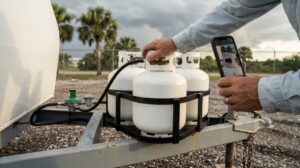
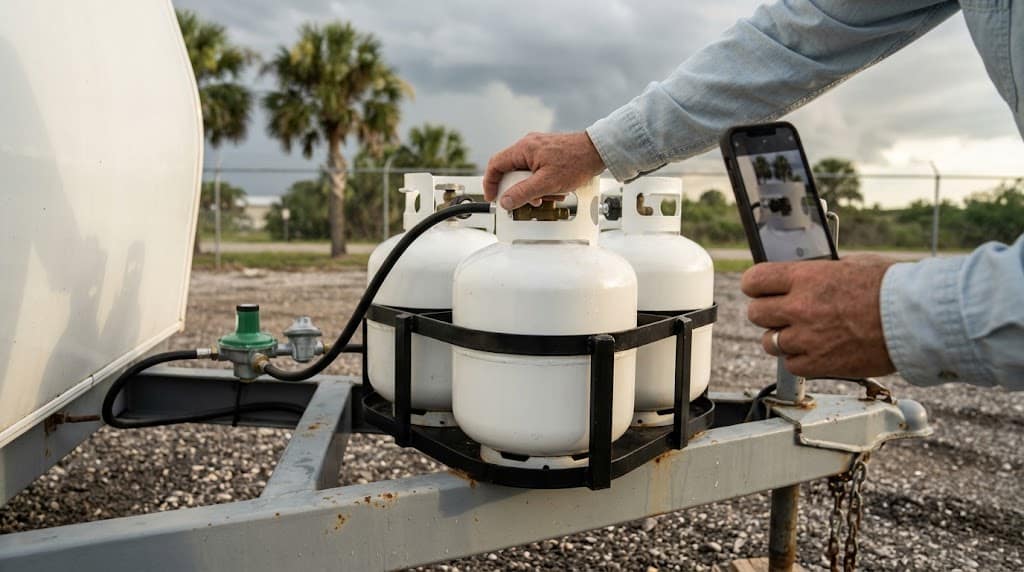
Most owners turn off the stove and call it done. Propane tank shutoff deserves a fuller routine. NFPA 58, the National Fire Protection Association’s Liquefied Petroleum Gas Code, covers how propane cylinders are stored. That includes keeping cylinder valves closed. In hurricane season this matters even more. An evacuation or storm damage at a facility can turn a leaking or open LP system into a fire risk. That risk reaches your RV and the vehicles around it.
Closing the Service Valve and Inspecting the System
Closing the valve is quick, but skipping the inspection is where problems hide. Complete the liquefied petroleum (LP) system shutoff in this order:
- Turn off interior appliances: Switch off the stove, furnace, gas-mode refrigerator, and water heater.
- Close the service valve: Turn the tank’s service valve fully clockwise until it stops.
- Inspect the regulator, hoses, and fittings: Look for cracks, stiffness, or corrosion, since salt air speeds rubber wear, and replace anything that looks worn.
- Document the shutoff: Write down the date and that the valve is closed, and keep photos. Insurance documentation of your prep steps can help if storm damage occurs.
Interior and Plumbing Prep: Stopping Mold Before It Starts
Interior moisture control matters as much as the exterior checklist. A sealed RV in Manatee County humidity will grow mold without active prevention.
Draining the Fresh Water System
Fresh water system draining is a must before a months-long stay, because standing water in a warm, sealed tank grows bacteria and biofilm. Do it in this order:
- Drain the fresh water tank completely.
- Open all faucets and low-point drains to clear standing water from the lines.
- Drain and bypass the water heater.
- Sanitize the tank with a diluted bleach solution before sealing it.
- Empty, flush, and treat the gray and black holding tanks, since residue left in a hot tank causes odor and corrosion.
Moisture, Mold, and Pest Prevention
Place several desiccant containers throughout the interior, spread across the bedroom, kitchen, and bathroom, and remove fabric items such as cushions, bedding, and curtains that trap humidity. Close the roof vents against rain, and in covered storage use vent covers that still allow some airflow.
Remove all food, including canned goods, because Florida supports rodent and insect activity year-round and food left behind is the main way pests get in. Seal gaps around utility connections, slide perimeters, and plumbing access panels with steel wool or foam.
Choosing the Right Storage Facility in Ellenton Before Hurricane Season
The facility is part of storm preparation, and a thorough checklist does less if the RV spends six months in an open, unshaded spot. Ask any facility these questions before you sign:
- Covered or enclosed options: Is covered or enclosed storage available, and how is the structure built to handle wind?
- Shore power: Does the facility offer 30-amp electrical hookups for a battery tender?
- Storm watch policy: Are owners required to remove vehicles when Manatee County issues a hurricane watch or warning?
- Security: Is the facility gated and monitored through the storage period?
Book before the season starts, since covered spots tend to fill in spring as seasonal residents head north and local owners get ahead of June.
Covered vs. Outdoor Storage for Gulf Coast Conditions
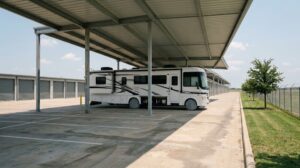
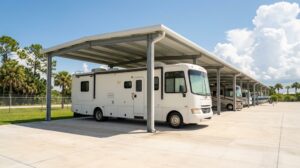
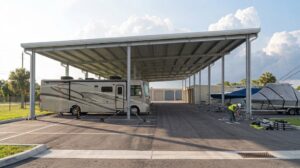
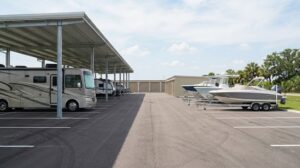
Covered or enclosed storage helps in three ways. It keeps direct UV off seals and paint. It cuts salt buildup on metal. It also shelters your RV from wind-driven rain in storms that don’t hit directly.
Outdoor storage costs less up front. But six months of open Gulf Coast exposure adds up in seal replacement and mold cleanup. If you’re asking is vehicle storage worth it, the answer tips toward protection faster here than in milder markets.
RecNation’s nearest facility is about 5.7 miles away in Bradenton. It offers covered canopy and indoor garage options for RV storage in Ellenton. Ask about shore power and storm policies before you reserve. When you compare covered storage for your RV, remember that a roof helps with sun and rain but is not a hardened structure.
Storm Watch Policies and What to Ask Your Facility
Whether you must remove your RV when a watch is issued usually comes down to the facility’s lease terms. Some facilities won’t allow unattended large vehicles during a mandatory evacuation of their zone. Get the policy in writing before you sign. Ask which evacuation zone the property sits in. Decide this before June, not when a Gulf advisory arrives with two days of lead time.
A few more steps help:
- Check official guidance: Look at Manatee County Emergency Management and the Florida Division of Emergency Management for current updates.
- Review FEMA hurricane preparedness guidelines: They explain owner responsibilities during watches.
- Call your insurer: Confirm your RV policy covers storm damage while the vehicle is at a third-party facility.
- Photograph the RV: Document its condition before you park.
De-Storage Inspection: What to Check Before You Drive Away in November
Your RV has sat through six months of heat, humidity, and storms. A few quick checks now can save you a breakdown or a surprise on the road. When you return at the end of the season, work through this list before you pull out.
Mechanical and Fluid Check Before the First Drive
- Check tire pressure and condition: Inflate to the maximum cold pressure on the sidewall, and look for flat-spotting or sidewall cracking after months on one contact patch.
- Test the battery: Reconnect it and check it before you start the engine.
- Check fluids: Look at engine oil, coolant, and brake fluid.
- Test the generator: Run it under load for a few minutes and listen for irregular behavior.
Interior and LP System Reactivation
- Remove the desiccant containers and dispose of them.
- Inspect for mold or moisture: Check roof vent bases and slide seals first, since these are the usual failure points after a storm.
- Flush the fresh water system before you drink from it.
- Reopen the LP valve carefully: Confirm all interior appliances are off, open the valve slowly, and check for any propane odor at the regulator and fittings.
Final Thoughts on Prepping Your RV for Hurricane Season Storage in Ellenton
Storing your RV for the full June to November window? The facility you choose matters as much as your prep work. RecNation’s nearest facility is about 5.7 miles away in Bradenton. RecNation’s nearest facility is about 5.7 miles away in Bradenton, with covered canopy and indoor garage options for RV storage near Ellenton. Confirm availability and access details with the facility before you commit.
Frequently Asked Questions
When should I start prepping my RV for hurricane season storage in Ellenton?
Start no later than mid-May so the RV is stored by June 1, when the Atlantic hurricane season begins. Storms can form in the Gulf with little lead time, so finishing early beats rushing. Book the facility before you finish prep, since covered spaces in the area tend to fill in spring.
Is indoor or covered RV storage better than outdoor storage during hurricane season in Ellenton?
Covered or enclosed storage is meaningfully better across the season, since it removes direct UV, reduces salt buildup on metal, and gives some protection from wind-driven rain. No structure is guaranteed to survive a direct major hurricane strike. What matters most is a documented storm watch policy and knowing whether you must remove the RV during a watch.
What should I do with my RV’s propane tanks before storing it for hurricane season?
Close the tank’s service valve fully, turn off every interior propane appliance, and inspect the regulator, hoses, and fittings for cracks or stiffness. Write down the date you closed the valve, since insurers may ask how the system was secured after storm damage. If the facility has its own propane rules, follow them.
How do I protect my RV’s tires during six months of storage in Ellenton, Florida?
Inflate to the maximum cold pressure on the sidewall before parking, because pressure drops slowly over months and low tires flat-spot and crack. Tire covers help in Florida sun, especially for outdoor spaces. If the facility allows, move the RV slightly every month or so to shift the contact patch.
Does my RV insurance cover hurricane damage while it’s in storage in Florida?
Many comprehensive RV policies cover storm damage at a third-party facility, but terms vary by insurer. Check your declarations page for exclusions tied to named storms, storage duration, or facility type. Photograph the RV’s condition before storage, and keep records of your prep steps. Ask your insurer before the season begins.
Does Manatee County require RV owners to remove their vehicles from storage during a hurricane watch?
County rules do not generally spell out vehicle removal from private storage, but an individual facility can require it in its lease, particularly in an evacuation zone. Confirm the facility’s policy in writing before you sign, not when a watch is issued. Bookmark Manatee County Emergency Management’s storm page for live guidance once the season starts.