If your RV sits outside between trips, it needs protection. The question is whether that protection comes from a cover you put on the rig or from the facility you park it in. Both work, both have costs, and the right answer depends on your climate, how long the RV sits, and how much hassle you are willing to deal with every time you use it.
This guide covers the materials that go into RV covers, what each one actually lasts in the real world, how to choose by your climate, the practical realities of living with a cover, and where covered or enclosed storage makes more sense. If you are shopping for a cover, you will leave knowing what to buy. If a cover is not the right fit, you will know that too.
RV Cover Materials: What Each One Does and Where It Falls Short
Every RV cover is built from one of a few base fabrics, and the material determines how long the cover lasts, what it protects against, and where it struggles. Here is the honest breakdown.
Polypropylene
Polypropylene is the most common RV cover material and the most affordable. It is naturally water-resistant and breathable, which helps prevent moisture and mildew buildup underneath. Single-layer polypropylene covers are the budget entry point, starting under $200 for a travel trailer. The tradeoff is durability: polypropylene has poor UV resistance, and in high-sun states like Arizona, Texas, and Florida, a single-layer cover can degrade in one to two seasons. Multi-layer polypropylene (like triple-layer construction) improves the lifespan, but the UV weakness is built into the fabric.
- Best for: budget protection, mild climates, shorter storage periods
- Lifespan: 1 to 3 years depending on UV exposure and layer count
- Weakness: poor UV resistance; degrades fastest in high-sun climates
Tyvek and SFS AquaShed
Tyvek is a synthetic material known for exceptional breathability and water resistance, and it is the premium option for wet climates. Covers that use a triple-layer Tyvek roof panel with polypropylene sides combine the best water protection on top with breathability on the sides. This construction handles rain, snow, and humidity better than straight polypropylene, and the breathability means moisture underneath evaporates rather than sitting against the finish. It is not fully waterproof, so prolonged soaking rain in tropical climates can eventually work through, but for seasonal rain and snow it is among the best options.
- Best for: wet and snowy climates, seasonal storage through winter
- Lifespan: 3 to 5 years with proper care; some owners report longer
- Weakness: not fully waterproof in sustained tropical rain; costs more
Olefin HD and UV-treated covers
Olefin (a polypropylene fiber) covers are built specifically for sun-dominant climates. The material resists fading, UV degradation, and weakening from sustained sun exposure better than standard polypropylene, which makes it the right pick for the Southwest, the Gulf Coast, and anywhere that sun, not rain, is the primary threat. If you store your RV in Arizona, West Texas, or inland California, this is the material category to focus on.
- Best for: high-UV climates, desert and southern sun belts
- Lifespan: 3 to 5 years in high-sun environments
- Weakness: less breathable than Tyvek; less effective in wet climates
Ripstop polyester
Ripstop polyester is the toughest cover fabric for physical durability. It resists tearing, abrasion, and wind stress, and UV-treated versions hold up well across climates. It is heavier than polypropylene or Tyvek, which makes it harder to install on larger rigs, but for areas with high winds or where the cover takes a beating, it outlasts lighter fabrics. Some ripstop covers carry a lifetime limited warranty, which is a useful signal of the manufacturer’s confidence.
- Best for: windy areas, physical durability, all-around protection
- Lifespan: 3 to 7 years; longest of the common materials
- Weakness: heavier and harder to install; less breathable than lighter fabrics
| Material | UV resistance | Water resistance | Best climate | Typical lifespan |
|---|---|---|---|---|
| Polypropylene | Low | Moderate | Mild, dry | 1 to 3 years |
| Tyvek / SFS | Moderate | High | Wet, snowy | 3 to 5 years |
| Olefin HD | High | Moderate | High-sun, desert | 3 to 5 years |
| Ripstop polyester | High (treated) | High | Windy, all-around | 3 to 7 years |
The Major Brands and What They Are Known For
The RV cover market is dominated by a handful of manufacturers, and knowing which brand focuses on what saves time. Here is a quick orientation based on what each is known for, drawn from the RV Life cover overview and owner experience across RV forums:
- ADCO: the longest-established name (since 1955). Their SFS AquaShed line is the go-to for wet climates, and their Olefin HD and UV Hydro lines are built for high-sun environments. Mid-range to premium pricing.
- Classic Accessories: the widest range. Their PolyPRO 3 (triple-layer polypropylene) is the budget workhorse, and their PermaPro (ripstop polyester) is the durability pick with a lifetime limited warranty.
- Camco: known for the Ultra-Shield (polypropylene, budget-friendly) and Pro-Shield (Tyvek, premium). A strong mid-market option with straightforward sizing.
- Eevelle: makes the Goldline (polyester top, 5-year warranty) and S2 Expedition (polypropylene, 3-year warranty). Less well known but well regarded for build quality.
What covers cost by rig size
Cover pricing depends on the material, the brand, and the size of the rig. As a rough guide for a mid-quality cover:
- Small trailer or pop-up (up to 20 feet): $100 to $250
- Travel trailer (20 to 30 feet): $200 to $400
- Fifth wheel or large trailer (30 to 40 feet): $300 to $500
- Class A motorhome (30 to 45 feet): $400 to $700
Premium materials (Tyvek, Olefin HD, ripstop polyester) sit at the top of each range, and budget polypropylene sits at the bottom. Remember that a cover is a consumable: you will replace it every few years, so the true cost is the purchase price divided by the lifespan, not the sticker alone.
Why Fit Matters More Than Material
The best fabric in the world will not protect the rig if the cover does not fit. A loose cover flaps in the wind, which scuffs paint, wears through at contact points, and tears at stress seams. A too-tight cover stretches and splits. The fit is what determines whether the cover protects or damages.
- Measure the full length: bumper to bumper, including the tongue, rear ladder, and any overhangs. Round up, not down.
- Match the RV type: covers are cut differently for travel trailers, fifth wheels, Class A, Class B, and Class C motorhomes. A travel trailer cover on a Class C will not fit the cab overhang.
- Check the width: if you have slide-outs, the cover needs to accommodate them retracted, and the extra fabric bunches around the slides if the width is too generous.
- Look for zippered access: a well-fitted cover should let you reach the door without removing the entire thing, because once a large cover comes off, putting it back on is a project.
The Practical Reality of Using an RV Cover
Cover reviews focus on materials and warranties, but the experience of actually living with a cover is the part most buyers underestimate. As the Camp Addict cover guide notes, covering a 30-foot travel trailer is not like putting a tarp over a grill. It is a two-person job that takes 30 to 60 minutes, involves climbing on a ladder to position the roof panel, threading straps underneath the rig, and cinching everything tight enough that it does not blow off in the first windstorm. Taking it off before a trip is the same process in reverse.
Over a season, that adds up. Every trip starts and ends with a cover session, and after a few rounds, many owners start skipping it, which defeats the purpose, or start looking at storage as the alternative. The hassle is not a dealbreaker for everyone, but it is genuinely part of the cost of ownership, and the reviews rarely mention it.
RV Cover vs. Covered Storage: The Honest Comparison
A cover and covered or enclosed storage solve the same problem, keeping sun, rain, and debris off the RV, but they solve it differently. Understanding the tradeoff lets you pick the one that fits your situation rather than defaulting to whichever one you heard about first.
When a cover is the right choice
- Your budget is tight. A quality cover runs $200 to $600 depending on the material and rig size. Monthly storage adds a recurring cost.
- The RV is small enough to cover easily. Covering a 20-foot travel trailer is manageable. Covering a 40-foot Class A is a serious project.
- You store at home. If the RV sits in your driveway or on your property, a cover is the only protection option short of building a structure.
- Storage is short-term or seasonal. A cover for a few months between trips is reasonable; replacing it every 2 to 3 years is part of the deal.
When covered or enclosed storage is the better investment
- The RV is large. A Class A or a large fifth wheel is genuinely difficult to cover, and the wind stress on a cover at that size accelerates wear.
- Your climate is harsh. High-UV states eat through covers in 1 to 2 seasons. Covered or enclosed storage removes UV, rain, and dust without a consumable fabric in between.
- You use the RV frequently. If you are pulling the rig out monthly or more, the cover-on, cover-off cycle becomes the bottleneck. Storage lets you drive in and drive out.
- You want the rig protected, not just covered. A cover degrades. A roof over the rig does not. Over a few years, the cumulative cost of replacing covers can approach the cost of storage, especially in high-UV climates.
- Security matters. A cover is not security. Gated, monitored storage with app-controlled access is.
| Factor | RV cover | Covered or enclosed storage |
|---|---|---|
| Upfront cost | $200 to $600 one-time | Monthly recurring ($100 to $300+) |
| Protection level | Good when new, degrades over time | Consistent, does not degrade |
| UV protection | Depends on material and age | Full shade, no consumable layer |
| Hassle | 30 to 60 min on/off each trip | Drive in, drive out |
| Security | None | Gated, monitored, app access |
| Lifespan | 1 to 7 years depending on material | Permanent |
| Best for | Budget, small rigs, home storage | Frequent use, large rigs, harsh climates |
If Storage Is the Better Fit
For owners who decide the cover math does not work, whether because of the climate, the rig size, the hassle, or all three, the next question is what storage actually looks like and what it costs. Here is the honest breakdown by protection level.
Outdoor storage
Outdoor storage parks the RV in an open, paved space inside a secured and fenced facility. It does not block sun or rain, so you would still want a cover on the rig, but the security, gated access, and dedicated space are a significant upgrade over a driveway or an open lot. Outdoor storage is the entry point, typically running about $50 to $200 a month depending on the rig size and market.
Covered storage
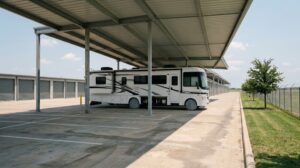
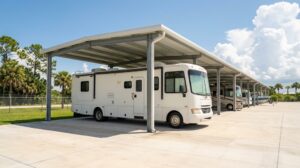
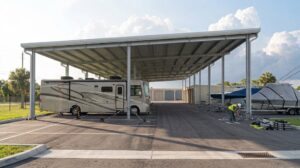
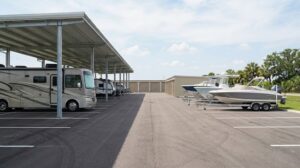
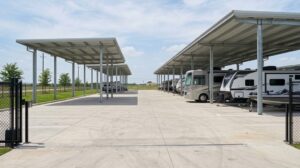
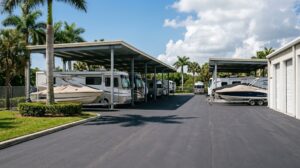
Covered storage adds a roof over the space while leaving the sides open. This is where the cover-versus-storage math shifts, because a roof that does not degrade replaces the single biggest job a cover does: blocking direct sun and most rain. In high-UV states, covered storage eliminates the need for a cover entirely, since the roof handles UV and the open sides allow airflow that prevents moisture buildup. Covered storage typically runs $100 to $300 a month.
Enclosed storage
Enclosed storage places the RV inside a fully walled and gated unit, protected from sun, rain, dust, prying eyes, and theft. It is the highest level of protection available and the right choice for higher-value rigs, long-term storage, and severe-weather markets. A cover inside an enclosed unit is unnecessary. Enclosed storage typically runs $150 to $500 or more a month, depending on size and market.
The cost over time
The upfront comparison favors a cover: $200 to $600 versus a monthly bill. But covers are consumables. A $400 cover that lasts 3 years costs about $11 a month in replacement value, and that does not include the time spent installing and removing it. Covered storage at $150 a month costs more in dollars, but it provides permanent, hassle-free, facility-grade protection that a cover cannot match. The question is which cost you are willing to carry: a lower dollar amount with recurring hassle and degrading protection, or a higher dollar amount with zero hassle and consistent protection. For owners of higher-value rigs, in harsh climates, or who use the RV frequently, storage usually wins that math within a season or two.
What to look for in a storage facility
Not all storage is equal. The features that separate a good facility from a spot that merely holds the trailer:
- Gated access you can verify from your phone; app control that shows whether the gate is locked, not just a keypad code shared with every tenant.
- Cameras covering the actual storage rows, not just the entrance, since that’s where a cover would otherwise be your only theft deterrent.
- No long-term contract required; the whole point of comparing storage to a cover is flexibility, so month-to-month terms should carry over to the facility choice too.
- Access hours that match your travel habits, especially if you tend to leave before sunrise for a long tow.
- A unit sized for your specific rig, not just “big enough”; measure the same way you would for a cover, bumper to bumper including any overhang.
Compare Cover Cost to Storage Cost
RecNation offers outdoor, covered, and enclosed RV storage across multiple US, including Arizona, California, Florida, and Texas, with all of the above: 24/7 gated access, video monitoring, app-based gate control, and month-to-month terms. Check the RV dimensions guide to confirm the right unit size for your rig.
Search RV storage near you to compare real pricing against the cost of a quality cover.
Frequently Asked Questions
What is the best material for an RV cover?
It depends on your climate. Olefin HD and UV-treated covers are best for high-sun states like Arizona and Texas. Tyvek and SFS AquaShed covers are best for wet and snowy climates. Ripstop polyester is the most durable all-around option. Polypropylene is the budget choice but degrades fastest under UV.
Are RV covers a good idea?
Yes, for the right situations. An RV that sits outside without any protection will degrade faster than one that is covered or stored under a roof. A quality, well-fitted cover provides meaningful protection from sun, rain, and debris. The main tradeoffs are the installation hassle on larger rigs, the need to replace the cover every few years, and the fact that covers degrade while a storage roof does not.
How long should an RV cover last?
Most RV covers last 1 to 5 years depending on the material and your climate. Single-layer polypropylene covers in high-UV states may last only 1 to 2 seasons. Multi-layer and UV-treated covers typically last 3 to 5 years. Ripstop polyester with a lifetime limited warranty can last longer, though the warranty terms vary by manufacturer.
Are ADCO RV covers good?
ADCO is one of the most established RV cover manufacturers, in the business since 1955. Their SFS AquaShed line is well regarded for wet climates, and their Olefin HD and UV Hydro lines are designed for high-sun environments. Forum reviews range widely, with some owners getting 5 to 7 years and others reporting faster degradation, which usually correlates with UV intensity and how well the cover fits.
Is it better to cover an RV or store it?
A cover is the better choice when budget is tight, the RV is small enough to cover easily, or you store at home. Covered or enclosed storage is the better investment when the RV is large, the climate is harsh, you use the rig frequently, or you want protection that does not degrade. In high-UV climates, the cumulative cost of replacing covers every 2 to 3 years can approach the cost of monthly storage.
What size RV cover do I need?
Measure the full length of your RV from bumper to bumper, including the tongue and any overhangs, and round up to the nearest cover size. Match the cover to your RV type (travel trailer, fifth wheel, Class A, B, or C) since each is cut differently. If you have slide-outs, confirm the cover’s width accommodates them retracted.