Professional boat shrink wrapping runs $17 to $19 per foot depending on boat length, with the total varying based on add-ons and whether the boat is still in the water.
This article covers per-foot pricing by boat size, what inflates a professional quote, the honest DIY calculation including the first-year cost barrier, and the point at which indoor storage undercuts wrapping on cost. The numbers below give you a framework to run the same comparison for your own boat.
What Professional Boat Shrink Wrapping Costs
Professional shrink wrap services quote a job by the foot, and the rate shifts with boat length. According to Boatzon’s 2026 cost breakdown, one Minnesota and Wisconsin mobile service charges the following rates as of September 2026:
- Boats up to 19 feet: $17 per foot
- Boats 20 to 29 feet: $18 per foot
- Boats 30 to 39 feet: $19 per foot
Boatzon puts typical regional shop pricing at $17 to $19 per foot, though local market conditions affect individual quotes. These figures are for the shrink wrap installation itself and do not include add-ons covered below, and since they are estimates from a single source, it helps to confirm current rates with the specific service.
What Gets Measured in Your Quote
The footage used to calculate your quote is not the hull’s nominal length. The measured length includes the swim platform, pulpit, and motor, not just the hull. A boat listed as 24 feet can therefore be quoted at a longer length, which is a frequent source of sticker shock when the invoice arrives.
Add-Ons That Raise the Price
Two add-ons materially increase what a professional shrink wrap service charges. Leaving a sailboat mast up adds $2 to $3 per foot to the total, and wrapping a boat that is still in the water can add $100 to $150 to the job. Both figures come from Boatzon’s September 2026 data.
The DIY Reality: First Year vs. Later Years
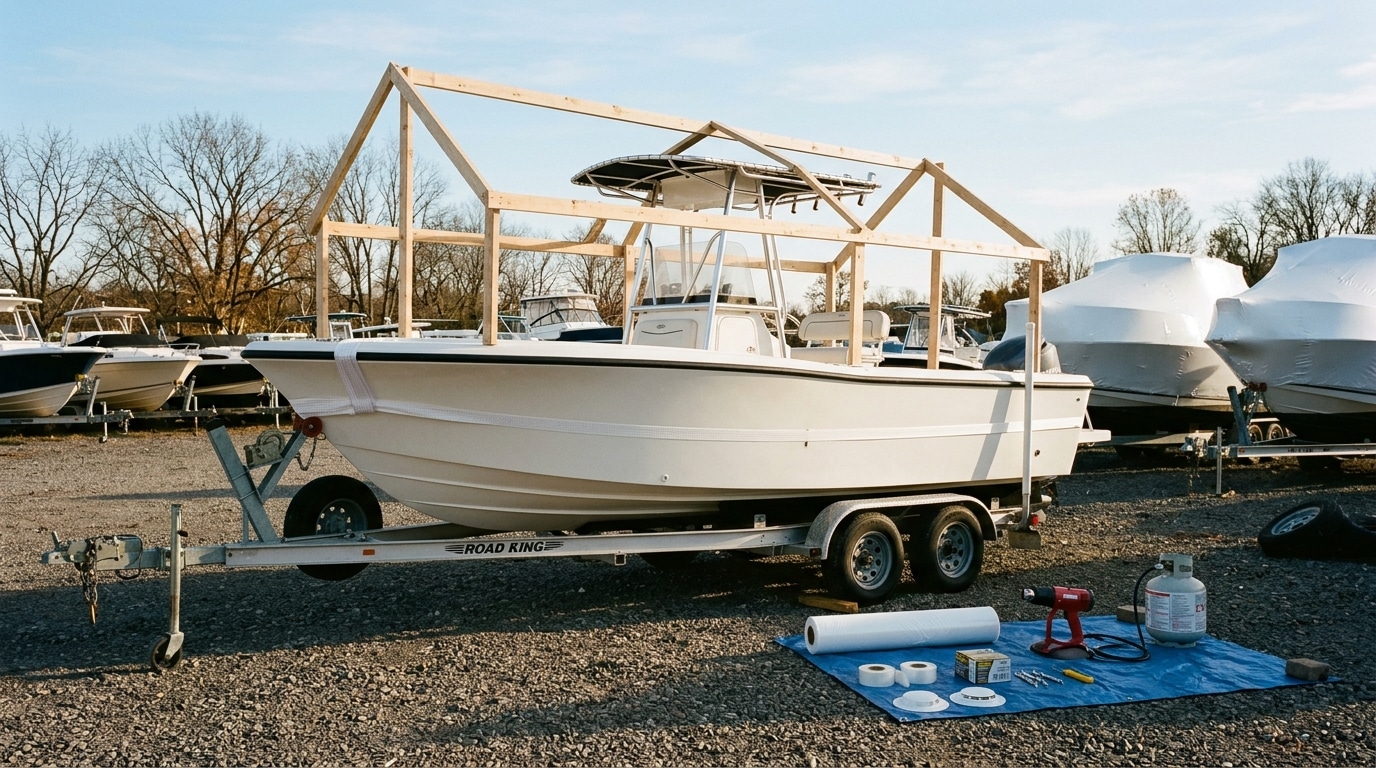
DIY shrink wrapping can cost less than hiring out once you have done it a season or two, but the first year is a different story. Before you apply a single sheet of polyethylene film, you need a heat gun, support structures to tent the film properly, shrink wrap tape, and other supplies on top of the shrink wrap film itself. Those startup costs mean your first-year total can approach or exceed what a professional would have charged.
The economics shift in year two and beyond, because the heat gun and support structures are already owned and reusable.
Shrink wrap is one piece of winterization, and winterizing a boat properly is a useful next read for the mechanical side of layup. Owners comparing it against other seasonal protection can weigh it against boat covers as a winter boat cover alternative.
Ventilation Is Not Optional
Shrink wrap film limits airflow below deck by design. That tight seal is what makes it effective against snow, ice, and debris, but it also traps moisture if venting is not installed as part of the job. Skipping vents creates conditions for moisture and mildew buildup inside the hull, which can damage upholstery, woodwork, and electrical systems over a full winter layup. Any wrap job needs venting, whether done professionally or by the owner.
When DIY Starts to Pay Off
After the first year, the recurring cost is film, shrink wrap tape, and consumable supplies. That is when DIY begins to deliver real savings over hiring a professional shrink wrap service each season. An owner who wraps the same boat for three or four winters amortizes the first-year equipment cost across multiple seasons, making the long-run economics much more favorable than the first-year comparison suggests.
The Cost Comparison: Shrink Wrapping vs. Indoor Storage
Running the numbers side by side is the most direct way to see which option fits your situation. Here is a worked example, labeled as an estimate, using the figures above.
A 24-foot boat falls in the 20 to 29-foot pricing tier. At $18 per foot and using the nominal hull length, professional shrink wrap installation costs an estimated $432 for the season. That figure covers the wrap itself and does not include any add-ons or the spring shrink wrap removal visit.
RecNation offers boat storage at 70 facilities across eight states, with indoor garage spaces running $114 to $216 a month as of October 2026. Prices vary by location, size, and availability, so it helps to confirm current rates with the specific facility.
Here is how indoor storage compares with the $432 wrap on that 24-foot boat, by length of layup:
- Two-month layup: $228 to $432, at or below the wrap.
- Three-month layup: $342 to $648.
- Four-month layup: Roughly $456 to $864 for the season. Once the layup reaches four months, even the lowest rate in the range costs more than the wrap on this boat.
Indoor storage also adds a few things the wrap does not:
- No film to buy: There is no shrink wrap film at all.
- No installation labor: Nothing to schedule or pay for at the start of the layup.
- No spring removal: There is no removal visit to schedule.
- Protection: It offers ultraviolet (UV) protection, along with protection from precipitation and wind, which matters for owners whose primary concern is hull and cover condition over a long layup.
The math shifts depending on how many months your boat sits and whether you are in year one of DIY or a later repeat year. For what to budget across the full winter season, boat storage costs by season breaks down the range by storage type.
Running the Numbers for Your Boat Size
Apply the same math to your own boat in three steps:
- Find your per-foot rate: Use the pricing tier that matches your boat. Up to 19 feet is $17 per foot, 20 to 29 feet is $18 per foot, and 30 to 39 feet is $19 per foot.
- Calculate the wrap cost: Multiply that rate by your measured footage, which includes the swim platform, pulpit, and motor, not the nominal hull length.
- Compare it with storage: Set that single-season wrap cost against the monthly storage rate multiplied by the number of months you store. Then factor in whether you are in year one of DIY, where the equipment investment raises your true cost, or a repeat year where the ongoing cost is film and supplies only.
Choosing the Right Winter Protection for Your Boat
No single answer fits every boat owner, because the right choice depends on how long your boat sits, where it is stored, and what you have already invested in winterization equipment. Any boat going into storage, wrapped or indoor, benefits from preparing a boat for storage properly beforehand. For owners who want a closer look at enclosure, indoor boat storage lays out why some owners make the switch.
It helps to weigh these variables when making your decision:
- Layup length: On the 24-foot example, a layup of two to three months can cost less in storage than the wrap, while a longer layup adds up month by month and favors the wrap on price alone.
- Access between trips: A frequent-use boat benefits from easy access between trips, which indoor storage offers more readily than a sealed wrap.
- Vessel size: Larger boats cost more per season to wrap professionally, because wrapping is priced by the foot, which moves the break-even toward storage.
- DIY equipment owned: Owners who already own a heat gun, support structures, and shrink wrap tape from prior seasons have already absorbed the year-one barrier and may find DIY the more practical choice.
- Local storage availability: When indoor storage is not available in your area, wrapping is often the practical choice for outdoor boat storage at a marina or yard.
When Shrink Wrapping Makes More Sense
Wrapping is the practical choice when the boat is stored outdoors at a marina or yard with no indoor option nearby, when the owner has already invested in DIY equipment from prior seasons, or when the layup is long enough that the monthly storage math does not favor renting a space. It also suits a boat that needs a sealed barrier against snow, ice, and debris in an exposed outdoor location.
When Indoor Storage Makes More Sense
Indoor storage becomes the stronger option when the owner wants full enclosure without an annual film purchase, wants to skip the labor of installation and removal, or stores a larger vessel where per-foot wrapping costs add up quickly. A shorter layup can also come in under the wrap on price, and easy access between trips is another point in its favor. For the full cost context across a winter season, winterizing and storing a boat covers both sides of that expense.
Find Indoor Boat Storage at 70 Facilities
If the annual cost of professional wrapping or the first-year investment in DIY equipment tips the balance toward a permanent solution, RecNation provides boat storage at 70 facilities across eight states, with indoor garage spaces starting at $114 a month as of October 2026. For a shorter layup, that monthly rate can work out to less than a single professional wrap job, with no film to buy, no heat gun to manage, and no removal appointment to schedule in spring. For longer layups, the monthly rate adds up, so run the numbers for your own boat length and number of months before you decide. Prices vary by location, size, and availability.
Frequently Asked Questions
How much does it cost to shrink wrap a boat?
Professional boat shrink wrapping typically costs $17 to $19 per foot at regional shops. One Minnesota and Wisconsin mobile service charges $17 per foot for boats up to 19 feet, $18 per foot for 20 to 29-foot boats, and $19 per foot for 30 to 39-foot boats, based on Boatzon’s September 2026 pricing data. For a 24-foot boat at $18 per foot, that works out to an estimated $432 for the season, before any add-ons.
Is it better to shrink wrap a boat or use a boat cover?
Shrink wrap creates a tighter, sealed barrier against snow, ice, and debris, which suits cold-weather storage in exposed outdoor locations. A fitted boat cover is reusable season after season, so it can cost less over time for a boat in a sheltered or indoor space. The right choice depends on where the boat sits and how long the layup lasts.
What adds to the cost of a professional boat shrink wrap job?
Beyond the base per-foot rate, a mast left up on a sailboat adds $2 to $3 per foot, and wrapping a boat that is still in the water can add $100 to $150, per Boatzon’s September 2026 data. Quotes are also built on measured length, which counts the swim platform, pulpit, and motor, so the billable footage can run past the hull’s stated length.
When does indoor storage cost less than annual shrink wrapping?
It depends on the boat’s length and how many months it sits. On a 24-foot boat, a two-month layup in indoor storage costs $228 to $432 at $114 to $216 a month (as of October 2026, prices vary by location and availability), which is at or below the $432 wrap, while a four-month layup costs $456 to $864 and exceeds it. Owners in year one of DIY are still absorbing equipment costs, so the comparison also shifts with how many seasons they have wrapped.
Does boat shrink wrap need ventilation?
Boat shrink wrap needs ventilation because the film limits airflow below deck. Vents are part of any wrap job, professional or DIY, since a sealed hull traps moisture and invites mildew that can reach upholstery, woodwork, and electrical systems over the layup.
How long does boat shrink wrap last?
Boat shrink wrap is designed as a single-season cover and is typically removed in spring before the boat returns to the water. It is not reusable after removal, so owners who choose this method pay for new film each winter.