Driveway storage is free, and that’s exactly what makes it tempting. But “can I just leave it in the driveway?” doesn’t have one answer; it depends on what you’re storing, how long it sits, and where in Florida you actually live. In Sarasota, that last part changes everything. The Gulf Coast climate stacks salt air, a UV index that runs above 10 from April through October, and summer humidity that sits above 80 percent, and none of that is doing your vehicle any favors.
Put those three together, and you get real, measurable damage to anything stored outdoors without mitigation, cars, boats, RVs, all of it. This guide gives you the honest version so you can make the call yourself.
What Sarasota’s Climate Actually Does to a Vehicle Stored Outside
Sarasota weather isn’t just “hot and sunny.” The city’s Gulf Coast position creates a specific combination of environmental stressors that compounds faster than most vehicle owners expect, well beyond what inland Florida cities deal with, which is mostly just heat and rain. Sarasota adds salt-laden air from the Gulf, sustained coastal humidity, and Florida sun exposure intense enough to degrade materials built to last years.
Salt Air Corrosion on the Gulf Coast
Salt air corrosion is the first thing Sarasota’s coastal location adds that inland Florida doesn’t have to deal with. Sarasota’s downtown sits less than two miles from Sarasota Bay, with Gulf exposure beyond, and that proximity places vehicles in an accelerated corrosion zone defined by airborne chloride deposits carried on Gulf breezes. The ASTM B117 salt spray standard is the industry reference for measuring coastal corrosion risk, and the exposure levels in coastal Southwest Florida place vehicles in a high-corrosion category.
The components most affected:
- Brake lines
- Trailer frames
- Boat hardware
- Exposed undercarriage fasteners
- Exhaust components
Salt air corrosion is cumulative and mostly invisible until it becomes a repair bill, a trailer frame that looks fine after one Sarasota summer may show significant rust and oxidation by year three.
UV Exposure and Paint Fade in Florida Sun
Sarasota’s UV index averages 10 to 11 from April through October, a range the EPA UV Index Scale classifies as “very high,” the second-highest category on the scale.
At this intensity, unprotected surfaces degrade fast:
- Automotive paint: Begins fading within a single outdoor season.
- Boat gel coat: Oxidizes noticeably within one to two years of full exposure.
- Rubber seals: Deteriorate faster on RV slide-outs, roof seams, and boat hatch gaskets.
Even a quality car cover slows UV degradation but doesn’t stop it entirely, because the cover itself degrades under sustained Florida sun exposure and loses effectiveness over time.
Humidity, Mold, and What Happens Inside a Sealed Vehicle
Humidity is the third compounding factor, and it’s specifically a problem for anything sealed up rather than driven regularly. Sarasota’s summer relative humidity consistently exceeds 80 percent, and inside a sealed, unventilated vehicle parked in a driveway, that moisture has nowhere to go.
Mold and mildew growth can begin within a few weeks of parking a boat or RV without active ventilation, showing up in:
- Carpeting
- Upholstery
- Cabinetry
Temperature fluctuations between Sarasota’s hot days and cooler nights create condensation cycles inside sealed compartments. For RV owners and boat owners, this means moisture accumulating around electronics, wiring, and cabinetry over time, and the interior damage from coastal humidity is often more expensive to remediate than the exterior deterioration.
When Driveway Storage Is Actually Fine (And When It Isn’t)
Not every vehicle in every Sarasota driveway is heading toward a repair bill. Driveway storage works for some situations and fails badly for others, and figuring out which one you’re in starts with the specific vehicle and how often you actually use it. If you want the fuller breakdown, is vehicle storage worth it walks through that exact tradeoff.
| Driveway Works | Driveway Causes Problems | |
| Vehicle Type | Daily-driver car or truck | Boat, RV, trailer, collector car, motorcycle |
| Storage Duration | Days to 2 weeks | More than 2 to 3 weeks without use |
| Use Frequency | Driven multiple times per week | Sits unused for weeks or months |
| HOA Status | No HOA or deed restriction | Governed by an HOA |
| Vehicle Value | Utilitarian, replaceable | Collector, classic, or high-value recreational |
The Case for Leaving a Daily Driver in the Driveway
A regularly used car in a Sarasota driveway is not going to suffer catastrophic damage, especially if you wash off salt deposits monthly and park in the shade where possible. Movement prevents moisture buildup.
You notice problems quickly because you see the vehicle every day. For a car used several times a week, a driveway is genuinely adequate with basic upkeep.
Vehicles That Take the Most Damage from Driveway Exposure
Once you’re talking about anything that doesn’t move for weeks at a time, Sarasota’s coastal conditions stop being a minor inconvenience and start being a real cost. Some vehicle types are categorically more vulnerable than others:
- Boats on trailers: Hull and marine hardware sit exposed to salt air and UV damage around the clock.
- RVs and campers: Rubber roof seals, slide-out seals, and interior compartments absorb coastal humidity without active ventilation.
- Classic and collector cars: Paint, chrome trim, and original interiors oxidize and fade faster than modern clearcoat finishes.
- Motorcycles stored seasonally: Fuel systems and batteries degrade quickly when combined with sustained heat and humidity levels above 80 percent.
For any of these, the driveway is not a neutral choice. It is a slow-moving cost.
HOA Rules and Sarasota County Ordinances: The Driveway May Not Be Your Choice
For many Sarasota-area homeowners, the driveway storage question isn’t really about vehicle damage. It’s about whether driveway storage is even legal, and for most Sarasota subdivision residents, it isn’t.
What Sarasota HOAs Can Actually Fine You For
Florida Statute §720.305 gives HOAs legal authority to issue written notices of violation and impose fines after a cure period expires. The process works like this:
- Notice period: At least 14 days’ written notice before a hearing.
- Fine cap: $1,000 in the aggregate per violation by default, unless an HOA’s own governing documents authorize a higher amount.
- Most-cited violations: Boats on trailers parked in the driveway, RVs or campers visible from the street, and commercial vehicles in residential driveways.
Nearly every planned community in Sarasota prohibits driveway storage of boats and RVs. If you’ve received a violation notice, the cure period is the starting point, not the deadline, fines begin once that window closes.
Sarasota County Rules If You Don’t Have an HOA
No HOA doesn’t mean no restriction. Sarasota County’s Zoning Regulations (Appendix A, Article 7, Section 7.1) restrict extended parking and storage of recreational vehicles, boats, and trailers on residential lots in unincorporated areas, even without a deed restriction or HOA agreement. Many residents assume that owning their land outright means they can store whatever they want; that assumption isn’t accurate in Sarasota County.
The Real Cost Comparison: Driveway vs. a Storage Facility in Sarasota
The “free driveway” calculation changes when you factor in HOA fines, environmental damage repair costs, and what comparable storage alternatives actually cost per month. For a fuller breakdown of what vehicle storage runs in this market, the vehicle storage cost guide gives a useful baseline.
| Storage Option | Estimated Monthly Cost | Key Risks or Limitations |
| Open driveway | $0 | HOA fines, environmental damage, county ordinances |
| Home carport or canopy | One-time cost, amortized | Partial UV and rain protection only; no humidity control |
| Sarasota marina wet slip | $12 to $20+ per linear foot | Costs scale with boat length; ongoing exposure to salt water |
| Covered outdoor vehicle storage facility | Varies by size and location | Addresses UV and rain; does not control interior humidity |
| Climate-controlled indoor storage unit | Higher monthly rate | Full protection from humidity, UV, and temperature fluctuations |
Florida law caps HOA fines at $1,000 for a single continuing violation, accruing at up to $100 per day, and that ceiling alone can cover several months of covered storage at most Sarasota-area facilities, which reframes the ‘free driveway’ calculation entirely.
What You’re Actually Paying for With Covered vs. Indoor Storage
The right tier here comes down to what you’re actually protecting against, weather on the outside, or humidity and temperature swings getting to the inside:
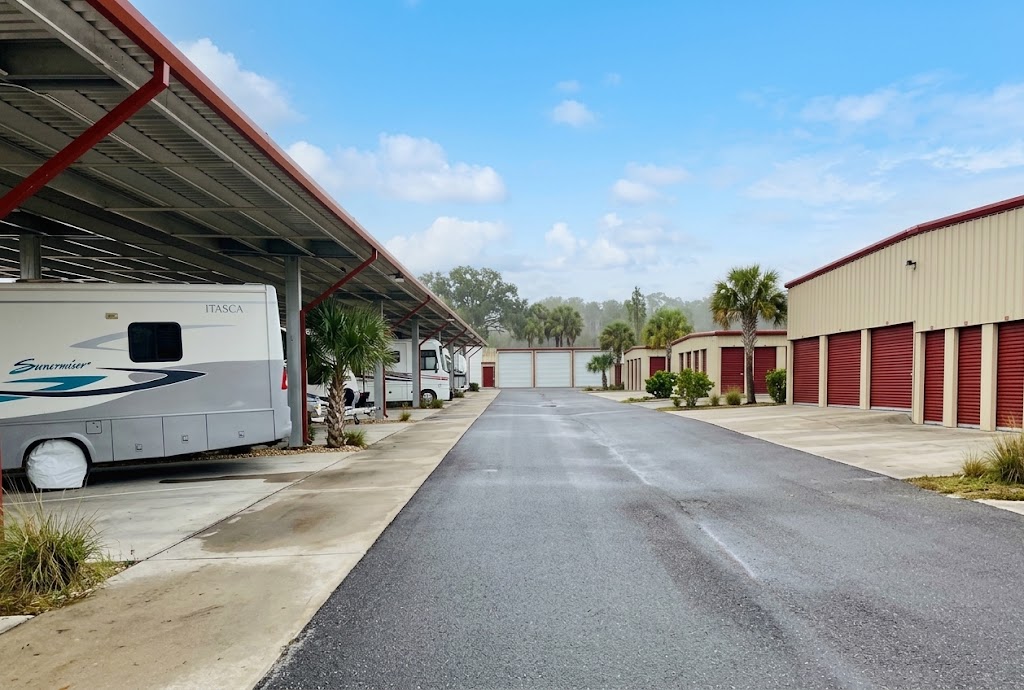
- Covered outdoor parking: Protects against direct UV damage and rain, but doesn’t control humidity levels or temperature fluctuations inside sealed compartments. For a boat hull or an RV shell, this offers meaningful long-term vehicle protection at a lower cost than an enclosed unit.
- Climate-controlled indoor storage: Addresses the condensation cycles and coastal humidity that cause the most expensive interior damage, worth the premium for a classic car or an RV with a furnished interior.
You can read more about the specific trade-offs in covered outdoor storage vs. street parking.
RecNation’s nearest facility, about 65-75 miles south in Fort Myers, offers both covered outdoor parking and enclosed storage options sized for boats, RVs, and vehicles, worth comparing against the drive time for your situation.
Practical Steps If You’re Keeping a Vehicle in a Sarasota Driveway
If you have decided to use your driveway, either temporarily or because your vehicle type and HOA status make it workable, these steps reduce the damage that Sarasota’s coastal conditions cause. They will not eliminate the risk, but they will make a meaningful difference. For more protection options, carport and covered storage are worth reviewing alongside these mitigation steps:
- Use a UV-resistant car cover rated for coastal conditions: Look for a cover with a UPF 50+ rating, breathable construction to prevent moisture trapping underneath, and a secure elastic hem or tie-down system for storm and hurricane season wind events.
- Wash salt deposits off the exterior and undercarriage at least monthly: In fall and winter, Gulf winds shift direction and deposit more airborne chloride, so increase washing frequency during those months.
- Place desiccant packs or a portable dehumidifier inside RV or boat compartments: Active moisture control is the only way to address interior humidity levels in a sealed, unventilated compartment.
- Apply UV protectant to rubber seals, tires, and exterior trim at least twice per year: Rubber seal deterioration accelerates significantly above a UV index of 8, which Sarasota exceeds for six months of the year.
- Inspect the undercarriage, trailer frame, and brake components every 60 to 90 days: Rust and oxidation from salt air corrosion develop slowly but become structural problems if caught late.
- Stabilize the fuel system and maintain the battery if the vehicle will sit unused for more than 30 days: Heat and coastal humidity accelerate fuel degradation and battery discharge faster than in non-coastal climates.
Choosing the Right Cover for Coastal Florida Conditions
A standard car cover designed for mild climates will degrade faster than the vehicle it is protecting under Sarasota’s Florida sun exposure. Look for covers rated UPF 50+ or equivalent for UV protection.
Breathability matters as much as UV rating: a non-breathable cover traps moisture against the paint, accelerating mold and mildew growth underneath. Secure tie-downs or a fitted elastic hem are not optional during storm and hurricane season in Southwest Florida.
What This Actually Means for Your Sarasota Driveway
Every mitigation step above buys you time; it doesn’t buy you out of Sarasota’s climate. Salt air, UV, and humidity keep working on a vehicle whether you’re maintaining it diligently or not, and at some point the math flips from “manageable with effort” to “cheaper to just stop fighting it.”
RecNation’s nearest facility, in Fort Myers, offers covered and enclosed options built for boats, RVs, and recreational vehicles, the categories that take the most punishment from coastal conditions in the first place. Whether you’re storing seasonally or need a permanent fix for an HOA violation, it’s one less thing actively working against your vehicle every day it sits in the driveway.
Frequently Asked Questions
Is it bad to leave your car in the driveway in Sarasota’s humidity?
Leaving a car in a Sarasota driveway isn’t inherently bad; it depends on how often it’s used. For a daily driver used several times per week, a Sarasota driveway is acceptable with basic maintenance like monthly washing and UV-protectant application. For vehicles stored longer than two to three weeks without use, Sarasota’s coastal humidity, consistently above 80 percent in summer, creates a real risk of mold and mildew growth inside sealed compartments, rubber seal deterioration from UV exposure, and accelerated rust and oxidation from salt air deposits. The risk compounds the longer the vehicle sits unused.
How does Florida coastal humidity affect a car stored outside?
Florida’s coastal humidity affects a car stored outside by accelerating moisture infiltration into the vehicle’s interior once sustained relative humidity climbs above 80 percent, causing mold and mildew growth in carpeting and upholstery, condensation damage to electronics, and corrosion on exposed metal components. In Sarasota specifically, salt air corrosion compounds humidity effects on undercarriage hardware and brake components, and remediation costs for that combination typically run higher than a straightforward exterior repaint or reseal job.
What are the benefits of using a climate-controlled storage facility in Sarasota?
A climate-controlled storage facility in Sarasota benefits a vehicle by maintaining stable temperature and humidity levels year-round, which prevents the condensation cycles that cause mold, mildew, and interior corrosion in the region’s subtropical climate. It also shields the vehicle from UV damage and salt air exposure. For vehicles stored longer than a month, the cost of a climate-controlled unit is typically less than a single repair cycle addressing humidity- or UV-related damage.
Does UV exposure in Florida cause more car damage than in other states?
Yes, UV exposure in Florida causes measurably more car damage than in most other states. Florida’s Gulf Coast UV index reaches 10 to 11 from April through October, a level the EPA classifies as “very high,” compared to a summer average of 6 to 7 in most northern states. At this UV intensity, unprotected automotive paint, vinyl trim, and rubber seals degrade at a rate that causes visible car paint fading and cracking within a single outdoor storage season rather than over several years.
Can I store a boat or RV in my driveway in Sarasota?
Storing a boat or RV in a Sarasota driveway depends on your HOA status and county zoning. Most Sarasota-area subdivisions governed by an HOA prohibit driveway storage of boats, trailers, and RVs under Florida Statute §720, which gives HOAs authority to issue violation notices and compound fines after the cure period. Even without an HOA, Sarasota County’s zoning regulations restrict extended trailer and RV parking on residential lots. Check your deed restrictions and county zoning code before assuming driveway storage is permitted.
How much does vehicle storage cost at a Sarasota storage facility?
Vehicle storage at a Sarasota facility costs less for covered outdoor parking than for indoor climate-controlled units, though climate-controlled options address humidity levels and temperature fluctuations that cause interior and mechanical damage. For boats, a covered storage unit at a vehicle self-storage facility is typically significantly less expensive per month than a wet slip at a Sarasota-area marina, which can run $12 to $20 per linear foot or more. Check current availability directly with local facilities for accurate rate comparisons.