In Sarasota, the protection gap between covered and enclosed storage is materially larger than it is in a dry inland climate. Subtropical humidity, Gulf Coast salt air, and a six-month hurricane season each stress-test your vehicle differently depending on which storage tier you choose.
This article matches storage type to vehicle category and idle duration, so you leave with a defensible decision rather than a generic “enclosed is better” conclusion.
What Covered and Enclosed Storage Actually Mean
Covered and enclosed storage describe two fundamentally different environments, even though facility websites often use the terms interchangeably. Carport and covered storage means the structure is open-sided; enclosed storage means the vehicle is physically sealed from the outside.
What “Covered” Storage Includes (and Doesn’t)
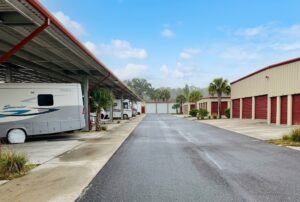
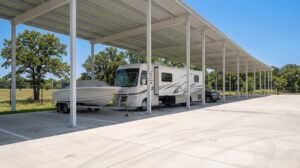
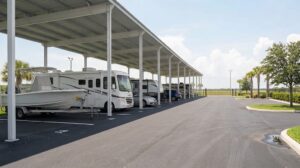
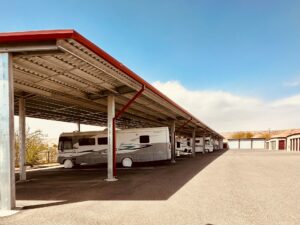
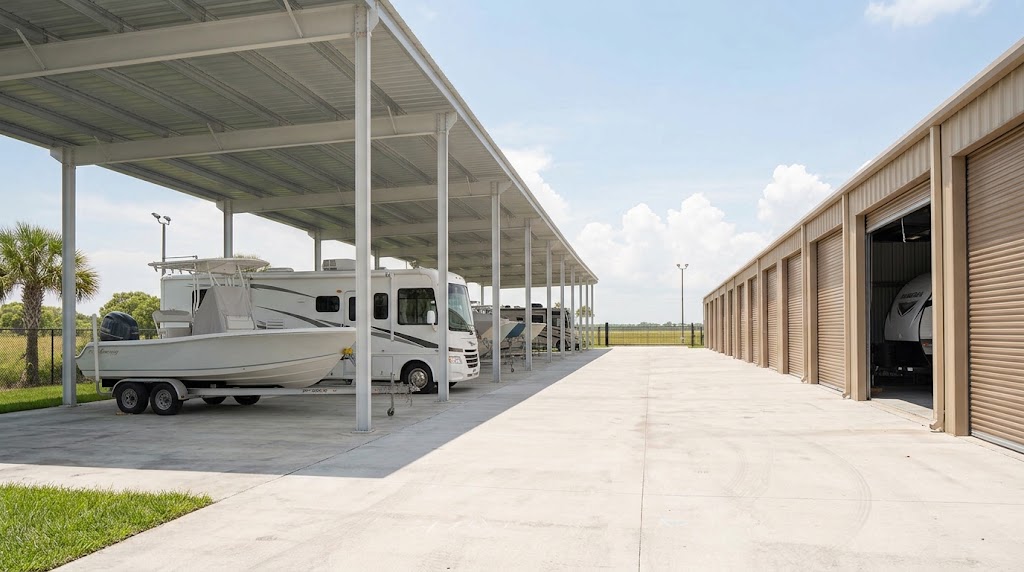
Covered storage is a roofed structure on posts, typically metal or fabric, with open sides. Here’s what that does and doesn’t protect against:
- Blocks: Direct sun and vertical rain.
- Does not block: Wind-driven rain, airborne salt, or humidity.
- Security add-on: Some covered facilities include perimeter fencing and gated access, which improves security, but the individual bays themselves remain open to outdoor air and whatever it carries.
What “Enclosed” Storage Includes (and Doesn’t)
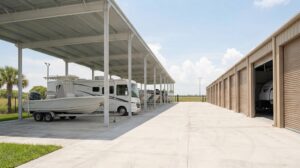
Enclosed storage is a fully walled unit with a roll-up or swing door and a lockable seal, similar to a large self-storage unit sized for vehicles. Here’s what that does and doesn’t guarantee:
- Isolates: Outdoor air, debris, and wind, the vehicle is physically sealed off. For a deeper breakdown of what these units include structurally, see enclosed vehicle storage.
- Does not guarantee: Climate control. Many enclosed vehicle units in Florida are non-conditioned, which creates its own risk profile explained in the next section.
| Feature | Covered Storage | Enclosed Storage |
| Roof | Yes | Yes |
| Walls | No (open-sided) | Yes (four walls) |
| Door and lock | No individual bay lock | Yes, rollup or swing door |
| Ventilation | Continuous outdoor airflow | Sealed; no natural ventilation |
| Climate control available | No | At some facilities only |
| Typical price tier | Lower | Higher |
How Sarasota’s Climate Stress-Tests Each Storage Type
Sarasota’s environment isn’t a generic “humid” climate. It sits on the Gulf Coast with year-round subtropical humidity, airborne salt that travels miles inland, and a six-month storm season, and each of these three threats hits covered and enclosed storage differently. For a fuller picture of how climate shapes every storage decision, the ultimate guide to vehicle storage covers these variables across vehicle categories.
Humidity and Mold Risk
Humidity above 70 percent relative humidity is the threshold where mold becomes a real threat, and Sarasota sits above that threshold year-round. NOAA climate data for the Sarasota/Bradenton station (USW00012842) shows relative humidity averaging 74 to 80 percent, not seasonally, but as a baseline condition from January through December. At that level, mold spores can colonize organic materials, including canvas awnings, upholstery foam, wood cabinetry, and carpet, within 24 to 72 hours.
Covered and enclosed storage handle that humidity very differently:
- Covered storage: Tracks outdoor humidity almost exactly, since the open-sided bays let your vehicle’s interior breathe the same 78 percent air Sarasota sees on a typical August afternoon.
- Non-climate-controlled enclosed storage: Seals that humid air inside a metal box, which can trap moisture on stagnant days and produce worse conditions than a ventilated covered bay.
- Climate-controlled enclosed storage: The only tier that actively manages humidity through temperature regulation, the only configuration that reliably prevents mold and mildew for a vehicle idle more than 30 days during summer months.
Moisture control isn’t a convenience feature in this market. It’s maintenance prevention.
Salt Air and Corrosion
Airborne salt from the Gulf travels several miles inland and deposits on every exposed surface, and it doesn’t just cause discoloration, it accelerates galvanic corrosion that eats through metal fittings and electrical connections over months of idle storage. The materials most at risk:
- Aluminum trailer frames
- Copper wiring in marine electrical systems
- Chrome fittings
- Stainless steel hardware
- Rubber seals
Covered storage offers no barrier to salt-laden air, the open sides mean continuous exposure for the full storage period. Enclosed storage reduces salt contact significantly by sealing the vehicle from outdoor air, though non-climate-controlled units that are opened regularly still let salt air in and let it linger. For vehicles stored through multiple months without being moved, corrosion and rust risk drops meaningfully in an enclosed environment.
Hurricane Season and Wind-Driven Rain
Sarasota’s hurricane season runs June through November, and it’s where the protection gap between covered and enclosed storage is largest. Tropical storms produce sustained winds of 40 to 73 mph with rain driven horizontally, bypassing an open-sided roof entirely, and a Category 1 hurricane pushes that to 74 to 95 mph gusts. At those speeds, covered storage offers near-zero incremental protection compared to open-air parking, the roof stays, your vehicle gets soaked.
Enclosed storage with a properly sealed door provides a real physical barrier to wind-driven rain and airborne debris, the minimum viable tier if you’re leaving a vehicle unattended during hurricane season. For boats stored near waterfront areas, check your facility’s elevation against FEMA Flood Map Service Center data for Sarasota County, since ground-level storage in certain flood zones carries additional risk independent of the roof above it.
Which Storage Type Is Right for What You’re Storing
The right tier depends on what you’re storing and how long it will sit. The table below gives you a starting point. The sections that follow explain the reasoning for each category. You can also browse RV and boat storage options in the broader Southwest Florida region.
| Vehicle Type | Covered Acceptable? | Recommended Minimum | Notes |
| Boat (60+ days idle) | No | Enclosed or climate-controlled | Marine electrical corrosion, canvas mold |
| Boat (active season, weekends) | Yes | Covered | Short gaps between uses |
| RV or motorhome (30+ days) | No | Enclosed non-climate-controlled | Climate-controlled for summer absences |
| Classic or collector car | No | Climate-controlled enclosed only | Paint, chrome, rubber gasket integrity |
| Daily driver (under 30 days) | Yes | Covered | Seasonal short-term use |
| ATV, motorcycle, jet ski (multi-season) | No | Enclosed | More than one season idle |
Boats and Marine Watercraft
For boats idle more than 60 days, enclosed storage is the minimum recommended tier. Here’s what’s actually at risk in a covered bay:
- Marine electronics: Corrode quickly under sustained salt air exposure.
- Canvas covers: Grow mold and mildew within weeks in Sarasota’s humidity.
- What covered storage misses: An open-sided bay keeps rain off the hull, but does nothing for the wiring below deck or the upholstery inside the cabin.
If your boat sits through summer, climate-controlled enclosed storage is the better choice.
For active-season boats stored between weekend uses, covered storage is acceptable, you’ll be moving the boat frequently enough that brief outdoor air exposure is manageable. Keep a quality cover on it and check for mold on canvas surfaces every few weeks.
RVs and Motorhomes
Enclosed non-climate-controlled storage is the minimum recommended tier for any recreational vehicle (RV) or motorhome stored more than 30 days. Here’s what sustained exposure actually does:
- Slide-out seals: Degrade faster under sustained UV and humidity exposure.
- Roof membrane adhesives: Soften in prolonged heat.
- Interior materials: Still absorb ambient humidity in a sealed but non-conditioned unit if temperatures spike and condensation forms on surfaces.
For Class A motorhomes with residential-style interiors, solid wood cabinetry, leather seating, or owners who leave the area during summer peak humidity months, climate-controlled enclosed storage is the right call. RecNation’s nearest facility, about 65-75 miles south in Fort Myers, offers both covered and enclosed options if the drive works for your situation.
Classic Cars and High-Value Vehicles
Covered storage is not appropriate for any vehicle where original paint, chrome, or rubber integrity is a preservation priority. Here’s why:
- Original finishes and chrome trim: Salt air deposits cause damage that’s expensive and sometimes irreversible.
- Rubber door gaskets and window seals: Degrade faster under sustained Gulf Coast climate humidity.
For detailed guidance on long-term preservation, see storing a classic car long-term.
Climate-controlled enclosed storage is the only appropriate tier for classic and collector cars in Sarasota. Temperature regulation and active humidity management aren’t upgrades for these vehicles, they’re the standard the vehicle requires to retain its condition and value.
The Insurance Angle Most Sarasota Owners Miss
Many Sarasota owners compare covered and enclosed storage unit costs as a pure facilities expense. That framing misses a meaningful variable: your insurance policy may treat storage type as a coverage condition.
Some RV and boat insurance policies include provisions tied to where the vehicle was stored at the time of a wind event or theft. A vehicle in an enclosed structure may qualify for a lower comprehensive deductible or stronger coverage language than one stored on an open lot.
The specific storage-type language lives in individual policy endorsements, not in a single standard clause, so review your policy or ask your insurer directly before selecting a tier. The Florida Office of Insurance Regulation publishes consumer guidance on vehicle coverage if you want a starting point before that call.
What to Ask Your Insurer Before You Rent
None of this is guesswork you have to do alone, your insurer has the actual answers. Before signing a storage agreement, ask these questions directly:
- Wind damage coverage: Does my policy distinguish between covered and enclosed storage for wind damage claims?
- Deductible reduction: Is there a lower deductible for vehicles stored in an enclosed structure?
- Named storm coverage: Does my comprehensive coverage apply during a named storm if the vehicle is at a commercial storage facility?
- Theft provisions: Does storage location affect theft coverage under my policy?
Sarasota Zoning and HOA Rules That Make This Decision for You
Many Sarasota vehicle owners are not choosing between a storage facility and their driveway. They are choosing between facility tiers because home storage is not a legal option. Sarasota County’s Zoning Regulations (Appendix A, Article 7, Section 7.1) restrict recreational vehicle and boat storage on residential lots, particularly where the vehicle would be visible from a public right-of-way. The full text is publicly posted on Sarasota County’s Municode page.
Beyond county rules, homeowners association (HOA) covenants, conditions, and restrictions (CC&Rs) in large planned communities throughout the area, including developments along the I-75 corridor and coastal neighborhoods, frequently prohibit any RV, boat, or trailer on residential property regardless of visibility.
The practical effect is that a large share of vehicle storage Sarasota decisions are already made by regulation. If you live in one of these communities, the covered versus enclosed question is about facility tiers, not about comparing a facility to a free spot in your driveway.
How to Check Your HOA Rules Before Assuming Home Storage Is an Option
Check your HOA CC&Rs before assuming your driveway is a viable alternative. Your HOA management company can provide a copy, or you can search HOA records through the Florida Department of Business and Professional Regulation’s portal. If the documents prohibit visible recreational vehicles or boats, that rule typically applies year-round regardless of how long the vehicle sits.
Match the Tier to What Sarasota’s Climate Actually Threatens
Whether you’re storing a boat between seasons, protecting a motorhome through a summer absence, or keeping a classic car away from Gulf Coast salt air, the right storage tier makes a measurable difference in what you come back to.
RecNation’s nearest facility, in Fort Myers, offers covered and enclosed vehicle storage with the security infrastructure and facility standards Florida’s climate demands, worth comparing against the drive time from wherever you’re actually storing. Knowing what each tier actually protects against, humidity, salt air, wind, is the whole reason this article exists.
Frequently Asked Questions About Covered vs. Enclosed Storage in Sarasota
Is covered or enclosed storage better for protecting items from Florida humidity?
Neither covered nor standard enclosed storage fully solves Sarasota’s humidity problem, but they fail differently. Covered storage tracks outdoor humidity closely because it’s open-sided, meaning your vehicle’s interior is exposed to Sarasota’s 74 to 80 percent year-round relative humidity. Non-climate-controlled enclosed storage seals the vehicle away from airborne salt and debris, but can trap humid air on stagnant days. Climate-controlled enclosed storage is the only tier that actively manages humidity, and it’s the recommended choice for vehicles stored more than 30 days during summer months.
How much does enclosed climate-controlled storage cost in Sarasota?
Enclosed climate-controlled storage costs in Sarasota vary by vehicle size, unit availability, and facility amenities. Nationally, enclosed vehicle storage ranges from roughly $150 to $400 or more per month depending on size and whether climate control is included. For current pricing in Sarasota specifically, contact a local facility directly, pricing fluctuates seasonally, and spaces for large vehicles like Class A motorhomes or boats over 30 feet are often limited.
Can humidity damage items in a covered but not enclosed storage unit?
Yes, humidity can damage items in covered storage, since covered storage in Sarasota doesn’t meaningfully reduce the humidity your vehicle is exposed to. Because the bays are open-sided, outdoor air averaging above 74 percent relative humidity circulates freely through the storage area, and at sustained humidity above 70 percent, mold can colonize organic materials like upholstery, canvas awnings, and wood cabinetry within days. A weatherproof vehicle cover reduces direct moisture contact, but it doesn’t substitute for an enclosed or climate-controlled environment for vehicles stored long-term.
What is the difference between covered storage and climate-controlled storage?
Covered storage and climate-controlled storage describe different things and aren’t directly comparable. Covered storage is a structural description, a roofed, open-sided carport that blocks direct sun and vertical rain but leaves the storage environment open to outdoor air, while climate-controlled storage is an environmental description: an enclosed unit with active temperature regulation and humidity management. A unit can be enclosed without being climate-controlled; many enclosed vehicle units in Florida are sealed but not conditioned, which creates a distinct risk profile for mold and heat-related damage.
Is covered storage safe for boats and RVs in Sarasota during hurricane season?
Covered storage is not safe for boats and RVs during hurricane season, it offers minimal protection during a named storm event. An open-sided roof does nothing to stop wind-driven rain, and gusts at tropical-storm strength or higher push water sideways under the structure regardless of how well the roof itself holds up, so enclosed storage with a properly sealed door is the recommended minimum for any vehicle left unattended. No storage type eliminates all storm risk, drainage, facility elevation, and pre-storm preparation protocols at the facility also matter, but the structural difference between covered and enclosed is most consequential during a hurricane or tropical storm event.