Storing an electric car long term requires more preparation than parking a gas vehicle and walking away. The single most important step is setting your battery to the correct charge level before leaving: 50% state of charge is the most widely recommended target across manufacturers, and leaving a lithium-ion battery at 100% during storage actively accelerates cell degradation.
This guide covers the exact charge levels by brand, how to prepare your vehicle before storage, where to keep it, and what to do when you return.
What Charge Level Should You Store Your Electric Car At?
The charge level recommendation that matters most is this: store your electric car at 50% to 80% battery state of charge, with 50% being the most common manufacturer target. Most competing guides stop at a vague “40 to 60%” range. The brand-by-brand breakdown below is more useful.
Why 100% Charge Damages the Battery Over Time
A lithium-ion battery stored at full charge creates persistent electrochemical stress on the cells. At 100%, lithium ions remain densely packed against the anode material, which promotes a process called lithium plating over time.
SAE International’s J2464 and J2289 standards document this degradation pathway as a function of both charge level and temperature. Storing at 50% relieves that pressure on the cell structure during the months the vehicle sits unused.
Brand-Specific Storage Charge Recommendations
Electric vehicle manufacturer guidelines vary enough that you should check your owner’s manual and brand app before storage. These are the current targets for the most common platforms:
- Tesla (all models): Set the charge limit to 50% using the Tesla app under Charging settings before leaving the vehicle. Tesla’s official documentation recommends this as the long-term storage target.
- Nissan Leaf: Target 50 to 60% and do not exceed 80% for extended storage. The Leaf uses passive air cooling with no active thermal management, which makes it more vulnerable to temperature-related battery degradation than actively cooled vehicles.
- Hyundai Ioniq 5 / Kia EV6: Both vehicles include a dedicated storage mode that manages battery state of charge automatically once enabled through the in-vehicle settings menu. This is the most hands-off option available on any current production EV.
- GM Ultium platform (Chevy Silverado EV, Equinox EV, Blazer EV): GM recommends a target of 50 to 60% for long-term storage and advises keeping the vehicle plugged in at a low charge limit where possible.
- Rivian (R1T / R1S): Enable Transport Mode through the vehicle menu, which limits charge behavior and reduces parasitic draw. Rivian targets 50% for extended storage periods.
Always verify against the current version of your owner’s manual. Charge level recommendations are updated periodically as manufacturers refine their battery management system software.
How to Prepare Your Electric Car Before Storage
Work through these steps in order. Skipping any one of them increases the risk of returning to a vehicle that needs dealer attention before it will move.
- Set the correct charge level for your specific vehicle using the brand-specific targets above.
- Enable storage mode or transport mode if your vehicle supports it. Tesla: open the app, go to Schedule, and select Storage Mode. Hyundai and Kia: navigate to in-vehicle settings and select Storage Mode. Rivian: access Transport Mode through the vehicle’s main menu. Note that the Nissan Leaf has no native storage mode and requires manual charge management.
- Address the 12-volt auxiliary battery. This is the step most EV owners miss entirely.
- Clean the vehicle thoroughly inside and out. Moisture trapped in the interior promotes mold, and contaminants left on paint cause surface damage over months.
- Inflate tires to the manufacturer’s cold-inflation spec, or 2 to 3 PSI above it. Tires lose approximately 1 PSI per month at rest, and tire flat spots develop on stationary vehicles within weeks.
- Do not apply the parking brake for long-term storage. Use wheel chocks instead. Brake pads can bond to rotors when held in contact for extended periods, which causes damage that requires resurfacing.
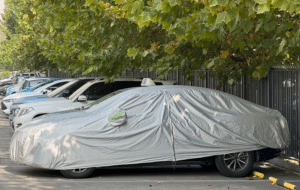
- Cover the vehicle if storing in an unconditioned space or outdoors. See our breakdown of whether you should cover a car in storage for the tradeoffs between cover types.
Enabling Storage Mode: Which Vehicles Have It and How
Storage mode is not a universal feature. Tesla, Hyundai, Kia, and Rivian all include some version of it. GM Ultium vehicles do not have a dedicated storage mode but support a low charge limit setting. The Nissan Leaf requires manual management of charge level and has no automated storage behavior.
When storage mode is active, the vehicle typically reduces cellular polling, limits charge cycling, and may disable features like Sentry Mode. Confirm your settings before leaving, because a software update during storage can reset them.
The 12V Auxiliary Battery: The Part Most EV Owners Forget
Every electric vehicle carries a 12-volt auxiliary battery that is completely separate from the main traction pack. This battery powers door locks, displays, low-voltage control systems, and the circuitry the car needs to wake up and accept a charge.
If it drains during storage, the vehicle may:
- Refuse to start.
- Display fault codes.
- Require a dealer-level reset to recover.
The 12-volt auxiliary battery can drain in as little as three to four weeks when the vehicle is parked and unplugged. Connect a standard 12V trickle charge device (also called a battery tender) to the 12V terminal, not the main charging port. If a power connection is not available at your storage location, plan to check on the vehicle every two to three weeks.
This risk isn’t unique to EVs either: our guide on how long a car battery can sit unused covers the same trickle-charging logic for any 12V system.
Where to Store an Electric Car Long Term
The optimal storage temperature for a lithium-ion battery at rest is between 50°F and 77°F. NREL battery degradation research documents that temperatures above 95°F measurably accelerate electrochemical battery degradation even when the vehicle is not in use. That temperature context shapes every storage location decision.
Why Temperature Matters More for EVs Than Gas Cars
A gas car parked in summer heat faces cosmetic risks: faded trim, dried seals, cracked rubber. An EV in the same heat has active chemical degradation happening inside the battery cells, whether or not the car is running, and in Arizona, Texas, and Florida summers, unconditioned outdoor storage can expose a parked battery to sustained temperatures well above 95°F for weeks at a time.
Active thermal management compounds this in both directions: the system draws power from the traction battery to cool cells in extreme heat or warm them in extreme cold, so the car is protecting itself, but that protective draw reduces charge while the vehicle sits either way.
Your storage options, from least to most protective, are:
- Outdoor with a quality cover: Acceptable for short periods. High-risk in hot climates during summer months due to direct sun and ambient heat.
- Unconditioned garage or carport: Better than outdoor but still subject to seasonal temperature swings, similar to the tradeoffs covered in whether it’s okay to store a car in an unheated garage.
- Climate-controlled storage: The best option for long-term storage in any climate, particularly in states with extreme summer heat. See what enclosed vehicle storage actually includes before you commit to a facility.
For EV owners without a climate-controlled garage at home, covered storage protects the vehicle from direct sun and the temperature extremes that accelerate battery degradation, and EVs are included among what vehicles can be stored in a facility like this one. If you want to understand how much storage costs before committing to a facility, and our car-specific breakdown of how much it costs to store a car in a storage unit narrows that down further.
Should You Leave Your EV Plugged In During Storage?
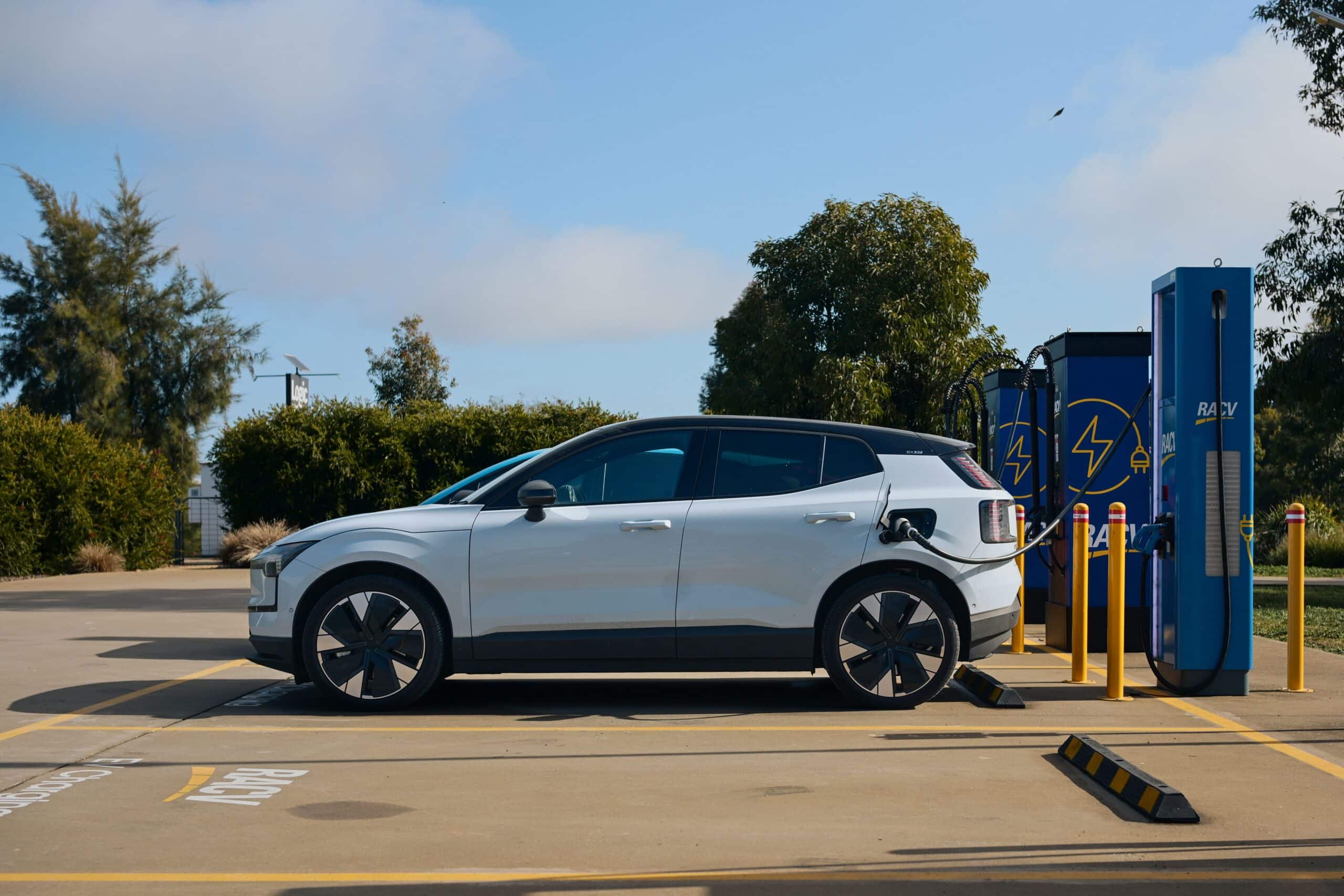
For vehicles with active thermal management (Tesla, Rivian, GM Ultium, Hyundai, and Kia), leaving the car plugged in at a low charge limit is better than unplugged storage. The thermal system can run without draining the traction battery, and the charge limit prevents the battery from sitting at 100%.
For the Nissan Leaf, unplugged storage at the correct state of charge is generally fine. The Leaf has no active thermal management system drawing power in the background, so there is no thermal loop to sustain.
The Hidden Risk: Vampire Drain and Thermal Management During Storage
Even when an EV is locked and off, it is not truly dormant. The battery management system, cellular connection, and thermal management loop continue drawing small amounts of power from the traction battery. This is called vampire drain.
In moderate temperatures, the draw is minor: roughly one to three miles of range per day. In cold conditions, where the thermal system works harder to protect cells, that figure rises to five or more miles per day.
A vehicle stored at 50% in a cold, unplugged garage can drop below 20% within two to four weeks. Below 20%, some battery management systems enter a deep discharge state they cannot exit without external intervention.
How to Reduce Vampire Drain Before Storage
Practical steps to reduce standby draw before leaving:
- Disable Sentry Mode (Tesla): Sentry Mode draws significant power around the clock. Turn it off in the app before storage.
- Turn off Wi-Fi and cellular polling where your brand’s app supports it. Fewer active connections mean less standby draw.
- Enable storage or transport mode as covered above, which limits background system activity.
- Leave the vehicle plugged in at a low charge limit if your storage location has accessible power. This is the single most reliable way to prevent vampire drain from becoming a problem. If you do not have power access at home, a dedicated vehicle storage facility like RecNation’s covered storage can provide a covered, powered space where the vehicle stays connected throughout the storage period.
How Often Should You Check on Your EV During Long-Term Storage?
If the vehicle is stored unplugged, check it every two to three weeks. Confirm the traction battery has not dropped below 20% and that no fault codes have appeared on the vehicle app.
This is a different rhythm than how often you should start a gas car in storage, since an EV doesn’t need starting the way an ICE vehicle does. If stored plugged in at a low charge limit, a monthly check is sufficient. Each visit should also include a quick look at tire pressure.
EV-Specific Storage Risks You Won’t Have With a Gas Car
Owners who have stored gas cars before sometimes underestimate the EV-specific risks, even when they already know how long a personal car can sit without being driven. Two in particular catch people off guard.
Brake Rotor Corrosion in Stored EVs
Because regenerative braking handles the majority of deceleration in normal driving, the physical disc brakes on an EV are used far less than on a comparable gas vehicle. Rotors that rarely get used are already more prone to surface rust during regular ownership. During storage, when the brakes are never applied at all, visible surface rust can develop on exposed rotor faces within four to six weeks.
In most cases this is cosmetic. Light surface rust clears within the first few miles of cautious braking after storage. For vehicles stored longer than eight weeks, apply a brake-safe anti-corrosion spray to exposed rotor surfaces before parking. If you skip this step, plan to brake gently for the first 10 to 15 minutes after retrieving the vehicle before any hard stops.
Over-the-Air Updates and Storage Settings
Many EVs receive over-the-air software updates automatically when connected to Wi-Fi. A major update can reset charge limits, storage mode settings, or Sentry Mode to default values without any notification. If this happens mid-storage, a previously correct 50% charge limit could shift, or a disabled Sentry Mode could re-enable and begin drawing power.
Check your app settings before leaving the vehicle and again when you return. Do not assume the configuration you set before storage is still active after months away.
Returning to Your EV After Long-Term Storage
Follow these steps in order when you retrieve the vehicle.
- Check the traction battery state of charge first. If it has dropped below 20%, charge it to 50 to 80% before driving. Avoid DC fast charging from a critically depleted state where possible; slow Level 1 or low-rate Level 2 charging is easier on cells that have been sitting for months.
- Check the 12-volt auxiliary battery. Fault codes on startup are most commonly caused by a depleted 12V system, not the main pack. Jump-start or replace the 12V battery if needed.
- Check tire pressure. Re-inflate to the manufacturer’s cold-inflation specification. Tires lose roughly 1 PSI per month at rest, and cold-storage conditions can accelerate that loss.
- Inspect the brake rotors visually. Light rust is normal and clears with careful braking in the first few miles. Heavy corrosion warrants an inspection before highway use or hard braking.
- Check for software updates that may have altered charge limits or storage settings since you parked.
- Take a short, low-speed test drive before returning to normal use. Let the vehicle run self-diagnostics and clear any stored alerts from the idle period.
What to Do If the Battery Dropped Below 20% During Storage
A lithium-ion battery recovered from deep discharge should be charged slowly if the vehicle allows it. Use Level 1 or a low-rate Level 2 charger rather than a DC fast charger. Most vehicles will limit functionality and display a low-battery warning until partial charge is restored. Once the battery reaches 20 to 30%, normal charging behavior typically resumes.
Signs Your EV May Need Service After Storage
Most EVs return from storage without incident if the preparation steps were followed. Watch for these signs that a service visit is warranted before regular use:
- Persistent fault codes after the 12V auxiliary battery has been confirmed healthy.
- Brake vibration or pulsing that does not clear after 10 to 15 minutes of gentle driving.
- The vehicle refusing to accept a charge or stopping the charge cycle early.
Final Thoughts on Storing Your EV Long Term
Finding a location that keeps your EV shielded from heat, cold, and weather is one of the most effective things you can do to protect the battery during an extended storage period. If a home garage is not an option, RecNation covered and enclosed vehicle storage offers a secure facility for cars, EVs, and other vehicles across multiple states, so you can leave the vehicle with confidence and return to it in the same condition you left it.
Frequently Asked Questions About Storing an Electric Car Long Term
What charge level should I store my electric car at long term?
Most EV manufacturers recommend storing the vehicle at approximately 50% battery state of charge. Storing above 80% places ongoing stress on lithium-ion cells and accelerates battery degradation. Dropping below 20% risks deep discharge, which some battery management systems cannot fully recover from without dealer intervention. Hyundai and Kia vehicles with a dedicated storage mode manage this automatically, while Tesla owners should set the charge limit to 50% in the app before leaving the vehicle.
Is it bad to leave an electric car sitting for months without driving?
An EV can be stored for months without driving if it is properly prepared, but several risks require active management. Vampire drain from the battery management system can slowly deplete the traction battery even when the car is off. The 12V auxiliary battery can drain independently and prevent the vehicle from waking up. Brake rotors can develop surface corrosion from disuse, and software updates can reset storage settings mid-storage. Checking the vehicle every two to three weeks and storing at the correct charge level reduces these risks significantly.
Does cold weather damage an electric car battery during storage?
Sustained cold temperatures do not permanently damage a properly stored modern EV battery, but they increase the rate of parasitic drain. Vehicles with active thermal management, including Tesla, Rivian, and GM Ultium-based vehicles, continue drawing power from the traction battery to keep cells warm even when parked and unplugged. In a cold garage, this can deplete a battery stored at 50% to below 20% within two to four weeks. Leaving the vehicle plugged in at a low charge limit is the most reliable way to prevent this during cold weather storage.
Should I disconnect the 12-volt battery when storing an electric car?
Disconnecting the 12-volt auxiliary battery is not recommended for most EVs. Unlike a gas car, an EV’s 12V system is integrated with the vehicle’s main control systems. Disconnecting it can trigger fault codes, reset stored settings, or cause the battery management system to require a dealer-level reset to recover. Instead, connect a standard 12V trickle charge device to the 12V terminal to maintain charge during storage without disconnecting the battery entirely.
How often should I check on my electric car during long-term storage?
If the vehicle is stored unplugged, check on it every two to three weeks. Confirm the traction battery charge has not dropped below 20% and that no fault codes have appeared. Both are signs that the 12V auxiliary battery or thermal management system may need attention. If the vehicle is stored plugged in at a low charge limit, a monthly check is generally sufficient. At each visit, also verify tire pressure, which drops roughly 1 PSI per month at rest.