A good recreational vehicle (RV) storage facility protects your rig with physical barriers, cameras, appropriate space sizing, and clear contract terms before you ever sign anything. The word “secure” gets used loosely by facilities of every type, so knowing exactly what to ask cuts through vague marketing language and puts you in control of the comparison. The ten checks below cover fencing, gated access, cameras, lighting, space length, space type, access hours, dump stations, insurance, and contract terms.
What "Secure" Actually Means at an RV Storage Facility
“Secure” is not a regulated term. Two facilities can both advertise secure RV storage while offering very different levels of protection. One may have full perimeter fencing, gated keypad entry, and camera coverage throughout the storage lot. Another may have a single gate camera and an unlocked rear perimeter.
The physical layers that actually matter to a renter are specific and verifiable:
- Perimeter fencing: Restricts unauthorized foot and vehicle access to the lot.
- Gated access: A keypad or access card logs who enters and when.
- Camera coverage: Cameras at entry points and throughout the lot create a visual record.
- Lighting: Lit access lanes make the storage lot visible after dark.
When evaluating any facility, it helps to ask for details rather than accepting a general security claim. If a facility cannot describe its security setup plainly, that vagueness is itself useful information.
Why Vague Security Claims Are a Red Flag
A facility that says “secure” without naming specific features gives you nothing to verify. It helps to ask direct follow-up questions:
- Cameras: Are they monitored or recorded only, where are they positioned, and how long are recordings kept?
- Gate: Is it attended by on-site management during business hours, or keypad-only around the clock?
- Perimeter: Is the entire perimeter fenced, or only the entry?
These questions separate a genuinely secure storage facility from one that uses the word as a marketing label.
The 10-Point Checklist for Evaluating RV Storage Security
The right facility checklist gives you a consistent framework for comparing options. If you are planning a long stay, long-term RV storage tips are a useful companion for the preparation steps that apply regardless of which facility you choose.
It helps to work through these checks in order when visiting or calling any RV storage facility.
Checks 1 to 5: Physical Security and Access
- Perimeter fencing
A full-lot fence is the first thing to confirm, since a partial fence leaves side and rear access points open. The question is whether the entire lot is fenced or only the front entrance, and the fencing material and height are worth confirming while you are on-site.
- Gated access
Entry may be by keypad, access card, or mobile app, so it is worth finding out which one the facility uses. Who controls access codes and whether access logs are kept are the other points to confirm. A gated system that records entry and exit times is more useful for vehicle theft prevention than one that only restricts entry.
- Camera coverage
Camera placement matters as much as camera count, so it helps to ask where cameras are positioned and whether they record continuously. Entry-point cameras alone leave the interior of the storage lot unmonitored. Coverage should extend to access lanes and individual spaces, not just the front gate.
- Lighting
Walking the lot after dark, if you can, shows how well lit it really is. Otherwise, the facility can say whether access lanes and individual spaces are lit. Poor lighting at the rear of a large lot undermines every other security measure on this list.
- Space length
Exact space length is worth confirming before booking. RV spaces start at 20 feet, and teardrops, pop-ups, and camper vans generally fit in a 20 to 25-foot space. Most standard travel trailers, fifth wheels, and motorhomes need more, so measuring your rig’s total length, including the hitch, and confirming it fits the space offered is a sensible step before you sign.
Checks 6 to 10: Space Type, Amenities, and Contract Terms
- Space type
Outdoor uncovered spaces offer no weather protection. Covered canopy spaces provide overhead shelter from sun and rain with open sides. Enclosed indoor garage spaces add four walls. Each type carries a different monthly cost and a different level of physical protection.
- Access hours
Gate hours should be confirmed in writing before you sign. Some facilities offer 24-hour access; others operate on restricted business-hour schedules. Limited gate hours can prevent an early-morning or late-evening departure when your travel schedule demands it.
- Dump station availability
Only some facilities offer this amenity, so it is worth confirming whether the facility has a dump station and whether its use is included in the rental fee or billed separately. Knowing before you book saves a separate trip to a dump site before or after a storage period.
- Insurance requirements
Many facilities require proof of RV insurance as a rental condition, so that is the first thing to ask. Your own policy deserves a check as well: confirm what it covers while the rig is in off-site commercial storage, since coverage varies significantly by policy.
- Contract terms
The agreement may be month-to-month or require a longer commitment, and the facility can say which. The required notice period to vacate, how late fees are structured, and any clause about rate increases or facility-sale provisions are also worth learning. These details matter most when you need to leave quickly or the facility changes hands.
Outdoor, Covered, and Enclosed RV Storage: What Each One Protects
Matching your storage type to your situation means understanding what each option actually protects against. For owners weighing outdoor storage, the trade-offs of storing an RV outside are worth understanding before you commit.
Each storage type protects against different things:
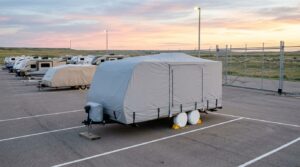
- Outdoor uncovered RV storage: The most common and least expensive option.
- Setup: Your RV sits on an open lot with no overhead cover.
- Exposure: It is fully exposed to sun, rain, hail, wind-driven debris, and seasonal temperature swings.
- Best for: Owners on tight budgets or those storing short-term in mild climates.
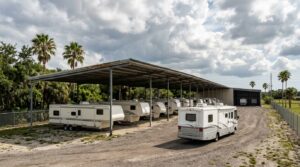
- Covered canopy RV storage: Adds a roof over the space, with open sides.
- Protection: It blocks direct sun and rain from hitting the RV’s roof and exterior. Ultraviolet (UV) exposure to roof seals, rubber components, and exterior finishes is reduced significantly over a full storage season.
- Limitation: Wind-driven rain can still reach the sides of the rig.
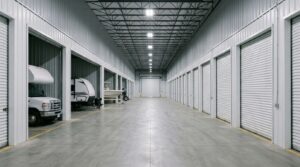
- Enclosed indoor garage storage: Places the rig inside four walls.
- Protection: It adds a physical barrier against wind-blown debris and provides an additional layer of protection against unauthorized access.
- Limitation: Indoor garage spaces are enclosed, not climate-controlled. Interior temperatures can still rise in summer and drop in winter, depending on the building’s construction.
As of October 2026, monthly storage rates vary by location, size, and availability:
- Outdoor uncovered: Approximately $57 to $183 a month.
- Covered canopy: Approximately $99 to $351 a month, with most spaces falling in the $108 to $239 range.
- Enclosed indoor garage: Approximately $114 to $216 a month for most sizes.
- Online booking: Typically reduces those rates by about $20 a month.
Since these figures are industry estimates, it helps to confirm current rates with the specific facility.
RecNation operates 70 facilities across eight states and offers all three storage types, with 24/7 security cameras at every location; most locations are fenced and gated. For location-specific details, the RV and boat storage amenities page is the place to confirm what each facility offers.
When Covered Storage Is Worth the Extra Cost
The practical calculation comes down to how long your rig will sit and what your climate does to it. A full season of direct sun exposure degrades roof sealants, fades exterior graphics, and dries out rubber slide seals. The monthly premium for covered RV storage adds up, but roof seal repairs and exterior restorations can cost more. For long-term RV storage lasting several months or more in a hot or high-UV region, the canopy premium is often worth paying.
Insurance and Contract Terms: Two Checks Most Renters Skip
Physical security gets most of the attention during a facility search. Insurance coverage and contract language are the two areas where problems surface later.
Insurance coverage varies, and gaps are easy to miss. Policies handle storage in different ways:
- Full coverage: Some policies cover the rig fully while it is stored at a commercial facility.
- Reduced coverage: Others reduce coverage during extended storage.
- Storage address notice: Some require the owner to notify the insurer of the storage address.
- Excluded perils: Others exclude specific perils such as theft or weather damage during long-term storage.
Three steps help close those gaps before you sign:
- Your insurer: Call before signing anything and ask directly whether your policy covers the rig at an off-site commercial facility.
- Proof of insurance: Many facilities require proof of RV insurance as a rental condition, so confirming your policy is active and adequate saves a problem at the front desk. For a closer look at what storage-specific provisions typically look like, RV insurance in storage is a useful next read.
- Facility liability: Ask the facility whether its own liability policy covers damage to stored vehicles.
Contract terms are worth reading before you sign, not after. The two agreement types trade off differently:
- Month-to-month agreements: These give you flexibility to leave if the facility changes management, raises rates, or declines in quality.
- Longer commitments: These may come with a lower monthly rate but add friction if your plans change.
What to Ask Before You Sign
It helps to bring these questions to any facility before committing to a rental agreement:
- Does my existing RV policy cover theft and damage during off-site commercial storage?
- Does the facility require proof of insurance before I can rent?
- Is the rental agreement month-to-month or does it require a longer commitment?
- What is the required notice period to vacate?
- How are late fees calculated?
- Are rate increases capped or disclosed in advance within the contract?
RV Storage Costs: What to Expect by Type
The ranges above give you a realistic benchmark for spotting an outlier quickly. As of October 2026, larger enclosed spaces, such as a 15 x 50-foot garage, run up to approximately $701 a month. The wide spread across types reflects differences in space size, location, and storage type, not security level alone. A higher monthly rate does not automatically mean better cameras or stronger fencing, so it helps to evaluate security features and pricing separately.
Once you have a benchmark, RV storage costs goes deeper on what drives price variation by type and region, and the RV storage options guide helps you match a storage type to your rig and use pattern.
How to Get the Best Rate at a Storage Facility
Booking online rather than walking in is the simplest way to lower the rate, typically by the $20 a month noted above. Month-to-month agreements offer flexibility but sometimes cost more than longer commitments. Move-in specials and prepay discounts are also worth asking about when you call.
Ready to Book Secure RV Storage?
The checklist covers the physical security features to verify, the storage type that fits your rig and climate, and the insurance and contract questions to ask before you sign. The next step is putting it to work at a real facility.
If you are ready to move from checklist to booking, RecNation RV storage covers all three storage types, outdoor, covered canopy, and enclosed indoor garage, across 70 facilities. Bring your checklist, confirm the details that matter most to your rig and your travel schedule, and book the space that fits.
Frequently Asked Questions
What should I look for in a secure RV storage facility?
A secure facility names its features specifically: perimeter fencing around the whole lot, gated keypad or card access, cameras covering the lanes and spaces, and lighting after dark. Beyond physical security, it helps to verify that the space length fits your rig, that access hours match your travel schedule, and whether proof of insurance is required before renting.
How much does secure RV storage cost per month?
Monthly cost depends mostly on storage type and space size rather than security level. As of October 2026, outdoor uncovered spaces start around $57 a month, covered canopy spaces reach about $351, and enclosed indoor garage spaces cost approximately $114 to $216 for most sizes. Prices vary by location, size, and availability, and booking online typically reduces the rate by about $20 a month.
Is covered or enclosed RV storage worth the extra cost?
The answer depends on three factors: your climate, how long the rig will sit, and the replacement cost of what exposure damages. A canopy mainly reduces sun and rain exposure, while an enclosed indoor garage also shields the rig from blowing debris and adds a barrier against unauthorized access, so the premium tends to pay off for longer stays in hot or high-UV regions.
Does my RV insurance cover the rig while it is in storage?
It depends on the policy, because storage provisions differ between insurers. The most reliable step is to call your insurer before signing, ask whether the rig is covered for theft and weather damage at a commercial facility, and confirm whether the storage address must be reported. The facility may also require proof of insurance as a rental condition.
What is the minimum space size I need for RV storage?
The minimum is 20 feet, which suits a teardrop, pop-up, or camper van in a space of up to 25 feet. Most standard travel trailers, fifth wheels, and motorhomes need a longer space, so the length that matters is your rig’s total tow length, including the hitch or any attached tow vehicle. Confirming that figure with the facility before booking helps you avoid paying for a space that does not fit.
What access hours should I expect at an RV storage facility?
Access hours differ from one facility to the next, ranging from around-the-clock keypad or code entry to standard business-hour gates. Because restricted hours can complicate an early-morning or late-evening departure, it helps to get the specific gate hours from the facility before signing.