Trailers fall into two broad categories: recreational and consumer trailers, and commercial freight trailers. Each category contains a dozen or more specific types built for different loads, tow vehicles, and legal requirements.
This guide covers both audiences in a single resource, organized so you can jump to the section that fits your situation.
Trailer Types at a Glance: Quick-Reference Comparison Chart
Before diving into the detail sections, this table gives you a side-by-side view of the most commonly searched trailer types. Use it to identify the right category, then read the relevant section for specifics.
| Trailer Type | Primary Use | Typical Length | Typical GVWR Range | CDL Required? | Best For |
| Travel trailer | Recreational camping | 12 to 35 ft | 3,000 to 14,000 lbs | No | Campers with a capable SUV or half-ton pickup |
| Fifth wheel trailer | Recreational camping | 25 to 40 ft | 12,000 to 20,000 lbs | No (private use) | Full-timers needing a pickup with a bed hitch |
| Toy hauler | Camping with gear garage | 22 to 42 ft | 10,000 to 20,000 lbs | No | ATV and motorcycle owners |
| Pop-up/folding camper | Lightweight camping | 10 to 20 ft folded | 1,500 to 5,000 lbs | No | Campers wanting minimal tow weight |
| Utility trailer | Yard and light hauling | 4 to 20 ft | 1,000 to 7,000 lbs | No | Homeowners and contractors |
| Dump trailer | Bulk material transport | 8 to 16 ft | 5,000 to 14,000 lbs | No | Landscapers and debris removal |
| Enclosed cargo trailer | Tool and equipment transport | 8 to 24 ft | 2,000 to 10,000 lbs | No | Contractors and hobbyists |
| Boat trailer | Watercraft transport | 12 to 40 ft | 1,200 to 15,000 lbs | No | Recreational boaters |
| Car hauler trailer | Vehicle transport | 16 to 24 ft | 7,000 to 14,000 lbs | Depends | Collectors and auto transporters |
| Gooseneck trailer | Heavy agricultural/commercial hauling | 25 to 40 ft | 20,000 to 30,000 lbs | Depends | Ranchers and construction operators |
| Dry van trailer | General freight | 48 to 53 ft | Up to 80,000 lbs | Yes (Class A) | Shippers of packaged and retail goods |
| Flatbed trailer | Open-deck freight | 48 to 53 ft | Up to 80,000 lbs | Yes (Class A) | Lumber, steel, machinery |
| Refrigerated trailer | Temperature-controlled freight | 48 to 53 ft | Up to 80,000 lbs | Yes (Class A) | Perishable food and pharmaceuticals |
| Lowboy trailer | Oversized equipment hauling | 24 to 30 ft deck | 40,000 to 80,000+ lbs | Yes (Class A) | Construction equipment transport |
| Tanker trailer | Liquid or bulk dry goods | 40 to 43 ft | Up to 80,000 lbs | Yes + Hazmat endorsement | Fuel, chemicals, food-grade liquids |
| Livestock trailer | Animal transport | 16 to 53 ft | 10,000 to 80,000 lbs | Depends | Ranchers and agricultural operators |
CDL requirements vary by state and by the combined weight of your tow vehicle and trailer. Always verify current thresholds with the FMCSA.
How to Read This Table
The GVWR column shows the trailer’s maximum legal loaded weight, not its empty weight. A trailer with a 10,000 lb. GVWR might weigh 3,000 lbs. empty and carry 7,000 lbs. of cargo. The CDL column reflects the trailer’s typical use, but the legal trigger is your gross combined weight rating (GCWR), which is the combined weight of your tow vehicle and the loaded trailer together. A trailer GVWR alone does not determine CDL requirement; the combination does.
Recreational and Consumer Trailer Types
This section covers the trailer types a private buyer, camper, boater, or hobbyist is most likely to encounter. Each entry leads with the primary use case and includes size ranges and tow vehicle notes to help you match the trailer to what you already drive.
Travel Trailer
A travel trailer is a bumper-pull recreational vehicle (RV) towed through a standard trailer hitch receiver at the back of the tow vehicle. Most range from 12 to 35 feet in length and can be pulled by a capable half-ton pickup or a full-size SUV rated for the load. Unlike a fifth wheel trailer, a travel trailer does not require a truck bed hitch, which makes it compatible with a wider range of vehicles.
The gross vehicle weight rating on most travel trailers falls between 3,000 and 14,000 lbs., so matching it to your vehicle’s towing capacity is the most important step before buying.
Fifth Wheel Trailer
A fifth wheel trailer connects to a kingpin hitch mounted in the truck bed rather than a standard hitch receiver. This connection point sits forward of the rear axle, which distributes weight more evenly and provides a more stable tow than a bumper-pull design. Fifth wheels typically run 25 to 40 feet and require at minimum a three-quarter-ton pickup, with most full-size units needing a one-ton.
They are the preferred choice for full-time RV travelers who need more living space and prefer the handling advantage of an in-bed hitch.
Toy Hauler
A toy hauler is a hybrid travel trailer or fifth wheel with a rear garage section built to carry ATVs, motorcycles, side-by-sides, or other power sports equipment. The garage typically accommodates one to four vehicles depending on model size, with a fold-down ramp door for loading. When the toys are left at the destination, the garage converts to additional sleeping or living space.
Because toy haulers and car hauler trailers tend to be larger and heavier than standard trailers, they often do not fit in a residential garage or driveway. For owners who need a secure place to keep their trailer between trips, RV and trailer storage at a dedicated facility is a practical alternative to leaving it exposed at home. Our ultimate guide to trailer parking covers the full range of options if a dedicated facility isn’t the right fit for your situation.
Utility, Dump, and Cargo Trailers
These three trailer types are the workhorses of the consumer and small business world. An open utility trailer handles yard debris, landscaping supplies, and light equipment hauling, with GVWRs typically ranging from 1,000 to 7,000 lbs. A dump trailer adds a hydraulic lift bed for bulk materials like mulch, gravel, and demolition waste, with GVWRs commonly between 5,000 and 14,000 lbs.
An enclosed trailer provides a lockable box for tools, equipment, and business inventory, with GVWRs ranging from 2,000 to 10,000 lbs. depending on size.
Boat, Jet Ski, and Watercraft Trailers
Boat trailers are designed around the hull they carry, so trailer selection must match both the hull type and the vessel’s weight. Bunk trailers support the hull along padded rails and are better suited to fiberglass and V-hull boats. Roller trailers use a series of rollers that make launching and retrieval easier in shallow ramps.
Jet ski trailers typically handle 500 to 1,200 lbs., while trailers for larger center-console or cabin boats can exceed 10,000 lbs. GVWR. Federal lighting and reflector standards under NHTSA FMVSS 108 apply to all trailers, including watercraft trailers, so confirm compliance before trailering on public roads.
Car Hauler, Motorcycle, and ATV Trailers
A car hauler trailer moves vehicles that cannot drive under their own power or need to be transported without adding miles. Open two-car haulers run 18 to 20 feet and require at minimum a three-quarter-ton tow vehicle, given GVWRs that typically reach 12,000 to 14,000 lbs. Enclosed car hauler options add weather protection for collector and show cars at the cost of additional trailer weight.
Motorcycle trailers and ATV trailers come in single-vehicle or multi-unit configurations, ranging from small open carriers that a mid-size truck can handle to multi-slot enclosed units built for teams heading to race events.
Commercial and Freight Trailer Types
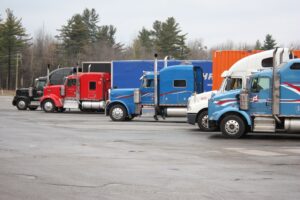
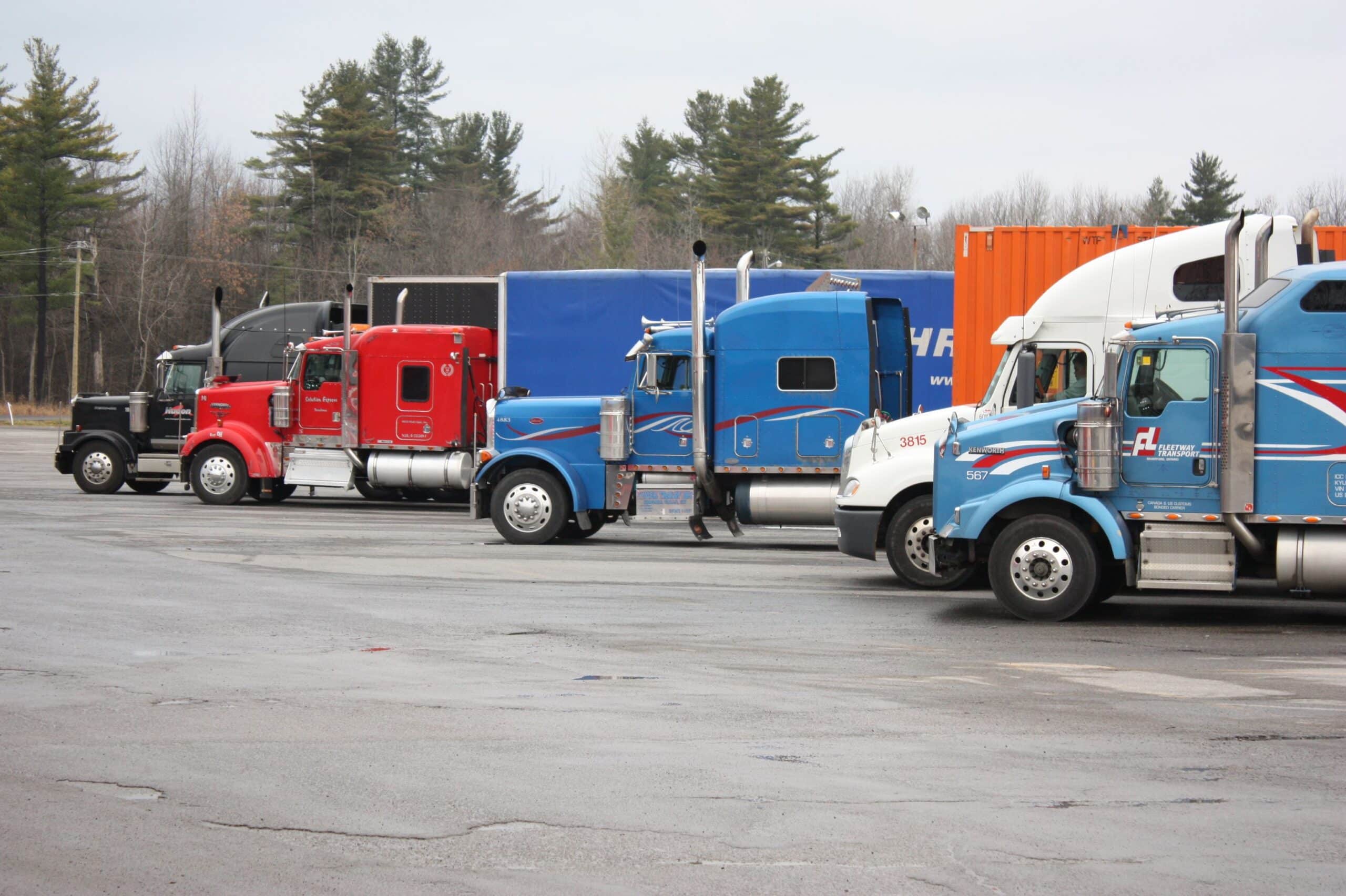
Commercial freight trailers are purpose-built for specific cargo types, and most require a Class A commercial driver’s license (CDL) when operated as part of a tractor-trailer combination. Commercial operators who store trailers between loads often need dedicated truck parking at a facility equipped for large vehicles rather than leaving units on-street or in unmanaged lots.
If you’re trying to decide between the two, our breakdown of the difference between trailer storage and truck parking covers exactly when each one applies. The sections below cover the major semi-trailer types used in commercial freight transport, including key structural features and regulatory notes.
Dry Van Trailer
The dry van trailer is the most common semi-trailer on U.S. highways. It is a fully enclosed, weatherproof box measuring 48 or 53 feet in length, designed for general freight, packaged retail goods, and manufactured products that do not require temperature control. Dry van shipments account for roughly 70% of all truckload freight volume in the United States.
Operating a tractor with a dry van semi-trailer requires a Class A CDL under 49 CFR Part 390 to 393 as enforced by the Federal Motor Carrier Safety Administration (FMCSA).
Flatbed and Flatbed Variants
A flatbed trailer has an open deck with no sides or roof, making it the right choice for cargo that cannot be loaded into an enclosed trailer: steel coils, lumber, machinery, and pre-fabricated structural components. Standard flatbeds run 48 to 53 feet and handle loads up to 48,000 lbs. of cargo weight within federal limits.
Step-deck trailers (also called single-drop trailers) have a lower rear deck than a standard flatbed, allowing taller loads that would otherwise exceed legal height clearances. Extendable flatbeds stretch beyond standard length for oversized freight, while double-drop designs lower the deck further for loads requiring even more headroom.
Refrigerated Trailer
A refrigerated trailer, commonly called a reefer, maintains internal temperatures between -20°F and 70°F using an onboard diesel-powered refrigeration unit. Reefer trailers are required for perishable freight, including fresh produce, dairy, meat, and temperature-sensitive pharmaceuticals.
The FDA Food Safety Modernization Act (FSMA) mandates specific temperature control and sanitation standards for vehicles transporting food across state lines. The refrigeration unit adds 3,000 to 5,000 lbs. to the trailer’s tare weight, a factor that matters when calculating total payload capacity against federal weight limits.
Lowboy and Heavy Haul Trailers
A lowboy trailer uses a double-drop deck design that lowers the cargo surface to as little as 18 inches from the ground. This low deck height is the defining feature of heavy equipment hauling:
- It allows excavators, bulldozers, cranes, and other tall construction machinery to be transported without exceeding state DOT height limits.
- Loads on lowboy trailers frequently exceed the federal 80,000 lb. gross weight limit, requiring state-issued oversize and overweight permits before the truck moves.
A gooseneck trailer serves a similar heavy-hauling role in agricultural and construction markets, using a ball-and-coupler connection rather than a fifth wheel kingpin system. Many gooseneck and RGN setups also raise the question of whether you can park your trailer separately from your truck, which matters for operators without room to store both together.
Specialty Trailers: RGN, Conestoga, and Tanker
A removable gooseneck (RGN) trailer allows the front section to detach so self-propelled equipment can drive directly onto the deck, making it the safest loading method for wheeled or tracked machinery.
A Conestoga trailer uses a rolling tarp system over a flatbed frame, giving shippers the weather protection of an enclosed trailer with the side-access loading flexibility of a flatbed.
A tanker trailer is engineered for liquid or bulk dry goods, with a cylindrical tank mounted on the trailer frame. Hazardous liquid cargo requires a hazmat endorsement in addition to a Class A CDL.
Livestock trailers round out the specialty category, used in agricultural commercial freight transport to move cattle, hogs, and horses with ventilated compartments and interior dividers.
How to Match a Trailer to Your Tow Vehicle
Choosing the right trailer is only half the decision. The other half is confirming your tow vehicle can handle it safely and legally, which comes down to three numbers: your vehicle’s rated towing capacity, the trailer’s GVWR, and the tongue or pin weight the trailer puts on the hitch.
Manufacturer towing capacity ratings must comply with the SAE J2807 tow rating test standard, so the number on the spec sheet is a tested limit, not a marketing estimate. Exceeding it voids most warranties and may create legal liability in an accident.
Tongue weight should fall between 10% and 15% of GVWR for bumper-pull trailers, or up to 25% for fifth wheel pin weight, so a 10,000 lb. trailer should put 1,000 to 1,500 lbs. on the hitch. Too little causes sway; too much overloads the rear axle.
Hitch Classes and What They Support
Your trailer hitch class sets the upper limit on what you can tow through a standard hitch receiver:
- Class I: Up to 2,000 lbs. GVWR. Light utility trailers and small cargo trailers behind compact cars or crossovers.
- Class II: Up to 3,500 lbs. GVWR. Small utility trailers and pop-up campers behind mid-size SUVs.
- Class III: Up to 8,000 lbs. GVWR. The most common class for half-ton pickups and larger SUVs pulling travel trailers and boat trailers.
- Class IV: Up to 12,000 lbs. GVWR. Three-quarter-ton pickups and heavy-duty SUVs pulling larger travel trailers and car haulers.
- Class V: Up to 20,000 lbs. GVWR. One-ton pickups and heavy-duty trucks pulling fifth wheels, gooseneck trailers, and large equipment haulers.
CDL Requirements by Trailer Type and Weight
A Class A CDL is required when the gross combined weight rating (GCWR) of the tow vehicle and trailer together exceeds 26,001 lbs. and the trailer alone has a GVWR over 10,001 lbs. This threshold is routinely crossed with commercial semi-trailers and heavy equipment haulers.
Most private recreational towing does not reach it, though a large fifth wheel RV pulled by a heavy-duty pickup in a commercial-use context may approach the limit depending on vehicle ratings. If you are operating commercially, always verify your GCWR against the FMCSA threshold, not just the trailer’s GVWR alone.
What Does It Cost to Buy or Rent a Trailer?
Trailer costs span a wide range depending on category, size, and whether you are buying new, buying used, or renting for a one-time job. The figures below cover typical new purchase pricing. Used pricing varies by age and condition; NADA Guides is a standard reference for used trailer valuations across both recreational and commercial categories.
Recreational Trailer Purchase Price Ranges
Consumer trailer prices reflect a significant spread across categories:
- Utility trailer: $500 to $3,000 new. Wide used market availability makes these among the easiest trailers to buy secondhand.
- Enclosed cargo trailer: $3,000 to $15,000 new. Size and build quality drive most of the price variation.
- Dump trailer: $4,000 to $15,000 new. Hydraulic system quality is the primary differentiator.
- Travel trailer: $15,000 to $60,000 new, depending on length and amenities.
- Fifth wheel trailer: $30,000 to $150,000 new. Luxury residential-style units push the upper end.
- Toy hauler: $25,000 to $120,000 new, depending on garage size and sleeping capacity.
- Boat and watercraft trailer: $500 to $5,000 for personal watercraft trailers; up to $30,000 or more for large vessel trailers.
- Car hauler trailer: $2,500 to $15,000 new for open designs; more for enclosed versions.
Contractors who rely on enclosed cargo trailers as mobile job-site storage may find it worth reading about contractor storage options from RecNation when a trailer needs to live somewhere between jobs.
Insurance on recreational trailers typically runs $100 to $300 per year for full coverage on a mid-range unit, though high-value fifth wheels and toy haulers warrant a quote specific to the unit’s replacement value. Once you’ve bought one, how much it costs to park a trailer somewhere is the next expense worth budgeting for.
Commercial Trailer Costs and Rental Options
New commercial semi-trailer pricing reflects the equipment complexity involved in each type:
- Dry van: $35,000 to $60,000 new.
- Flatbed: $25,000 to $50,000 new.
- Reefer: $60,000 to $100,000 or more, the highest upfront cost in the standard category, largely because of the refrigeration unit.
- Specialty units (RGN, lowboy): Vary widely based on capacity and configuration.
Smaller fleet operators who don’t want to own outright often lease or rent trailers through equipment companies such as XTRA Lease or TRAC Intermodal.
For lighter-duty needs, utility and enclosed trailer daily rental rates through national equipment rental companies typically run $50 to $100 per day. Commercial semi-trailer liability insurance commonly runs $5,000 to $15,000 per year depending on freight type, operating radius, and claims history.
Final Thoughts on Choosing a Trailer Type
Once you have identified the right trailer type, storage becomes the next practical question, particularly for recreational trailers, car haulers, and utility trailers that do not fit in a standard garage.
RecNation Storage offers covered and uncovered storage options designed for large vehicles including RVs, trailers, and boats, with facilities across Arizona, California, Florida, Texas, and other states. It is a straightforward way to keep your trailer protected, accessible, and off your driveway when it is not in use.
Frequently Asked Questions About Trailer Types
What is the most common type of trailer used for freight?
The dry van trailer is the most commonly used trailer in commercial freight transport. It is a fully enclosed, weatherproof box measuring 48 or 53 feet, and it carries the majority of general retail, packaged goods, and manufactured freight moving on U.S. highways. Industry data indicates dry van shipments account for roughly 70% of all truckload freight volume in the United States.
What is the difference between a flatbed trailer and a lowboy trailer?
A standard flatbed trailer has a deck height of approximately 60 inches from the ground, which limits the total height of the loaded combination under most state DOT clearance rules. A lowboy trailer uses a double-drop deck that lowers the cargo surface to as little as 18 inches, allowing it to carry tall construction equipment such as excavators and bulldozers that would exceed legal height limits on a standard flatbed. Most states set the maximum legal load height at 13.5 to 14 feet total, and a lowboy is required once equipment height approaches that ceiling.
What type of trailer is best for hauling heavy equipment?
The answer depends on whether the equipment is self-propelled. For self-propelled machinery such as excavators or wheel loaders, a removable gooseneck (RGN) trailer allows the equipment to drive directly onto the deck, which is the safest loading method. For non-propelled equipment, a lowboy or step-deck trailer is typically used. Any load exceeding 80,000 lbs. gross weight or 8.5 feet in width requires state-issued oversize and overweight permits before transport.
What are the different types of trailers for recreational use?
The five most common recreational trailer types are: travel trailers (bumper-pull RVs from 12 to 35 feet), fifth wheel trailers (truck bed-mounted RVs with a kingpin hitch, 25 to 40 feet), toy haulers (travel trailers or fifth wheels with a rear garage for ATVs or motorcycles), pop-up campers (lightweight folding trailers for tent-style camping), and boat or watercraft trailers (designed to match specific hull types and weights). Utility trailers and car hauler trailers are also widely used for recreational purposes.
How do I choose the right type of trailer for my needs?
Start with three questions: What are you hauling? How much does it weigh when loaded? What vehicle will be towing it? Once you know the load type and weight, you can identify whether you need an open, enclosed, specialty, or recreational trailer. Then check your tow vehicle’s rated towing capacity against the trailer’s GVWR, and confirm your hitch class supports the tongue weight. For commercial loads, also check whether the combined weight of your tow vehicle and trailer exceeds the 26,001 lb. GCWR threshold that triggers a Class A CDL requirement.
Do I need a CDL to pull a trailer?
Most recreational and light-duty trailers do not require a CDL. A CDL is required when the GCWR of the tow vehicle and trailer together exceeds 26,001 lbs. and the trailer alone has a GVWR over 10,001 lbs. This threshold is commonly reached with commercial semi-trailers and heavy equipment haulers. Towing a large fifth wheel RV with a heavy-duty pickup may approach but generally does not exceed this threshold in private, non-commercial use. Requirements vary by state, so verify with your state’s DMV before operating near the limit.