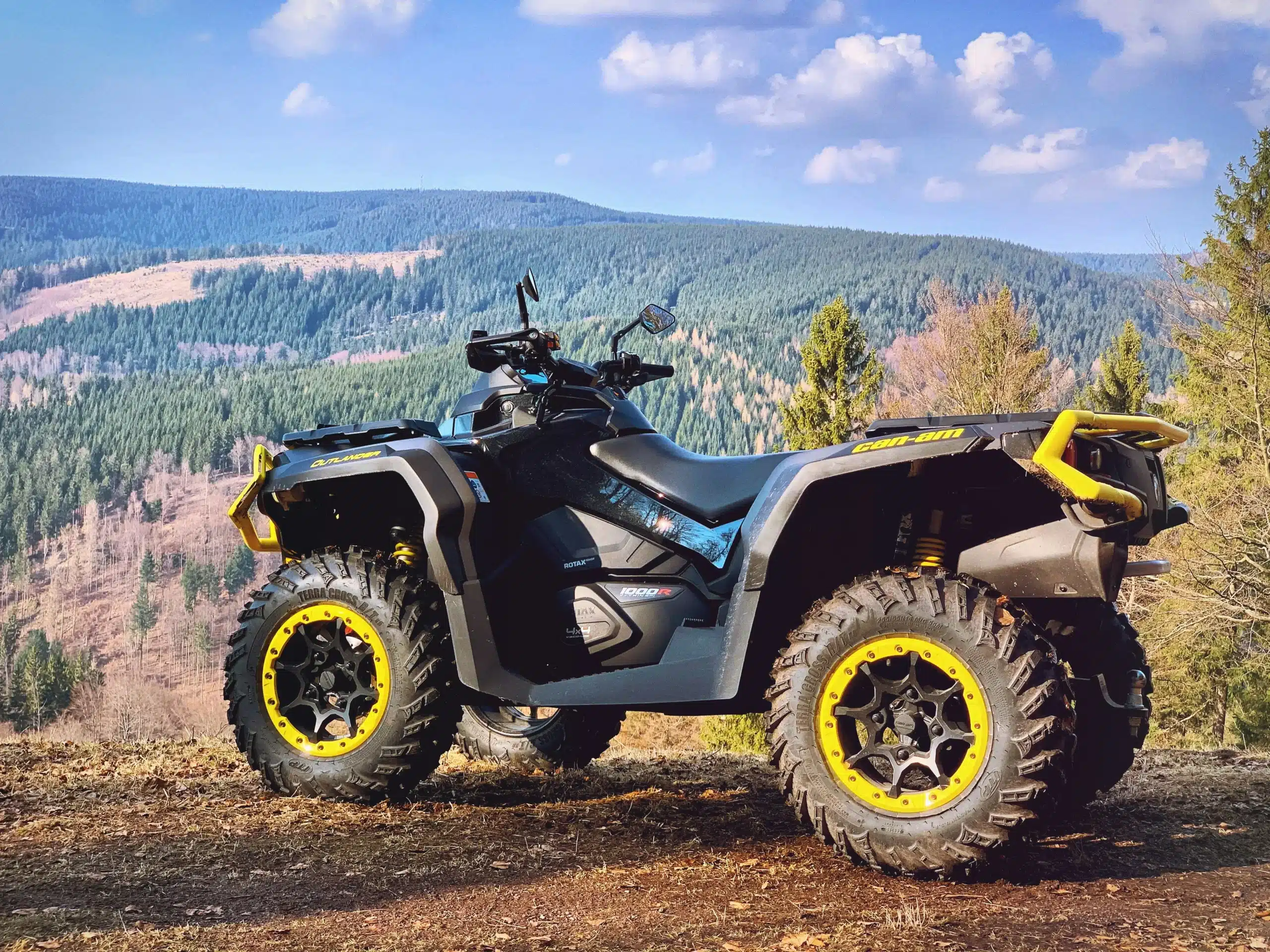
Where you park your all-terrain vehicle (ATV) overnight depends entirely on the situation. Hunting land, a developed campsite, a trailhead, and a motel parking lot all carry different rules, risks, and physical requirements. This guide covers four common scenarios so you can make the right call for each one.
It Depends Where You’re Riding: Here’s How to Think About Overnight Parking
Overnight ATV parking (and overall safety) isn’t one problem with one answer. The right spot on a private hunting lease looks nothing like the right spot at a National Forest trailhead, and neither one looks like a motel parking lot during a multi-day trail ride.
The rules change based on land type:
- Private land gives you latitude to park where the landowner allows.
- Public land, meaning National Forest, Bureau of Land Management (BLM), or state wildlife management area (WMA), has specific regulations about where motorized vehicles may sit unattended overnight.
This article covers four scenarios, so find yours and start there:
- Hunting land or private property.
- Developed campsite.
- Trailhead or public land.
- A motel or roadside stop during a trail trip.
Private Land vs. Public Land Changes the Rules
Who sets the rules, and what happens if you get it wrong, both depend entirely on which category of land you’re standing on.
| Private Land | Public Land | |
| Who sets the terms | The landowner | A federal or state agency |
| Consequences of getting it wrong | Depends on the landowner | Fines and vehicle impoundment |
Knowing which category you’re on matters before you park for the night.
Parking Your ATV Overnight on Hunting Land or Private Property
Hunters on private land have more flexibility than riders on public ground, but there are still two things worth getting right: where you park relative to your stand, and what that parking spot does to the surrounding area overnight.
How Far Should You Park from Your Stand?
A practical starting point is 200 to 400 yards downwind of your stand location. That range isn’t a hard rule. Terrain, wind direction, and property layout all shift it.
If you’re hunting a field edge, parking at a barn lot or equipment shed at the property boundary keeps the ATV off travel corridors entirely. Timber access often means parking at a two-track entry point and walking the last stretch. The goal is putting engine noise and startup disturbance as far from prime movement zones as the property allows.
Overnight Scent Buildup at the Parking Spot
Most hunters focus on scent at the stand. The parking location is a second scent source that gets less attention. Exhaust residue, fuel vapor, and human scent settle at the parking spot overnight and can create an odor signature that deer detect and avoid the following morning. Research on ungulate olfactory response to persistent anthropogenic odor sources suggests that scent accumulation at a single location can alter deer movement patterns in the surrounding area.
Park off primary travel corridors when you can. Let the ATV cool fully before leaving it for the night, since a hot engine disperses scent farther than a cold one. If the property layout forces you to park near a trail or pinch point, consider whether an alternate access route changes the equation.
Overnight Parking at Developed Campsites and Trailheads
Developed campgrounds typically have a designated ATV staging or parking area separate from the camp pad. Use it. Parking your machine next to the fire ring is a fire safety issue on federal campgrounds, and some campground hosts will ask you to move it regardless of the hour.
For campsite parking, choose flat terrain and use a wheel chock if the site is sloped or the ground is soft. Position the ATV so it isn’t immediately visible from the road or the main camp perimeter. A machine that’s easy to see is easier to assess as a theft target.
What to Check Before Leaving It at a Trailhead Overnight
Many developed trailheads allow overnight parking, but some require a permit or day-use pass displayed on the vehicle:
- Rules vary by managing agency and specific trailhead. Check the kiosk signage when you arrive.
- If the posted information doesn’t answer the question, call the district ranger office before you assume it’s permitted.
One note that applies everywhere: never leave keys in the ignition or under the seat. Some states have motor vehicle codes that prohibit leaving an unattended motorized vehicle with keys accessible, so take them with you.
Campsite Physical Setup Checklist
Before you turn in for the night, run through these steps:
- Level ground or wheel chock: An unsecured ATV on a sloped or soft site can shift or roll.
- ATV cover deployed: Protects from dew and frost, and reduces visual identification of make and model.
- Cable lock through frame: Attach to a fixed object such as a tree trunk, trailer tongue, or ground anchor.
- Valuables removed: Helmets, gear bags, and anything loose come with you or go into a locked vehicle.
- Keys in your possession: Every time, without exception.
Public Land Overnight Parking, What’s Actually Allowed
On National Forest land, Motor Vehicle Use Maps (MVUMs) designate which roads and trails are open to motorized vehicles and under what conditions. Parking overnight in a dispersed camping zone on an MVUM-designated route is generally permitted. Parking on a route where motorized use is restricted is not, and enforcement does occur.
On BLM land, Travel Management Plans govern the same question. Dispersed camping is often allowed, but motorized vehicles typically must stay within 300 feet of a designated road. State WMAs have their own rules, and many prohibit leaving motorized vehicles unattended overnight entirely.
The practical takeaway: download the MVUM or Travel Management Plan for your specific riding area before the trip. If the document is unclear, call the local ranger district or BLM field office directly. A five-minute call is faster than dealing with an impoundment.
How to Find the Rules for Your Specific Riding Area
Use the USDA Forest Service MVUM portal at fs.usda.gov to search by national forest. BLM Travel Management Plans are available by field office at blm.gov. Your state DNR or wildlife agency website will have WMA-specific regulations. For a specific trailhead question, a direct call to the local ranger district is the fastest path to a clear answer.
ATV Theft Prevention for Overnight Parking
ATVs are among the most stolen powersport vehicles in the United States. According to the National Insurance Crime Bureau, powersport theft spikes during hunting and riding season, with rural and trailhead locations representing a disproportionate share of incidents. Leaving a machine unprotected overnight in a remote area is a real risk, not a theoretical one.
Layer two or three of these deterrents together. No single measure stops a determined thief, but the combination raises the difficulty enough that most opportunistic attempts won’t succeed.
- GPS tracker: A hidden, subscription-based tracker (Optimus, Bouncie, or similar) is the highest-ROI investment because it enables recovery even after the ATV is moved.
- Hardened cable lock: Run it through the frame and around a fixed object. A ground anchor spike works when no tree or trailer is available.
- Disc brake lock with alarm: Visible deterrent that prevents rolling and triggers an alarm on movement.
- Wheel chock with locking mechanism: Applies in truck-bed overnight scenarios.
- ATV cover: Reduces visual identification of make and model at a trailhead.
- Keys out of the vehicle: Every time. No exceptions.
For owners who ride seasonally and need a secure, monitored location to keep their ATV between trips, ATV storage facilities like RecNation offer an alternative to leaving a machine exposed at a trailhead or driveway for weeks at a time. See how much ATV storage costs per month to compare against the cost of theft-prevention gear alone.
Confirm your off-road vehicle insurance policy includes comprehensive theft coverage before relying solely on physical deterrents. Many powersport policies exclude theft unless comprehensive coverage is added explicitly.
If You’re Parking in a Truck Bed Overnight
A truck bed at a motel or highway rest stop is more exposed than private property:
- Use a minimum of two crossed tie-down straps rated for the machine’s weight.
- Engage the parking brake.
- Close and lock the tailgate. A tailgate lock is a worthwhile addition if your truck doesn’t have one built in.
- GPS tracker. The same recommendation from the theft prevention section applies here equally.
- Bed cover or tonneau, if you have one available, adds a meaningful visual deterrent.
Cold-Weather Overnight Parking: Getting It Started the Next Morning
An ATV that won’t start at 4:30 a.m. in 20°F weather costs you the first hours of a hunt or ride. Cold-weather overnight parking creates three specific problems worth preparing for.
Battery voltage drop is the most common. Lead-acid batteries lose measurable cranking power below 32°F. Lithium batteries handle cold significantly better. For overnight trips in freezing temperatures, bring a portable jump pack or connect a battery tender if a power source is accessible. Polaris and Can-Am both publish cold-weather starting and storage specs in their owner’s manuals, available through their respective support portals.
Carbureted ATVs need extra attention below 20°F. Fuel-to-air mixture calibration is sensitive at extreme cold. Use the choke correctly on cold start and expect a longer warm-up than normal. Fuel-injected models handle the mixture automatically but still benefit from a warm-up period before riding hard.
Tire pressure drop catches riders off guard. ATV tires lose roughly 1 PSI for every 10°F drop in temperature. A machine that was fine at 50°F the night before may have noticeably soft tires at 20°F the next morning. Check pressure before you ride, not after you notice handling that feels wrong.
If you plan to store your ATV outdoors between cold-weather trips rather than bringing it home, covered storage can help protect the machine from frost accumulation and temperature cycling that accelerates battery and fluid degradation. Our guide on how to store an ATV outside safely covers the fuller checklist if a facility isn’t the right fit.
What to Pack for Overnight Cold-Weather Riding Trips
- Portable jump pack: Compact lithium jump starters fit in a pack and handle most ATV batteries.
- Tire pressure gauge and small pump: Check in the morning before you ride.
- Extra fuel: If carbureted and temperatures are expected below 20°F, a small fuel shutoff valve check and topped-off tank reduce cold-start complications.
- Hand warmers: Useful for the rider and for warming a stubborn battery before a cold-start attempt.
- Weatherproof ATV cover: Traps residual engine heat and blocks frost accumulation on electrical contacts.
Final Thoughts on Overnight ATV Parking
When your ride is over and you’re back home, overnight security doesn’t have to be a problem you solve with a cable lock and a prayer. RecNation ATV storage provides dedicated, secured storage for ATVs at facilities across the country, so your machine is protected between trips without taking up garage or shed space or sitting exposed in the driveway. Whether you ride seasonally or year-round, having a consistent, secure home base for your ATV makes every next trip easier to leave for.
Frequently Asked Questions About Parking an ATV Overnight
Is it safe to leave an ATV outside overnight?
It depends on the location and what security measures you have in place. An ATV parked in a remote area without a lock or GPS tracker is a genuine theft risk. Powersport vehicles are among the most frequently stolen motorized vehicles, particularly in rural and trailhead areas during hunting and riding season. At minimum, use a cable lock through the frame, remove the keys, and deploy a cover to reduce visual identification.
How do you secure an ATV at a campsite?
Run a hardened cable lock or chain through the frame and around a fixed object such as a tree trunk, trailer tongue, or ground anchor. Add a disc brake lock as a secondary deterrent, and use a weatherproof ATV cover to reduce visibility from the road or camp perimeter. Remove loose gear, helmets, and valuables from the machine before turning in for the night.
What is the best way to lock an ATV to prevent theft?
A GPS tracker combined with a hardened cable lock provides the highest protection for overnight outdoor parking. The cable lock prevents the ATV from being rolled or quickly loaded; the tracker enables recovery if the machine is moved regardless. A visible disc brake lock with an alarm adds a deterrent layer that stops most opportunistic attempts. Layering two or three measures together raises the difficulty significantly more than any single device alone.
Can you park an ATV on the street overnight?
In most jurisdictions, ATVs are not street-legal and cannot be parked on public roads or streets overnight. Even in areas where limited ATV road use is permitted, overnight street parking is typically prohibited under state motor vehicle codes governing unattended off-road vehicles. Check your local ordinances and state ATV statutes. The safest assumption is that street parking is not permitted unless your jurisdiction has explicitly authorized it.
Should you use a cover when storing an ATV outside overnight?
Yes. A weatherproof ATV cover serves two purposes: it protects the machine from dew, frost, and precipitation that accelerate corrosion on exposed metal and electrical contacts, and it reduces visual identification of the make and model at a trailhead or campsite. Look for a cover with tie-down loops or an integrated lock cord slot so it cannot be easily removed by someone scouting the area.