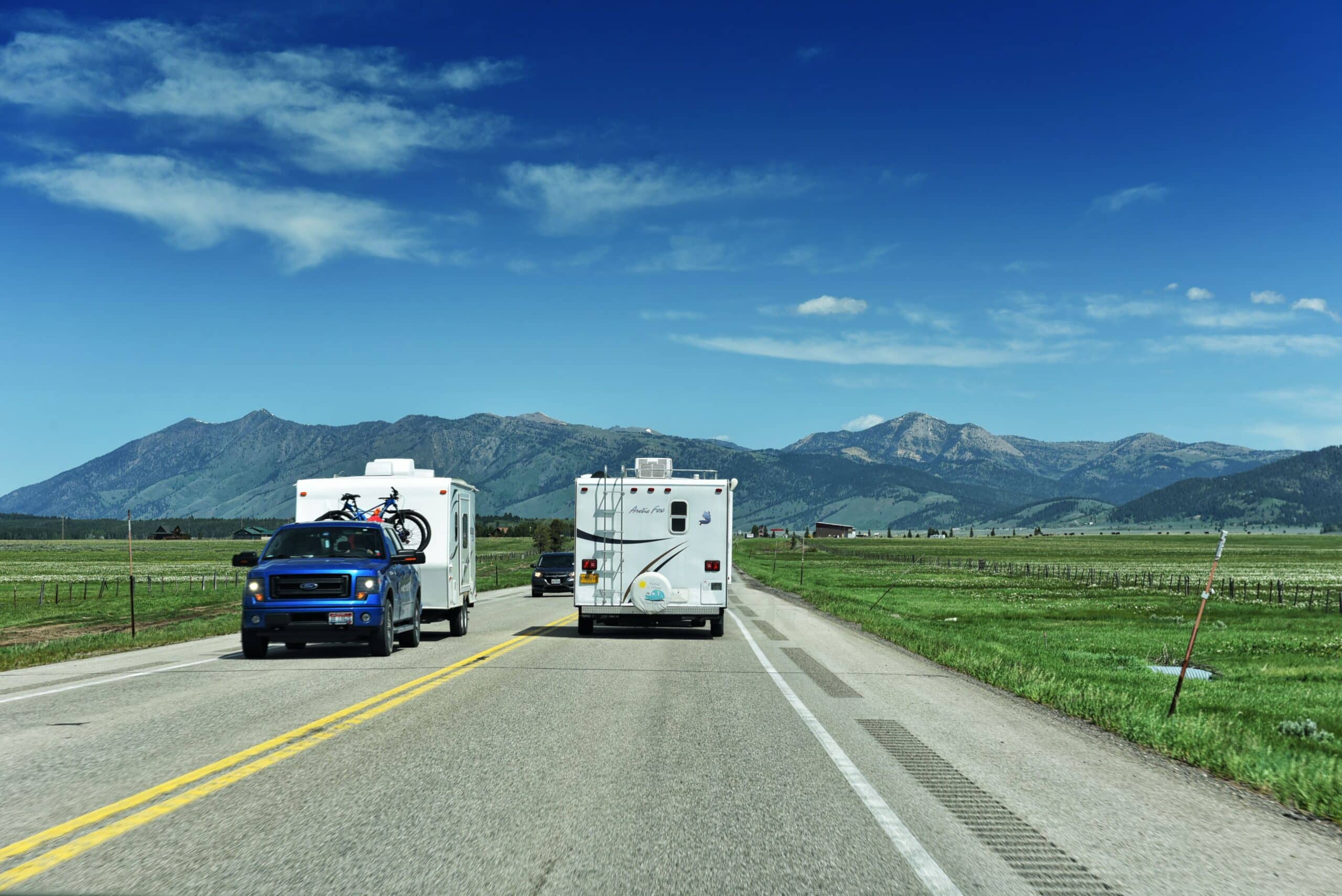
For most recreational vehicle (RV) travelers, 200 to 300 miles per day with 4 to 6 hours of actual driving time is the right target. That range holds across the majority of trips, rigs, and experience levels. It shifts based on your RV class, the number of drivers you have, your passengers, and the hard deadline imposed by campground check-in cutoffs. Here is how to calculate the right number for your specific situation.
The Short Answer: 200 to 300 Miles and 4 to 6 Hours
Most experienced RVers land in the 200 to 300 miles per day range, and that is not a coincidence. It is the range that keeps driving hours manageable, leaves time for setup at camp, and avoids the accumulated fatigue that turns a travel day into an ordeal.
The table below breaks this down by experience tier. These figures assume clear weather, flat or rolling terrain, and no significant passenger constraints.
| Driver Profile | Daily Mileage Target | Driving Hours |
| Beginner (first 1 to 3 trips) | 150 to 200 miles | 3 to 4 hours |
| Experienced (several trips) | 200 to 350 miles | 4 to 6 hours |
| Full-time RVers / co-driver | Up to 400 to 500 miles | 6 to 8 hours split |
RV ownership involves ongoing costs beyond the road itself. If you are budgeting your setup and want to understand what storage, maintenance, and other expenses look like across the year, how much should you pay for storage is a useful reference.
Why Experienced RVers Stop Earlier Than You’d Expect
An RV is not a car. A Class A motorhome requires constant active steering correction, is sensitive to crosswinds and road camber, and demands a higher level of attention than a passenger vehicle. Research from the AAA Foundation for Traffic Safety shows measurable cognitive impairment begins after about two hours of continuous driving. That fatigue accumulates faster in a large vehicle than in a sedan.
How Cruising Speed Affects Your Actual Travel Day
Most motorhomes and tow vehicles cruise at 60 to 65 mph on highway driving, not 75 mph. At 63 mph, 300 miles is roughly 4.75 hours of pure drive time. Add two fuel stops, a lunch break, and a rest stop, and you are looking at a 7 to 8 hour travel day total. That reframe matters: 300 miles per day is a full day, not a conservative one.
The 300/3pm Rule: A Practical Planning Framework
The 300/3pm rule is a simple planning heuristic that experienced RVers use: aim for no more than 300 miles on a travel day, and plan to arrive at your destination by 3 p.m. Both elements matter independently.
The 300-mile cap keeps most solo drivers within a safe fatigue window. The 3 p.m. arrival target gives you time to set up camp, troubleshoot hookups, handle any unexpected issues, and actually enjoy where you are. Arriving at 7 p.m. after a long travel day means you are setting up in fading light with tired hands.
For beginners, treat this rule as the default, not a conservative edge case. It is an excellent starting point for route planning on your first few trips. Experienced drivers with a co-driver can stretch it, but the 3 p.m. target remains useful regardless of mileage.
What Happens When You Arrive After Dark
Backing a 35 to 40 foot rig into an unfamiliar site after dark significantly increases the risk of collision, hookup errors, and damage to the rig or neighboring sites. KOA Campgrounds enforces check-in cutoffs at most locations, typically between 9 p.m. and 10 p.m. Army Corps of Engineers recreation sites, governed by 36 CFR Part 327, enforce defined check-in windows and may turn away after-hours arrivals.
A late arrival is not just stressful. If you’re relying on same-day campsite reservations rather than a guaranteed booking, it can mean no site at all, which is why knowing whether you can sleep at a rest stop is worth having as a backup plan for any day that runs longer than expected.
How to Build a Route That Respects the Rule
Start with drive time, not mileage. Most mapping tools will show you both, but time is the more honest variable because it accounts for traffic and terrain. Identify campgrounds with 24-hour check-in as backup options on longer days. Build in one short travel day (under 150 miles) for every three to four full travel days on extended trips. On days with mountain passes or winding routes, adjust your mileage target before you leave, not after you are already tired.
Variables That Change Your Daily Limit
The 200 to 300 mile benchmark is a starting point. Several variables shift it meaningfully in either direction, and each one comes with a concrete adjusted range you can apply to your trip.
RV Class and Size
Not all rigs drive the same. A Class A motorhome is one of the most demanding vehicles to pilot on a daily basis. It sits high, catches wind, and requires constant micro-corrections on highway driving. A Class B camper van handles much closer to a large passenger vehicle. A tow vehicle pulling a fifth wheel sits somewhere in between, with the added cognitive load of managing trailer sway, similar to what you’d manage towing a car behind your RV on a motorhome trip.
A beginner in a Class A should target the lower end of the beginner range: 150 to 200 miles per day. An experienced driver in a Class B can comfortably hit 300 or more on a clear day. Know your rig before you set your daily driving limit.
Co-Drivers and Passengers
A co-driver changes the math entirely. Alternating two-hour stints means neither driver approaches the impairment threshold. With a co-driver, experienced RVers can comfortably reach the 400 to 500 mile range in a single day.
Young children move the number in the opposite direction. Kids under 10 typically require stops every one to two hours regardless of driver readiness, which compresses realistic daily mileage significantly. A family with young children should plan for 150 to 200 miles per day and treat that as a complete success, not a disappointment.
Terrain and Weather Conditions
A 300-mile day in flat terrain is not the same as a 300-mile day through mountain passes. Mountain driving reduces average speed and adds sustained braking and steering fatigue that does not appear on a map. On days with significant elevation changes, winding roads, or forecast crosswinds above 25 to 30 mph, drop your target mileage by 20 to 25%.
Weather conditions compound fatigue in ways that are easy to underestimate. Rain, construction zones, and gusty winds each add cognitive load. If your route includes any of these factors, factor them in during route planning, not midway through the day.
If your rig is in storage between trips, the condition it comes out in matters just as much: carport and covered storage protects your investment from UV, weather, and road debris so it’s ready when you are.
Do FMCSA Driving Hour Rules Apply to RV Owners?
Many first-time RV travelers assume the 11-hour commercial driving limit from the Federal Motor Carrier Safety Administration (FMCSA) applies to them. It does not. Under 49 CFR 390.3(f), private recreational vehicle operators are explicitly exempt from hours-of-service rules under 49 CFR Part 395. There is no federal legal limit on how many hours an RV owner can drive in a day.
That legal freedom does not override the physiology. The FMCSA rules were written in response to documented crash data showing impairment and increased accident risk after extended driving hours. RV drivers face the same biological reality, even without the same regulatory obligation.
What the Research Actually Says About Driving Fatigue
The AAA Foundation for Traffic Safety has documented that drowsiness-related cognitive impairment becomes comparable to alcohol impairment after sufficient time without sleep. Driver fatigue as a contributing factor in large vehicle crashes is well-documented in NHTSA’s Large Truck Crash Causation Study. RV driving, with its elevated mental load, likely accelerates that fatigue curve compared to a standard passenger car. Stopping every 1.5 to 2 hours is not a comfort preference. It is active RV safety management.
How to Structure a Multi-Day RV Trip Without Burning Out
Good RV trip planning is not just about picking daily mileage targets. It is about sequencing those travel days so you arrive at the end of the trip as alert and capable as you were at the start. Here is a simple framework:
- Identify your total trip miles and divide by your target miles per day to get your travel day count.
- Add one short day (under 150 miles) or rest day for every three to four full travel days.
- Work backward from each campsite’s check-in cutoff to set your departure time.
- Schedule your longest driving days at the beginning of the trip when you are freshest.
- Never plan a maximum-mileage day immediately before a hard arrival deadline like a ferry or a fixed event.
Full-time RVers develop a personal rhythm over time. Beginners should start conservative and adjust on subsequent trips. Rest stops are a structural element of this plan, not an afterthought.
If your rig sits between trips, a dedicated RV and boat storage facility keeps it protected and ready for the road without taking up space at home.
When to Take a Zero-Mile Day
A zero day is a full day parked at one campground with no driving. On trips longer than seven days, build in at least one zero day per week. Accumulated fatigue does not reset overnight. A full rest day allows your body and your focus to recover before the next string of travel days.
Planning Fuel Stops Into Your Mileage Target
Most Class A motorhomes carry 100 to 150 gallons of fuel and burn 6 to 8 miles per gallon, so fuel range is rarely the limiting factor on a single day. But planning fuel stops every 100 to 125 miles serves a double purpose. You are handling a logistical necessity and building in the rest cadence your body needs. Frame it that way during route planning, and the stops feel like part of the plan rather than interruptions to it. Scenic stops work the same way: they add time to the travel day and give the driver a genuine mental break.
Final Thoughts on Planning Your RV Driving Days
When the trip is over, the logistics do not stop at the campground exit. Storing your RV properly between travel seasons protects the investment you just drove across the country and makes the next trip easier to launch.
RecNation RV and boat storage offers dedicated vehicle storage facilities across multiple states, so your rig has a secure, accessible home when the travel days are done.
Frequently Asked Questions About RV Daily Driving Limits
What is the maximum number of miles you should drive an RV in one day?
For most RV travelers, 300 to 350 miles is a realistic daily maximum under good conditions: flat terrain, clear weather, and an experienced solo driver. With a co-driver alternating shifts, some experienced travelers push to 400 to 500 miles. Going beyond that in a single day significantly increases driver fatigue and leaves little margin for unexpected delays, fuel stops, or a late campground arrival.
How many hours a day should you drive an RV?
Most RV travelers aim for 4 to 6 hours of actual driving time per day, with breaks every 1.5 to 2 hours. Research from the AAA Foundation for Traffic Safety shows measurable cognitive impairment begins after about two hours of continuous driving, which is why frequent rest stops matter as fatigue management, not just comfort. A 6-hour driving day with breaks typically translates to an 8 to 9 hour travel day once you factor in fuel, meals, and stops.
Is it safe to drive an RV for 8 hours straight without stopping?
No. For most drivers, 8 continuous driving hours behind the wheel of an RV exceeds the safe threshold. RVs require constant active correction for wind, road camber, and vehicle movement, which accelerates mental fatigue compared to a passenger car. Most experienced RVers and RV safety researchers recommend stopping every 1.5 to 2 hours regardless of how alert you feel, because impairment often develops before a driver recognizes it.
How far can you drive a Class A motorhome in one day?
A beginner driving a Class A motorhome should target 150 to 200 miles per day. An experienced driver in good conditions can comfortably cover 250 to 350 miles. Class A motorhomes cruise at around 60 to 65 mph on the highway, require active steering management, and are highly sensitive to crosswinds. Build in rest stops every 100 to 125 miles and plan to arrive at your RV campground before dark.
What is the best driving schedule for a long RV road trip?
The most sustainable schedule for a multi-day trip is 200 to 300 miles per day, stopping every 1.5 to 2 hours, and targeting campground arrival by 3 p.m. On trips longer than a week, build in at least one zero-mile rest day per week to let accumulated fatigue reset. Schedule your longest travel days at the beginning of the trip when you are freshest, and never plan a maximum-mileage day immediately before a hard arrival deadline.