Dry boat storage means your boat stays on its trailer, on dry land, at a storage facility or yard rather than floating in a marina slip or sitting on a rack system. If you’ve been comparing options and aren’t sure whether “dry storage,” “wet slip,” and “dry stack” all mean the same thing, they don’t. This article explains all three formats, how they compare, and how to figure out what size space your boat actually needs.
What Dry Boat Storage Actually Means
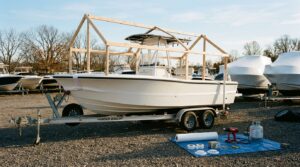
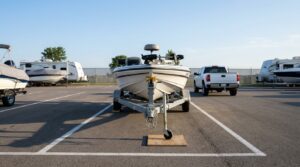
Dry boat storage is the most straightforward of the three main options. Your boat sits on its trailer in a yard or building, out of the water, for the full storage period. The word “dry” is the key distinction: the hull isn’t in contact with water between trips, and the boat isn’t lifted by marina equipment each time you go out.
This format is available from land-based storage facilities rather than marinas. You tow the boat in, park the rig in your assigned space, and return when you’re ready to go out. There is no forklift, no dock staff, and no advance call required, so boat trailer storage at a land-based facility is a self-managed arrangement from start to finish.
Dry boat storage comes in three coverage tiers, each suited to different budgets, weather conditions, and storage durations. The boat almost always stays on its trailer throughout.
Outdoor, Covered, and Indoor Dry Storage
The outdoor versus indoor storage decision depends on your local weather, how long you’re storing, and what your budget allows. The three tiers break down like this:
- Outdoor uncovered: An open yard space with the boat on its trailer and no overhead protection. It is the most affordable tier, but it leaves the boat exposed to sun and weather.
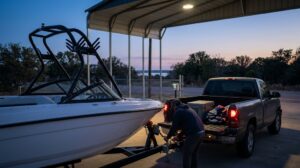
- Canopy or carport: Overhead cover with open sides. Covered boat storage sits between the other two tiers on both protection and cost.
- Indoor enclosed: A fully enclosed building space. Indoor boat storage protects the hull from UV, wind-driven debris, and precipitation. Indoor garage spaces are enclosed, not climate-controlled storage, so the building keeps weather out but does not regulate temperature or humidity.
RecNation, which operates 70 facilities across eight states, offers on-land dry storage at three coverage levels: outdoor uncovered, canopy-covered, and indoor enclosed. Rates start at about $57 a month for outdoor uncovered spaces and vary by location, size, and availability, and the costs section below lays out each tier. For a closer look at that tier, indoor boat storage is a useful next read.
What Is a Wet Slip?
A wet slip is a designated berth at a marina where your boat stays in the water, tied to a dock, for the duration of the rental. The boat is always afloat and always ready, which makes wet slips genuinely convenient for boaters who go out frequently. There’s no launch process and no towing: you show up and go.
The trade-off is constant hull contact with water. That contact accelerates marine growth, such as algae and, on saltwater hulls, barnacles, and it can accelerate corrosion if maintenance isn’t kept up. Wet slips are priced by linear foot per month and aren’t available in landlocked areas.
Who Benefits Most from a Wet Slip
A wet slip suits a boater who goes out multiple times a week, lives close to the marina, and keeps up with regular hull and mechanical maintenance. For that owner, the convenience is worth the cost and the ongoing upkeep.
The occasional boater is in a different position. If you’re paying wet slip fees year-round for a boat you use a handful of times each season, dry boat storage typically delivers better hull protection and better value. Keeping the hull out of the water during long idle stretches slows marine growth, reduces corrosion risk, and can lower long-term maintenance costs.
What Is Dry Stack Boat Storage?
Dry stack storage is a form of marina storage, run by the marina rather than rented as a land-based space. Your boat is stored out of the water on a multi-tier rack storage system inside a large marina building. When you want to go out, you call ahead and marina staff retrieve your boat with a forklift, launch it, and have it at the dock when you arrive. When you return, staff haul it out, rinse it, and re-rack it.
This is a fully managed format. You don’t handle launching or retrieval, and in most cases you don’t use a trailer because the marina owns the handling equipment. Dry stack storage is generally available only at marinas near navigable water, access requires advance notice, and the service level comes with a higher price than land-based dry boat storage.
Dry Stack vs Dry On-Land Storage: The Key Differences
The two formats share the word “dry,” but they work very differently. This table shows the main distinctions side by side.
| Feature | Dry stack (marina) | Dry on-land (facility) |
| Operated by | Marina staff | Owner self-manages |
| Launch method | Forklift boat launch by staff | Owner tows to water |
| Trailer required | Typically no | Yes |
| Access | Advance notice required | During facility access hours |
| Coverage | Indoor rack system | Outdoor, canopy, or indoor |
| Relative cost | Higher | Typically lower |
Once you see how the two formats differ, comparing boat storage options is a useful next step for weighing marina storage against every land-based choice.
How to Size a Dry Storage Space for Your Boat
Boat spaces at a land-based boat storage facility are sized by trailer length, not hull length alone. For a small boat, that typically means adding 3 to 5 feet to the hull measurement to get the total rig length. A 17-foot hull, for example, works out to roughly a 20- to 22-foot rig, which lands in the 20-to-30-foot band.
The size bands at a land-based facility break down like this:
- Up to 20 feet: Available at select locations for jet skis and jon boats.
- 20 to 30 feet: Fits bass boats, bowriders, and smaller pontoons.
- 30 feet and over: Fits larger boats.
Bass boats are the most common boat type stored at land-based facilities, and most fall comfortably in the 20-to-30-foot band. Measure your rig with the trailer before booking, and if it falls near the edge of a band, the guide to space size for a boat goes into more detail.
Measuring Your Rig for Storage
The full rig matters more than the hull. Running a tape from the front of the trailer tongue to the rearmost point, whether that’s the motor, a bracket, or the trailer itself, gives you the number a facility needs. If the facility asks for overall trailer length, that is the number to give. A quick call before booking will confirm which space lengths are available and whether your rig fits.
Dry Boat Storage Costs: What to Expect
The monthly rate for dry boat storage depends on four things: the coverage level you choose, the length of your trailer, your local market, and how you book. The table below shows the ranges for each tier as a benchmark:
| Coverage level | Approximate monthly rate (as of October 2026) |
| Outdoor uncovered | About $57 to $183 |
| Canopy-covered | About $99 to $351 |
| Indoor enclosed | About $114 and up for most sizes, up to about $701 for a 15 x 50 ft space |
These figures are estimates as of October 2026. Prices vary by location, size, and availability, so it helps to confirm current rates with the specific facility. Online booking rates typically run about $20 a month below standard rates, which makes the facility’s website worth checking if that option is available.
Monthly rates are one way to look at the budget, and boat storage costs by year shows the same spending across a full year of annual storage fees. For owners leaning toward the outdoor uncovered tier, storing a boat outside lays out the pros, cons, and best practices.
What Affects the Monthly Rate
Four factors move the rate within any given range. This is not a pricing deep-dive, just enough to help you judge a quoted rate:
- Coverage level: Outdoor, canopy, and indoor spaces are priced differently at the same facility, and this factor has the biggest impact.
- Space size: A 30-foot-plus space costs more than a 20-foot one.
- Location: Facilities near high-demand boating markets tend to price higher.
- Booking method: Online rates are typically lower than standard rates.
What to Ask Before You Rent a Dry Storage Space
Before you sign an agreement at any boat storage facility, run through these questions. The answers will tell you whether the space actually works for how you use your boat.
- Space length: What is the total rentable space length? Confirm it matches your trailer-to-motor measurement, not just the hull.
- Access hours: What are the access hours? Make sure the gate is open when you typically head out on the water.
- Rental terms: Is there a minimum rental term or seasonal surcharge?
- Liability: What is the facility’s liability policy if the boat or trailer is damaged on site, and does it carry insurance for stored vehicles or should you confirm coverage with your own marine insurer?
- Boat prep rules: Are there restrictions on boat prep work on site, such as boat shrink wrapping or winterization?
- Lighting: Is there on-site lighting?
- Security: What boat storage security features does the facility have?
For further guidance on evaluating a facility, best boat storage is a useful next read, and the ultimate boat storage guide works as a companion reference for the whole process.
Preparing Your Boat Before Storage
Before the boat goes into seasonal boat storage, work through these steps in order. They protect the boat and trailer between trips, and each one applies whichever coverage tier you choose.
- Drain the live wells and bilge: Empty both completely.
- Handle the battery: Disconnect the battery, or connect a trickle charger if the facility supports it.
- Flush the motor: Do this if the boat was last used in saltwater.
- Treat the fuel: Treat it if you’re storing for more than a month.
- Cover the boat: Use a fitted cover or arrange for boat shrink wrapping, especially for outdoor spaces.
Boat winterization is a separate, longer process, and these steps cover the basics regardless of season.
Find Dry Storage That Fits Your Boat
If you’re weighing dry on-land storage for a bass boat, bowrider, or larger vessel, RecNation boat storage covers spaces from 20 feet up to 30 feet and beyond across 70 facilities in Arizona, California, Florida, Kansas, Missouri, South Carolina, Tennessee, and Texas. Spaces are sized by trailer length, so it’s worth measuring your full rig before you search for availability.
Frequently Asked Questions
How much does dry boat storage cost per month?
Monthly dry boat storage rates depend mainly on coverage level, trailer length, and local market. As of October 2026, outdoor uncovered runs about $57 to $183, canopy-covered about $99 to $351, and indoor enclosed from about $114, with prices varying by location, space size, and availability. Booking online typically takes about $20 off the standard monthly rate.
What is the difference between dry stack storage and indoor boat storage?
The difference is who handles the boat. With dry stack storage, marina staff rack the boat on a multi-tier indoor system and launch it for you, so no trailer is involved. With indoor boat storage at a land-based facility, you park the boat on its trailer in an enclosed building and handle every trip yourself.
Is dry boat storage better than keeping a boat in the water?
It depends on how often you use the boat. A wet slip suits frequent boaters because the boat is always ready at the dock. Dry on-land storage avoids constant water contact, which reduces upkeep for many owners, and it is typically less expensive than a comparable wet slip.
How do I find dry boat storage near me?
Search for “boat storage” or “dry boat storage” with your city or zip code to find land-based facilities in your area. When you contact a facility, confirm the space sizes available, the coverage options, and the monthly rate. Book early if you’re in a high-demand boating market, since spaces fill quickly before peak season.
What should I look for when choosing a dry boat storage facility?
A good fit starts with a space length that matches your trailer, a coverage level suited to your boat, and access hours that match when you head out on the water. Liability and insurance arrangements, lighting, and any limits on boat preparation work such as shrink wrapping or boat winterization are the next things to ask about.
What size storage space does a bass boat need?
A bass boat, bowrider, or smaller pontoon typically fits a 20-to-30-foot space at a land-based storage facility. Trailer length sets the space size, so the hull measurement plus roughly 3 to 5 feet gives a starting estimate. A long trailer tongue or a motor that extends past the transom adds to the total.