The United States has hundreds of millions of acres of public land where overnight camping is free and legal. Most of it sits on Bureau of Land Management (BLM) territory and National Forest land concentrated in the American West. If you are planning a trip and want to skip the campground fees, you have real options.
This guide covers the main land types where free boondocking is permitted, the rules that govern each one, and the tools you can use to find and verify a specific site before you arrive.
The Main Types of Land Where Boondocking Is Legal
Free camping in the US falls into four primary categories: BLM land, National Forests, state trust lands, and private property networks. Each is managed by a different agency or owner, which means the rules, stay limits, and geographic availability vary significantly between them.
Here is a quick overview before the full breakdown:
- BLM land: Managed by the Bureau of Land Management. Approximately 245 million acres, concentrated in the West.
- National Forests: Managed by the U.S. Forest Service. Approximately 193 million acres across 154 forests nationwide.
- State trust lands: Managed by individual state agencies. Common in Arizona, Montana, Idaho, and New Mexico.
- Private property networks: Land owned by individuals or businesses who allow overnight guests through membership campground programs or direct permission.
Federal vs. State vs. Private Land
The rules for each land type are entirely separate, so knowing which one you’re on before you camp matters.
| Land Type | Managed By | Permission Needed |
| Federal | BLM, Forest Service, Corps of Engineers | None for most dispersed sites; the largest and most accessible category |
| State-managed | Individual state agencies | Recreation permit purchased directly from the state, available in specific western states |
| Private | Individual landowners or membership networks | Explicit permission required; membership networks make that permission scalable and predictable |
A few things follow directly from this:
- Availability drops sharply as you move from federal to state to private land.
- Stay limits and rules aren’t interchangeable between categories; a BLM rule doesn’t tell you anything about a state trust land permit.
- Confirming which category you’re on is the first step, not an afterthought, since it determines everything else about how long you can stay and what you need before arriving.
BLM Land: The Most Accessible Free Boondocking in the US
BLM Land: The Most Accessible Free Boondocking in the US
The Bureau of Land Management administers approximately 245 million acres, most of it across the western United States. Dispersed camping is permitted by default on the majority of this land unless a specific area has posted restrictions or closure orders. That open-by-default policy is what makes BLM land the most practical starting point for anyone new to free boondocking.
The governing rule for stay limits is 43 CFR § 8365.1-2, which prohibits camping longer than the period permitted by the authorized officer. Here’s how that plays out in practice:
- BLM’s standard policy under this rule caps dispersed camping at 14 days within any 28-day period at a single location.
- After that window, you’re required to relocate.
- Many BLM field offices specify a minimum relocation distance in their local land-use orders, and 25 miles is a commonly cited figure, though it is not universal.
- Check the specific BLM field office website for the area you plan to visit to confirm the relocation requirement before you count on it.
Some of the most well-known BLM boondocking regions include:
- Quartzsite, Arizona, which draws tens of thousands of RVers each winter season.
- The canyon country outside Moab, Utah.
- The Nevada high desert, where BLM acreage is vast and restrictions are minimal.
These are proven areas with established dispersed sites and active user communities that post current road and condition reports.
To find specific BLM boondocking sites, use BLM’s own recreation map at blm.gov alongside discovery tools like onX Off-Road or Campendium. These apps show land boundaries and user-reported site conditions, but they are a starting point, not a substitute for checking official closure orders before you arrive.
How to Confirm a BLM Site Is Open Before You Arrive
Before committing to a BLM dispersed site, take two verification steps:
- Check BLM.gov’s field office closure orders for your target area.
- Review InciWeb for active wildfire closure maps.
Dispersed camping can be temporarily prohibited due to fire danger, flooding, or resource protection orders, even when the land appears open on a third-party app. If the online closure map is unclear or the information is outdated, call or email the local BLM field office directly. A five-minute phone call before a multi-day drive is worth making.
National Forests: Dispersed Camping With More Variables
The U.S. Forest Service manages 193 million acres across 154 national forests, and dispersed camping is generally permitted under 36 CFR § 261.58. That baseline rule allows off-grid camping outside of designated campgrounds on most Forest Service land. The complication is what comes on top of that baseline: individual forests and ranger districts layer their own stay limits, setback requirements, and motor vehicle travel restrictions over the federal default.
A few things to know about those local layers:
- Setback rules typically require you to camp at least 100 to 200 feet from water sources, trails, and roads.
- Stay limits default to 14 days in many districts but can be shorter, with some ranger districts near popular trailheads or scenic corridors reducing limits to 7 days or fewer.
- None of this is posted universally, which is why confirming rules with the specific ranger district before arrival is not optional.
The most important tool for National Forest dispersed camping is the Motor Vehicle Use Map (MVUM). The Forest Service publishes MVUMs for each national forest, designating which roads are open to motor vehicles and which allow dispersed camping. You can access the MVUM viewer at fs.usda.gov/visit/maps.
The road classification on the MVUM is what matters legally:
- A road that appears open on Google Maps or a camping app may still be restricted for motor vehicle travel on the MVUM.
- Driving or camping on a restricted road is a violation regardless of what your app showed.
- Always verify the MVUM for any Forest Service road you plan to use before driving it.
Stay Limits and Setback Rules by District
While 14 days is a common default stay limit in National Forests, some ranger districts cap stays at 7 days or fewer, particularly in heavily used recreation corridors. Setback requirements for water sources, trails, and roads also vary by district and are not always posted at the site.
The only reliable source for these specific rules is the ranger district website or a direct call to the district office. Apps and crowdsourced databases may reference stay limits, but those entries are not always current or district-specific.
Fire Restrictions That Can Override Dispersed Camping Legality
Fire restrictions can make an otherwise legal dispersed site temporarily off-limits, and no competitor guide covers this adequately. Under 36 CFR § 261.52 and corresponding BLM emergency closure authorities, land managers issue Stage 1 and Stage 2 fire restrictions when conditions warrant:
- Stage 1 typically prohibits campfires, charcoal, and wood fires.
- Stage 2 may restrict generators, fireworks, and in some cases camping itself within specific closure areas.
These restrictions change seasonally and sometimes overnight, and third-party apps do not update in real time when a new order is issued. Before arriving at any dispersed site during dry months, check three sources:
- The individual forest’s fire restrictions page.
- InciWeb at inciweb.wildfire.gov.
- AirNow for current air quality and fire conditions.
Finding your site closed after a long drive is avoidable with a quick check the day before departure.
State Trust Land, Corps of Engineers, and Other Public Land
Beyond BLM and National Forest land, several additional public land categories offer free or low-cost overnight camping that many RVers overlook entirely.
State Trust Lands in the West
Some western states manage state trust lands where dispersed camping is permitted with a day-use or annual recreation permit. Arizona’s State Land Department, Montana’s Department of Natural Resources, Idaho’s Department of Lands, and New Mexico’s State Land Office all manage parcels that can be accessed with a recreation permit purchased directly from the state agency.
These lands do not appear on federal land maps, which is why they are frequently overlooked. Availability and access rules vary significantly by state and by individual parcel, so check the relevant state agency’s website for current permit requirements before planning a stay.
Corps of Engineers Reservoirs
The U.S. Army Corps of Engineers manages land around hundreds of reservoirs and lakes across the country. Dispersed camping is permitted in designated areas near many of these projects, often free of charge. Recreation.gov lists Corps of Engineers camping areas and is the most reliable way to identify specific sites and confirm availability.
Stay limits vary by project but typically follow a 14-day standard. Unlike BLM land, Corps of Engineers sites are more likely to have designated dispersed zones rather than open, undesignated camping, so confirm the site type before you plan around it.
A brief note on roadside rest areas: overnight parking is permitted in many states for 8 to 10 hours, which makes them a workable emergency stop but not a camping destination. For the specific rules on how long you can legally park and what to watch for, see our guide on whether you can sleep at a rest stop. They are included here for completeness, not as a boondocking strategy.
Private Property Boondocking: Networks and Apps That Make It Work
Camping on private land legally is possible through two main paths: paid membership networks and direct permission from landowners. Both approaches open up options that public land simply cannot provide, including coverage in the eastern US where public land for dispersed camping is scarce.
Three main options, at a glance:
- Harvest Hosts: wineries, breweries, farms, and attractions; no hookups; one-night stays.
- Boondockers Welcome: peer-to-peer RV owner hosts; hookups at most locations; more flexible stay length.
- Direct permission: asking rural landowners directly; no membership fee, but no vetting or guarantee.
Harvest Hosts is a membership program (currently $99 per year) that provides access to wineries, breweries, farms, and attractions that allow free overnight parking for members. There are no hookups, stays are typically limited to one night, and members are expected to patronize the business. It is best suited for travelers who enjoy the experience of staying at unique properties along a route.
Boondockers Welcome, a peer-to-peer network where RV owners host other RVers on their private property, connects travelers with welcoming hosts across the country. The network includes approximately 3,675 host locations across North America, and roughly 70% of those hosts offer hookups. It is a strong option for RVers who want the security of a vetted host and the possibility of utility access at no nightly cost beyond the annual membership.
Direct permission from rural landowners is a third option. Approaching a farmer or rancher directly, asking clearly in advance, and leaving the site in better condition than you found it has worked for dispersed travelers for decades.
A small purchase or genuine appreciation goes a long way, and the same courtesy norms covered in our guide to RV etiquette serve you just as well on private land as they do in a crowded campground.
Harvest Hosts and Boondockers Welcome Compared
| Feature | Harvest Hosts | Boondockers Welcome |
| Annual cost | ~$99/year | ~$79/year |
| Number of locations | 5,000+ | ~3,675 |
| Hookups available | No | Yes, at ~70% of hosts |
| Stay length | Typically 1 night | Flexible, per host |
| Best use case | Unique experiences at farms, wineries, breweries | Hookup access and host community |
Parking Lots and Urban Boondocking
Walmart, Cracker Barrel, and Cabela’s have traditionally allowed overnight RV parking in some locations. This is a convenience option for a night in transit, not a camping experience. Policies vary by individual store and can change without notice. Always call the specific location ahead of time and look for posted signs before pulling in.
Do not assume a chain-wide policy applies to any given parking lot. Our guide to overnight RV parking covers additional considerations for this kind of stop, from legality by state to what to look for in a safe spot.
The Best Apps and Tools to Find Free Boondocking Sites
Knowing the land types is one thing. Finding a specific site for a specific night is another. These five tools are the most useful for moving from general knowledge to an actual campsite on a map.
- Freecampsites.net: Crowdsourced database of free and low-cost sites with user reviews and photos. Strong for established dispersed sites across BLM and National Forest land. Good first stop for site discovery.
- Campendium: Review-focused platform with photos, fire restriction notes, and road condition updates. Particularly reliable for BLM and National Forest boondocking sites. User reviews often flag current road or access issues.
- iOverlander: Best for remote and international routes. Strong on off-grid specifics and vehicle access conditions. More useful for overlanders and extended backcountry travelers than for first-timers at established sites.
- onX Off-Road: Shows property ownership boundaries overlaid on satellite imagery. Critical for confirming whether a potential campsite is on BLM, Forest Service, private, or state land. Use this to verify what discovery apps tell you before you drive to a site.
- BLM.gov and fs.usda.gov maps: Primary sources for official land boundaries and Motor Vehicle Use Maps. Use these to confirm what apps report and to check current closure orders.
The key limitation of all apps is that they do not update in real time for fire closures, flood restrictions, or emergency orders. An app may show a site as open when the land management agency issued a closure order last week. Always cross-reference with the official agency source before arrival.
How to Build a Pre-Trip Verification Workflow
A three-step routine before every trip eliminates most bad surprises at the gate:
- Identify the site on a discovery app. Use Freecampsites.net or Campendium to find candidate sites with recent user reviews. Look for notes on road conditions, access vehicle type, and whether reviews are current.
- Confirm the land boundary on onX or the official agency map. Cross-check the site’s land type against BLM.gov or the USDA Forest Service MVUM viewer. Confirm the road classification if you are accessing a National Forest site. If the road is restricted on the MVUM, find an alternate access point or a different site.
- Check the relevant agency’s closure page or call the field office. Review fire restriction status on InciWeb and the land management agency’s own site. If you cannot confirm the site is open from the official source, call the local BLM field office or ranger district. This step takes five minutes and can save a wasted trip.
Top States for Free Boondocking
Free dispersed camping availability in the US is not evenly distributed. The western states hold the overwhelming majority of accessible public land. If you are still choosing a destination, these states offer the most options for legitimate off-grid camping.
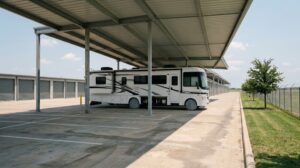
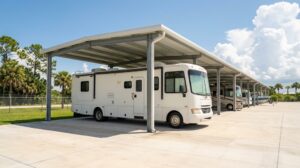
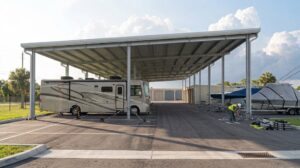
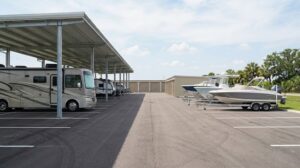
If you are based in the Southwest and heading out for an extended boondocking trip, many RV owners find it easier to leave their rig at a secure facility between adventures rather than storing it at home. RecNation RV and boat storage has facilities across Arizona and other western states if you need a home base for your vehicle when you are not on the road.
- Arizona: Home to some of the most popular dry camping in the country. Quartzsite BLM land draws thousands of RVers each winter. The Tonto National Forest offers dispersed camping in the high country. State trust land through ASLD adds further options with a day-use permit.
- Nevada: Vast BLM holdings with some of the fewest restrictions of any western state. The Black Rock Desert and areas around Ely and Winnemucca are well-known off-grid camping destinations. Little to no permit infrastructure in most areas.
- Utah: BLM canyon country around Moab, Kanab, and the San Rafael Swell is iconic boondocking territory. Some high-use areas near popular national parks have implemented permit systems or seasonal restrictions. Confirm current use orders for specific areas.
- Montana: The Gallatin and Beaverhead-Deerlodge National Forests offer substantial dispersed camping acreage. Road access can be limited by seasonal snow. Check MVUM for open roads and confirm seasonal access dates with the relevant ranger district.
- Wyoming: BLM and National Forest land spread throughout the state. Less crowded than Utah or Arizona. The Shoshone and Bridger-Teton National Forests are strong options for forest dispersed camping.
- New Mexico: A combination of state trust land (with an NMSLO recreation permit), Carson National Forest, and Santa Fe National Forest. Less traffic than Arizona or Utah while still offering significant public land access.
- Idaho: BLM land in the south and National Forest land in the north. The Sawtooth National Recreation Area and Salmon-Challis National Forest are known for quality dispersed camping with genuine solitude.
States With Limited or No Free Boondocking
Most states east of the Mississippi have very limited dispersed camping options. The reason is land ownership: a much higher percentage of eastern land is privately held, and the public land that does exist is typically managed as state parks with established campgrounds and nightly fees.
A handful of National Forests in the Southeast and Appalachian region do permit dispersed camping, including parts of the Pisgah, Nantahala, and Monongahela National Forests, but the acreage and availability are far more constrained than in the West.
If you are planning a trip east of the Mississippi and want free camping, research the specific ranger district well in advance rather than assuming dispersed camping is permitted. If dispersed camping isn’t realistic for your route, our roundup of affordable campgrounds and RV parks is a better starting point than counting on a free site.
Final Thoughts on Boondocking for Free
When you are not out exploring BLM land or a remote National Forest, your RV still needs a safe place to stay. RV storage facilities and covered storage options at RecNation give you a secure, accessible base across Arizona, Texas, Florida, and other states, so your rig is protected between trips and ready to go when the next one starts.
Frequently Asked Questions
How long can you legally stay at a free boondocking site?
On BLM land, the standard stay limit is 14 consecutive days at any single location. After 14 days, you are required to relocate. Many BLM districts require you to move at least 25 miles away before the clock resets, but the exact distance varies by field office. National Forest dispersed camping stay limits vary by ranger district and can be as short as 7 days in high-use areas. Always check the specific land management unit’s rules before arrival. Overstaying your permitted duration can result in a citation.
Is boondocking legal everywhere in the US?
No. Free dispersed camping is concentrated on federally managed land in the American West, primarily BLM and National Forest land. Most states east of the Mississippi have limited to no public land available for dispersed camping. The majority of land in those regions is privately owned or managed as state parks with fee-based campgrounds. Even on federal land, specific areas may be seasonally closed or subject to fire closure orders that temporarily prohibit camping.
Do I need a permit to boondock on BLM land?
Most BLM dispersed camping does not require a permit for stays under 14 days. Some areas, particularly in heavily used regions like Quartzsite, Arizona during peak winter season, may require a permit or fee for extended stays. A small number of BLM areas have designated dispersed zones with self-registration requirements. Check the specific BLM field office website for the area you plan to visit before assuming no permit is needed.
What apps are best for finding free boondocking spots?
Freecampsites.net and Campendium are the most widely used crowdsourced databases for finding specific dispersed camping sites with user reviews and photos. onX Off-Road is especially useful for confirming land ownership boundaries before you commit to a site. Always cross-reference any app with the official BLM or Forest Service maps and check current closure orders before arrival. Apps do not update in real time for fire or flood restrictions, so an open listing on an app does not guarantee the site is currently accessible.
Can you boondock on private property?
Yes, with permission. Membership networks like Harvest Hosts and Boondockers Welcome provide access to private land where hosts allow overnight RV parking, often at no cost beyond the annual membership fee. You can also approach rural landowners directly and ask for permission in advance. Always get clear permission before parking on private land. Trespassing laws apply regardless of intent.
What should I check before arriving at a free boondocking site?
Before you arrive, verify the site on the land management agency’s official map rather than relying solely on a third-party app. Confirm there are no active fire or flood closure orders through InciWeb or the agency’s own website. Check whether a seasonal permit is required. If you are camping in a National Forest, confirm the road classification on the Motor Vehicle Use Map to make sure motor vehicle access is permitted at your intended site. A quick call to the local BLM field office or ranger district before a long drive is always worth the time.